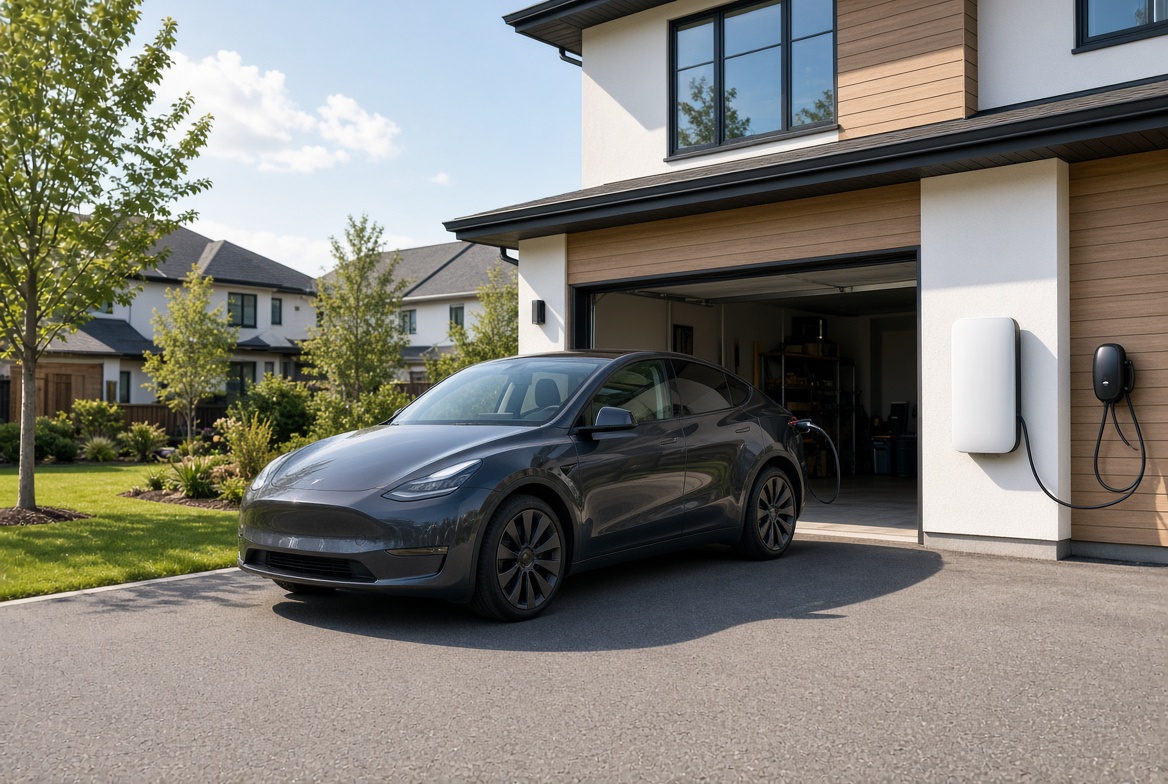
As electricity demand surges from electrification, data centers, and extreme weather, utilities and regulators are turning to customer-owned resources—electric vehicles (EVs) and home battery storage—to balance the grid. This involves “load balancing” or demand flexibility: shifting or reducing consumption (or discharging stored energy) during peak times, often through virtual power plants (VPPs) or demand response programs. Participants earn incentives while helping avoid costly infrastructure upgrades and peaker plants.
A key recent roadmap is GridLab’s (with Kevala and Energy and Environmental Economics) Unlocking California’s Flexible Load: A Durable Blueprint for Affordability and Reliability (released around August 2026). It builds on earlier work showing virtual power plants could meet over 15% of California’s peak demand and save utilities/customers about $550 million annually using existing technologies like EVs, home batteries, smart thermostats, and water heaters.
The blueprint highlights that enrolling just 10% of California’s projected EVs in vehicle-to-grid (V2G) programs by 2036 could supply roughly 9 GW of power for 12 hours—108 GWh of storage, more than one-third of the state’s long-duration energy storage target for that year. It calls for standardized program designs across the state, common technical requirements, and performance-based payments for verified grid services. The goal is greater affordability and reliability without relying solely on new power plants or grid-scale batteries. Related analyses (including GridLab-Kevala work) estimate that strategic deployment of home batteries, EV chargers, and smart devices to meet load-shift goals could avoid up to $13.7 billion in distribution grid upgrade costs through 2030.
Similar programs are expanding in New York and New Jersey, allowing homeowners to use home storage (and in some cases managed EV charging) to cut peak consumption or export power.
In New York, NYSERDA offers residential energy storage incentives (typically $200/kWh of usable capacity, higher in some cases or for disadvantaged communities, capped around 25 kWh). Enrollment in utility demand response or “Bring Your Own Battery” (BYOB)/ConnectedSolutions-style programs is increasingly required. Participants receive annual performance payments (often ~$50/kW based on average contribution during events). Events typically run May–September (10–20 per season, lasting 3–4 hours). Utilities involved include National Grid (ConnectedSolutions), NYSEG/RG&E (Energy Storage Solutions), Orange & Rockland, and Con Edison. Batteries maintain a reserve (e.g., 20%) for home backup. Upfront incentives can reach thousands of dollars; seasonal earnings often fall in the $100–$300 range depending on system size and performance.
In New Jersey, programs are developing rapidly. The Board of Public Utilities is advancing a transitional technology-neutral VPP program (expected to start no later than mid-2027), evolving into an open-access framework. PSE&G has discussed an upfront incentive around $5,000 for an 8 kW home battery with on-bill repayment, in exchange for discharge during peak-shaving events. Jersey Central Power & Light (JCP&L) runs an Energy Savings Rewards program (Tesla VPP integration) paying up to ~$360 per Powerwall annually based on performance ($100/kW of average hourly contribution). The broader Garden State Energy Storage Program aims for significant behind-the-meter deployment with proposed rebates (up to hundreds of dollars per kWh in planning stages) plus performance adders. These allow stacking of local grid services with potential wholesale market value where permitted.
Does This Put More Wear on EV Batteries?
Vehicle-to-grid (V2G), vehicle-to-home (V2H), or bidirectional use involves extra charge/discharge cycles. Studies consistently show that managed participation—with limited events, shallow depth-of-discharge (often keeping batteries in the 30–80% state-of-charge window), and moderate power rates—causes only modest additional degradation.
Reviews and modeling indicate that infrequent V2G for peak shaving or frequency regulation (e.g., 20 high-value days/year or daily short sessions) adds little wear relative to normal driving and calendar aging. One analysis found frequency regulation and peak shaving do not cause significant degradation; another quantified that daily V2G can increase throughput but that economic benefits often outweigh the modest capacity loss when properly controlled. Battery management systems (BMS) and manufacturer guidelines further limit stress. Some research notes that avoiding prolonged high or low states of charge can even be neutral or beneficial compared with uncontrolled charging. Real-world and experimental data show the extra aging from well-managed V2X is often smaller than cell-to-cell manufacturing variation. Deep, frequent cycling would accelerate wear more, but programs are designed to avoid this.
Home stationary batteries (often lithium iron phosphate/LFP chemistry) are optimized for daily cycling and typically rated for thousands of cycles.
Will This Increase Potential Fires?
Fire risk exists with any lithium-ion system, primarily from thermal runaway triggered by damage, defects, poor installation, or extreme abuse. However, evidence does not show that controlled load-balancing or demand response meaningfully elevates the risk beyond baseline.EV fires remain rare—far less frequent than internal-combustion engine vehicle fires on a per-vehicle basis. Home storage systems, especially LFP-based units, have higher thermal stability than many EV NMC chemistries. Proper installation (following codes such as NFPA 855, UL 9540, electrical standards, ventilation, and separation from combustibles) is the dominant safety factor. Bidirectional chargers and systems add complexity but are not inherently higher risk when engineered and installed correctly. Large-scale utility storage incidents (e.g., Moss Landing) involve different scales and conditions than residential systems. Programs emphasize certified equipment and professional installation. Overall incident rates for residential batteries remain low relative to the energy stored, and comparable household risks (propane tanks, natural gas, gasoline vehicles in garages) are often higher.
Insurance Rate Trends
EV auto insurance is typically higher than for comparable gas vehicles (often 50%+ more on average) mainly due to higher vehicle values, specialized repair costs, battery replacement expense, and longer repair times—not primarily home charging. Homeowners insurance generally covers professionally installed EV chargers and battery storage as part of the dwelling or personal property (subject to policy limits and perils). Some carriers offer EV-specific endorsements for chargers or mobile charging.
Installing a home charger or battery can require updating the sum insured (raising premiums modestly for the added value, e.g., tens of dollars annually) and disclosure of the equipment. There is no widespread evidence of sharp, systematic rate spikes solely from these installations when properly permitted and installed. Some analyses note potential for discounts or claim avoidance benefits from backup power (reducing outage-related losses like food spoilage or pipe bursts). Poor installation or non-disclosure can create issues or exclusions. Trends more strongly reflect overall home insurance inflation from weather claims than EV/battery-specific factors.
Good for Consumers—or Just Greenwashing?
When structured with performance-based incentives, customer control (opt-out rights, reserve capacity), transparent compensation, and shared system savings, these programs deliver real value: bill reductions or direct payments, enhanced home resilience during outages, and lower overall system costs that benefit all ratepayers by deferring expensive upgrades and peak generation. California analyses project hundreds of millions in annual savings; New York and New Jersey incentives can offset a meaningful share of battery costs while providing ongoing revenue.
Risks include program complexity, potential under-compensation relative to battery wear or inconvenience, and uneven access. Poorly designed schemes that shift costs onto non-participants or over-promise without verified performance would lean toward greenwashing. The better programs (standardized, performance-verified, with affordability guardrails) align consumer economics with grid needs and are a practical tool rather than pure marketing. As more EVs and batteries deploy, the scale of flexible load becomes a genuine reliability and cost-management asset.
In short, managed load balancing from EVs and home storage is generally safe when equipment is certified and installed correctly, imposes limited additional battery wear under typical program rules, shows no clear pattern of punitive insurance hikes, and can be affordable and beneficial for participating consumers while supporting broader grid economics. Continued focus on standardization, fair compensation, and transparency will determine whether it scales as a durable solution. We will be watching for the insurance trends.
Appendix: Sources and Links
- GridLab CA Flex Blueprint page and related: https://gridlab.org/portfolio-item/ca-flex-blueprint/; PR Newswire summary: https://www.prnewswire.com/news-releases/new-report-californias-path-to-affordable-energy-bills-starts-in-homes-and-driveways-302853525.html; Electrek coverage: https://electrek.co/2026/08/18/just-10-percent-of-californias-evs-could-provide-9-gw-of-grid-power/
- Related GridLab/Kevala distribution savings: https://gridlab.org/ca-load-mgmt-standard/; Canary Media: https://www.canarymedia.com/articles/virtual-power-plants/reduce-costs-california-distribution-grid-study
- New York programs (Enphase, Tesla, NYSEG, NYSERDA, etc.): https://enphase.com/installers/grid-services/ny-residential-energy-storage-demand-response-programs; https://www.tesla.com/support/energy/virtual-power-plant/connectedsolutions-nationalgrid-ny; https://www.nyseg.com/energy-storage-solutions-program; https://www.nyserda.ny.gov/All-Programs/Energy-Storage-Program/Developers-and-Contractors/Residential-and-Retail-Storage-Incentives; Con Edison BYOB guidelines and related utility reports
- New Jersey VPP/storage: Utility Dive: https://www.utilitydive.com/news/battery-eligible-new-jersey-vpp-program-begins-to-take-shape/826969/; JCP&L/Tesla: https://powerlutions.com/jackson/jcpl-powerwall-incentive-2026/; BPU straw proposal and GSESP references; PSE&G discussions
- Battery degradation studies: ScienceDirect reviews and papers on V2G aging (e.g., https://www.sciencedirect.com/science/article/pii/S1364032124007391; earlier quantifications showing limited impact for managed services); experimental V2X evaluations; CRC and other modeling reports
- Fire risk: Analyses of home battery safety (LFP stability), EV fire statistics (far lower than ICE), NFPA/UL standards context; Moss Landing context for utility-scale contrast
- Insurance: State Farm, Liberty Mutual, The Zebra, EcoFlow, and related guides on EV/home charger/battery coverage and rate factors; general observations that value/repair costs drive EV premiums more than charging equipment alone
- Additional supporting context from California demand flexibility goals (SB 846, CEC reports), Brattle/GridLab VPP studies, and program manuals from the utilities named above.
All claims draw from publicly available reports, utility program pages, peer-reviewed or technical analyses, and recent industry coverage as of mid-2026. Program details evolve; participants should verify current terms with their utility and installer.