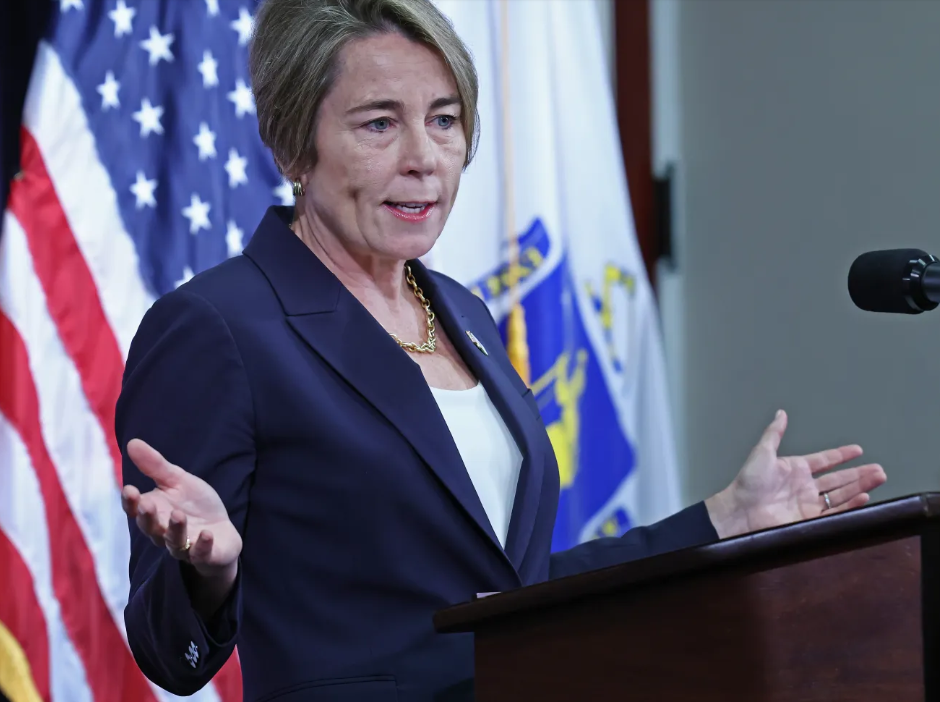
Governor Maura Healey is asking the Trump administration to move faster on a natural gas pipeline expansion she once made a political career out of opposing. The request landed on October 1, about a month before the November 2026 general election, in a letter to Energy Secretary Chris Wright urging federal agencies to clear reviews for Enbridge’s Algonquin Reliable Affordable Resilient Enhancement project, known as Project RARE.
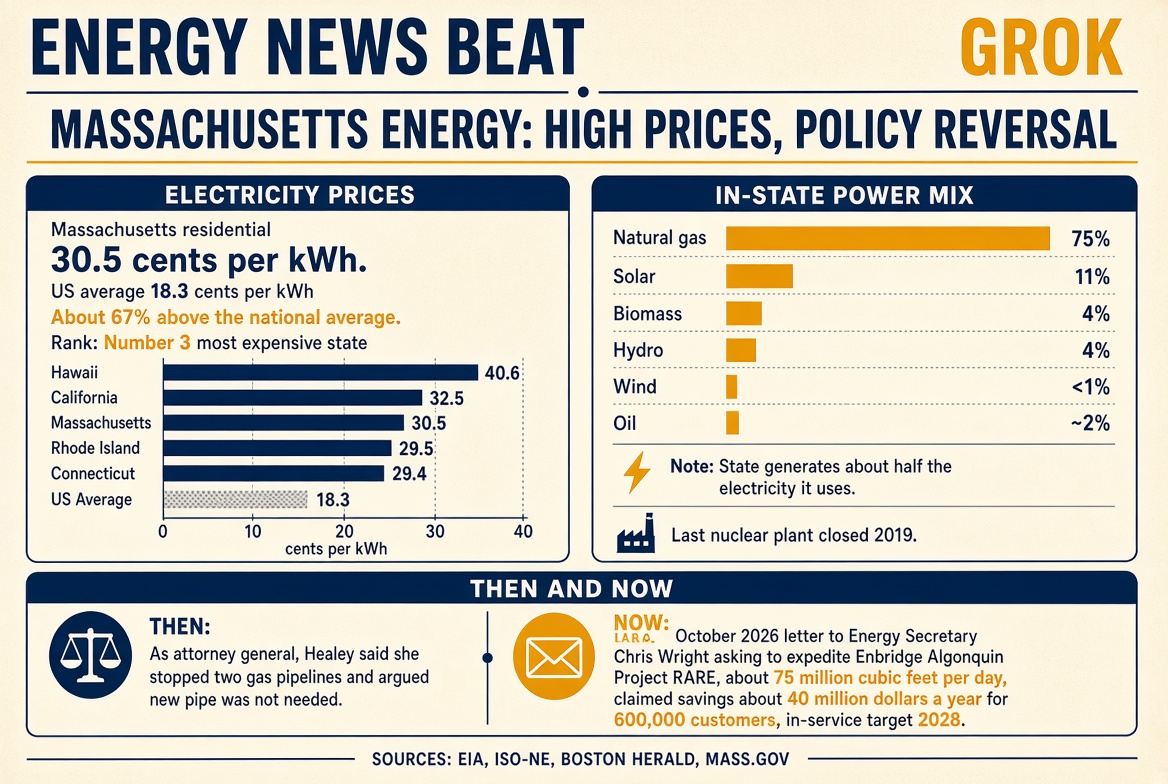
Healey wrote that she and Wright have discussed “our mutual desire to get more U.S. natural gas into New England to reduce reliance on higher-cost imported fuel and lower costs for customers.” Her office says the project would serve about 600,000 gas customers and cut bills by roughly $40 million a year, or about $400 million over the ten-year Eversource contracts the Department of Public Utilities approved in January. The planned in-service date is 2028; the contracts start November 1, 2029. FERC opened environmental review in February under the pre-filing process.
The political timing is hard to miss. Energy costs are a central issue in her reelection race against Republican Mike Minogue, who has made more pipeline capacity a campaign plank and has criticized the state’s offshore-wind push. Healey’s Thursday statement framed the letter as “all-of-the-above” policy that still includes solar, wind, storage, nuclear, geothermal, hydro, and gas, with the developer — not ratepayers — paying for the build. Environmental groups, including the Conservation Law Foundation, immediately called the savings claim a false narrative.
The record she is walking back
As attorney general, Healey treated new gas pipe as something the state did not need and should not finance. In November 2015, she released an Analysis Group study and said Massachusetts could meet reliability needs without more gas capacity, and that electric ratepayers should not pay for pipelines. She opposed Kinder Morgan’s Northeast Energy Direct and Spectra’s Access Northeast. In 2016, her office successfully argued before the Supreme Judicial Court that the Baker administration could not use electric-ratepayer tariffs to underwrite pipeline capacity. After the ruling, she said developers would have to find money other than ratepayers’ wallets.
She later treated that outcome as a credential. At a 2022 WBUR event, she told the audience, “Remember, I stopped two gas pipelines from coming into this state,” and said she opposed building more gas infrastructure. In a December 2025 NBC Boston interview, after critics accused her of rewriting that history, she called the earlier projects a “lousy deal” because ratepayers would have paid. Her office’s defense has been that the companies could have built if they financed the lines themselves. Project RARE is structured that way: developer-funded, with utilities contracting for supply rather than electric customers underwriting the pipe. The distinction is real on paper. The policy reversal is also real. The governor who campaigned on stopping pipe is now asking a Republican energy secretary to accelerate it.
What the grid actually runs on
Massachusetts does not have a surplus of dispatchable power. The state’s last nuclear unit, Pilgrim, closed in May 2019. In-state generation is still overwhelmingly gas.
EIA’s 2024 state profile lists natural gas as the primary energy source, with about 20.9 million megawatt-hours of net generation against roughly 49.4 million megawatt-hours of retail sales. The state consumes about twice what it generates. Wikipedia’s compilation of EIA utility-scale figures for 2024 puts the in-state mix at about 74.7 percent natural gas, 10.9 percent solar, 4.4 percent biomass, 3.8 percent hydro, 0.9 percent petroleum, and 0.9 percent wind. Full-year 2025 utility-scale shares are similar: gas about 75.8 percent, solar 10.8 percent, wind 0.9 percent. Small-scale solar added another roughly 4,064 gigawatt-hours in 2024, more than utility-scale solar that year, but it does not show up on a cold winter evening.
Across ISO New England in 2025, net energy for load was about 117,744 gigawatt-hours. Natural gas supplied 51 percent, nuclear 23 percent, net imports 7 percent, hydro 6 percent, solar 4 percent, and wind 4 percent. Oil was only 1 percent for the year, but it spikes when the pipe is full. During the prolonged cold of winter 2025–26, ISO-NE reported pipelines constrained, LNG sendout roughly double the prior winter, and oil generation averaging about 4,000 megawatts an hour for more than two weeks in late January and early February as dual-fuel units switched off gas. Peak winter load hit about 20,200 megawatts. Solar and wind contribution on those cold, high-demand hours was marginal. New England’s gas system is contracted first to heating customers, so power plants are the residual user — exactly the constraint Healey’s 2015 study said efficiency and demand response could manage without new pipe.
Wind and solar have grown, but not into the role of firm capacity. Regional wind output rose 31 percent from 2024 to 2025, to 4,618 gigawatt-hours. Massachusetts utility-scale wind remains a rounding error: a few dozen megawatts of onshore turbines, with offshore projects still the political priority rather than operating baseload. Solar’s growth is real and mostly behind the meter. It lowers midday net load in summer. It does not heat homes or run combined-cycle plants in January.
Prices
Massachusetts residential electricity is among the most expensive in the country. EIA’s 2024 state profile put the average retail price at 23.94 cents per kilowatt-hour, fifth-highest. For calendar 2025, compiled EIA residential averages put Massachusetts at about 30.48 cents per kilowatt-hour, roughly 76 percent above the U.S. average and behind only Hawaii and California. In July 2026, EIA’s Electric Power Monthly showed Massachusetts residential at 30.49 cents, all-sectors at 26.56 cents, against a U.S. residential average of 18.31 cents. Monthly reads through mid-2026 have stayed in the high 20s to low 30s. Households use less power than the national average, so bills are not always the highest in absolute dollars, but the rate is.
The Fiscal Alliance Foundation estimated last week that a broader Algonquin expansion could save Massachusetts ratepayers on the order of $367 million each winter. That is a study figure, not a regulatory finding. The DPU’s number for the Eversource slice of RARE is the smaller $40 million a year from displacing imported LNG at Everett. Either way, the price gap with gas-producing states is not subtle, and winter scarcity pricing is a recurring feature of the ISO-NE market.
Permitting is the bottleneck, not just in Massachusetts
Healey’s letter is a state-level version of an argument now moving in the Senate. David Blackmon’s October 2 note on the bipartisan permitting package — the American Affordability and Jobs Act, framed by supporters as a “Freedom to Build” bill — argues that the country has a permitting shortage, not an energy shortage. Sponsors include Capito, Lee, Whitehouse, and Heinrich. Industry groups cite more than 650 major projects stuck in federal review, on the order of $1.1 trillion to $1.5 trillion in investment. An ICF analysis commissioned by the American Petroleum Institute estimates comprehensive reform could cut residential electricity bills by a combined $55.6 billion from 2026 through 2035.
The bill’s core mechanics, as described by supporters: narrower NEPA reviews tied to the project rather than every hypothetical downstream effect; a 150-day clock on lawsuits limited to parties who commented and can show direct harm; remand of defective paperwork without vacating a finished permit; Clean Water Act Section 401 confined to water-quality effects of a discharge; and enforceable deadlines when agencies simply do not decide. Environmental standards stay. Open-ended delay does not.
That fight is not gas-specific. Data centers, manufacturing, transmission for offshore wind, and pipeline looping all sit in the same queue. Massachusetts is a clear case of the mismatch: high renewable targets, a closed nuclear plant, thin in-state wind, solar that does not cover winter peaks, and a gas system that still sets the marginal price when it is constrained. Healey is now asking Washington to speed one incremental looping project — about 75 million cubic feet per day, roughly 2 percent of Algonquin system capacity, mostly wider pipe in existing corridors in southeastern Massachusetts and Rhode Island — while the larger structural problem remains the time and litigation risk attached to almost any firm energy infrastructure.
Whether the letter is an election-year correction or a lasting shift will be clearer after November, and after FERC’s schedule. The underlying arithmetic is already clear. New England still runs on gas, nuclear, and imports, with oil as the winter insurance policy. Stopping pipe did not replace that stack. It left the region buying more expensive LNG and burning more oil when the weather turned.
Making Appendices Great Again
Check out the World’s Greatest Podcast Show Notes at EnergyNewsBeat.co or EnergyNewsBeat.com.
Appendix: Sources
Boston Herald, “Healey to feds: Step on the gas!,” October 1, 2026
https://www.bostonherald.com/2026/10/01/healey-to-feds-step-on-the-gas/
Massachusetts Governor’s office press release, October 1, 2026
https://www.mass.gov/news/governor-healey-calls-on-trump-administration-to-expedite-review-of-gas-pipeline-expansion
WBUR, “Gov. Healey asks feds to expedite review of proposed gas pipeline expansion in Mass.,” October 1, 2026
https://www.wbur.org/news/2026/10/01/governor-healey-project-rare-natural-gas-pipeline-expansion-fossil-fuels-climate
CommonWealth Beacon, “Healey asks Trump administration to speed up review of planned gas expansion,” October 1, 2026
https://commonwealthbeacon.org/energy/healey-asks-trump-administration-to-speed-up-review-of-planned-gas-expansion-in-latest-sign-of-shifting-energy-politics/
Conservation Law Foundation statement, October 1, 2026
https://www.clf.org/newsroom/clf-challenges-gas-pipeline-push/
Boston Herald, “Gov ‘gaslighting’ on pipelines, critic says,” December 17, 2025 (includes the 2022 WBUR “I stopped two gas pipelines” remark and the NBC Boston interview)
https://www.bostonherald.com/2025/12/17/gov-gaslighting-on-pipelines-critic-says/
Boston Globe, “Mass. AG sees no need for new natural gas pipelines,” November 18, 2015
https://www.bostonglobe.com/business/2015/11/18/healey-study-natural-gas-pipelines-sees-pros-and-cons/gPaGdvJyH8PWGnkUddgSfN/story.html
The Berkshire Edge, Supreme Judicial Court pipeline-tariff ruling and Healey statement, August 18, 2016
https://theberkshireedge.com/supreme-judicial-court-strikes-down-natural-gas-pipeline-tariff/
Boston Globe, Enbridge $300 million Algonquin expansion announcement, September 3, 2025
https://www.bostonglobe.com/2025/09/03/business/gas-pipeline-expansion-enbridge/
EIA, Massachusetts Electricity Profile 2024
https://www.eia.gov/electricity/state/Massachusetts/
EIA, Electric Power Monthly, average prices by state, July 2026 (Table 5.6.A)
https://www.eia.gov/electricity/monthly/
ISO New England, 2025 energy-source breakdown, February 12, 2026
https://isonewswire.com/2026/02/12/iso-ne-publishes-amounts-sources-of-electric-energy-used-to-meet-demand-in-2025/
ISO New England, winter 2025/2026 recap, March 5, 2026
https://isonewswire.com/2026/03/05/winter-2025-2026-recap-grid-stays-reliable-during-prolonged-cold/
David Blackmon, “Sign the Frickin’ Permitting Bill, Congress,” October 2, 2026
https://blackmon.substack.com/p/x-post-sign-the-frickin-permitting