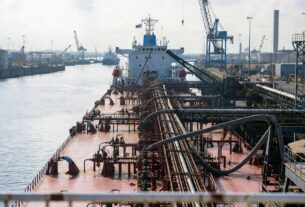
In a striking intervention that challenges Europe’s long-standing energy decoupling strategy, Claudio Descalzi, CEO of Italy’s state-backed energy giant Eni, has publicly urged the European Union to suspend its upcoming ban on Russian liquefied natural gas (LNG). Speaking at a political event organized by Italy’s Lega party, Descalzi stated: “I think that it is necessary to suspend the ban that will take place from January 1, 2027 on LNG supply coming from Russia.” He emphasized that the issue is not prices but volumes, warning that scarcity could further strain industry, power grids, and social stability.
Descalzi, re-elected for a record fifth term, did not advocate scrapping the ban entirely but called for a suspension or phased delay to avoid penalizing Europe’s already struggling industrial base. “One cannot be radical and dogmatic. In extraordinary situations, common sense must prevail,” he added. His remarks coincide with acute supply pressures: the same weekend, around 600 fuel stations in Italy ran dry, QatarEnergy declared force majeure on LNG contracts affecting Italy, and broader Middle East disruptions (including the ongoing Iran conflict and Hormuz Strait tensions) have roiled global LNG flows.
The EU’s phased ban—adopted earlier in 2026—targets Russian pipeline gas and LNG imports, with full LNG prohibition from January 1, 2027, and pipeline gas following in autumn 2027 (with some flexibility). Russia currently supplies roughly 20 billion cubic meters (bcm) of LNG annually to Europe, a volume Descalzi described as critical for grid flexibility that renewables alone cannot replace.
Europe’s Gas Storage Crisis: Starting the Refill Season from a Deficit
As summer injection season begins, Europe faces one of its toughest refill campaigns in years. According to data from Gas Infrastructure Europe (GIE) via the AGSI+ platform, EU-wide underground gas storage stood at approximately 28.9–29.6% full as of early-to-mid April 2026—roughly 327–334 TWh out of ~1,130 TWh total capacity. This is significantly lower than ~35% at the same time in 2025 and well below the five-year average.

Storage has depleted more sharply this winter due to colder temperatures and reduced Russian pipeline flows. The EU has urged early filling and invoked flexibility provisions in the Gas Storage Regulation, allowing countries to target 80% (instead of the standard 90%) by November 1 to ease market pressure. Analysts warn the refill will require substantial additional LNG—potentially 17–20 bcm extra versus prior years—while global supply remains tight amid Qatar disruptions and Asian competition.
Without adequate volumes, Europe risks entering the 2026/27 winter with thinner buffers, increasing the odds of price volatility or even supply alerts.
Consumer Outlook: Higher Prices and Winter Pain Ahead
Descalzi’s warning about “social stability” is grounded in hard economics. Elevated refill costs in a constrained LNG market are already feeding into forward prices. Benchmark Dutch TTF gas futures have seen recent spikes amid geopolitical shocks, with forecasts pointing to sustained elevation through 2026–27. HSBC, for instance, projects TTF averages around $14/MMBtu in 2026 and $10/MMBtu in 2027—40% higher than pre-crisis outlooks—driven by the supply shortfall.
TTF Natural Gas Price Outlook (Recent Historical and Forward Curves)

For households and businesses, this translates to higher heating bills, elevated electricity costs (as gas remains a key flexible power source), and squeezed industrial competitiveness. Energy-intensive sectors already face high costs plus carbon taxes; further price surges could accelerate deindustrialization or force production cuts. Consumers could see winter 2026/27 bills rise 20–40% in a cold scenario, depending on refill success and weather. Descalzi highlighted the risk: “If industry pays a fortune for energy AND gets hit with carbon taxes, we risk social stability.”
A Pragmatic Pivot or Geopolitical Gamble?Descalzi’s call reflects growing frustration with policy inconsistencies exposed by successive crises—2022’s Russian pipeline cutoff, the 2025–26 Middle East shocks, and the limits of rapid renewable rollout. Renewables provide volume but lack the dispatchable flexibility gas offers for grid stability. Europe has diversified via U.S. LNG, Norwegian pipeline gas, and LNG terminals, yet Russian LNG still plays a role in the current mix (around 6–13% of total imports depending on the month).
EU Natural Gas Imports by Source (Recent Breakdown Example)

Critics argue resuming Russian flows would undermine sanctions and energy security goals. Supporters of Descalzi’s view counter that pragmatism is needed to protect citizens and industry until alternatives scale up. Italy’s Deputy PM Matteo Salvini has echoed the call for realism.
The coming months will test whether Brussels prioritizes ideological consistency or winter preparedness. As refill season intensifies, the math of volumes—not rhetoric—may force Europe’s hand. This will be where you hear the popcorn starting….. this is going to be an interesting scenario play out.
Appendix: Sources, Links, and ChartsKey Data Sources & Live Dashboards
- Gas Infrastructure Europe (GIE) AGSI+ Platform (live EU storage levels & charts): https://agsi.gie.eu/
- European Gas Hub (detailed refill scenarios, storage reports, and import analysis): https://europeangashub.com/
News & Statement References
- OilPrice.com: “Eni CEO Calls for Suspending EU Ban on Russian LNG” (April 2026)
- Brussels Signal / Decode39 / Reuters reports on Descalzi’s remarks
- LinkedIn Post by Giacomo Prandelli (full context of CEO statement): https://www.linkedin.com/posts/prandelligiacomo_the-ceo-of-a-major-european-energy-giant-activity-7449765499120492544-hnKJ
Additional Charts in Article (sourced via public energy analytics platforms and news reports, April 2026 data):
- EU storage % full historical comparison (GIE AGSI-derived)
- TTF price forward curves
- EU import mix by pipeline/LNG source (Keppler/ENTSO-G/EOA data)
All data current as of mid-April 2026. Energy News Beat will continue monitoring storage injection progress and policy responses. Stay tuned for updates.