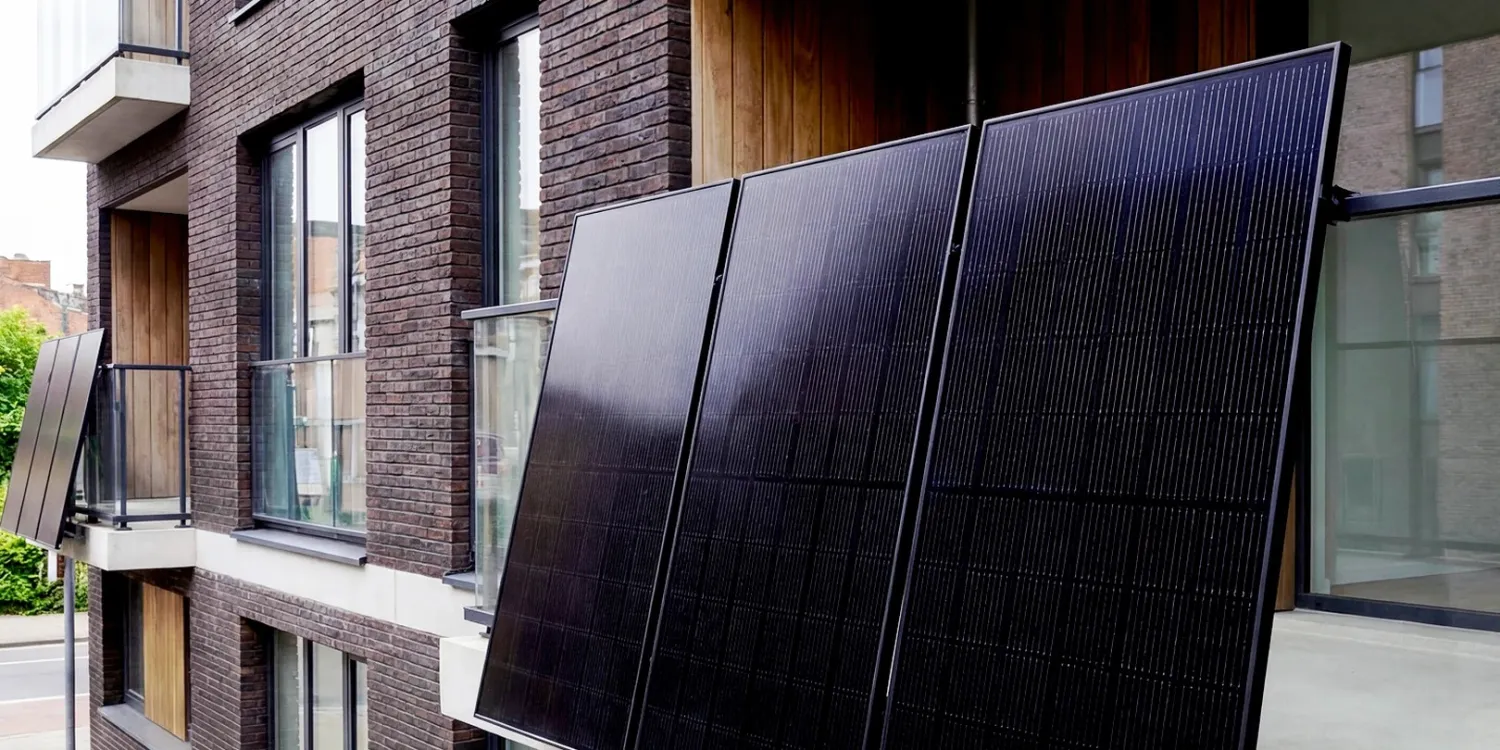
New Jersey just made plug-in solar panels legal. No roof required. For renters, condo owners, and anyone whose roof is shaded, leased, or owned by someone else, that is not a slogan. It is a change in the rules.solarpowerworldonline.com
On September 1, 2026, Governor Mikie Sherrill signed the Garden State Balcony Solar Act (S2368/A4836, now P.L.2026, c.82). The law takes effect March 1, 2027. It legalizes portable solar systems that plug into a standard 120-volt outlet, with a combined output cap of 1,200 watts—roughly two or three modern panels. The panels can sit on a balcony, patio, or sunny yard. A microinverter converts DC to household AC. Excess power is not credited through net metering. Savings come from using the electricity on site.
That is the point. Treat a small solar kit more like an appliance than a power plant.
What the law actually does
The statute defines a “portable solar generation device” as movable PV equipment that:
- outputs no more than 1,200 watts
- plugs into a standard 120-volt outlet
- sits on the customer side of the meter and is meant to offset household use
- is listed or certified to UL 3700 (or a comparable nationally recognized lab standard)
- shuts off exports during a grid outage so line workers are not back-fed
Utilities cannot demand an interconnection agreement, prior approval, extra fees, or extra hardware beyond what is already in the kit. Municipalities cannot ban the devices or require a permit just to place or use them. Building modifications and real electrical work still follow the National Electrical Code and the State Uniform Construction Code. Systems of 400 watts or less are exempt from code provisions that would force changes to wiring or the panel.
Landlords cannot ban a qualifying system if the tenant pays the electric bill. HOAs and condo associations cannot impose blanket bans. They can set reasonable rules on size, location, and placement. Tenants must give at least 14 days’ written notice, name the location, and show the kit complies. The tenant owns the risk of damage from the device.
The bill passed the Senate 40-0 and the Assembly 79-0. Public polling from Fairleigh Dickinson earlier in 2026 found nearly 80 percent support.
Governor Sherrill called it “a practical, easy-to-use tool that can help families save money while allowing more people to participate in our clean energy future.” Environment New Jersey’s Doug O’Malley put it more simply: solar small enough to plug in, big enough to matter for people who could not go solar otherwise.
Specifications and real-world savings
Typical kits use one or two panels plus a microinverter. Hoymiles’ HiFlow Pro is the first U.S. microinverter certified to UL 3700. One 360-watt unit is advertised at up to about 721 kWh per year; four units in parallel can reach the 1,200-watt cap. Bright Saver, CraftStrom, EcoFlow, and generic Hoymiles DIY kits are already selling into this market. Prices run from a few hundred dollars for a starter 180–400 watt kit to roughly $1,500–$2,000 for an 800–1,200 watt setup.
Advocates say a qualifying system can offset 10 to 25 percent of household use, depending on sun and load. New Jersey officials have cited monthly savings starting around $15 and rising toward $50, or up to about $600 a year in a high-rate state where residential power sits near 18 cents per kWh. Those numbers assume daytime use that matches generation. There is no payment for leftover power sent to the grid.
This is not a rooftop replacement. It is a low-friction first step for the large share of New Jersey households that rent or live in apartments.energysage.com
Companies in the mix
A few names keep showing up:
- Hoymiles — first UL 3700-certified balcony microinverter in the U.S. (HiFlow Pro). That certification is the safety keystone of the new state laws.
- CraftStrom — German-rooted balcony specialist selling U.S.-spec kits; CEO Stephan Scherer praised New Jersey’s density and renter base.
- Bright Saver — California nonprofit selling at-cost kits (180 W around $285 for members; 360 W around $414) and lobbying for enabling laws. They have sold systems well beyond California.
- EcoFlow and various Hoymiles/APsystems DIY bundles — consumer electronics and component routes for buyers who want monitoring or batteries.
Consumers get helped when products are listed, anti-islanding works, and the price is low enough that payback is measured in a few years of bill reduction. Consumers get hurt when uncertified import inverters skip anti-islanding, overload a shared circuit, or get sold as if they were full rooftop systems with net-metering credits they do not have.
A national pattern, not a party monopoly
New Jersey is the ninth state with an explicit plug-in solar framework. The list as of September 1, 2026: Utah, Maine, Virginia, Colorado, Maryland, Connecticut, New Hampshire, Vermont, and New Jersey. New York’s SUNNY Act was still awaiting the governor. California’s SB 868 had passed both chambers but was not yet law.
Party control of those nine states is mixed, which matters if the claim is that only one side “helps consumers.”
|
State
|
First mover / status
|
Governor party
|
Legislature / trifecta
|
|---|---|---|---|
|
Utah (2025, first)
|
Enacted
|
Republican (Spencer Cox)
|
Republican trifecta
|
|
New Hampshire
|
Enacted
|
Republican (Kelly Ayotte)
|
Republican trifecta
|
|
Vermont
|
Enacted
|
Republican (Phil Scott)
|
Democratic legislature (divided)
|
|
Maine
|
Enacted
|
Democrat (Janet Mills)
|
Democratic trifecta
|
|
Virginia
|
Enacted
|
Democrat (Abigail Spanberger)
|
Democratic trifecta
|
|
Colorado
|
Enacted
|
Democrat (Jared Polis)
|
Democratic trifecta
|
|
Maryland
|
Enacted
|
Democrat (Wes Moore)
|
Democratic trifecta
|
|
Connecticut
|
Enacted
|
Democrat (Ned Lamont)
|
Democratic trifecta
|
|
New Jersey
|
Enacted
|
Democrat (Mikie Sherrill)
|
Democratic trifecta
|
Utah wrote the national template: 1,200 watts, no interconnection paperwork, safety listing required.
Utah wrote the national template: 1,200 watts, no interconnection paperwork, safety listing required. Republican New Hampshire followed. A Republican governor signed Vermont’s bill. Democratic legislatures then piled on in the Northeast and Mid-Atlantic. Virginia’s House vote was 96-0. New Jersey’s votes were unanimous. This is one of the rare energy files where the politics have been less tribal than the rhetoric.
That is the useful lesson. When the product is small, certified, and aimed at bill relief rather than a utility-scale mandate, both parties can vote for it.
The same country that is opening balcony outlets still ties people in knots on basic self-reliance.
Off-grid living is not banned by any state. The friction is local: zoning, occupancy certificates, mandatory sewer or water hookups when lines are nearby, building codes, and sanitation rules that treat a composting toilet as incomplete unless a septic system is also approved. Rural counties in Tennessee, Texas, Missouri, Arkansas, and parts of the Mountain West often leave more room. Dense counties and many coastal jurisdictions do not. About 30-plus states have statutes or case law that let local governments force a connection to public water or sewer when service is available. That is where “you may generate your own power” collides with “you must still pay for the pipe.”
The pattern is not “red states freedom, blue states control” in a clean line. Utah—the first plug-in solar state—still registers larger rain cisterns. Colorado passed both a high plug-in cap (1,920 watts) and the nation’s tightest rain-barrel limit. New Jersey just unlocked balcony solar while remaining a high-code, high-utility-regulation state. California’s building and septic rules make true off-grid living expensive even as the legislature debates balcony kits.
How consumers get helped—and how they get hurt
Helped:
- Renters and apartment dwellers finally have a legal, permit-light path.
- No interconnection queue, no utility “study,” no extra monthly rider for a toaster-sized generator.
- Certified kits with anti-islanding reduce the fire and worker-safety arguments utilities used to kill the category.
- Portable assets move with the tenant.
Hurt:
- Cap of 1,200 watts is real. It will not run a house through a heat wave.
- No net metering means midday surplus is wasted unless a battery is added.
- Cheap unlisted inverters remain a hazard in gray-area states.
- “Reasonable” HOA and landlord rules can still be used as a veto if the association wants them to be.
- Utilities lose a little daytime load. If that becomes a pretext for higher fixed charges on everyone else, the savings get clawed back.
Nationally, the legislation we need is the kind New Jersey just passed: clear wattage, clear safety standard, no paperwork tax, tenant protections with notice, and no fake claims that a balcony kit is a climate plan by itself. What we do not need is the opposite instinct—treating a rain barrel, a composting toilet, or a 400-watt panel as a threat to the system.
Plug-in solar will not replace combined-cycle plants or fix PJM capacity prices. It will shave a noticeable slice off some bills for people who never had a roof to work with. That is a modest, measurable win. The country should copy the modest part and skip the overreach.
At Energy News Beat, we Make Appendices Great Again.
Appendix: sources and linksNew Jersey law and official statements
- Electrek: “New Jersey just made plug-in solar panels legal” — https://electrek.co/2026/09/01/new-jersey-just-made-plug-in-solar-panels-legal/
- Office of the Governor of New Jersey press release — https://www.nj.gov/governor/news/2026/20260901a.shtml
- New Jersey Globe bill-signing report — https://newjerseyglobe.com/governor/sherrill-signs-balcony-solar-law-to-expand-access-to-clean-energy/
- Bill text, S2368 (LegiScan) — https://legiscan.com/NJ/text/S2368/id/3451324
- Bill status, S2368 — https://legiscan.com/NJ/bill/S2368/2026
- Assembly statement on A4836 — https://pub.njleg.state.nj.us/Bills/2026/A5000/4836_S3.HTM
- PluginSolarUS New Jersey page — https://pluginsolarus.com/learn/new-jersey-s2368-garden-state-balcony-solar-act
Coverage of specs, savings, and industry
- pv magazine USA — https://pv-magazine-usa.com/2026/09/01/new-jersey-legalizes-plug-in-solar-up-to-1200-w/
- Solar Power World — https://www.solarpowerworldonline.com/2026/09/new-jersey-governor-signs-balcony-solar-bill-to-law/
- Gothamist — https://gothamist.com/news/a-whole-new-world-new-jersey-eases-restrictions-on-residential-solar-panels
- New Jersey 101.5 / Solar Now — https://now.solar/2026/09/02/nj-residents-save-up-to-600-annually-with-plug-in-solar-panels-new-jersey-101-5/
- mGrid on unanimous votes — https://mgrid.org/2026/06/30/new-jersey-legislature-passes-plug-in-solar-bill-in-unanimous-votes/
- PluginSolarHub NJ guide — https://pluginsolarhub.org/state-legality/new-jersey/
UL 3700 and companies
- Electrek on Hoymiles HiFlow Pro — https://electrek.co/2026/07/20/us-first-ul-3700-balcony-solar-microinverter-hoymiles/
- Canary Media on balcony solar vendors — https://www.canarymedia.com/articles/solar/balcony-solar-for-sale-us
- Bright Saver kits — https://www.brightsaver.org/balcony-solar-kits
- pv magazine USA on Bright Saver nationwide sales — https://pv-magazine-usa.com/2026/07/13/bright-saver-begins-offering-plug-in-solar-kits-at-wholesale-costs-to-customers-nationwide/
- EnergySage balcony solar explainer — https://www.energysage.com/news/plug-in-balcony-solar-panels/
State-by-state plug-in solar trackers
- PluginSolarUS 2026 roundup — https://pluginsolarus.com/learn/state-legislation-roundup-2026
- PluginSolarUS April 2026 wave — https://pluginsolarus.com/learn/april-2026-plug-in-solar-wave
- Perfect Fit legislation page — https://power.perfectfit.com/legislation
- YourSolarPlug tracker — https://yoursolarplug.com/state-tracker.html
- PluginSolarGuide map — https://pluginsolarguide.com/
- WattRank U.S. laws — https://wattrank.io/us/plug-in-solar-laws
- Solar.com 2026 guide — https://www.solar.com/learn/guide-to-balcony-plug-in-solar/
Partisan control
- MultiState Governors and Legislatures 2026 — https://www.multistate.us/resources/2026-governors-and-legislatures
- NCSL partisan composition PDF — https://documents.ncsl.org/wwwncsl/Elections/Legis_Control_2026_1.27.26_Adam%20Kuckuk.pdf
- Ballotpedia trifectas — https://ballotpedia.org/State_government_trifectas_and_triplexes
Rainwater and off-grid rules
- Rain Reclamation Station, 50-state rainwater laws — https://rainreclamationstation.com/state-laws.html
- Rediscover Rural rainwater summary — https://rediscoverrural.com/rainwater-harvesting-laws-by-state/
- AllowedHere rainwater — https://allowedhere.com/legality/collecting-rainwater/
- LegalClarity rainwater — https://legalclarity.org/is-collecting-rainwater-illegal-in-your-state/
- Live Off The Grid laws index — https://liveoffthegrid.com/off-grid-laws
- LegalClarity off-grid and mandatory hookups — https://legalclarity.org/is-it-actually-legal-to-go-off-the-grid/
- GoOffGrid zoning explainer — https://gooffgrid.tools/off-grid-laws-by-state
- AllowedHere off-grid — https://allowedhere.com/legality/off-grid-living/