

The International Energy Agency’s latest Oil Market Report underscores a deepening imbalance in global oil markets. Despite a sharper-than-expected contraction in demand driven by elevated prices from the ongoing Iran conflict and related disruptions, supply shortfalls have widened even more, producing the tightest near-term balances in years.
At the time this article is written, Brent is $88.90, and WTI is $83.38, but physical delivery of a barrel ranges from $140.34 to $189.56 depending on the delivery point and tanker route.
According to the IEA, the world faces a supply deficit of 1.8 million barrels per day (bpd) in the third quarter of 2026—more than double the agency’s prior estimate. This stems from “renewed hostilities and maritime disruptions” that have undermined a partial production recovery in the Middle East. For the full year 2026, the deficit is projected as the widest in five years, with global supply expected to fall by 4.3 million bpd (around 4%) to roughly 102 million bpd. Demand is forecast to contract by 1.6 million bpd (revised deeper from about 1 million bpd previously), the largest annual decline since the 2020 pandemic.
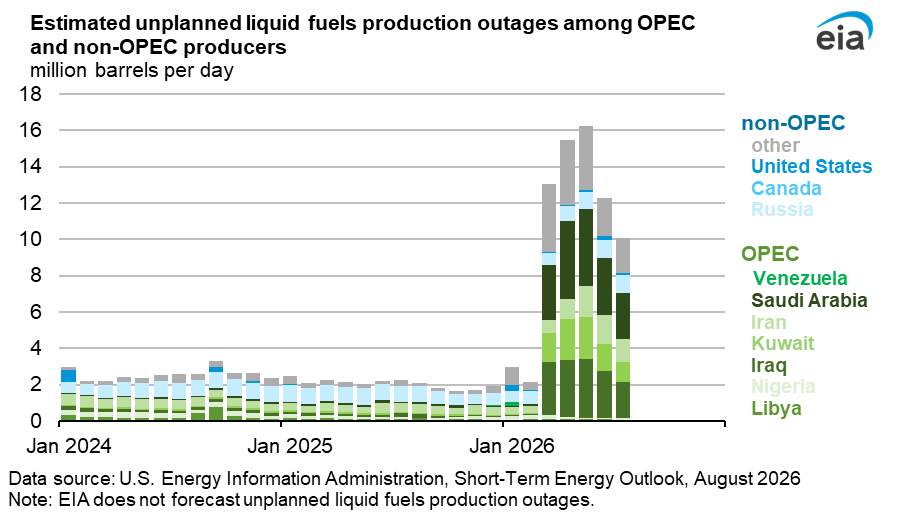
Middle East Gulf production remains about 8.3 million bpd below pre-conflict levels in July, even after a partial rebound. Shipments through the Strait of Hormuz and alternative routes have been constrained, with the waterway’s effective re-closure earlier in the summer derailing recovery. Global observed inventories fell below 7.9 billion barrels in July for the first time since April 2025, with draws accelerating this quarter at more than twice the previously estimated rate. Russian refining runs also hovered near 20-year lows amid Ukrainian drone attacks, further limiting product availability.
The IEA assumes gradual de-escalation later in the year could allow a return to surplus by late 2026 or into 2027 (potentially a multi-million-bpd surplus next year if flows normalize), with supply rebounding sharply. Risks remain elevated while an agreement to reopen Hormuz and ensure unhindered transit through Bab el-Mandeb stays elusive.
EIA estimates unplanned liquid fuels production outages among OPEC and non-OPEC producers
Analyst Perspectives on Demand vs. Supply
Analysts broadly align with the IEA’s diagnosis of a supply-driven squeeze outweighing demand destruction in the near term, though views diverge on the path to normalization.
The Oxford Institute for Energy Studies (OIES) has flagged even tighter balances in recent months, projecting a larger 2026 deficit amid slower Hormuz recovery assumptions and noting that ceasefire optimism in mid-year proved premature when hostilities resumed. Other voices, including those tracked by market reports, highlight that high prices have already induced significant demand destruction (especially in Asia, with sharp drops in Chinese and Japanese imports earlier), yet physical availability constraints—particularly for refined products—keep the market tight.
Looking ahead, some banks and research houses (including comments associated with Goldman Sachs earlier in the cycle) have pointed to a potential 2027 surplus once production and shipping normalize and inventories begin rebuilding, which could pressure prices lower. The consensus near-term view remains that supply disruptions via chokepoints are the dominant force, with demand response lagging and incomplete. Record Atlantic Basin refining margins in July reflected product-market tightness colliding with seasonal demand, even as crude balances adjusted.
Paper Markets vs. Physical Delivery Costs to Refineries
A persistent feature of this crisis has been the divergence—and occasional reconvergence—between paper (futures) prices and physical market realities. Futures curves have repeatedly moved into steep backwardation (near-term contracts trading at significant premiums to later months), signaling immediate physical scarcity and a high convenience yield for prompt barrels. This structure rewards holders of physical oil and generates positive roll yields for long futures positions but discourages inventory building.
Physical differentials have swung dramatically. At peaks of disruption, Asian physical benchmarks (such as Dubai) commanded massive premiums over paper Brent—sometimes $30–$40+ per barrel—while Dated Brent and other grades saw extreme strength as refiners scrambled for deliverable cargoes. When temporary diplomatic signals or partial flow recoveries appeared, differentials collapsed into discounts in some regions (Europe, West Africa, and parts of the Middle East), with ample Atlantic Basin availability weighing on prices. As of early August commentary, European crude differentials had softened toward or below pre-war levels in places, though geopolitical uncertainty provided a floor.
Delivery costs to refineries remain elevated due to the conflict. War-risk insurance premiums for Hormuz or high-risk Red Sea/Bab el-Mandeb transits have surged (reports of 7.5–10% of hull value at peaks, adding millions per VLCC voyage).
Longer alternative routes (around Africa) inflate freight, fuel (bunker prices significantly higher), and time costs. Demurrage, crew risk premiums, and occasional reported “tolls” or waiting times compound this. Refiners face not only higher crude acquisition costs but also constrained product exports from the Middle East and reduced Russian runs, transmitting tightness into gasoline, diesel, and jet markets. High crack spreads (refining margins) have partially offset crude costs for complex refiners but ultimately pass through to end-user fuel prices.
As of mid-August 2026, benchmark futures hovered near $83–$85 for WTI and around $89 for Brent, reflecting ongoing volatility tied to diplomatic headlines.
Implications for Investors and Consumers
For investors, the environment favors selective exposure to upstream producers, integrated majors with refining leverage, and tanker operators, while demanding careful risk management. Steep backwardation supports roll returns in futures or commodity indices, and inventory draws plus chokepoint risks create upside potential on any further escalation or delayed resolution. Energy equities and related infrastructure may benefit from sustained higher prices and margins.
However, the IEA’s (and many analysts’) base case of eventual surplus in 2027 implies sharp downside risk if diplomacy succeeds—prices could reprice lower rapidly once flows normalize and stocks rebuild. Volatility remains extreme; position sizing, hedging, and monitoring of Hormuz traffic, insurance markets, and inventory data are essential. Strategic petroleum reserve dynamics and non-OPEC+ supply growth (Americas) offer additional variables.
For consumers, the picture is more uniformly challenging in the near term. Higher crude and especially refined-product prices translate into elevated gasoline, diesel, and jet fuel costs at the pump and for industry. Demand destruction is already evident, but essential transportation and industrial use provide limited short-term elasticity. Broader inflationary pressure on goods (via shipping and energy input costs) and potential economic drag in oil-importing regions persist until supply recovers. Households and businesses in import-dependent economies face the heaviest burden; any prolonged disruption risks further price spikes and secondary effects on growth.
In summary, the IEA report confirms that supply constraints from the Iran-related disruptions continue to dominate, overpowering even a deepened demand hit. Physical market tightness—evident in backwardation, elevated delivery costs, and product margins—remains more acute than some paper-market optimism around eventual de-escalation might suggest.
Resolution of the Hormuz standoff is the pivotal variable for both investors seeking asymmetric opportunities and consumers hoping for relief at the pump.
Appendix: Sources and Links
- Bloomberg: “Oil Supply Crunch Worsens Despite War’s Demand Hit, IEA Says” / “IEA Sees Wider Oil Supply Deficit Despite Hit to Demand From War” (August 12, 2026) — https://www.bloomberg.com/news/articles/2026-08-12/iea-sees-wider-oil-supply-deficit-despite-hit-to-demand-from-war
- Reuters: “IEA slashes 2026 supply forecast as Hormuz reopening remains elusive” (August 12, 2026) — https://www.reuters.com/business/energy/iea-slashes-2026-supply-forecast-hormuz-reopening-remains-elusive-2026-08-12/
- Argus Media: “IEA sees greater oil demand fall in 2026” (August 12, 2026) — https://www.argusmedia.com/en/news-and-insights/latest-market-news/2864083-iea-sees-greater-oil-demand-fall-in-2026
- CNBC: “IEA cuts 2026 oil demand forecast on Hormuz disruption” (August 12, 2026) — https://www.cnbc.com/2026/08/12/iea-oil-demand-hormuz.html
- The National: “IEA deepens 2026 oil supply forecast as Iran war disrupts flows” (August 12, 2026) — https://www.thenationalnews.com/business/energy/2026/08/12/iea-deepens-2026-oil-supply-cut-as-iran-war-disrupts-flows/
- MarketScreener / related summaries of IEA report details (August 12, 2026)
- Oxford Institute for Energy Studies (OIES) Oil Monthly analyses (recent 2026 issues)
- CME Group insights on backwardation and energy markets (2026)
- Kpler analyses on physical differentials and European crude markets (2026)
- Various reports on war-risk premiums, freight, and shipping costs (Reuters, Marsh, S&P Global, International Banker, and related 2026 coverage of Hormuz/Red Sea impacts)
- Price data references from market sources around August 11–12, 2026 (Brent/WTI levels)
Additional supporting context drawn from earlier 2026 IEA Oil Market Reports, EIA Short-Term Energy Outlook references, and contemporaneous physical market reporting on differentials and refining margins. All figures are as reported in the cited sources and subject to revision with subsequent data.