

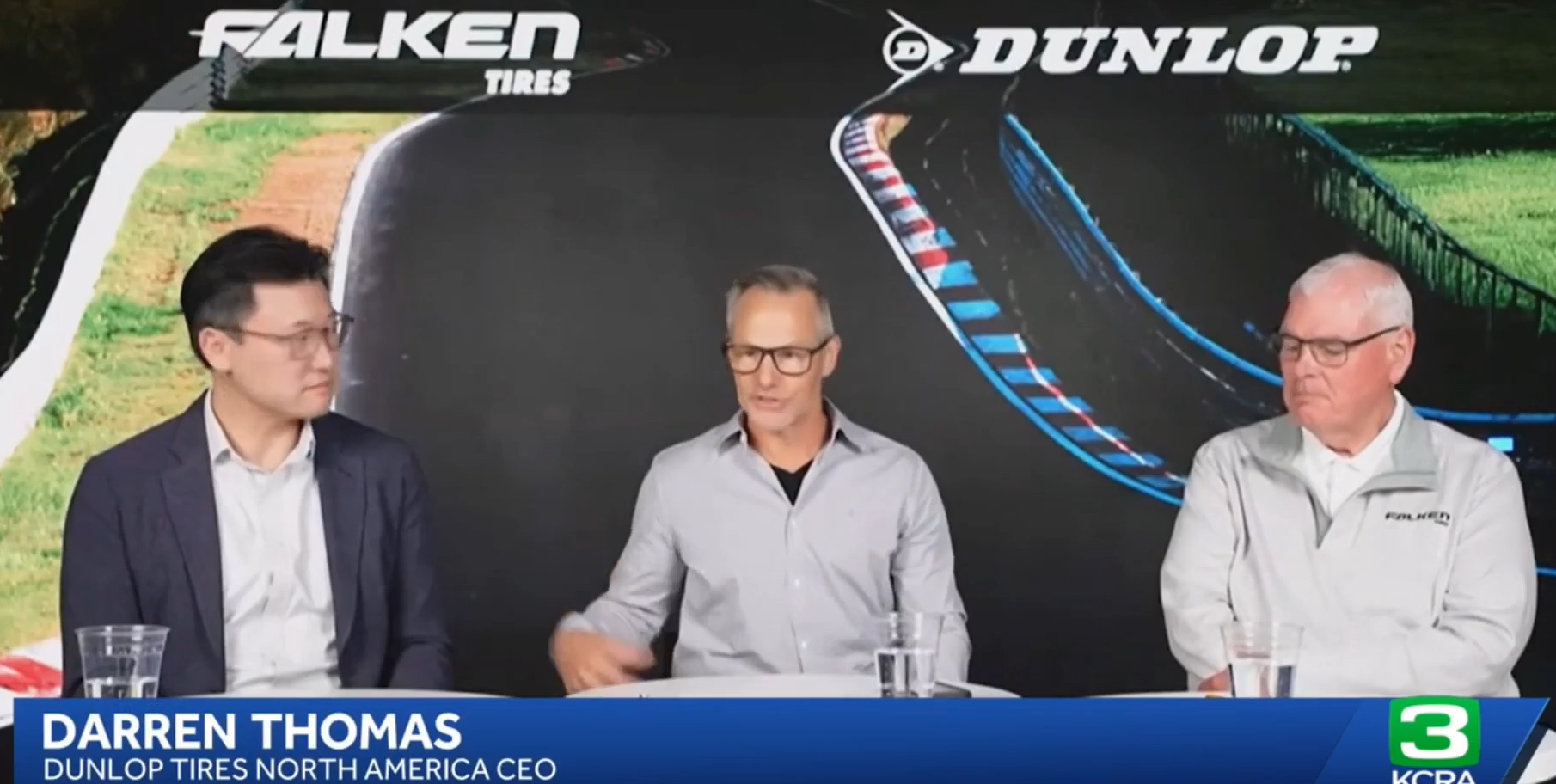
Gavin Newsom’s California is set to become more expensive starting in 2029 under new state tire efficiency rules approved last week by the California Energy Commission (CEC). Dunlop Tires North America President and CEO Darren Thomas used a lengthy Monday press conference to warn of higher costs, reduced consumer choice, and unintended consequences for drivers of electric vehicles, light-duty trucks, and conventional gasoline vehicles.
Thomas did not mince words about the regulation’s origins and design. “Generally, when you attempt to regulate something you don’t understand or don’t care much about, you create bad policy, and that’s probably what we have here,” he said.
The rules, known as the Replacement Tire Efficiency Program, set minimum standards for rolling resistance on most replacement tires sold for passenger vehicles and light-duty trucks. Phase 1 takes effect for tires manufactured on or after January 1, 2029; a stricter Phase 2 begins in 2033. The CEC projects nearly $1 billion in annual fuel and electricity savings statewide and a reduction of about 2 million metric tons of CO2 emissions per year—roughly equivalent to removing 400,000 gasoline cars from the road. Regulators claim incremental tire costs of only $1.50 each in Phase 1 and $6.50 in Phase 2, with typical gasoline-vehicle drivers saving around $179 over the life of a set.
Thomas and other Dunlop/Falken executives rejected that rosy picture. “Will prices increase? You bet they’ll increase,” Thomas said. “It’s going to be a real issue, in terms of cost, it’s going to go up. By how much? We don’t know. Is there going to be fuel savings? In theory.”
In the briefing, he estimated a realistic rise of 15 to 20 percent once fewer manufacturers, importers, and distributors remain in the market: “When the supply goes down, and the demand stays stable, prices go up.”
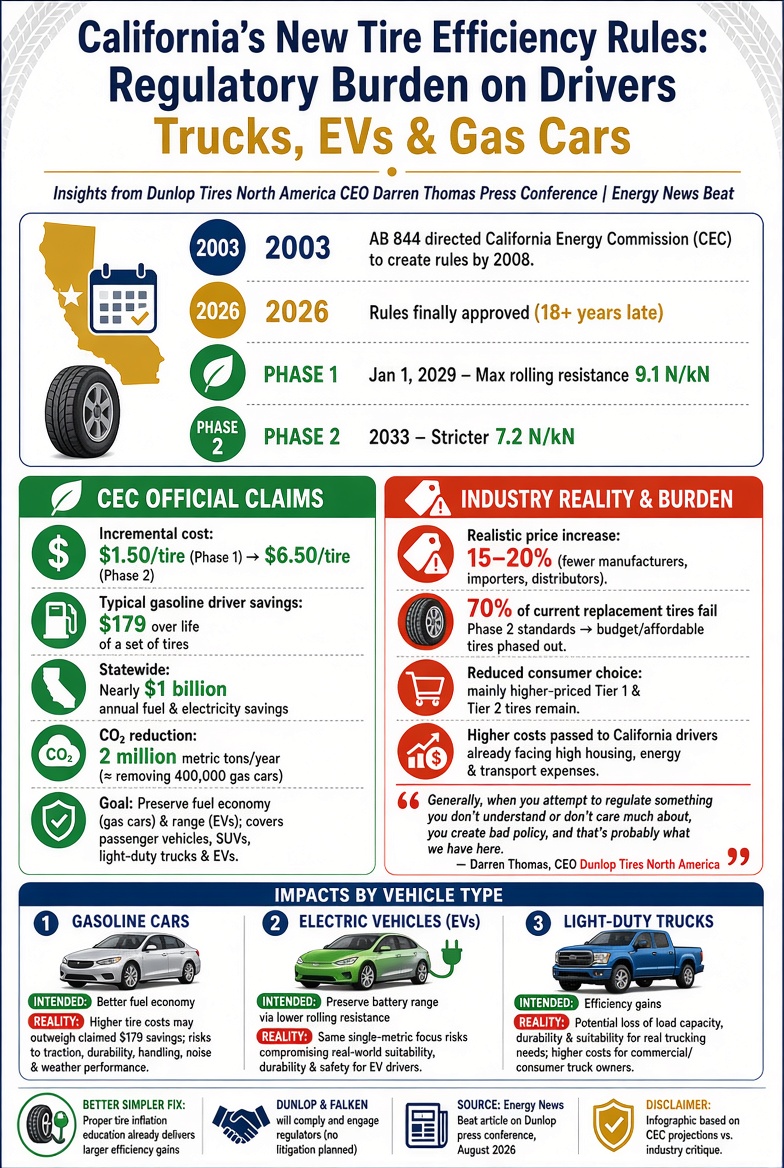
Industry critics note that roughly 70 percent of current replacement tires would fail the eventual Phase 2 standards, effectively wiping lower-cost “budget” tires out of the California market. Those more affordable options—often the only practical choice for many households—would be phased from sale, leaving mainly higher-priced Tier 1 and Tier 2 products. Former Assemblyman Joe Nation, author of the original authorizing legislation, acknowledged the concern while comparing budget tires to “budget sushi”: cheaper products that may wear faster and require earlier replacement. Tire shops across the state have already flagged inventory problems for cost-conscious customers.
The impact is not limited to conventional cars. The standards cover replacement tires for passenger vehicles, SUVs, light-duty trucks, and EVs. Lower rolling resistance is intended to preserve fuel economy on gasoline engines and range on electric vehicles; critics counter that forcing a single performance metric risks compromising traction, durability, handling, load capacity, noise, weather performance, and overall suitability for real-world driving. “We can all do it tomorrow,” Thomas noted of meeting the efficiency numbers. “Will it accomplish the needs you have for your vehicle and your driving use? The answer is no.” He argued that simply keeping tires properly inflated already delivers larger efficiency gains than the regulation targets, and that education would be a simpler, cheaper fix.
The long delay only compounds the frustration. Assembly Bill 844 (Nation, 2003) directed the CEC to adopt and implement a statewide replacement-tire efficiency program by July 1, 2008. The agency paused work after federal legislation raised the prospect of national standards, then largely sat on the mandate through the Great Recession and the following decade-plus. Rules were finally approved only last week—nearly 18 years past the statutory deadline. Nation told KCRA he prioritized emissions reductions when he wrote the bill and expressed confidence in the CEC’s technical work, while conceding he had not reviewed the latest cost analyses.
Thomas said Dunlop and Falken (both under Sumitomo Rubber Industries) will comply and continue talking with regulators rather than litigate. Larger rivals Michelin and Bridgestone have voiced support; Goodyear and others have joined the opposition. Republican lawmakers and consumer advocates describe the episode as classic California overreach—another layer of cost on a state already burdened by high housing, energy, and transportation expenses.
Whether the promised fuel savings materialize or whether the market simply becomes thinner and more expensive will become clear after 2029. For now, the state’s largest tire manufacturers are sounding the alarm that consumers, especially those who rely on affordable options for everyday cars, trucks, and EVs, will pay the price.
On a side note: If Gavin runs for the White House, every American, trucker, and driver will see costs spike through the roof. This story is not just about some tire regulations; it is about government overreach.
Primary reporters and outlets covering the press conference and fallout
- Ashley Zavala, KCRA 3 / California Politics 360 (video of Thomas remarks and interview with Joe Nation): https://x.com/ZavalaA/status/2092254612934058000 and https://www.kcra.com/article/california-tire-rules-backlash-dunlop-cost-concerns/73515667
- Rob Nikolewski, San Diego Union-Tribune: https://www.sandiegouniontribune.com/2026/08/24/more-fallout-from-californias-tire-regulation/
- Zain Khan, New York Post: https://nypost.com/2026/08/25/us-news/dunlop-tires-scorches-gavin-newsoms-new-rules-thatll-have-startling-impact-on-drivers/
Official and legislative sources
- California Energy Commission approval announcement (Aug. 17, 2026): https://www.energy.ca.gov/news/2026-08/cec-approves-nations-first-replacement-tire-efficiency-standards-saving
- Assembly Bill 844 (Nation, Chapter 645, Statutes of 2003) text and legislative history: https://leginfo.legislature.ca.gov/faces/billCompareClient.xhtml?bill_id=200320040AB844
- CEC Replacement Tire Efficiency Program proceeding page and supporting documents: https://www.energy.ca.gov/proceeding/replacement-tire-efficiency-program-proceeding
Additional reporting and industry statements
- KCRA explainer on the rules: https://www.kcra.com/article/california-replacement-tire-rules-explained/73497689
- Dunlop Tires North America official statement (Aug. 19, 2026): https://www.globenewswire.com/news-release/2026/08/19/3347965/0/en/dtna-statement-on-california-replacement-tire-efficiency-requirements.html
- ABC10 / related local coverage of industry reaction: https://www.abc10.com/article/news/politics/tire-industry-weighs-in-on-new-replacement-tire-regulation/103-85803d3b-0681-4c79-91da-27340922d57e
All quotes attributed to Darren Thomas are drawn from the Monday press conference as reported by the outlets above and from the video posted by Ashley Zavala.
