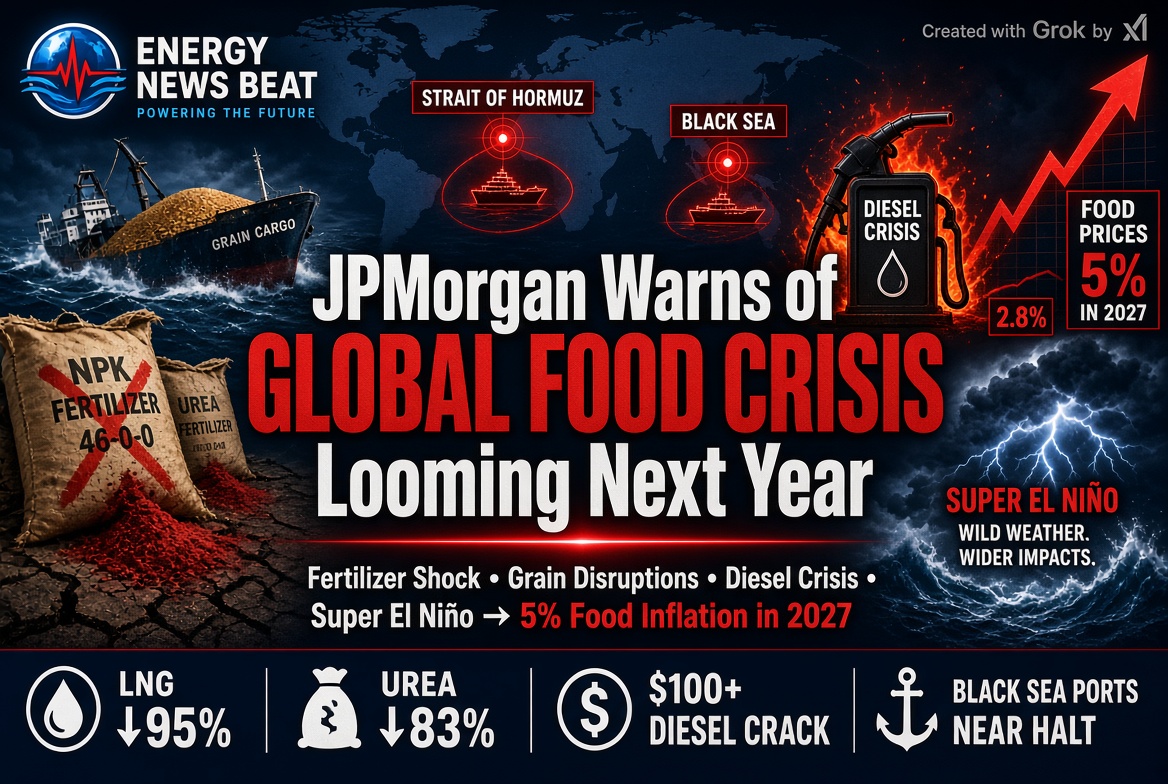
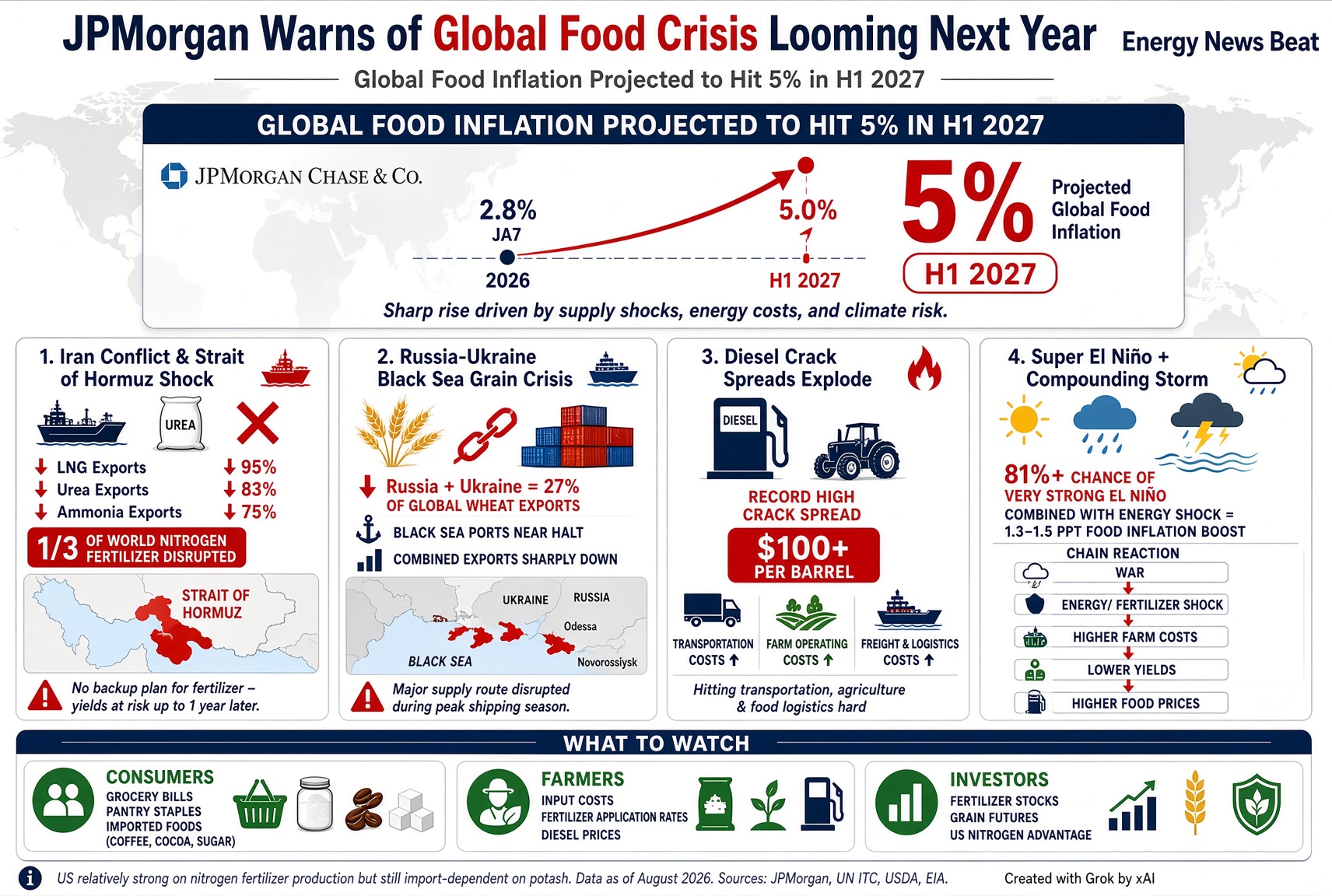
A recent JPMorgan report titled “Food Security is National Security: A Compounding Storm,” led by senior global economist Nora Szentivanyi, has sounded the alarm on rising risks of elevated global food inflation into 2027. The bank projects food inflation accelerating from about 2.8% in the first half of 2026 to around 5% annualized in the first half of 2027. Combined with energy shocks, this could add roughly 0.6 percentage points to global headline inflation and slow the expected cooling of prices.
The warning gained fresh attention in a Fox Business segment featuring market commentator Scott Shellady (“the Cow Guy”), which circulated widely, including via posts highlighting the JPMorgan outlook amid ongoing geopolitical tensions.
JPMorgan frames the risks around compounding pressures—often described as the “Five Ws” (War, Weather, Warehousing, Water, and Waste)—with particular emphasis on fertilizer disruptions and a potential “super” El Niño. Unlike oil markets, which have more flexible substitutes and strategic reserves in some cases, nitrogen fertilizer has limited near-term alternatives and must be applied at precise points in the crop cycle. Delays reduce yields regardless of later conditions.
Iran Conflict Impacts on LNG and Fertilizer
The Iran conflict, which escalated with strikes beginning around late February 2026, severely disrupted the Strait of Hormuz—a chokepoint handling a significant share of global energy and fertilizer trade. Roughly one-third of the world’s nitrogen fertilizer (essential for about half of global crops) and a substantial portion of seaborne fertilizer trade normally transit the strait. The Middle East supplies a large share of urea and ammonia exports.
UN International Trade Center analysis of Gulf exporters (Bahrain, Iran, Iraq, Kuwait, Qatar, Saudi Arabia, UAE) showed sharp volume declines between periods: liquefied natural gas (LNG) exports dropped by 95% (about 5.5 million tonnes absolute decline in the comparison), urea by 83%, and ammonia by 75%. Overall merchandise export volumes across key products fell around 54%. Qatar’s LNG facilities and other regional plants faced damage or reduced output, hitting feedstock for nitrogen fertilizer production.
Nitrogen fertilizer prices rose 25–50% from late February to April in various benchmarks. Gulf urea export capacity disruptions removed millions of tonnes from markets (estimates of suspended exports in the range of several million tonnes early in the conflict). Some recovery in shipments occurred after interim arrangements in mid-2026, but full normalization has been slow due to damaged infrastructure (repairs estimated at 1–4 years for fertilizer plants and longer for some gas facilities) and lingering risks.
These cuts cascade: higher natural gas/LNG costs raise fertilizer production expenses globally, while direct export losses tighten physical availability. Farmers facing elevated prices may apply less fertilizer, lowering yields that show up in harvests months later.
Russia-Ukraine Impacts on Grain Shipments
Parallel pressures come from the Black Sea. Russia and Ukraine together account for roughly 27% of global wheat exports in recent marketing years. Escalating attacks on ports, terminals, and vessels since mid-2026 have heavily constrained flows during peak post-harvest periods.
Ukrainian Black Sea deepwater ports (Odesa region) saw capacity cuts of about one-third or more at peaks, with seaborne throughput falling dramatically—at times near zero in August periods—as insurers and shipowners pulled back. Russian terminals at Novorossiysk and Taman faced suspensions, taking large shares of capacity offline (over 90% of Russia’s Azov-Black Sea grain export capacity affected in some assessments). Combined monthly wheat/grain exports from the two countries dropped sharply versus prior years (e.g., August estimates well below historical averages of several million tonnes).
Alternative routes (Danube, rail, road) cannot fully compensate. Carryover stocks have built in Ukraine, pressuring local prices, while global buyers turn to higher-cost origins such as Australia, Canada, or the US. USDA adjustments have reflected these logistics constraints in lower export forecasts for both countries.
Diesel Crack Spreads Hitting Transportation and Agriculture
Global diesel (middle distillate) markets tightened sharply in summer 2026. US Gulf Coast ultra-low sulfur diesel crack spreads versus WTI hit records above $100 per barrel (intraday highs around $102), with Northwest Europe and Singapore cracks also elevated at multiples of historical norms ($20–40 range in balanced markets).
Drivers include Russian refining attacks and diesel export restrictions, Middle East disruptions via Hormuz and facility hits, lower global refinery runs, and seasonal agricultural demand for tractors, harvesters, and trucking. US distillate inventories reached multi-decade lows for the season. Retail diesel prices rose, raising costs for freight, farming operations, and food logistics—feeding into broader inflation and grocery prices.
Diesel powers critical links in the food chain; elevated cracks act as a tax on transportation and on-farm activities precisely during harvest and planting windows in both hemispheres.
What Consumers, Farmers, and Investors Should Watch
Consumers: Monitor grocery inflation, especially staples and imported items (coffee, cocoa, sugar, rice) more exposed to weather and input shocks. Build modest pantry buffers for essentials if feasible, track USDA and FAO price indexes, and watch for any export restrictions by major producers. Emerging markets face higher vulnerability due to larger food shares in household budgets.
Farmers: Focus on input cost management—nitrogen application rates, timing of purchases, and soil testing to optimize use. Track diesel prices and local fertilizer availability closely. Diversify where possible (crop mix, marketing strategies) and evaluate risk management tools (crop insurance, forward contracts). US producers benefit from relatively stronger domestic nitrogen access but still face global price transmission and diesel costs. Higher input prices may encourage reduced application rates in some areas, affecting 2027 yields.
Investors: Watch fertilizer equities and producers with North American exposure (nitrogen advantages from cheap US natural gas), agricultural commodity futures (wheat, corn, soy), and related logistics/refining names. Grain exporters from alternative origins and companies with strong domestic fertilizer production or logistics could see relative resilience. Broader themes include food-security equities, farmland, and any policy-driven capacity expansions. Volatility remains high from geopolitics and weather; position sizing and hedging matter. El Niño probability (high chance of a strong event persisting into 2027) adds a weather premium to certain softs and grains.US Fertilizer Position
The US is relatively well-positioned on nitrogen compared with many importers. Domestic nitrogen fertilizer production roughly doubled between 2010 and 2020 thanks to abundant low-cost natural gas; the country produces the large majority of its ammonia needs and has ongoing capacity expansions. Phosphate production is also significant domestically.
However, overall fertilizer imports still cover a substantial share (around half of total use in recent years), and potash dependence is acute—net import reliance near 90%+, with the bulk from Canada and limited domestic output (hundreds of thousands of tonnes versus multi-million-tonne consumption). Prices for nitrogen and phosphates have been elevated versus recent years, though some nitrogen products saw mid-2026 relief.
Policy responses under the current administration include suspending certain duties, Jones Act waivers for domestic movements, investments via programs like FIELDS, accelerated permitting, and targets for capacity growth (nitrogen, potash, phosphate). New ammonia projects are in the pipeline. These steps aim to reduce foreign reliance over time, but near-term global tightness still transmits price pressure.
Overall, the US agricultural system has buffers in stocks, production scale, and policy tools, making severe domestic shortages less likely than in highly import-dependent emerging markets. Still, higher costs for fertilizer, diesel, and some imported foods remain a headwind for 2027.The JPMorgan outlook is not a prediction of empty shelves but of sticky higher prices from delayed input effects meeting weather risks. Markets will continue reacting to Hormuz traffic normalization, Black Sea security, diesel inventories, and El Niño updates. Food security and energy security remain tightly linked.
- JPMorgan-related coverage and report summaries: https://finance.yahoo.com/markets/commodities/articles/jpmorgan-warns-global-food-crisis-183000431.html; https://www.reuters.com/sustainability/cop/jpmorgan-warns-super-el-nio-oil-shock-could-prop-up-global-inflation-2026-07-24/; https://www.businesstoday.in/india/story/jpmorgan-warns-of-global-food-crisis-in-2027-how-el-nino-fertiliser-shortages-could-hit-india-549573-2026-08-17; https://www.ibtimes.co.uk/jpmorgan-global-food-prices-fertiliser-shortages-el-nino-1814525
- X post with Fox segment: https://x.com/DemocraticWins/status/2092279170210447795
- Strait of Hormuz / LNG / fertilizer impacts: https://news.un.org/en/story/2026/08/1168074; https://www.foodsecurityportal.org/node/3839; https://www.reuters.com/business/energy/how-does-iran-war-affect-fertiliser-supplies-prices-food-security-2026-03-17/; https://www.ifpri.org/blog/the-iran-war-potential-food-security-impacts/
- Russia-Ukraine grain: https://www.spglobal.com/energy/en/news-research/latest-news/agriculture/082026-factbox-black-sea-grain-trade-strained-by-escalating-russia-ukraine-conflict; https://www.straitstimes.com/world/europe/russia-and-ukraines-black-sea-grain-exports-grind-to-a-virtual-halt; https://www.reuters.com/world/russian-attacks-could-cut-ukraine-grain-exports-by-third-2026-06-18/
- Diesel cracks: https://energynewsbeat.co/downstream/asia-europe-and-us-diesel-crack-spreads-are-on-fire-what-does-this-mean-for-consumers-and-investors/; https://www.reuters.com/business/energy/us-diesel-crack-surpasses-100-barrel-first-time-supply-disruptions-2026-08-17/; https://www.bloomberg.com/news/articles/2026-08-18/diesel-margins-top-100-a-barrel-to-reach-record-high-as-supply-crunch-grows
- US fertilizer: https://www.atlanticcouncil.org/dispatches/how-to-secure-the-flow-of-fertilizers-lets-talk-about-potash/; https://agtransport.usda.gov/stories/s/Fertilizer-Transportation-Dashboard/dtqv-e4ux/; https://www.fertilizerdaily.com/20260513-trump-wants-to-increase-u-s-fertilizer-production-aiming-at-30-nitrogen-boost-100-potash-expansion-and-200-phosphate-growth/; USGS and industry capacity notes from related reports
Data reflects conditions as of late August 2026 reporting; markets and geopolitics can shift rapidly. This is analysis for informational purposes, not investment, farming, or policy advice.