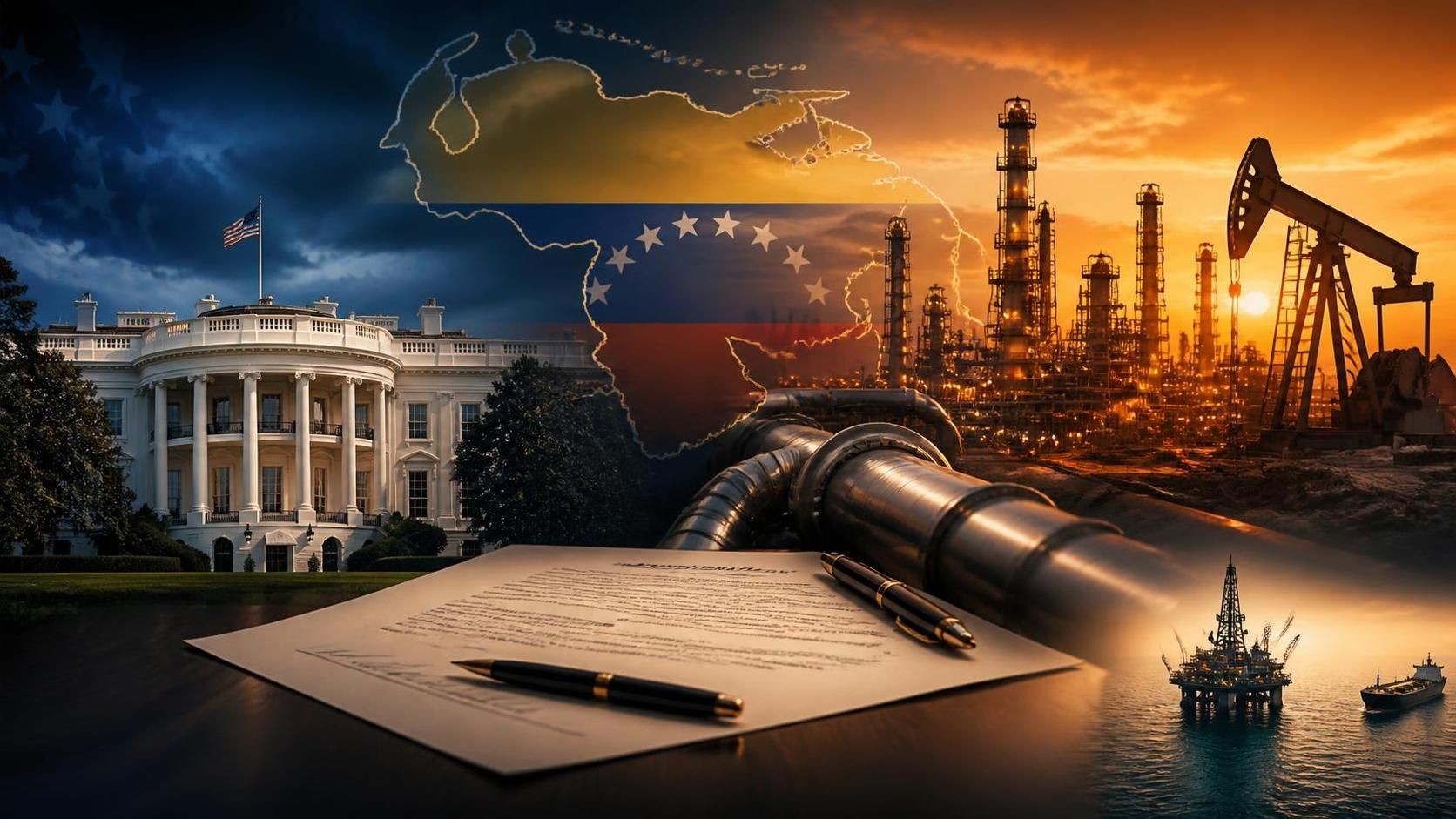
The U.S. government receives a 35% equity stake in NABEP’s corporate parent via the Department of War’s Office of Strategic Capital, a guaranteed right to buy 20% of offtake at production cost, and a right of first refusal on the remaining 80%. U.S. governance rights include veto power over board appointments, a requirement that a majority of directors be U.S. citizens, U.S. auditors and advisors, and jurisdiction under U.S. law.
President Trump described it as the biggest oil deal in world history, signed by Secretary of State Marco Rubio and Secretary of War Pete Hegseth with Venezuelan interim authorities under Delcy Rodríguez. It forms part of a broader stabilization, reconstruction, and democratic-transition effort after the January 2026 capture of Nicolás Maduro. NABEP, already Venezuela’s second-largest private producer at about 200,000 barrels per day, plans up to $100 billion in infrastructure investment and aims to scale output significantly, with authorities targeting 1.5 million barrels per day from the fields over time. Venezuela currently produces around 1.25 million bpd.
How the Deal Benefits Venezuela
The agreement injects private capital and operational expertise into a sector crippled by years of underinvestment, sanctions, mismanagement, and infrastructure decay. NABEP’s planned $100 billion in new oil infrastructure is projected to create thousands of high-paying jobs in Venezuela and generate tens of billions in broader economic activity. Over the first 25 years, NABEP is expected to pay $200 billion in royalties and taxes under Venezuela’s new hydrocarbons law (adopted with U.S. support), funding reconstruction, social programs, and earthquake recovery after the June 2026 disasters. Interim President Rodríguez has cited more than $209 billion in potential state revenue.
Production growth from mature fields plus new development in the Orinoco Belt and Lake Maracaibo would restore output toward historical levels and generate export revenue. The deal includes U.S.-backed banking and judicial reforms, release of political prisoners, and reconciliation talks between the 2015 National Assembly and interim authorities. Fields previously operated by Chinese and Russian firms are transferring to NABEP, reducing reliance on those partners. Private-sector operators, rather than a cash-strapped PDVSA, take the lead on scaling production.
How the Deal Benefits the United States
The arrangement expands effective U.S. access to reserves far beyond the roughly 46 billion barrels of proven U.S. territorial reserves, at zero direct cost to taxpayers. The 35% equity stake carries potential dividends worth hundreds of billions over time. The 20% offtake at cost supports Strategic Petroleum Reserve refills (depleted under the prior administration) and military or sensitive uses, while the right of first refusal provides a hemispheric emergency supply.
Millions of barrels will flow to U.S. Gulf Coast refineries designed for heavy, sour Venezuelan crude, supporting American jobs in refining, rigs, and related infrastructure. The deal displaces Russian and Chinese influence in incremental fields, aligns with a reasserted Monroe Doctrine, and aims to stabilize energy prices through additional nearby supply. Officials have already noted that roughly half of Venezuela’s current output—more than 500,000 bpd—is reaching U.S. refineries built for this grade. Trump has stated that ExxonMobil and Chevron are among companies “going in.”
U.S. Refineries Processing Venezuelan Crude
Gulf Coast plants, upgraded in the 1990s and later with coking capacity and corrosion-resistant metallurgy, are the natural destination for Venezuela’s heavy, high-sulfur grades (Merey, Boscan, Hamaca). Texas has received about 43% of recent U.S. Venezuelan imports, Louisiana 39%, Mississippi 14%, and Delaware 4%. Key facilities and operators include:
- Phillips 66’s Lake Charles (Louisiana) and Sweeny (Texas) plants, which executives say can handle on the order of 100,000–200,000 bpd of Venezuelan crude and have resumed purchases.
- Valero’s Port Arthur, Corpus Christi, and Texas City (Texas) plus St. Charles (Louisiana) refineries; Valero was a major historical importer.
- Marathon Petroleum’s Galveston Bay (Texas) and Garyville (Louisiana) complexes, which have bought cargoes and can pivot to more heavy sour slates.
- Chevron’s Pascagoula, Mississippi refinery, a major current processor of Chevron’s Venezuelan production (the company has imported hundreds of thousands of barrels per day).
- Citgo’s Lake Charles and Corpus Christi plants (PDVSA-owned).
- ExxonMobil’s Baytown and Beaumont (Texas) and Baton Rouge (Louisiana) facilities.
- PBF Energy’s Chalmette, Louisiana refinery.
These plants historically ran large volumes of Venezuelan crude before sanctions tightened; they are now absorbing the rebound. Additional U.S. naphtha has been shipped to Venezuela as diluent to help move extra-heavy oil.
Companies Stepping Up to Restore Fields
NABEP, controlled by Venezuelan businessman Alejandro Betancourt López, is the central operator for the 17 concession fields (some previously held by Chinese firms such as Sinopec, CNPC, and China Concord Resources, plus one Russian-operated project). It plans to raise production toward 1 million bpd in coming years from its current ~200,000 bpd base through company-funded and new capital. The firm has issued a statement welcoming the partnership.
Separate but complementary agreements are advancing this week or imminently:
- Chevron, the largest remaining U.S. producer in Venezuela (~260,000 bpd from joint ventures), is migrating contracts under the new hydrocarbons law, expanding its Petropiar and Petroindependencia positions in the Orinoco Belt (including Ayacucho 8), and seeking additional blocks and diluent sources. It never fully exited.
- Hunt Oil (with Crossover Energy) signed a production-participation contract for the Caro and Carisito fields in the Orinoco Belt.
- SLB (formerly Schlumberger) signed a nationwide framework for integrated reservoir studies and is preparing to reactivate up to 15 idle drilling and workover rigs already in country, with additional imports under discussion via partners such as Formentera. Only a handful of rigs have been active recently.
- GE Vernova, India’s ONGC (targeting a tenfold increase at San Cristobal with ~$200 million), Italy’s Eni, and Colombia’s GeoPark (talks on the Bare field, potentially 1 billion barrels of reserves) are on track for final pacts covering production, power, and related infrastructure.
Trump has publicly included ExxonMobil among companies entering; Exxon has sent or planned technical teams but has emphasized the need for durable legal protections after prior expropriations. Other service and midstream players are evaluating rigs, equipment, and logistics. Infrastructure bottlenecks—power outages, ports, pipelines, and well integrity—remain the binding constraint.
What Investors Should Watch
Public-market opportunities center on companies already positioned for heavy-sour crude and field rehabilitation rather than the private NABEP vehicle itself.
- Refiners with existing coking and heavy-crude capability: Phillips 66 (PSX), Valero (VLO), and Marathon Petroleum (MPC) stand to improve utilization and margins if discounted Venezuelan barrels remain available. Watch quarterly crude slates and Gulf Coast utilization.
- Producers with on-the-ground positions or announced intent: Chevron (CVX) has the clearest near-term expansion path. ExxonMobil (XOM) comments and any contract announcements would be material given its Guyana adjacency and technical capacity.
- Oilfield services and equipment: SLB (SLB) for studies, rigs, and digital tools; watch Halliburton and others for follow-on work. GE Vernova (GEV) for power-generation needs in a grid-constrained country.
- Broader energy complex: midstream and shipping that move crude and diluent; any listed firms that win subcontracts on the $100 billion infrastructure program.
We use VectorVest as our trading platform for information, and today several key stocks in a down market are refineries.
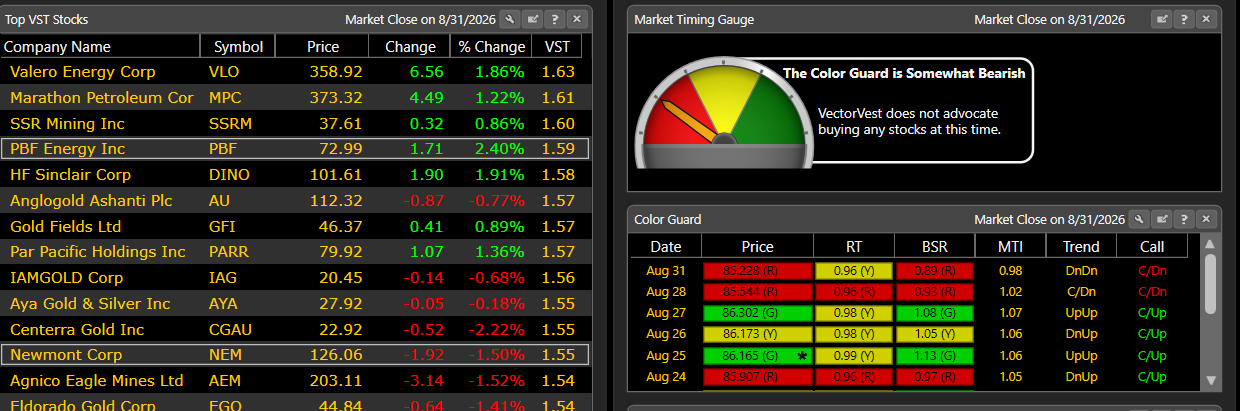
Key catalysts this week include expected contract signings in Caracas or Houston. Risks include Venezuelan legal and political challenges to 100-year concessions, execution delays from dilapidated infrastructure, oil-price volatility affecting the $200 billion royalty forecast, and scrutiny of NABEP’s ownership history. Production ramps will take years, not months, even with capital. Investors should track EIA import data, Baker Hughes rig counts in Venezuela, and official output figures rather than headline reserve numbers alone.
The fact sheet frames the pact as private-sector-led recovery paired with U.S. energy security. Delivery will depend on whether the new hydrocarbons framework, U.S. governance overlays, and incoming operators can actually lift barrels from fields that have been neglected for decades.
What is not covered in the White House Fact Sheet is how this affects global oil markets, including China, Canada, the UK, and even the EU. Stu Turley will be covering that portion of the article on the next Energy News Beat Stand Up. The Future of OPEC and OPEC+ is now in question, with the UAE already leaving, Iraq seeking to more than double its production quota, and Venezuela now considering leaving. It also sparks the question: will there be an American answer, including North and South America, to OPEC, and how will it shape out? But that is for a different article.
Appendix: Sources and Links
- White House Fact Sheet (Aug. 31, 2026): https://www.whitehouse.gov/fact-sheets/2026/08/fact-sheet-president-donald-j-trump-announces-historic-oil-agreement-to-secure-american-energy-dominance-and-drive-venezuelas-economic-recovery/
- Related White House fact sheets on Venezuelan oil tariffs (2025), revenue safeguards (Jan. 2026), National Energy Dominance Council (2025).
- Reuters coverage of deal terms, NABEP structure, company signings, and refiners: multiple reports Aug. 28–Sept. 1, 2026 (e.g., https://www.reuters.com/business/energy/white-house-releases-terms-oil-deal-with-north-american-blue-energy-partners-2026-09-01/, https://www.reuters.com/business/energy/firms-including-chevron-ongc-ge-vernova-track-sign-final-pacts-venezuela-sources-say-2026-08-31/, https://www.reuters.com/business/energy/how-are-caracas-washington-structuring-massive-oil-output-deal-2026-08-31/).
- NABEP / PR Newswire statement: https://www.prnewswire.com/news-releases/united-states-government-and-north-american-blue-energy-partners-nabep-reach-historic-deal-to-develop-venezuelas-oil-sector-302866215.html (and Spanish version).
- Chevron asset-swap announcement: https://www.chevron.com/newsroom/2026/q2/chevron-consolidates-venezuela-heavy-oil-position-in-asset-swap
- SLB, Hunt Oil, and Houston IMAGE conference reports (Reuters, Energy News Beat, PDVSA statements).
- Refinery and import data: EIA Refinery Capacity Report; S&P Global, Reuters, Infobae on Texas/Louisiana shares and specific plants (Phillips 66, Valero, Marathon, Chevron Pascagoula statements and cargo data).
- Additional reporting: New York Times, AP, Bloomberg, Politico, WSJ on structure and Betancourt/NABEP; Trump Oval Office comments on Exxon and Chevron.