


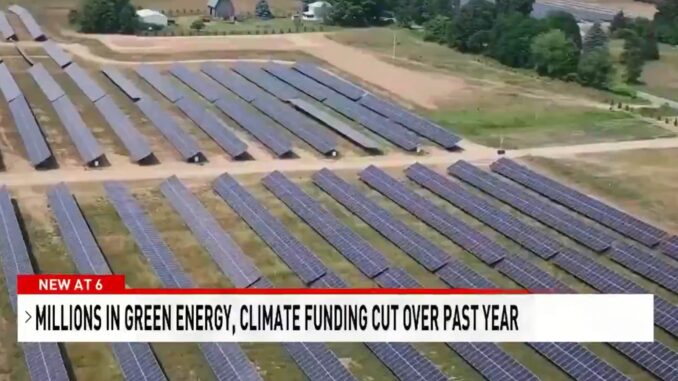
In a bold move aligning with President Trump’s campaign promises, the U.S. Department of Energy and related federal agencies have canceled hundreds of millions in green energy and climate-related funding. This includes a significant $540 million allocated to Michigan, impacting various programs aimed at solar expansion, energy efficiency, and resilience initiatives.
The cancellations, effective since early 2025, have sparked debate over the future of clean energy investments in the state, with advocates warning of economic setbacks while supporters view it as dismantling inefficient “green scams.”Details of the Cancellations in Michigan
The total funding cut for Michigan amounts to just under $540 million across at least seven major programs, plus additional smaller grants.
These were part of broader federal initiatives from the previous administration, including the Inflation Reduction Act and EPA-managed funds. While some programs were administered by the EPA, the overarching rollback has been driven by the Trump administration’s review of clean energy spending, with signals of more cuts to come.
Key canceled programs and amounts for Michigan include:
|
Program
|
Amount
|
Description
|
Recipient/Impact
|
|---|---|---|---|
|
Solar for All
|
$156 million (approx. $170M including related allocations)
|
Expanded solar energy access in low-income and disadvantaged communities, including shared funds for Native American tribes in the Great Lakes region (part of a $62M multi-tribe grant).
|
Michigan Department of Environment, Great Lakes, and Energy (EGLE); Native American tribes.
|
|
Kraft Heinz Facilities Efficiency Project
|
$170 million
|
Multi-state energy efficiency upgrades for facilities, affecting operations in Mt. Pleasant and Grand Rapids.
|
Kraft Heinz (multi-state impact).
|
|
LuxWall Inc. Grant
|
$31.7 million
|
Construction of an energy-efficient window glass factory.
|
LuxWall Inc., Detroit.
|
|
TS Conductor Grant
|
$28.2 million
|
Building a high-capacity power line manufacturing plant.
|
TS Conductor, Erie.
|
|
Ecoworks Grant
|
$20.4 million
|
Converting houses of worship into climate resilience hubs.
|
Ecoworks, Detroit nonprofit.
|
|
Inter-Tribal Council of Michigan Grant
|
$20 million
|
Improving energy efficiency in tribal homes.
|
Inter-Tribal Council of Michigan.
|
|
Southwestern Michigan Planning Commission Grant
|
$20 million
|
Building resilience hubs in Benton Harbor, upgrading low-income housing efficiency, and workforce development.
|
Southwestern Michigan Planning Commission.
|
|
Various Smaller Grants
|
Remaining to total ~$540M
|
Includes funds for climate resilience projects (e.g., $14,000 in west Michigan), energy-efficient housing in Kalamazoo, resilience planning in Flint, and wild rice restoration.
|
Multiple local entities.
|
The Solar for All program stands out as one of the largest single cancellations, with approximately $170 million in total impact when factoring in related tribal allocations.
The Solar for All program stands out as one of the largest single cancellations, with approximately $170 million in total impact when factoring in related tribal allocations.
This EPA initiative, terminated in mid-2025, was designed to provide solar installations for low-income households but has been halted amid the administration’s broader spending review.
These cuts extend beyond grants to include a freeze on a $20 billion federal “green bank” network, which was expected to funnel additional hundreds of millions to Michigan.
Nationally, over $3 billion in planned green investments have been scrapped through reductions in tax credits.
Insights from the Video and Post
The announcement gained attention through a News Channel 3 (WWMT) report featured in a post by former Rep. Jason Isaac (@ISAACforEnergyon X).
President Trump is taking on the ‘green’ scam by canceling hundreds of millions in federal climate handouts — including a whopping $540 million in Michigan alone.
Good. Promises made, promises kept! 🇺🇸 pic.twitter.com/k5L1nhjLiY
— Fmr. Rep. Jason Isaac (@ISAACforEnergy) January 7, 2026
The video, aired in early 2026, highlights the cancellations with visuals of solar farms, wind turbines, auto manufacturing, and EV charging stations—symbolizing the affected sectors. Reporter Remington Hernandez interviews Annabelle Rosser, a senior policy analyst at Atlas Public Policy, who notes the “pretty significant cutback and basically a cancellation of a lot of the obligated grants” from 2024.
Isaac’s post praises the move: “President Trump is taking on the ‘green’ scam by canceling hundreds of millions in federal climate handouts — including a whopping $540 million in Michigan alone. Good. Promises made, promises kept! ” The accompanying video underscores the local impact in areas like Kalamazoo, emphasizing the rollback’s effects on planned projects.
Impacts and Reactions
The cancellations are projected to cause job losses and economic setbacks in Michigan, a state heavily invested in manufacturing and emerging clean energy sectors.
Over 6,000 clean energy jobs have already been delayed or canceled, according to reports. Energy bills for Michiganders could rise without these efficiency upgrades, and communities would miss out on resilience against climate events.
Environmental advocates like Bentley Johnson from the Michigan League of Conservation Voters call the moves “counterproductive,” stating: “They’re making energy bills, which are already really high for Michiganders, continue to go up, and they’re a missed opportunity to help support our communities.”
Rosser adds: “There’s like a pretty significant drop off and a rollback of some of those investments that will lead to job losses and economic losses in the state.”Legally, Michigan Attorney General Dana Nessel has joined a multi-state lawsuit against the cancellations, arguing they “unilaterally and illegally terminated” congressionally approved programs.
Looking AheadAs the Trump administration continues its review of “tens of billions” in clean energy funds, Michigan’s energy landscape faces uncertainty.
While some see this as a necessary correction to wasteful spending, others warn it hampers the state’s transition to sustainable energy. We at Energy News Beat look to this as a redefinition of “Sustainable” Energy. Sustainable as Stu Turley calls for fiscal responsibility on the Energy News Beat podcast. If the energy source can not stand on its own without market subsidies, it should NOT be counted as truly sustainable.
The Energy News Beat will continue monitoring developments in federal energy policy and their local implications.


Be the first to comment