In an increasingly volatile global energy landscape, China—the world’s largest oil importer—relies heavily on discounted crude from sanctioned or geopolitically unstable suppliers to fuel its economy. Venezuela and Iraq together provide a significant portion of these imports, often at below-market prices due to sanctions on Venezuelan oil and competitive pricing from Iraqi heavy crudes. But what if these supplies were cut off?
This article explores China’s oil storage levels, volumes in transit, and whether Russia could step in to fill the gap, amid questions about Moscow’s spare production and shipping capacity.
China’s Reliance on Venezuelan and Iraqi Oil
China’s crude oil imports hit a record 11.55 million barrels per day (bpd) in 2025, driven by low prices and stockpiling amid global oversupply. Venezuela supplied around 470,000 to 642,000 bpd, accounting for about 4.5% of China’s seaborne imports. This oil, often Merey heavy crude, arrived at steep discounts—typically $14–$15 per barrel below Brent, and occasionally up to $21 below—due to U.S. sanctions that limited Western buyers. China absorbed 75–80% of Venezuela’s total exports in 2025, benefiting from the sanctions-evasion ecosystem that kept prices low.
Iraq, a more stable supplier without direct sanctions, provided around 1.2 million bpd in 2025, or about 10–12% of China’s imports. While not as heavily discounted as Venezuelan crude, Iraqi grades like Basrah Heavy offered competitive pricing for China’s independent “teapot” refiners, who process sour, heavy oils on thin margins. Together, these sources delivered approximately 1.7 million bpd of discounted supply—critical for China’s energy security and refining economics.
China’s total oil consumption averaged around 15.2 million bpd in 2025 (based on apparent consumption of 760 million metric tons, converted at approximately 7.3 barrels per ton). Domestic production contributed about 4.2 million bpd, leaving imports to cover the rest. Losing 1.7 million bpd would create a substantial gap, equivalent to roughly 11% of consumption or 15% of imports.
China’s Oil Storage: A Buffer Against Disruption
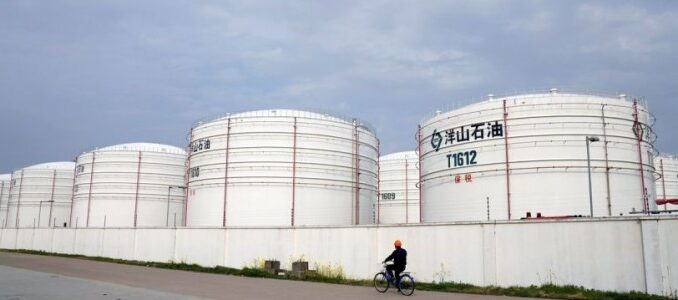
China has aggressively built up reserves in recent years, blending strategic petroleum reserves (SPR) with commercial stockpiles. As of early 2026, total onshore crude inventories stood at approximately 1.2 billion barrels, covering about 104 days of net imports at 2025 levels.
To break this down:
Strategic Reserves: Around 400 million barrels, managed by the government for emergencies.
Commercial Stocks: Approximately 670–800 million barrels, held by refiners and traders, with flexibility for rotation.
If China lost 1.7 million bpd from Venezuela and Iraq, these reserves could theoretically cover the shortfall without depleting all stocks.
Here’s the calculation:Daily gap: 1.7 million bpd.
Total reserves: 1.2 billion barrels.
Days to cover gap (using full reserves): 1,200,000,000 barrels ÷ 1,700,000 bpd ≈ 706 days (about 1.9 years). However, this assumes drawing down everything, which is unrealistic as some stocks are operational minimums.
More conservatively, using only SPR (400 million barrels): 400,000,000 ÷ 1,700,000 ≈ 235 days (about 8 months).
If drawing from total reserves at a sustainable rate (e.g., 50% depletion to maintain buffers): Around 350–400 days.
These figures assume no other supply adjustments. In practice, China would diversify imports while drawing stocks, extending the buffer.
|
Storage Type
|
Estimated Volume (Million Barrels)
|
Coverage of 1.7 mbpd Gap (Days)
|
|---|---|---|
|
Strategic Reserves
|
400
|
235
|
|
Commercial Stocks
|
800
|
471
|
|
Total Onshore
|
1,200
|
706
|
Note: Coverage calculated as Volume ÷ Daily Gap. Real-world drawdown rates would be lower to preserve minimum operational levels.
Oil in Transit: Additional Short-Term Cushion
Beyond onshore storage, China benefits from oil already en route. Estimates vary, but significant volumes of sanctioned crude float on tankers or in bonded storage. For Venezuelan oil alone, 43–52 million barrels were heading east in early 2026. Adding Iranian and other sources, total oil in transit or floating storage destined for China could reach 100–200 million barrels.
To estimate: Assuming 150 million barrels in transit (a midpoint based on Venezuelan 50 million + Iranian 170 million floating, prorated for China-bound shares).
Coverage of 1.7 mbpd gap: 150,000,000 ÷ 1,700,000 ≈ 88 days (about 3 months).
This in-transit volume acts as an immediate buffer, buying time for rerouting or new purchases. Calculation: Total transit volume ÷ daily gap provides the days until exhaustion, assuming no new shipments.
Can Russia Pick Up the Slack?
Russia has become China’s top oil supplier, exporting around 2 million bpd in 2025—about 20% of China’s imports. Deliveries surged to 2.07–2.1 million bpd in early 2026 as India reduced purchases under U.S. pressure. Russian crude, often ESPO or Urals grades, arrives at discounts of $5–$6 per barrel below Brent, making it a viable substitute for Venezuelan volumes.
However, Russia’s ability to fully compensate for a 1.7 million bpd loss is limited:
Spare Production Capacity: Russia produced 9.3–9.6 million bpd in 2025–2026, constrained by OPEC+ quotas (current quota: 9.57 million bpd). Spare capacity is estimated at 0.3–0.5 million bpd, far short of 1.7 million. Global OPEC+ spare is mostly in Saudi Arabia and the UAE (2.5 million bpd combined), not Russia. To calculate potential increase: If Russia boosts by 0.5 million bpd (optimistic, ignoring quotas), it covers only 29% of the gap (0.5 ÷ 1.7 ≈ 0.29).
Shipping Constraints: Russia’s exports rely on a “shadow fleet” of aging tankers to evade sanctions, with 68% of crude carried by such vessels in January 2026. Shifting more to China means longer routes—especially for Urals from western ports (via Suez or around Africa), increasing costs and delays. Kozmino terminal (eastern exports) is near capacity, limiting ESPO growth. Recent ship-to-ship transfers in the Red Sea highlight adaptations, but freight rates have risen, and vessel availability is strained. If Russia diverts 0.5 million bpd more to China, shipping bottlenecks could add $2–$5 per barrel in costs, eroding discounts.
In summary, Russia could realistically add 0.3–0.5 million bpd short-term, covering 18–29% of the gap.
Full replacement? Unlikely without violating OPEC+ or major infrastructure upgrades, which could take years.
|
Factor
|
Russia’s Current Exports to China (mbpd)
|
Potential Increase (mbpd)
|
Coverage of 1.7 mbpd Gap (%)
|
|---|---|---|---|
|
Production Spare
|
2.0
|
0.3–0.5
|
18–29
|
|
Shipping Constraints
|
Limited by shadow fleet and routes
|
Adds costs/delays
|
Reduces effective capacity
|
Note: Increase estimated from Russia’s ~0.4 mbpd average spare under quotas. Coverage = Increase ÷ 1.7 mbpd × 100.
Long-Term Implications and Survival Timeline
Get your CEO on the #1 Energy Podcast in the United States: https://sandstoneassetmgmt.com/media/
Is oil and gas right for your portfolio? https://energynewsbeat.co/invest/