


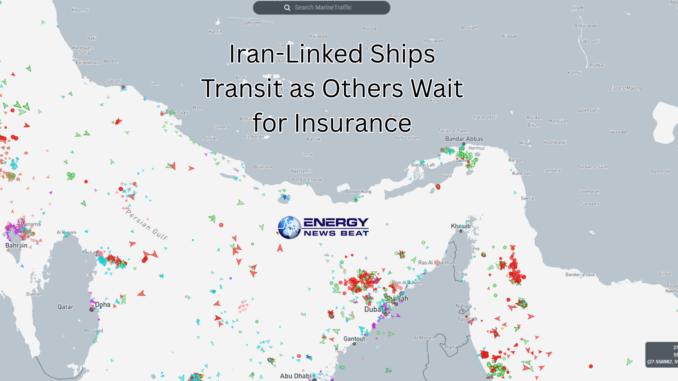
In the midst of escalating tensions in the Middle East, the Strait of Hormuz— a critical chokepoint for global energy supplies— remains largely impassable for most commercial vessels. As of March 7, 2026, only Iran-linked ships are braving the waters, while hundreds of others linger in limbo, awaiting resolution to a burgeoning insurance crisis. This bottleneck, exacerbated by the ongoing 2026 Iran war involving U.S.-Israeli strikes and Iranian retaliations, threatens to drive oil prices skyward and strain the global economy to its limits.
The Current Standstill in the Strait
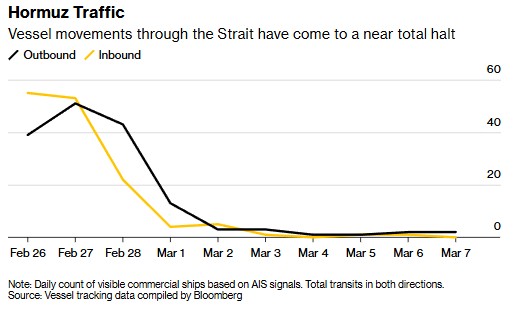
According to the latest Hormuz Tracker from Bloomberg, the strait has been at a near standstill for the sixth consecutive day.
In the past 24 hours, only two Iran-linked vessels have transited: one U.S.-sanctioned supertanker departing the Persian Gulf and one liquefied petroleum gas (LPG) carrier entering the strait. We are tryting to track that one now, but its transponders went dark.
No other large vessels have made the crossing, highlighting a stark divide between ships affiliated with Iran and the rest of the international fleet.
This comes on the heels of a dramatic drop in tanker transits, which fell to zero by March 3, 2026, creating a backlog of over 150 vessels, including oil and LNG tankers, anchored and unable to proceed.
Since that date, the total number of ships that have successfully transited the strait appears minimal—largely limited to a handful of Iran-linked vessels that are willing or able to navigate the risks without standard international insurance coverage. Attacks attributed to Iran’s Islamic Revolutionary Guards Corps (IRGC), including missile strikes on U.K. and U.S.-linked tankers, have further deterred traffic, with at least three tankers damaged and one seafarer killed in recent incidents.
The strait, through which about a fifth of the world’s oil and gas flows, is effectively experiencing a “de facto closure” due to these combined physical and financial threats.
The Insurance Crisis Fueling the Delay
At the heart of this impasse is a maritime insurance meltdown. War-risk premiums for transits through the Strait of Hormuz have skyrocketed from 0.05–0.15% to 0.3–0.7% or higher of a vessel’s hull value, adding hundreds of thousands of dollars per voyage.
Major mutual marine insurers, such as Gard, Skuld, NorthStandard, the London P&I Club, and the American Club, have canceled coverage for Gulf operations, leaving tankers without viable protection against potential attacks.
Lloyd’s of London has expanded its “high-risk” designations, issuing 72-hour cancellation notices and further hiking premiums.
The Trump administration has stepped in with a proposed $20 billion U.S. reinsurance program through the International Development Finance Corporation (DFC), aimed at providing political risk guarantees to encourage transits.
However, details are still pending, and industry sources indicate it could take several weeks to finalize and implement this untested “American system.”
Given the bureaucratic hurdles and the need for coordination with underwriters, I estimate it might require 2-4 weeks for the program to become operational enough to restore confidence among shippers. Until then, most vessels will likely remain sidelined, as operators hesitate to rely on incomplete assurances amid evolving threats.
Oil Prices on the Brink
Brent crude has already surged above $89 per barrel as of March 6, 2026, reflecting the immediate market jitters from the crisis.
If the strait remains inaccessible, oil prices are poised to climb further, potentially testing $100 per barrel in the near term and surging to $150 within two to three weeks, as warned by Qatar’s Energy Minister.
This escalation would stem from halted productions—such as Kuwait shutting down oilfields due to overflowing storage—and broader force majeure declarations that could halt all Gulf exports.
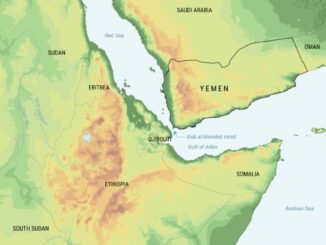
Compounding factors include a 65% drop in Red Sea shipping volumes by mid-2025 due to related Houthi attacks, which have already inflated freight rates by 50–100%.
While global markets are currently “very well supplied” with hundreds of millions of barrels afloat outside the Gulf, prolonged disruptions could trigger shortages, spiking Europe’s gas prices and eroding GDP worldwide.
The Ticking Clock for the Global Economy
The ripple effects of this crisis extend far beyond energy markets. Persistent blockages could lead to global shortages, factory shutdowns, and inflationary pressures within weeks.
At $150 oil, experts predict severe economic downturns, with potential GDP erosion and widespread disruptions.
However, talk of a full “economic collapse” is alarmist; the global economy has buffers like strategic reserves and alternative routes, though they’re costly and limited.That said, if the insurance issues aren’t resolved and transits don’t resume within the next month, we could see cascading effects: energy rationing in vulnerable regions, supply chain breakdowns, and a recessionary spiral. Based on historical precedents like the 1970s oil shocks, the world might have 1-3 months before these pressures culminate in a major economic contraction, assuming no diplomatic breakthroughs or military escalations worsen the situation. The Trump administration’s swift action on reinsurance will be pivotal in averting the worst outcomes.As the Energy News Beat continues to monitor this unfolding story, the world watches the Strait of Hormuz with bated breath. Will insurance lifelines arrive in time, or will Iran-linked ships remain the sole navigators of this vital artery? Stay tuned for updates.
Sources: theenergynewsbeat.substack.com, bloomberg.com, marinetraffic.com.
Get your CEO on the #1 Energy Podcast in the United States: https://energynewsbeat.co/energy-news-beat-media-kit/
Is oil and gas right for your portfolio? https://energynewsbeat.co/invest/


Be the first to comment