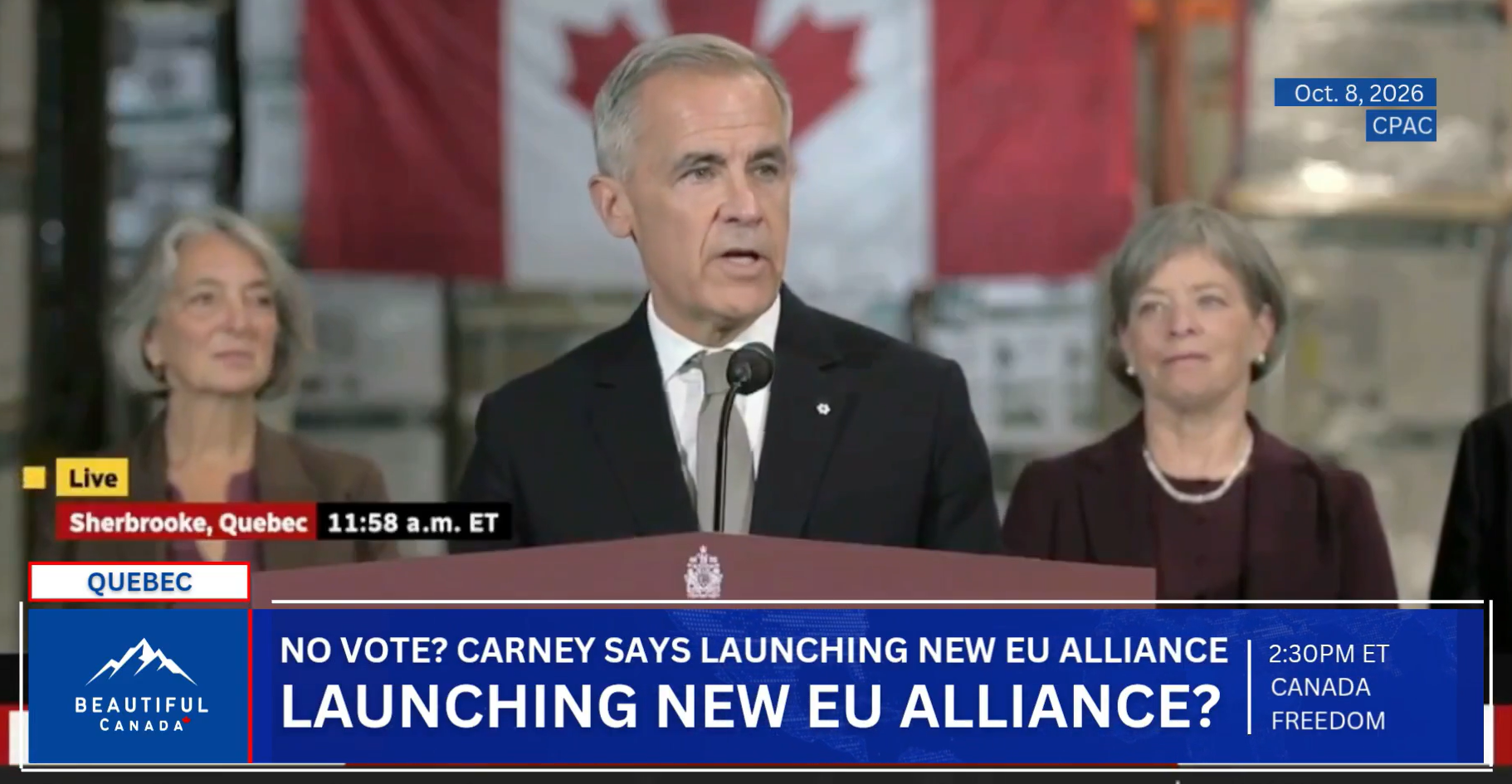
Prime Minister Mark Carney is moving ahead with a new Canada-EU “alliance” to be launched at the Canada-EU summit in Montreal on October 29-30, 2026. In an October 8 appearance in Sherbrooke, Quebec, he framed the step as advancing the relationship European Commission President Ursula von der Leyen floated on September 16—Canada as the EU’s first “associate member.” The status does not exist in the EU treaties. Carney has repeatedly said Canada is neither seeking nor positioned for full membership. Critics, including the post circulating the Sherbrooke clip, note that no parliamentary vote or election mandate has addressed the arrangement.
The practical question for energy and manufacturing is narrower than the headline. Roughly 70 percent of Canadian goods exports still go to the United States. Any EU deal is an attempt to diversify around a trade war that has already produced 25–50 percent U.S. tariffs on selected Canadian goods, collapsed formal talks in August 2026, and left the USMCA/CUSMA unreformed. Job losses already visible in autos and parts are driven by that U.S. friction, not by an unsigned European association whose rights and obligations remain undefined.
What “associate member” actually means
Von der Leyen’s September 16 State of the European Union address, delivered with Carney in the chamber, proposed moving beyond the existing Comprehensive Economic and Trade Agreement (CETA, provisionally applied since 2017) to an “Alliance for the Future.” Areas listed include intelligent manufacturing, a tech alliance, integrated defense industrial bases, an Arctic flagship project, energy, critical minerals, batteries, AI, quantum, and economic security. Carney’s September 17 reply in Strasbourg welcomed the ambition while stressing Canada would not become a full member, and that substance mattered more than the label. He highlighted LNG and hydrogen for European energy security, critical minerals, digital trade in non-agricultural goods, financial-services integration, and youth mobility via Erasmus+.
EU officials and analysts (Council on Foreign Relations, Politico, Euronews, Squire Patton Boggs) note that Article 49 TEU limits formal accession to European states, so a new legal vehicle—most likely an association agreement under Article 217 TFEU—would have to be invented. Precedents such as the European Economic Area give market access in exchange for adopting EU rules without a vote. Carney’s public list is sectoral rather than wholesale single-market entry. Ten EU member states have still not ratified CETA. The October Montreal summit is expected to begin defining the bargain. Canadian Conservatives have already drawn a line against EU taxes, laws, or open-border policies. No public cost-benefit study has quantified net Canadian employment from the associate track itself, because the obligations are not yet written.
Trump’s statements and the energy carve-out
President Trump called the associate-member idea “laughable” on September 16 and warned that if he judged it a hostile act he would impose “very serious tariffs or stop trading with Europe on many things.” He has separately described Canada as taking advantage of prior U.S. policy, said past leaders allowed cars to be built offshore, including in Canada, and stated he wants “no Canadian cars.” White House fact sheets and proclamations under Section 338 of the Tariff Act of 1930 (July and August 2026) imposed additional 50 percent tariffs on selected Canadian goods (alcohol, dairy, certain manufactured items) while explicitly exempting energy, potash, products already covered by Section 232, and certain critical minerals. Energy has faced a lower 10 percent rate in earlier actions, with USMCA-compliant crude often preferential. Canadian retaliation (15–50 percent on roughly C$27.6 billion of U.S. goods from September 8) has likewise left crude outside the fight.
Oil is the sector most likely to be left alone
Canada exported a record roughly 4.3 million barrels per day of crude in 2025, with about 3.9 million bpd (just over 90 percent) going to the United States; U.S. imports of Canadian crude averaged just over 4 million bpd in the first half of 2026. Canadian oil accounts for more than 60 percent of U.S. crude imports. Midwest and Gulf Coast refineries are configured for heavy Canadian barrels; rapid substitution is limited. Canada’s alternative outlets (Trans Mountain expansion and proposed further Pacific capacity) are growing but still secondary. Both sides have strong incentives to keep the crude trade outside the tariff war. A total U.S. shutoff of Canadian oil—politically and commercially unlikely—would force large discounts on Canadian barrels, idle or curtail oil-sands output, and raise feedstock costs for U.S. refiners. Direct oil-and-gas extraction employment has already fallen even as production rose (Statistics Canada series around 55,000–65,000 in recent years versus higher peaks a decade earlier; broader Alberta energy-sector employment near 161,000 in 2024 data). A prolonged shutdown would amplify those losses through services and construction, but neither government has treated energy as the lever of choice.
Autos and trucks: integrated, already under pressure
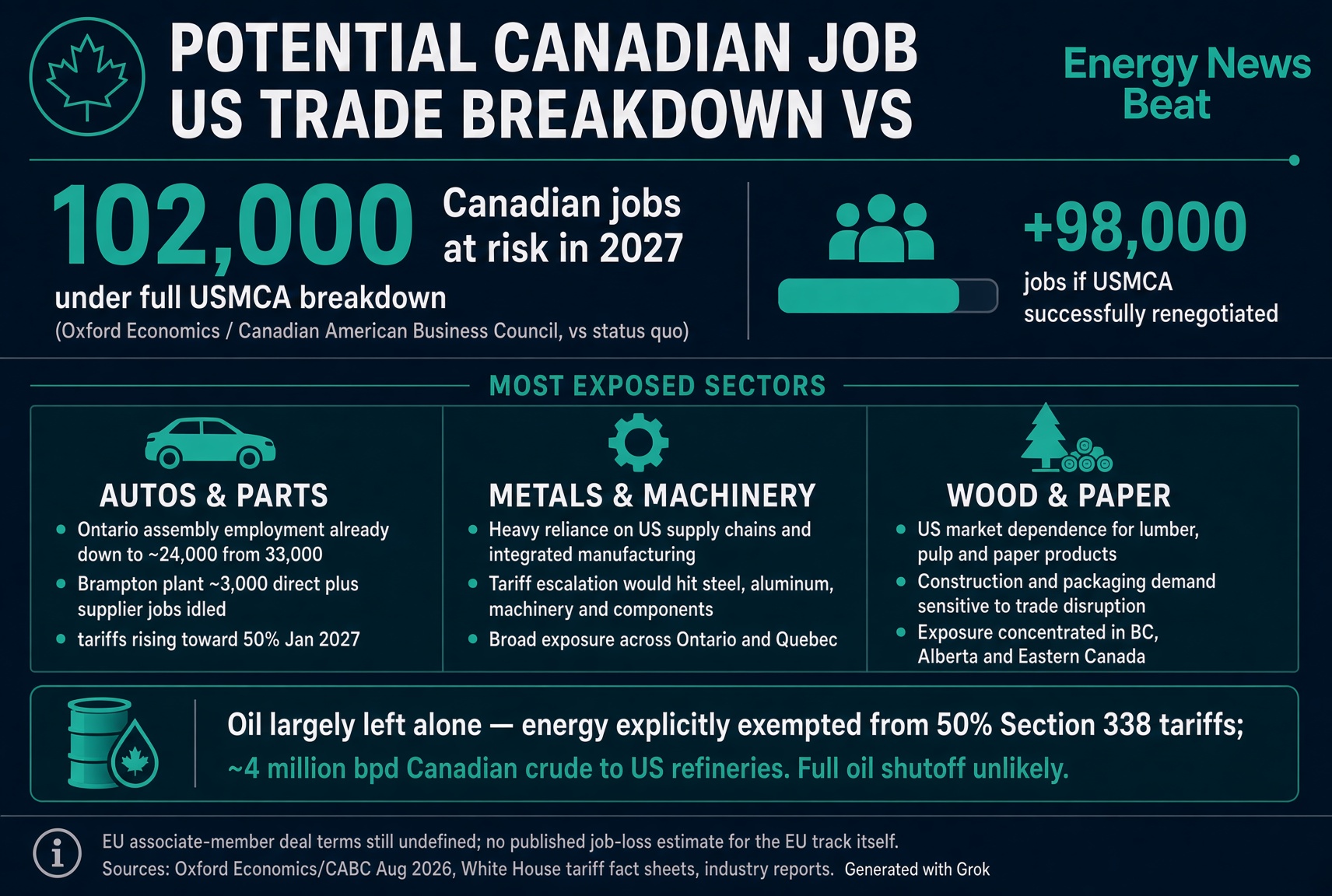
North American vehicle and parts production is deeply integrated; components routinely cross the border multiple times. Canadian light-vehicle production fell to about 1.2 million units in 2025 from 2.3 million in 2016, with assembly employment down from roughly 32,700 (2015) to 23,700 (2024) before further tariff-related cuts. Ontario motor-vehicle, body, trailer and parts manufacturing employed about 148,300 people in 2024. Detroit Three plants have absorbed the largest hits: GM ended or shifted Silverado light-duty work and closed the BrightDrop van plant; Stellantis idled Brampton (thousands of workers on layoff, with supplier estimates of 9,000–10,000 dependent jobs when the plant ran at capacity); Ford’s Oakville line has been in extended retooling. Toyota and Honda plants have been more stable. Unifor and industry groups cite local multipliers of five to six spinoff jobs per assembly job in places such as Brampton—useful for community impact, less precise for national aggregates.
U.S. Section 232 auto tariffs (25 percent on non-U.S. content of USMCA-compliant vehicles, producing effective rates often estimated in the mid-teens) are scheduled to rise toward 50 percent on Canadian cars, trucks and parts from January 1, 2027, under statements from the administration. The Canadian Vehicle Manufacturers’ Association has said flatly that without U.S. access there is no Canadian auto industry at scale. An EU associate arrangement could open defense-procurement or critical-minerals channels and might eventually support some manufacturing diversification, but the EU already has a large, protected auto sector and its own emissions and carbon-border rules. It is not a ready replacement for the U.S. light-vehicle market. Rules-of-origin or regulatory alignment costs could add friction for plants that also serve North America.
The low-probability total shutoff
A complete U.S. cutoff of Canadian goods is not the base case—energy exemptions, refinery dependence, and mutual services surpluses argue against it—but analysts have modeled severe breakdowns. An August 2026 Oxford Economics study prepared for the Canadian American Business Council compared scenarios around the USMCA review. Relative to a status-quo tariff path, a full USMCA breakdown was projected to cost about 102,000 Canadian jobs and 214,000 U.S. jobs in 2027, with a cumulative Canadian GDP hit on the order of C$271 billion by 2035. Ontario and Quebec manufacturing (autos, metals, machinery, wood, paper) absorb the largest shares. Successful renegotiation was modeled to add roughly 98,000 Canadian jobs versus the status quo. Statistics Canada has already recorded payroll declines in transportation-equipment manufacturing after tariffs began. KPMG surveys in 2026 found 42 percent of Canadian manufacturers had moved or were considering moving some production to the United States.
Those figures capture tariff escalation and agreement collapse, not the incremental effect of an EU associate deal. No equivalent published calculation isolates job losses “caused by” signing the European arrangement, because the text, sectoral coverage, financial contributions, and regulatory obligations do not yet exist. The larger employment risk remains failure to stabilize the U.S. relationship while the EU track is negotiated over years.
Bottom line
Oil volumes are the element both capitals have so far chosen to protect; a total energy shutoff would be mutually expensive and is the least likely escalation. Auto and parts employment is already contracting under existing and scheduled U.S. tariffs and is the sector most exposed if North American rules of origin fracture further. An EU associate framework, if it materializes as a lighter sectoral pact rather than EEA-style rule-taking, is unlikely by itself to destroy large numbers of Canadian jobs and could support critical-minerals and LNG optionality. It also cannot quickly replace the U.S. market that still dominates Canadian goods trade. The employment numbers that analysts have actually calculated attach to the U.S. tariff and USMCA scenarios, not to the still-undefined Montreal summit outcome.
Several things kick into high gear. Alberta and other provinces leaving are more likely; more jobs move to the US than we estimate, and we leave NATO over this. – Just an opinion, but there are indicators.
Check out the World’s Greatest Podcast Show Notes at EnergyNewsBeat.co or EnergyNewsBeat.com. And subscribe to: The Energy News Beat Substack.
Appendix: Sources and links
- X post and quoted Sherbrooke clip (Oct. 8, 2026): https://x.com/TheBuckYouWill/status/2108276664618893483
- CPAC, Carney Sherbrooke news conference (Oct. 8, 2026): https://www.cpac.ca/headline-politics/episode/pm-mark-carney-makes-an-announcement-in-sherbrooke-que
- BBC, Carney welcomes EU associate-member ambition (Sept. 17, 2026): https://www.bbc.co.uk/news/articles/cwly7vkke4jxo
- Council on Foreign Relations, “Membership Without Membership” (Sept. 18, 2026): https://www.cfr.org/articles/membership-without-membership-what-can-europe-really-offer-canada
- Euractiv / Fox Business, Trump “laughable” and tariff warning (Sept. 16, 2026): https://www.euractiv.com/news/trump-threatens-to-cut-eu-trade-over-canada-association-plan/ ; https://www.foxbusiness.com/politics/trump-calls-canadas-potential-eu-associate-membership-laughable-warns-europe-very-heavy-tariffs
- White House fact sheet, Section 338 tariffs and energy exemption (July 20, 2026): https://www.whitehouse.gov/fact-sheets/2026/07/fact-sheet-president-donald-j-trump-imposes-additional-tariffs-on-canada/
- OilPrice.com and Yahoo Finance on energy exemption and volumes (Aug.–Sept. 2026): https://oilprice.com/Energy/Crude-Oil/Canadian-Oil-Pushes-Deeper-Into-US-Gulf-Coast-Market.html ; https://finance.yahoo.com/energy/article/in-us-canada-trade-spat-washington-left-out-a-key-lever-canadian-oil-090000999.html
- Forbes, bilateral oil imperative (Aug. 25, 2026): https://www.forbes.com/sites/davidblackmon/2026/08/25/a-uscanada-trade-war-would-bring-dire-impacts-on-oil-trade/
- CBC, Oxford Economics / Canadian American Business Council USMCA scenarios, 102,000 Canadian jobs (Aug. 11, 2026): https://www.cbc.ca/news/business/trade-renegotiation-impact-report-9.7303374
- Globe and Mail and industry reporting on Oshawa, Brampton, production and employment trends (2026): https://www.theglobeandmail.com/business/article-gm-confirms-end-of-light-duty-silverado-in-oshawa-boost-heavy-duty/
- Statistics Canada employment trends in U.S.-dependent industries: https://www150.statcan.gc.ca/n1/pub/36-28-0001/2025012/article/00003-eng.htm
- TD Economics Canadian auto outlook (Feb. 2026): https://economics.td.com/ca-auto-outlook-update
- Politico explainer on associate membership mechanics (Sept. 18, 2026): https://www.politico.eu/article/friends-with-benefits-eu-associate-membership-explained/