In a groundbreaking move for North America’s energy and critical minerals sector, REAlloys Inc. has merged with Blackboxstocks Inc. (NASDAQ: BLBX), paving the way for the continent’s first commercial-scale heavy rare earth refinery. This merger, combined with a strategic partnership with the Saskatchewan Research Council (SRC), marks a significant step toward reducing dependency on foreign rare earth supplies, particularly from China. The deal not only bolsters domestic production capabilities but also aligns with upcoming U.S. procurement regulations set to take effect in 2027.
The Merger and Partnership Details
The merger between REAlloys and Blackboxstocks was formalized through a definitive agreement earlier this year, with REAlloys valued at approximately $400 million. Under the terms, Blackboxstocks shareholders will retain about 7.3% of the combined company’s common shares post-merger.
This transaction transforms Blackboxstocks, traditionally a fintech platform focused on AI-driven stock analytics, into a key player in the rare earth industry. Central to the deal is REAlloys’ historic partnership with the SRC, announced on December 8, 2025. REAlloys will invest around $21 million to expand SRC’s Rare Earth Processing Facility in Saskatoon, Saskatchewan. This expansion will triple the facility’s heavy rare earth throughput—focusing on elements like dysprosium (Dy) and terbium (Tb)—and increase neodymium-praseodymium (NdPr) metal output by 50%.
The upgraded plant will integrate monazite processing, AI-controlled separation, and metal production, with commercial operations slated to begin in early 2027.
REAlloys has secured an 80% long-term offtake agreement for the expanded output, positioning it as the primary supplier of these critical materials.
Projected annual production includes up to 30 tonnes of dysprosium oxide, 15 tonnes of terbium oxide, and 400-600 tonnes of high-purity NdPr metal.
This setup complements REAlloys’ broader ecosystem, including upstream resources from the Hoidas Lake deposit in Saskatchewan (with 2.15 million tonnes of measured and indicated total rare earth oxides) and downstream magnet production at its Euclid facility in Ohio.
Adding to the momentum, REAlloys received a $200 million Letter of Interest from the U.S. Export-Import Bank (EXIM) in October 2025 to support its integrated mine-to-magnet strategy.
This non-binding commitment underscores the deal’s strategic importance for national security and industrial resilience.
Financial Impact of the Merger
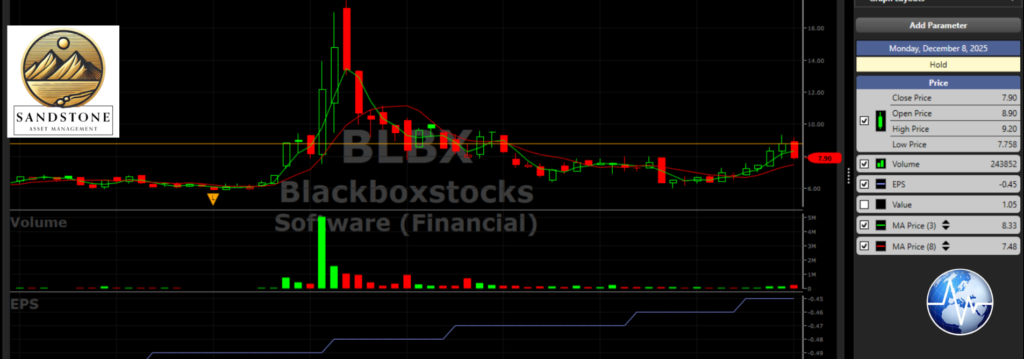
Financially, the merger injects significant value into Blackboxstocks. REAlloys’ $400 million valuation dwarfs Blackboxstocks’ prior market cap, potentially driving substantial upside for the combined entity.
The $21 million investment in SRC’s expansion is funded through REAlloys’ resources, with the offtake model operating on a cost-plus basis to ensure profitability.
Recent market reactions have been positive; Blackboxstocks’ stock (BLBX) saw a 2.5% pre-market bump to $9.24 following the SRC partnership announcement, amid a low float of around 4 million shares.
The EXIM funding could unlock further capital for scaling, reducing dilution risks and enhancing cash flow from rare earth sales. However, as with any resource-based venture, fluctuations in rare earth prices—driven by global demand for EVs and renewables—could influence short-term financials.
Overall, the deal creates a vertically integrated operation with projected revenues from high-margin heavy rare earths, which are essential for advanced magnets and command premiums due to their scarcity.
What This Means for Investors
For investors, this merger represents a high-growth opportunity in the burgeoning rare earth market, projected to expand amid the global energy transition. Blackboxstocks shareholders gain exposure to a sector critical for U.S. defense and clean energy, with REAlloys positioned as a first-mover in North American heavy rare earth production.
The alignment with 2027 U.S. procurement rules—barring sourcing from China, Russia, Iran, or North Korea—ensures a captive market for compliant suppliers.
This could lead to long-term contracts with the Department of Defense, automakers, and tech firms, stabilizing revenue streams. Recent X discussions highlight investor excitement, with posts noting the deal’s potential to boost BLBX’s valuation through secure supply chains.
Risks include execution delays in facility upgrades and regulatory hurdles, but the EXIM support and SRC’s proven expertise mitigate these. Savvy investors may see this as a play on geopolitical shifts, with potential for significant returns as North America ramps up domestic production.
Implications for Consumers
Consumers stand to benefit from a more resilient supply of rare earth-dependent products. Heavy rare earths like dysprosium and terbium enhance magnet performance in electric vehicles, wind turbines, medical devices, and satellites, improving efficiency and durability under extreme conditions.
By localizing production, the merger could stabilize prices and reduce shortages caused by export restrictions from dominant suppliers like China. End-users in industries such as automotive and renewable energy may see lower costs over time, fostering innovation in green technologies. For everyday consumers, this translates to more affordable EVs, reliable renewable power, and advanced electronics without the vulnerabilities of global supply disruptions.
Broader Impact on US and Canada Rare Earth Supply Chains
This merger profoundly strengthens the rare earth supply lines for the U.S. and Canada, addressing a long-standing midstream gap where raw materials have been shipped overseas for processing.
North America has lacked commercial-scale heavy rare earth refining for nearly two decades, forcing reliance on foreign refineries—primarily in China, which controls over 80% of global supply. The SRC facility, as the continent’s first fully integrated site for separation and metallization, creates a “zero China nexus” chain compliant with U.S. national security rules.
This fosters cross-border collaboration, with Canadian resources feeding U.S. manufacturing, enhancing bilateral energy security. It also positions Saskatchewan as a global leader in rare earths, potentially attracting further investments.
Long-term, the deal narrows vulnerabilities in defense, aerospace, and clean energy supply chains, supporting reindustrialization efforts. As REAlloys plans its own larger plant in Saskatoon—targeting 200 tonnes of Dy metal, 85 tonnes of Tb metal, and 2,700 tonnes of NdPr annually—the combined output could meet a substantial portion of North American demand.
In summary, this M&A deal isn’t just a corporate transaction—it’s a strategic pivot toward self-sufficiency in critical minerals. As production ramps up in 2027, expect ripple effects across energy markets, investor portfolios, and consumer technologies, solidifying North America’s role in the global rare earth landscape.
Want to get your story in front of our massive audience? Get a media Kit Here. Please help us help you grow your business in Energy.

https://energynewsbeat.co/request-media-kit/