Russia is extending its gasoline export restrictions through the end of 2026 while signaling that its temporary diesel export ban will be lifted once domestic markets stabilize, according to Deputy Prime Minister Alexander Novak. Speaking in Omsk on July 25, 2026, Novak said the diesel restrictions—imposed amid severe domestic fuel shortages—will be removed “in due course” to avoid a glut that could force refiners to cut runs.
The diesel ban took effect around July 8, 2026 (initially through July 31), following Ukrainian drone strikes that damaged significant portions of Russia’s refining capacity. Those attacks left large parts of the system offline at times (reports indicated more than a third to nearly 60% of capacity affected in peaks), triggering widespread shortages, long queues at fuel stations, and the need for Russia to import some products. Gasoline and jet fuel export curbs were already in place earlier.
Russia’s Role in Global Diesel, Gasoline, and Jet Fuel Exports
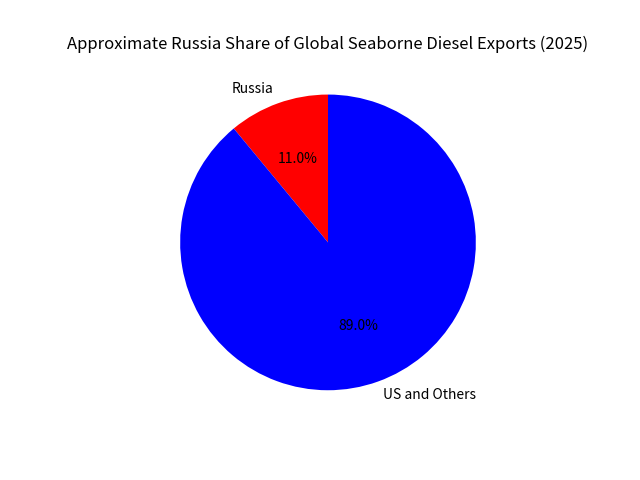
Russia ranks as the world’s second-largest diesel exporter after the United States. In 2025, Russian diesel exports averaged roughly 805,000 barrels per day (about 293.9 million barrels for the year). One estimate put Russia’s share of global seaborne diesel exports at around 11% that year. Volumes had already declined sharply before the full ban: loadings averaged about 400,000 b/d in June 2026 and fell further to the 200,000–234,000 b/d range in early July.
Gasoline exports from Russia have historically been smaller relative to diesel and were already restricted earlier in 2026. Russia is not a dominant global gasoline supplier. Jet fuel (kerosene-type) exports were modest—averaging around 30,000 b/d in 2025 (less than 2% of global supplies) and falling further in 2026 before a ban through late November. Overall, Russia accounted for roughly 7% of global petroleum product exports in recent pre-crisis data (around 1.9 million b/d total products in one earlier benchmark year).
The diesel market is the most consequential for global trade. Diesel constitutes a large share of oil product demand for transport, agriculture, industry, and power generation in many regions.
Main Customers for Russian Diesel
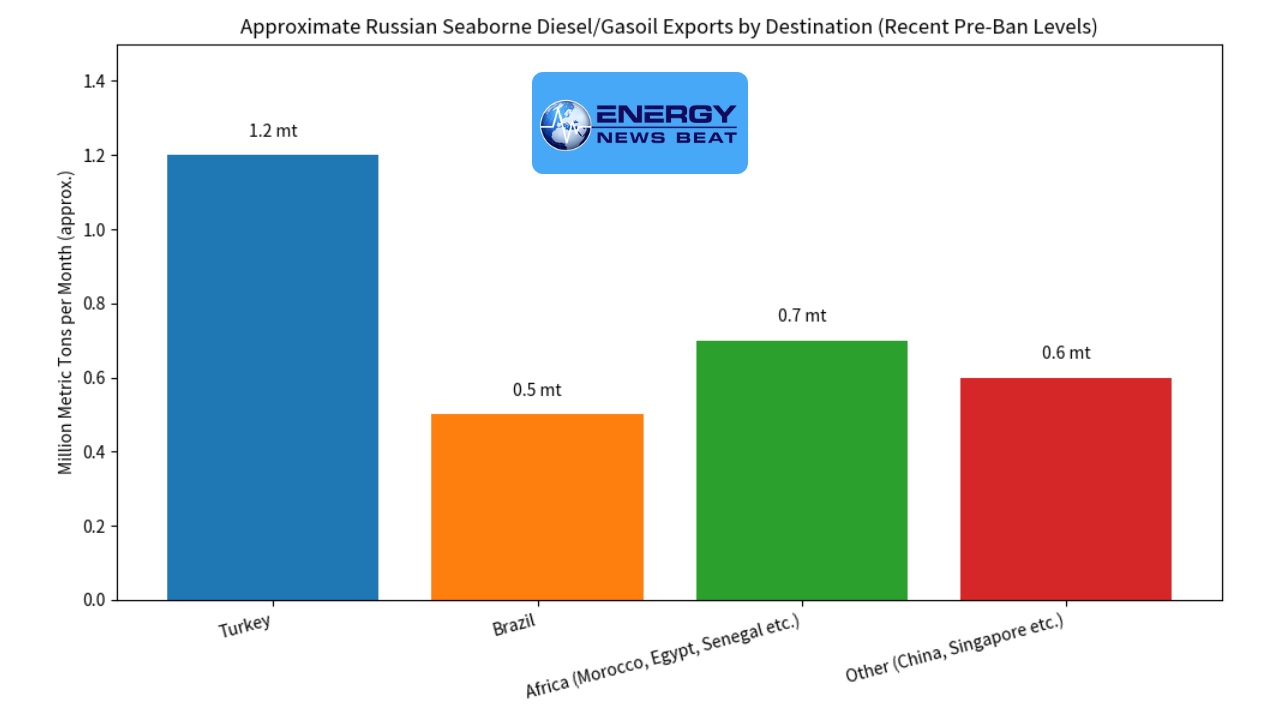
Post-2022 EU embargo on Russian oil products, Russian seaborne diesel and gasoil shifted heavily toward non-European buyers. Turkey and Brazil have been the dominant destinations, often taking a combined majority of available cargoes in recent months. African countries (including Morocco, Egypt, Senegal, Libya, Ghana, and others) form another key group, with smaller volumes to places such as China, Singapore, and others.
Approximate pre-ban monthly seaborne patterns (drawing from shipping data around 2025–early 2026, when monthly totals were frequently in the 3–3.5 million metric ton range before the sharp 2026 declines) looked roughly as follows:
Turkey has been especially exposed—reports indicated it sourced a very high share (in some periods the large majority) of its diesel imports from Russia. Brazil has relied on discounted Russian barrels to offset limited domestic refining capacity. African importers use the fuel for power generation, transport, and industry.
Impact of the Ban on Customers
The ban removes a major incremental supply source at a time when global diesel markets were already tight due to post-COVID demand recovery, Western refinery closures, and other geopolitical pressures. Customers must compete harder for cargoes from the United States, Middle East, India, and elsewhere. This has driven sharp rises in European diesel cracks and futures prices, with knock-on effects worldwide even in markets that do not buy Russian fuel directly.
Turkey: Faces the most direct pressure given high dependence. Higher import costs add to inflation and economic strain; some reports noted shifts toward Indian supplies.
Brazil and Latin America: Increased competition raises costs for farmers (planting/harvest seasons) and industry. Brazil has historically alternated between Russian and U.S. barrels.
Africa: Power generation and transport sectors are vulnerable to price spikes and potential shortages.
Indirect effects on Europe and others: Former Russian buyers bid away cargoes that might otherwise go to Europe or other regions, tightening Atlantic Basin balances. Neighboring countries reliant on Russian rail or pipeline product flows (e.g., parts of Central Asia) also feel pressure.
Russia itself risks refinery run cuts if domestic diesel builds up excessively once the immediate shortage eases, which is why Novak emphasized a timely lift of the ban. Gasoline restrictions remaining through year-end reflect ongoing domestic tightness in that product.Has the U.S. Been Filling the Gap—and Will That Continue?Yes. The United States, the world’s largest diesel (distillate) exporter, has supplied many of the same markets and others displaced by earlier shifts away from Russian barrels. In 2025, U.S. distillate fuel oil exports averaged around 1.2–1.3 million b/d overall (down slightly year-over-year in some data). Mexico remained the top destination (~220,000 b/d), but Brazil more than doubled to about 103,000 b/d. Europe (Netherlands ~98,000 b/d, UK record ~89,000 b/d) also took strong volumes, alongside other Latin American destinations.
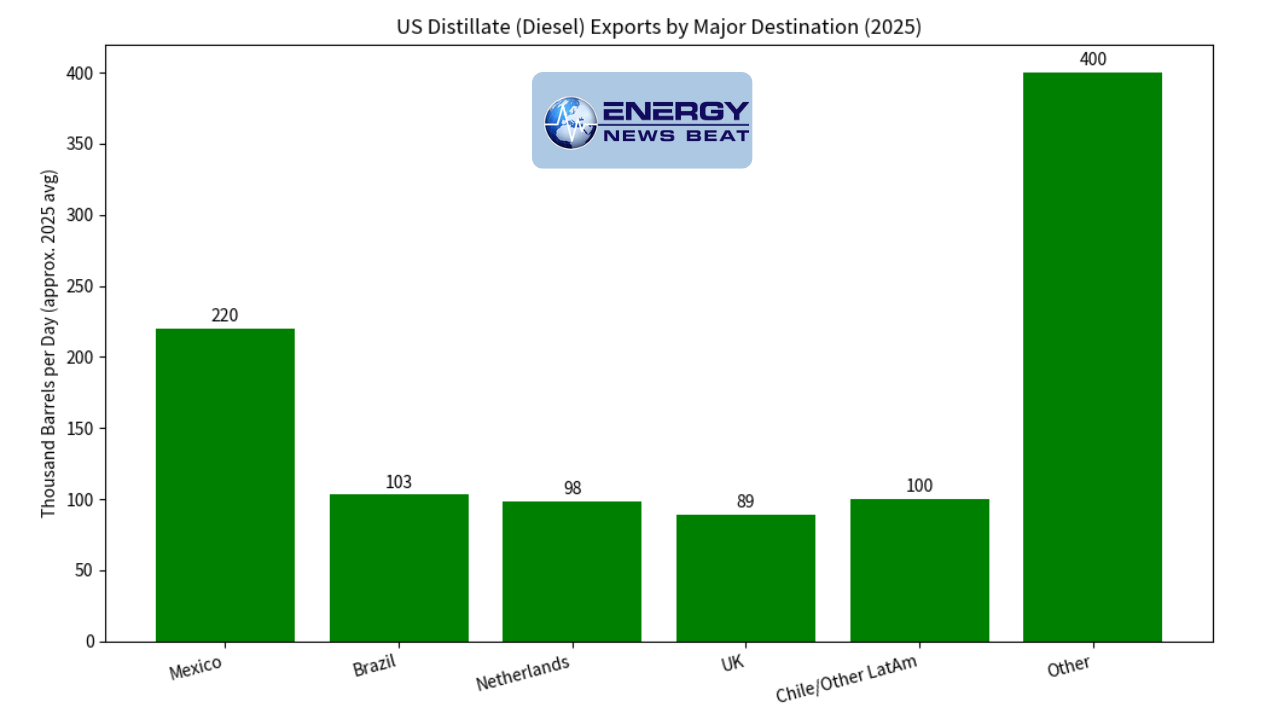
U.S. cargoes have helped offset some lost Russian volumes in Brazil and elsewhere, and the U.S. previously stepped in as a key supplier to Europe during other disruptions. However, U.S. distillate inventories have been below five-year averages in periods of strong export demand, limiting the ability to fully replace 700,000–800,000+ b/d of Russian supply without higher prices or domestic impacts.
Will U.S. shipments stop? Unlikely in the near term. U.S. refiners respond to global crack spreads and arbitrage. As long as diesel prices remain elevated relative to crude and other markets, exports to Turkey, Brazil, Africa, Europe, and Latin America will continue. Higher Russian-ban-driven prices actually incentivize more U.S. (and Middle Eastern/Indian) flows. Capacity, logistics, and U.S. inventory levels set practical limits, so the global market will clear at higher prices rather than through a complete one-for-one replacement. If the Russian ban lifts and volumes return, some U.S. cargoes could shift back toward other destinations, but structural post-2022 trade patterns mean the U.S. remains a core alternative supplier.
In short, Russia’s diesel is a material slice of seaborne trade concentrated in a few price-sensitive markets. The temporary ban has tightened an already constrained global diesel balance, raised costs for Turkey, Brazil, African importers, and indirectly Europe, and drawn more U.S. and alternative barrels into those routes. Novak’s comments suggest Moscow prioritizes avoiding a domestic surplus that would idle refining capacity, pointing to a potential resumption once Ukrainian strikes’ immediate effects and domestic stocks allow. Markets will watch Russian refining recovery rates and actual export loadings closely in the coming weeks and months.
- Bloomberg: “Russia Says It Will End Diesel Export Ban When Market Recovers” (July 25, 2026) — https://www.bloomberg.com/news/articles/2026-07-25/russia-says-it-will-end-diesel-export-ban-when-market-recovers
- Reuters: “Russia’s diesel export ban deepens global supply crunch” (July 11, 2026) — https://www.reuters.com/business/energy/russias-diesel-export-ban-deepens-global-supply-crunch-2026-07-11/
- S&P Global: “Global diesel market tightens as Russian export ban, Ukraine strikes bite” (July 14, 2026) — https://www.spglobal.com/energy/en/news-research/latest-news/crude-oil/071426-global-diesel-market-tightens-as-russian-export-ban-ukraine-strikes-bite
- Reuters: “Russia bans diesel exports to ensure domestic supply…” (July 8, 2026) — https://www.reuters.com/business/energy/russia-bans-diesel-exports-increase-domestic-supply-says-deputy-pm-2026-07-08/
- Centre for Research on Energy and Clean Air (CREA) monthly analyses (e.g., June 2026) — https://energyandcleanair.org/june-2026-monthly-analysis-of-russian-fossil-fuel-exports-and-sanctions/
- EIA: “U.S. exports of major transportation fuels in 2025…” — https://www.eia.gov/todayinenergy/detail.php?id=67304
- Additional supporting data from Kpler, LSEG shipping reports, Vortexa, and related Reuters/S&P coverage on destinations and volumes (2025–2026).
- Earlier context on product shares from EIA country analysis and historical trade data.
Charts are approximate visualizations based on aggregated shipping and trade reports for illustrative purposes; exact monthly figures vary with maintenance, strikes, and demand. All data current as of late July 2026 reporting.