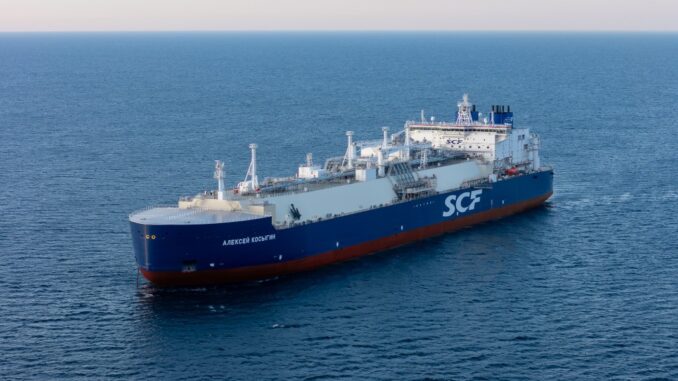
In a significant milestone for Russia’s energy sector, the newly commissioned Arc7 ice-class LNG carrier Alexey Kosygin has completed its inaugural delivery, underscoring Moscow’s push to bolster year-round operations in the harsh Arctic environment despite ongoing international sanctions.
In a significant milestone for Russia’s energy sector, the newly commissioned Arc7 ice-class LNG carrier Alexey Kosygin has completed its inaugural delivery, underscoring Moscow’s push to bolster year-round operations in the harsh Arctic environment despite ongoing international sanctions.
The First Year-Round Arctic LNG Carrier
The Alexey Kosygin, with a cargo capacity of 172,600 cubic meters, represents Russia’s first domestically assembled Arc7 ice-class vessel, capable of navigating through up to 2.1 meters of ice without icebreaker assistance.
Built at the Zvezda Shipbuilding Complex in Primorsky Krai, this advanced carrier was delivered to state-owned shipping company Sovcomflot in December 2025, after years of delays attributed to Western sanctions following Russia’s invasion of Ukraine in 2022.
Its design enables year-round transits along the Northern Sea Route (NSR), a critical shortcut for exporting liquefied natural gas (LNG) from Russia’s Arctic projects to global markets, reducing transit times to Asia compared to traditional routes via the Suez Canal.The vessel’s maiden voyage doubled as ice trials, successfully traversing the NSR from Bolshoy Kamen to the Arctic LNG 2 facility in the Gulf of Ob, demonstrating Russia’s resilience in sustaining its LNG ambitions amid logistical challenges.
Delivery Details: From Arctic LNG 2 to Saam FSU
On January 28, 2026, the Alexey Kosygin loaded its first cargo of LNG at Novatek’s Arctic LNG 2 project on the Gydan Peninsula in the Kara Sea.
The shipment was then transported westward along the NSR to the Saam floating storage unit (FSU) near Murmansk in the Ura Bay, Barents Sea, where it was unloaded on February 2, 2026.
This transshipment to the Saam FSU, a sanctioned storage facility, is part of Novatek’s strategy to facilitate further distribution to international buyers, often via shadow fleets to evade sanctions.
While the immediate “customer” is the FSU operated within Russia’s domestic logistics chain, the LNG from Arctic LNG 2 has primarily been destined for Asian markets, with China receiving the first cargo from the project in 2026 via another vessel loaded from the Saam unit.
This delivery highlights the growing role of floating storage in Russia’s sanctioned LNG trade, allowing for flexible rerouting to non-Western buyers.
Expanding the Fleet: How Many More Are Coming?
The Alexey Kosygin is the lead ship in a series of Arc7 carriers being constructed at the Zvezda shipyard, a Rosneft-led facility aimed at reducing Russia’s dependence on foreign shipbuilding.
Russia is eyeing at least two more such vessels in the near term, with deliveries potentially in 2026 or beyond, as part of efforts to support the full capacity of Arctic LNG 2, which requires up to 21 ice-class carriers for its three trains.
However, sanctions have slowed production, limiting Zvezda’s output and forcing reliance on a mix of existing and shadow fleet vessels for current operations.
Broader plans include additional projects like Murmansk LNG and Arctic LNG 1, but domestic shipbuilding capacity remains a bottleneck, with Russian yards struggling to meet demand for the dozens of specialized carriers needed to triple LNG exports as envisioned pre-sanctions.
Russia’s 2025 LNG Shipments Amid Sanctions
Despite intensified Western sanctions targeting projects like Arctic LNG 2 and key vessels, Russia managed to export approximately 31.3 million tonnes of LNG in 2025, a modest decline of 2.5% from 2024 levels.
This resilience is largely attributed to the Yamal LNG project, which shipped 19.7 million tonnes, with 76% heading to Europe despite EU pledges to phase out Russian gas by 2027.
The EU spent around €7.2 billion on Russian LNG in 2025, up from €6.3 billion the previous year, highlighting continued demand even as pipeline gas imports plummeted.
Arctic LNG 2 contributed limited volumes in 2025, with only a handful of cargoes shipped using a mix of ice-class and non-ice-class vessels, amid a shortage of suitable carriers.
Overall, Russia’s ability to maintain exports near record levels demonstrates the effectiveness of workaround strategies, including shadow fleets and transshipments, though future growth remains uncertain as sanctions tighten.This development not only boosts Russia’s Arctic energy infrastructure but also signals potential shifts in global LNG dynamics, as Moscow pivots toward Asia while navigating geopolitical headwinds.
Get your CEO on the podcast: https://sandstoneassetmgmt.com/media/
Is oil and gas right for your portfolio? https://sandstoneassetmgmt.com/invest-in-oil-and-gas/