


By Stuart Turley, Energy News Beat
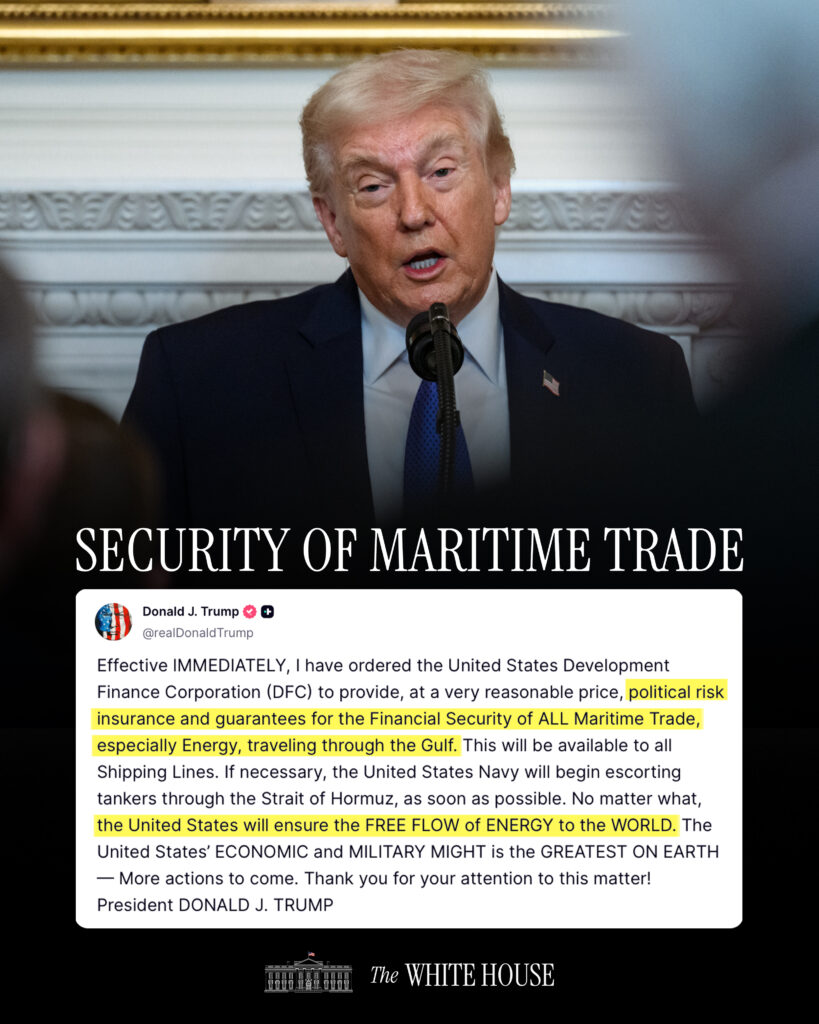
In a bold move to safeguard global energy supplies, President Donald J. Trump announced the “Security of Maritime Trade” initiative on March 3, 2026, directing the United States International Development Finance Corporation (DFC) to provide political risk insurance and financial guarantees for maritime shipping through the Persian Gulf. This executive action comes as tensions escalate in the Middle East, with Iran threatening disruptions in the Strait of Hormuz—a critical chokepoint for roughly 20% of the world’s oil and a significant portion of liquefied natural gas (LNG) exports.
The announcement, posted on Truth Social and shared via the White House’s official X account, emphasizes ensuring the “free flow of energy to the world” amid surging oil and LNG prices triggered by the conflict.
The initiative is designed to counteract the economic fallout from Iranian attacks on vessels, which have nearly halted traffic through the strait, driving up global energy costs.
Brent crude has already climbed 14% since the conflict intensified, with analysts warning of potential triple-digit prices if disruptions persist.
Trump’s directive positions the U.S. as a guarantor of maritime stability, leveraging both economic tools and military might to protect shipping lanes vital to allies and global markets.
Details of the White House Announcement
The core of the announcement is an immediate order for the DFC—a federal agency established during Trump’s first term via the BUILD Act—to offer “political risk insurance and guarantees for the Financial Security of ALL Maritime Trade, especially Energy, traveling through the Gulf.”
This coverage aims to protect shipping companies from losses due to political instability, such as attacks or blockades, encouraging them to resume operations in the high-risk area.
Key elements include:Immediate Availability: The insurance is effective right away, with no delays in implementation.
U.S. Navy Escorts: If needed, the Navy will begin escorting tankers through the Strait of Hormuz “as soon as possible,” echoing historical operations like Operation Earnest Will in the 1980s during the Iran-Iraq War.
Broad Focus on Energy: While applicable to all trades, the policy prioritizes energy shipments, including oil and LNG, to prevent supply shortages that could exacerbate inflation and economic strain worldwide.
Trump underscored U.S. dominance, stating, “The United States’ ECONOMIC and MILITARY MIGHT is the GREATEST ON EARTH—More actions to come.”
This signals potential further measures, possibly including expanded sanctions or diplomatic efforts to de-escalate with Iran.
The DFC, traditionally focused on development finance in emerging markets, is expanding its role here to underwrite risks typically handled by private insurers, who have withdrawn coverage amid the conflict.
This government-backed approach could stabilize freight rates, which have plummeted in futures markets due to the avoidance of the region.
Does This Include All Ships?
The announcement explicitly states the insurance is available to “all Shipping Lines” for “ALL Maritime Trade.”
This broad language suggests coverage for a wide range of vessels, from container ships to bulk carriers, with a special emphasis on energy transporters. However, practical limitations apply: the policy is geared toward legitimate, non-sanctioned trade to ensure compliance with U.S. laws.
In practice, this means eligible ships must adhere to international norms and U.S. sanctions regimes. Vessels flagged under U.S. allies or neutral parties are likely prime beneficiaries, while those involved in illicit activities would be excluded. The initiative aims to revive stalled traffic, which has dropped sharply since Iran’s actions began.
At What Cost?
Pricing is described as “very reasonable,” but specific figures remain undisclosed in the initial announcement.
This vagueness allows flexibility, with experts suggesting subsidized rates to make coverage attractive—potentially far below market war-risk premiums, which have skyrocketed amid the crisis.
The DFC’s involvement implies taxpayer-backed funding, raising questions about long-term costs to the U.S. budget. Analysts estimate initial outlays could run into hundreds of millions if claims arise, but proponents argue this is offset by preventing broader economic damage from energy shortages.
No caps on coverage amounts were mentioned, though standard DFC policies limit exposure per project.
Will It Include Sanctioned Dark Fleet Tankers?
Unlikely. The “Dark Fleet”—a network of aging, often flag-of-convenience tankers used to evade sanctions on oil from countries like Russia, Iran, and Venezuela—operates outside legal frameworks.
These vessels, estimated to account for 6-7% of global crude flows in 2025, are actively targeted by U.S. sanctions and seizures under Trump’s administration.
The initiative’s focus on “financial security” for legitimate trade aligns with U.S. efforts to dismantle these fleets, including recent interdictions in the Caribbean and elsewhere.
Providing insurance to sanctioned vessels would violate U.S. law and undermine the “maximum pressure” campaign against Iran.
Instead, this policy could indirectly pressure Dark Fleet operators by bolstering compliant shipping, making evasion costlier and riskier.
Will This Help Curb Rising Oil and LNG Prices?
Potentially yes, but results depend on execution. Oil prices have surged due to Hormuz disruptions, with U.S. crude up 8.6% to $77.36 per barrel and Brent at $81.29.
LNG spot prices in Asia have also spiked amid rerouting fears.
By offering insurance and escorts, the U.S. aims to resume flows, potentially trimming prices by $10-12 per barrel if disruptions are limited.
Markets reacted positively, with S&P 500 trimming losses after the announcement.
However, prolonged conflict could still push prices toward $100 or higher if Iran escalates.
Long-term, this bolsters U.S. energy dominance, complementing Trump’s push for increased domestic production and LNG exports.
If successful, it could stabilize global supplies, easing inflationary pressures on consumers and industries reliant on affordable energy.As the situation evolves, Energy News Beat will monitor developments in this critical arena. Trump’s promise of “more actions to come” suggests this is just the beginning of a multifaceted strategy to secure America’s energy future.
Sources: politico.com,energy.gov, wsj.com, finance.yahoo.com



Be the first to comment