


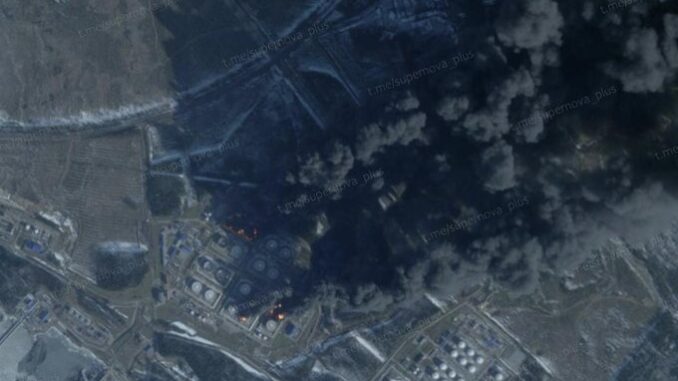
Russia’s two largest oil export terminals on the Baltic Sea — Primorsk and Ust-Luga — have suspended all crude oil and petroleum product loadings following a series of intense Ukrainian drone attacks this week. The shutdowns represent one of the most severe disruptions to Russian energy exports in modern history and come amid escalating Ukrainian strikes on Moscow’s oil infrastructure.
According to industry sources and Reuters calculations, the ports halted operations on March 25 after Ukrainian drones struck both facilities, igniting fires at storage tanks and loading infrastructure. Black smoke was visible from Finland across the Gulf of Finland. Primorsk and Ust-Luga had briefly resumed limited loadings earlier in the week after previous attacks but were forced to shut down again. Ukrainian officials described the strikes as targeted blows to Russia’s war economy.
Scale of Impact: Up to 2 Million Barrels Per Day Offline
Primorsk, Russia’s primary Baltic crude export hub, can handle more than 1 million barrels per day (bpd) of Urals crude and high-quality diesel. Ust-Luga, a major products terminal, exported 32.9 million metric tons of oil products in 2025; Primorsk exported another 16.8 million tons. Combined with reduced operations at the Black Sea port of Novorossiysk (capacity up to 700,000 bpd), damage to the Druzhba pipeline, and tanker seizures, Reuters estimates that at least 40% of Russia’s total crude oil export capacity — roughly 2 million bpd — is currently offline. This is described as the worst oil supply disruption in Russia’s modern history as the world’s second-largest oil exporter.
The immediate effect is a sharp reduction in seaborne exports from the Baltic region, which accounted for a significant share of Russia’s crude and product shipments (records showed Baltic ports moving over 12 million tons of crude in January 2026 alone). Russia is attempting to reroute volumes via eastern pipelines to China and the Kozmino terminal, but those routes have limited spare capacity.
Who Are the Customers Affected?
Russian oil exports have shifted heavily to Asian buyers since Western sanctions. China and India together purchase the vast majority (approximately 80%) of Russia’s seaborne crude and products, often via the shadow fleet of tankers. Baltic ports like Primorsk and Ust-Luga have been critical for Urals crude and diesel shipments to these markets. The current shutdown forces longer, costlier routes and could tighten supply for buyers already facing higher global prices amid Middle East tensions. Domestic Russian refiners and nearby Belarus may also feel knock-on effects from reduced throughput.
Broader Impact from Ukrainian Attacks on Russian Oil Equipment
This week’s port strikes are part of a sustained Ukrainian campaign targeting Russia’s energy sector. Ukraine has repeatedly hit refineries, storage facilities, and export infrastructure throughout 2025–2026. Recent examples include fires at the Kirishinefteorgsintez refinery (one of Russia’s largest, processing ~350,000 bpd) and earlier strikes on Saratov, Volgograd, and other facilities. While exact cumulative figures for “oil taken off the market” vary by source, the combined effect of refinery outages and export terminal closures has removed hundreds of thousands of barrels per day from global supply chains. Reuters notes the latest disruptions alone have idled ~2 million bpd of export capacity, exacerbating revenue losses for Moscow’s budget (oil and gas revenues make up roughly one-quarter of the state budget).
Did Israel Attack Russia?
No credible reports indicate that Israel has directly attacked Russian territory or oil infrastructure. Russia has publicly criticized Israel and the U.S. over strikes on Iranian targets during the ongoing Iran conflict and has accused Israel of striking Russian journalists in Lebanon. However, there is no evidence of any Israeli military action against Russia itself.
Is Russia Limiting Gas and Diesel Exports as Well?
Yes — Russia is actively restricting fuel exports to protect domestic supplies. A ban on diesel, marine fuel, and certain gas oils remains in effect through at least July 31, 2026. Deputy Prime Minister Alexander Novak stated on March 26 that the government may re-impose a gasoline export ban (potentially for a full quarter) if domestic prices continue rising, with a meeting scheduled with oil companies. These measures stem from refinery outages, seasonal demand, and spillover effects from Middle East conflicts. Earlier attacks had already prompted Russia to cut diesel exports from Black Sea and Baltic ports.
The combination of Ukrainian strikes and Russian export curbs is adding upward pressure on global oil and fuel markets at a time when prices are already elevated above $100 per barrel.
Appendix: Sources Reuters: “At least 40% of Russia’s oil export capacity halted” (March 25, 2026) – https://www.reuters.com/business/energy/least-40-russias-oil-export-capacity-halted-reuters-calculations-show-2026-03-25/
Reuters: “Russia’s Baltic ports halt oil loadings after heavy Ukrainian drone attack” (March 25, 2026) – https://www.reuters.com/world/blaze-russias-baltic-sea-port-ust-luga-after-major-ukrainian-drone-attack-2026-03-25/
OilPrice.com: “Ukraine Knocks Out 40% of Russia’s Oil Export Capacity” (March 26, 2026)
Additional reporting from Bloomberg, The Moscow Times, and industry data on port capacities and export bans (March 2026).
Energy News Beat will continue monitoring developments as Russia attempts to restore operations and reroute flows.




Be the first to comment