


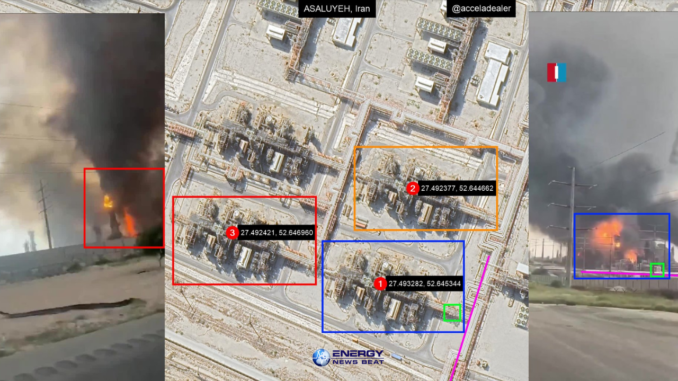
In a major escalation of the ongoing U.S.-Israeli war with Iran, strikes hit key processing facilities tied to the world’s largest natural gas field — Iran’s South Pars — today, knocking out critical infrastructure that supplies the bulk of the country’s energy needs. Iranian state media and multiple international reports confirm the attack targeted onshore gas treatment plants in the Assaluyeh Special Economic Energy Zone (Bushehr province), which process sour gas from offshore phases 3, 4, 5, and 6 of South Pars.
Who carried out the strikes?
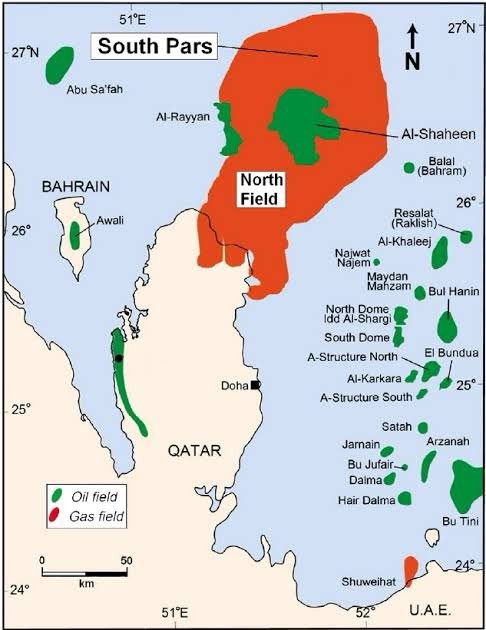
Iranian officials and state television explicitly blamed “US-Israeli” drones and projectiles. Israeli media, citing unnamed sources, reported that the Israeli Air Force executed the operation in coordination with — and with approval from — the Trump administration. Qatar, which shares the giant reservoir (calling its portion the North Field), condemned the Israeli targeting as a “dangerous and irresponsible step.”
Damage assessment
Four gas treatment facilities were damaged, triggering fires that authorities quickly brought under control. The affected plants were taken offline to prevent further spread, resulting in an immediate reduction in output from the linked offshore production platforms. While exact volume losses have not been publicly quantified yet, South Pars normally accounts for 70–75% of Iran’s total gas production (recently running near record levels of ~730 million cubic meters per day of rich gas). The hit marks the most significant disruption to Iran’s upstream gas infrastructure since the war began on February 28. No casualties were reported.
Who are the customers for South Pars gas?
The vast majority stays inside Iran. South Pars gas feeds domestic power plants (gas accounts for ~86% of Iran’s electricity generation), petrochemical complexes, industrial users, and residential heating. Limited pipeline exports go to Iraq (now halted after the strike, taking 3,100 MW of Iraqi power generation offline) and Turkey (under a long-term contract for up to ~9.6 bcm/year). Iran has virtually no LNG export capacity due to long-standing sanctions and technical constraints — unlike Qatar, which exports massive volumes of LNG from the same shared field.
Iranian retaliation plans
Tehran wasted no time signaling payback. Iranian authorities declared several Gulf energy assets “legitimate targets” and warned they “will be targeted in the coming hours.” The list includes: Saudi Arabia: SAMREF refinery (Yanbu) and Jubail petrochemical complex
UAE: Al Hosn gas field
Qatar: Ras Laffan refinery/LNG complex and Mesaieed petrochemical facilities
Semi-official outlets (Tasnim and Fars) stated that attacks on Iran’s energy infrastructure “will not go unanswered.” Evacuation warnings have already gone out to some Gulf energy sites.
Market reaction and broader energy impacts
Oil and gas prices jumped immediately on the news. Brent crude rose more than 6% (briefly topping $109/bbl), while European natural gas benchmarks climbed 5–9%. Fears of wider disruption to the Strait of Hormuz — already strained by the conflict — are amplifying volatility.
Electricity generation impact
Iran’s power sector is highly vulnerable. With South Pars providing the lion’s share of feedstock, analysts warn of potential blackouts or forced load-shedding in the coming days, especially in southern and central provinces already under stress. Iraq is already feeling the pinch: its Electricity Ministry confirmed Iranian gas flows have stopped, removing 3,100 MW from the grid.
LNG production impact
Direct impact on Iranian LNG is minimal — the country produces almost none for export. However, Iranian threats against Qatar’s Ras Laffan and Mesaieed complexes (major global LNG hubs on the shared North Field) have raised immediate concerns for Asian and European buyers. Any retaliation there could remove significant LNG volumes from the market and send spot prices even higher. This could impact Iran as they get 60% of their electricity from Iraq.
This strike represents a clear shift in the conflict: both sides are now directly targeting the region’s energy arteries. South Pars isn’t just Iran’s lifeline — it’s a shared global resource whose disruption ripples far beyond the Gulf. Energy News Beat will continue monitoring developments as retaliation risks and market volatility escalate. Stay tuned for update, and we are looking for more confirmations and verifications. If we find any incorrect statements, we will update.
Sources: Grok, aa.com.tr, bloomberg.com, aljazeera.com



Be the first to comment