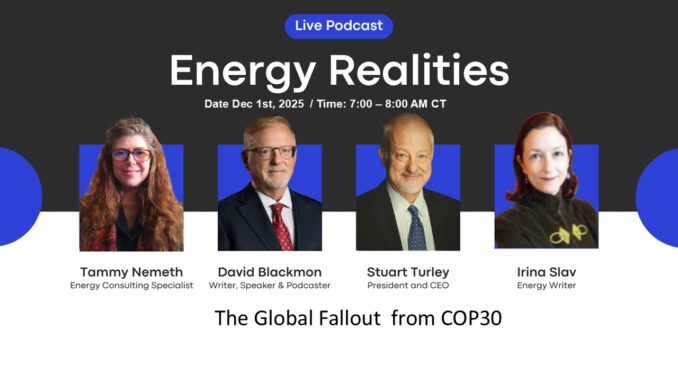
The Energy Reality team from Bulgaria, the US, and the UK had a fun energy discussion at the expense of the COP30 participants. When you get Tammy Nemeth, David Blackmon, Stu Turley, and Irina Slav on a podcast, buckle up, as fun is around the corner.
The main topics The Energy Realities Team discussed in this podcast episode include:
1. The outcomes and implications of COP30, the recent UN climate change conference:
– The lack of significant progress or agreements made at the conference
– Discussions around censorship and information control efforts that emerged from COP30
– The role and influence of the US, particularly under the Trump administration, on the outcomes
2. The geopolitical and economic shifts happening globally related to energy and climate policies:
– The diverging paths and trading blocs forming between countries/regions pursuing net-zero policies versus those resisting them
– China’s growing influence and the West’s increasing reliance on China for manufacturing and energy
– Concerns about deindustrialization and the fiscal impacts of net-zero policies in Western countries
3. Specific energy and climate policy developments:
– The “memorandum of understanding” between the Canadian federal government and the province of Alberta on oil pipelines
– The UK’s plans to tax electric vehicle drivers
– Germany’s increasing gas usage and LNG import needs
4. Commentary and analysis on the media’s coverage and portrayal of these energy and climate issues.
Live on the Energy Realtities Podcast https://t.co/ksMnLy7sec
— STUART TURLEY – Energy Podcast Host (@STUARTTURLEY16) December 1, 2025
Chapters:
00:14 Introduction
05:26 Was it Trump’s Fault COP30 failed?
07:14 Censorship
10:19 The Grid needs balancing between AC and DC renewables.
25:04 End of the war in Ukraine and what that means to oil prices
27:21 The end of the COP Conferences
39:30 Canada and pipelines
49:19 Germany and its energy crisis
52:25 California and Gavin Newsom’s war on oil
Got Questions on investing in oil and gas?

If you would like to advertise on Energy News Beat, we offer ad programs starting at $500 per month, and we use a program that gets around ad blockers. When you go to Energynewsbeat.co on your phone, or even on Brave, our ads are still seen. The traffic ranges from 50K to 210K daily visitors, and 5 to 7K or more pull the RSS feeds daily.
https://energynewsbeat.co/request-media-kit/

Full Transcript of Fun and we disavow any mistakes, unless it makes Stu look better.
David Blackmon, Energy Realities Co-Host [00:00:12] Well, good morning, everybody. This is David Blackman here in Texas, where the temperature is thirty-seven degrees Fahrenheit as we speak. We actually had a freeze on November 30th yesterday in North Texas. Little unusual, certainly not unprecedented, so we can’t really blame it on global warming. But here we are for the Energy Realities podcast, the podcast that I always like to brag about. We start on time. Today we’re four minutes late, but but you know, when I was in the oil industry, if a meeting started within 10 minutes of the stated time, that was on time. So I’m gonna say we were on time today as well. I am here today with Dr. Tammy Nimuth, who is in the UK this morning. How are you today, Tammy?
Tammy Nemeth, Energy Realities Co-Host [00:00:56] I’m doing well, thank you. It’s a bit stormy here, so yeah, it’s it’s good.
David Blackmon, Energy Realities Co-Host [00:01:01] It’s good, it’s normal, right? I mean you’re in the UK.
Tammy Nemeth, Energy Realities Co-Host [00:01:04] Normal for this time of year.
David Blackmon, Energy Realities Co-Host [00:01:05] Exactly. Come on. Irena Slav in Bulgaria. I understand it is warm in Bulgaria today.
Irina Slav, Energy Realities Co-Host [00:01:12] It’s warm in southern Bulgaria today. It’s chilly in the west in Sofia, but here it’s sunny, it’s lovely, but it does get cold during the night because winter is coming. Winter never fails to make an appearance and this year won’t be an exception.
David Blackmon, Energy Realities Co-Host [00:01:29] And from his handy bunker is somewhere in Oklahoma, Dr. Stu Turley is here today, our master of ceremonies every week, who gets all this ready. How you doing, Stu?
Stu Turley, Energy Realities Co-Host [00:01:41] Well, a little panic this morning since I sent out the wrong link. But you know, thank you for being such gracious folks and we’re gonna have a lot of fun.
David Blackmon, Energy Realities Co-Host [00:01:52] All right. Well, yeah, we we are going to have a lot of fun because we’re talking about my favorite subject in recent weeks, the global fallout from COP 30, the COP 30 event that was held in Bellum, Brazil, deep in the Amazonian jungle where they cut down hundreds of thousands of Amazon rainforest trees to build a what was 11-mile superhighway that to carry these globalist elites, 50,000 of them who flew in on their private jets to the local airport to get them faster into the city center where all the tents were set up to host this thing. It was basically I didn’t even know that until the meeting was ongoing that the venue for this deal was essentially a circus big top, which actually is is kind of appropriate for a for any new event. Yeah, it’s anyway. The the conference wasn’t exactly a rousing success, as I think pretty much everyone in the media media is reporting it. And everyone there is admitting. I mean, it’s really kind of surprising to me how frank everyone is has been in admitting they didn’t really accomplish a damn thing over two weeks. But Tammy, what is your what is your view on on the success or failure of the COP 30 event?
Tammy Nemeth, Energy Realities Co-Host [00:03:17] Well, I guess it depends on how you’re defining success or failure, right? Because if you go to some of the organizations like Carbon Brief or whatever, they they list all the accomplishments, you know, of what they believe was was accomplished. And I think there’s two things that are really important is number one, the agreement towards high integrity, high integrity voluntary carbon markets. That one I think was really important and is going to have long term consequences. And then the other one was the statement on in in information integrity, or you know, the the sort of call for global censorship, which
Speaker 5 [00:04:03] Yeah.
Tammy Nemeth, Energy Realities Co-Host [00:04:04] Irena had an an amazing substack on about you know fact checkers and and all this absurdity, but they want to basically make that the law in different countries. And I could totally see Canada going down that road or the EU or the UK. I mean, they’re it’s they’re already moving towards that right now, where you’re in the UK, you can’t criticize immigration, you can’t criticize stuff that the government is doing with respect to the overwhelming of the borders, which is hilarious given that the UK is an island. You’d think they’d be able to stop stuff, but I guess not. And in Germany, you can’t criticize politicians at all. You know, you can’t say, well, you’re you’re a fat loser. That gets you thrown in jail. You can’t criticize anything that they’re doing. So the EU’s already on that trajectory, and it would just be adding one more thing to the list of things you’re it is legal for you to say. So the fact that Canada led that, I think is problematic for North America. And the other thing that Canada was leading on was this high integrity voluntary carbon market, which is a brainchild of Mark Carney. So it’s it’s interesting
David Blackmon, Energy Realities Co-Host [00:05:24] So it’s gotta be great, right?
Tammy Nemeth, Energy Realities Co-Host [00:05:26] Gotta be great. And yeah, so you know, they they agreed on these different things. The the big thing was that America wasn’t there, and so then there was all the sort of left wing media saying China’s taking over the leadership for climate from the United States because oh, we have the big bad Trump in there. So yeah, it’s interesting the spin that China somehow is going to be the world’s climate leader, which they they always get a pass on all the coal that they’re doing and and all this other stuff. So yeah, I think it’s a mixed bag. I think there’s probably more long term consequences of things that they did agree on that will be detrimental to to the to the world. And you know what’s interesting? I just want to throw one last thing out here, is that when the Paris Agreement was negotiated and signed back in 2015, I was teaching a class on the geopolitics of energy and the environment, and the students were lamenting that the agreement wasn’t strong enough and that nothing was going to happen from it. And look where we are 10 years from then. So
David Blackmon, Energy Realities Co-Host [00:06:36] Yeah. Good point. That’s actually a really, really strong point. You know, I like to joke around about it, but it’s not like these people are going away or stopping their efforts. They they continue to push the ball forward on any number of different fronts, and few governments are are able or willing to resist the impulse to to follow them, unfortunately. Irina, talk about your take on the whole censorship agreement that was reached.
Irina Slav, Energy Realities Co-Host [00:07:05] Well, it is concerning. Did they actually reach a binding agreement or something? No, they didn’t.
David Blackmon, Energy Realities Co-Host [00:07:11] Did not.
Irina Slav, Energy Realities Co-Host [00:07:11] Of course they did not.
David Blackmon, Energy Realities Co-Host [00:07:13] Right.
Irina Slav, Energy Realities Co-Host [00:07:14] There’s a lot of talk during those cops, but very, very little actually happens, like from what I gathered. First of all, there wasn’t as much coverage as there was last year and the year before last. That was you know quite noticeable. That talk about censorship is really, really worrying, guys. And I’ve been thinking about sending you out my phone number in case I disappear because of the Digital Services Act or something they come up with to start shutting us up. So if I disappear for a week, something has happened to me. Yeah, unfortunately, I I’m only half joking because now they’re talking about tracking chats, including potentially on so-called encrypted platforms. Yeah, I don’t know what to tell you. They really, really love their censorship, and I can understand the push for censorship because more and more people are realizing that this whole energy transition business is essentially a scam. And to what Tammy said about the students thinking that Paris Agreement was not good good enough. And yeah, we’ve come a long way over the last 10 years, but not really in the direction these young people then probably envisioned. You know, we’ve spent trillions on wind and solar. And as David likes to remind everyone, we’re still dependent on oil and gas for over eighty percent and coal for over eighty percent of our primary energy consumption. So we haven’t really done anything transitioning, we’ve just spent a lot of money on you know things that don’t work all the time. Yeah, yeah, so
David Blackmon, Energy Realities Co-Host [00:09:09] A lot of money, yes.
Irina Slav, Energy Realities Co-Host [00:09:11] That’s a lot of money. Is that
David Blackmon, Energy Realities Co-Host [00:09:13] Trillions and trillions.
Irina Slav, Energy Realities Co-Host [00:09:15] Yeah. And then it it it’s like a joke. This circus tent was really appropriate, as you said, David. They once again failed to agree on you know declaring unnecessary phase out of fossil fuels. Once again, they blamed Saudi Arabia for it. I didn’t believe this was happening. It’s Saudi Arabia, really. The EU refused to sign this.
Speaker 5 [00:09:49] Yeah. Exactly.
Irina Slav, Energy Realities Co-Host [00:10:00] It’s a circus.
David Blackmon, Energy Realities Co-Host [00:10:02] It is a circus. It is a circus. Stuart Turley up there in Oklahoma. Tell us your view on all of this. Particularly weren’t wasn’t the US already kind of almost down that road on censorship before Elon Musk.
Stu Turley, Energy Realities Co-Host [00:10:19] Oh, we were we were so close. And I yesterday on my website, I got almost 11,000 denial of service attacks. And so they don’t like the fact that I try to speak the truth about energy. Physics and fiscal responsibility matter to the grid. Whoa, what a concept. You have in the Europe, European Union, UK, all around the world, you have 50 gigahertz through AC. You know, you got to have the asynchronous and you got to have a motion on the grid. The grid is a motion, it’s a live machine. Throw on wind and solar, that’s DC direct current in the United States. We’re 60 megahertz, except Japan. Japan is 50 megahertz or 60 gigahertz, whichever one megahertz. Depends on which half of the island you’re on. Guess what? Physics and fiscal responsibility matter to the grid. It could care less about what’s going on. Now let’s take Bill Gates. Bill Gates, one of my favorite persons. I now I I also have to hand out the two people that have made me more money on my website are Bill Gates and Gavin Newsom. Hats off to Gavin Newsom for being such a clown show. That man has actually driven more traffic to my site. I love all of my California, New York, New Jersey, Delaware, all the people paying high taxes in those areas. Come to my website. And now here you have Gavin Newsom. I’ll talk about him later, but you have him going to Comp 30 and standing up to President Trump. What a bonehead. Then you have Ed Miliband flying twice, not once, twice. Holy what a Muppet show. That man is absolutely horrific in his energy policies. Comp 30 proved my point that we are bifurcating into two worlds of trading blocks. Those following net zero and those following deindustrialization are going to be offloading all of their manufacturing to China. And Tammy, your article that you pointed out on Zero Edge about China’s building was Volkswagen. Yeah, Volkswagen was absolutely phenomenal. And let me bring that up here. You this was absolutely fantastic. You take a look at Volkswagen, this actually follows in to absolutely what I’m talking about, the trading blocks. The European Union is facing collapse. Yesterday I noticed on X that the Italy Prime Minister is looking at getting her gold reserves back out of the EU. Does that end the EU? No, but it sure weakens their financial aspects. Tyler Duren is a hoot, and he says Volkswagen says it can build an electric car entirely in China, roughly half the cost producing one in Germany. Why? Energy costs. And it is absolutely oh, these electric cars are gonna be built by what? Show. Oh yeah.
David Blackmon, Energy Realities Co-Host [00:13:53] Yeah, but cool. But doesn’t that make this Volkswagen is supposedly a German company, right? But if they’re building the car entirely in China, is Volkswagen now a Chinese company? Seriously.
Tammy Nemeth, Energy Realities Co-Host [00:14:05] Okay.
Irina Slav, Energy Realities Co-Host [00:14:06] Kind of like Bobo. Well no, it’s not.
David Blackmon, Energy Realities Co-Host [00:14:09] Well, but I mean it’s it’s subservient to China, right? It’s dependent on China. This is just another example of how every aspect of this energy transition is designed to make Western countries increasingly reliant on China. Anyway, sorry, Stu.
Tammy Nemeth, Energy Realities Co-Host [00:14:24] No, I would I would add to that that the the article said that originally Volkswagen had to set up that factory to produce the vehicles for consumption in China. China was making these new rules where you couldn’t export them to China, you had to make them in China. But after doing that, they realized oh, it’s much the supply chains are easier. They get preference in the supply chains because it’s for China, and they get all of these other things. The they can get things done quicker than in the EU because there’s all these reviews and stuff that have to go on. And now they’re saying, well, maybe we can make them in China and export them to the EU because it would be that much cheaper.
David Blackmon, Energy Realities Co-Host [00:15:09] Interrupt for a second and stop you right there because what you just said is that it’s easier and and cheaper to get permits to proceed in business in a communist country.
Tammy Nemeth, Energy Realities Co-Host [00:15:22] Yeah.
David Blackmon, Energy Realities Co-Host [00:15:22] Than it is in the European Union.
Tammy Nemeth, Energy Realities Co-Host [00:15:24] Yeah.
David Blackmon, Energy Realities Co-Host [00:15:26] And much easier, not just a little easier, much easier.
Tammy Nemeth, Energy Realities Co-Host [00:15:28] A lot. Yeah. Because the the number the amount of time that they that they stated in the article was like was it eighteen months difference? Which is significant when you’re I forget. It was it was it was a really large number and I’m like, Wow, that’s that’s pretty big.
David Blackmon, Energy Realities Co-Host [00:15:48] My goodness. Okay, Stu, I’m sorry you got interrupted there. Go back to your discussion.
Stu Turley, Energy Realities Co-Host [00:15:54] I’m I’m having fun. You guys are bringing up great fantastic points, and that’s why I love this podcast. When you sit back and take a look, it proves my point that the trading blocks are changing. The deindustrialization is tied to net zero. Net zero at COP 30. I think the comp 30s absolutely are eviscerated financially. In the United States, we are about to find out how bad fiscal responsibility and grid physics matter when we get rid of the subsidies. In Texas, where I spent half my time, you gotta you gotta love Texas. We have 182 gigawatts of nameplate capacity, but peak demand was only David. Are you ready for this? 82 gigawatts. Now, guess what they’re planning on data center new demand is 120 gigawatts. And in the words of Jasmine Crockett, one of the most incompetent Congress people we have, the math ain’t mathing up. I can’t math up fast enough to be this stupid. I went to Oklahoma State University, and this is absolutely horrific. You can’t put 120 gigawatts of capacity on a hundred and eighty gigawatt without going financially broke in a in a system. That’s just one piece of the entire United States grid. This is an amazing thing. Guess what’s happening to Europe? The same thing.
Speaker 5 [00:17:35] Okay.
Stu Turley, Energy Realities Co-Host [00:17:35] So
David Blackmon, Energy Realities Co-Host [00:17:36] So the Texas’s surplus of capacity though is mainly due to the fact, isn’t it, that we have built out all this wind and solar, which only operates at a less than 25% capacity factor, right?
Stu Turley, Energy Realities Co-Host [00:17:50] That is correct. And when you sit back and take a look at the storage, you know, you take a look at everything else, how much extra are they paid to be shut down? Here’s where it makes a difference. In the United States grid being paid to shut down in the UK, their pricing mechanisms are so weird. I mean, they they pay for the solar to shut down, then they pay for the interconnects to other countries, and it is just absolutely how much extra are we paying as a globe for all of these extra things in the name of clean energy? It is not clean because you’re paying to shut down the wind, you’re paying to shut down the solar, you’re then paying to have the the solar panel made, and nobody’s talking about end of life on this kind of stuff.
David Blackmon, Energy Realities Co-Host [00:18:51] Oh yeah, that’s when it’s gonna get really expensive.
Stu Turley, Energy Realities Co-Host [00:18:54] Oh, it we’re $89 billion for wind only liability in the United States.
Speaker 5 [00:19:02] Yeah.
Stu Turley, Energy Realities Co-Host [00:19:02] That is a liability that’s sitting there waiting to happen. And I drive by all those wind farms in Texas all the time and they’re starting to fail.
David Blackmon, Energy Realities Co-Host [00:19:12] Oh yeah. They’re getting old and rusty and dilapidated and it’s going on a lot faster than the industry claimed it would. So I have two roundtable discussion topics I want to throw out to the group. The first is Greta Thunberg. Greta Thunberg is in the middle of the COP 30 meeting. Greta, of course, for the last year or so has lurched off into anti Israel activity over the the war in Gaza, and God bless her for that, because we didn’t need her in this environmental discussion. But now she’s back on the climate change thing, and she was in Venice recently, about 10 days ago, pouring dye into the canals to turn them green. Is and I just want everyone to comment on whether or not that’s an effective tactic for the poster child for the green movement to be using during COP 30. Tammy, you go first.
Tammy Nemeth, Energy Realities Co-Host [00:20:08] It’s what they do. I mean that it’s that performance art that the these activists, especially the young people, they push that. There’s always some kind of theater. I think it mixes with the whole carnival circus attitude. But I think it’s really wearing thin. I mean, they’ve been doing that kind of stuff for fifty years now, whether it’s, you know, they they pretend to have a a die-in or a lie in, or they spray buildings with paint and make it look like blood, or you know, now they’re they’re painting the you know, putting and I was like, What about the fish and the and the what happens to biodiversity when you break these dye?
David Blackmon, Energy Realities Co-Host [00:20:48] They say it’s non-toxic it’s completely safe and non-toxic.
Tammy Nemeth, Energy Realities Co-Host [00:20:51] Of course, sure. Of course, whatever.
David Blackmon, Energy Realities Co-Host [00:20:53] Right.
Stu Turley, Energy Realities Co-Host [00:20:55] US food system.
Tammy Nemeth, Energy Realities Co-Host [00:20:56] Yeah, but I so I thought it was interesting ’cause now that the whole Palestine thing seems to have dissipated with the whatever agreement that’s been done, now Greta’s pivoting back to climate.
Speaker 5 [00:21:09] Yeah.
Tammy Nemeth, Energy Realities Co-Host [00:21:10] Tri a cause she’s trying to find to have purpose? Can’t she just enjoy her money? I know. She’s worth a lot.
Irina Slav, Energy Realities Co-Host [00:21:17] Yeah, maybe start a meaningful career, but I guess once you’re a calls warrior you’re a sorry, justice war.
Stu Turley, Energy Realities Co-Host [00:21:26] Has anybody thought to sit back and look at her parents what selfish beasts these people are?
Speaker 5 [00:21:33] Yeah.
Stu Turley, Energy Realities Co-Host [00:21:34] Yeah. To to sacrifice their child’s childhood for their own gain.
Speaker 5 [00:21:41] Yes, well.
Stu Turley, Energy Realities Co-Host [00:21:41] Well they certainly did that. Yes. Just thought I’d ask.
David Blackmon, Energy Realities Co-Host [00:21:45] Mm-hmm.
Speaker 5 [00:21:46] Ha ha.
David Blackmon, Energy Realities Co-Host [00:21:46] Okay. So second roundtable topic. Much of the media is blaming the disappointing outcome of COP thirty on Trump, of course, because Trump is the the global boogeyman who’s responsible for every failure. As as Stu mentioned, Governor Newsom was there leading a U.S. Delegation in place of the what normally is a US delegation from the presidential administration. Are the failures of COP thirty Trump’s fault? Irena, you go first.
Speaker 5 [00:22:18] Yes.
Irina Slav, Energy Realities Co-Host [00:22:22] Well I w I wouldn’t use the word fault, but I I can understand the perspective.
David Blackmon, Energy Realities Co-Host [00:22:28] Yeah, I mean is he having an influence on the global debate over climate? I think that’s really the question, right?
Irina Slav, Energy Realities Co-Host [00:22:34] Well, he just pulled out the US from the Paris Agreement. Again, refused to sign up for expensive garbage in the energy field. That’s all he did. But I think his very presence and the weight that the US president carries on a global level definitely shook the foundations of the whole COP concept and the idea, the admittedly extremely boring idea that every year when they meet, they will just agree on spending more and more and more money. Now the the biggest economy in the world says they will not be spending any more money on this, which probably was not received well. And maybe it had something to do with the EU’s decision to not assign that document about the phase out of fossil fuels. I mean, they just signed an agreement, a contract, a binding contract with the Trump administration to buy 750 billion fossil fuels. Yeah. Leaving aside the fact that this is impossible in the in the time frame agreed, but they did sign up to buy a lot of fossil fuels. So they can very well at the same time. Well they actually could because that’s the kind of people they are. They could have signed up for the phase out of fossil fuels, but I’m sure they were afraid that, you know, Trump would say, What are you doing?
Speaker 5 [00:24:10] Yeah, yeah. So
Irina Slav, Energy Realities Co-Host [00:24:12] In that sense, yes, it was Trump’s fault and I’m very grateful for it.
David Blackmon, Energy Realities Co-Host [00:24:19] Some Stu, is it Trump’s fault or
Stu Turley, Energy Realities Co-Host [00:24:23] I’ll tell you what, I I think President Trump is one of the funniest humans on the planet. Love him, hate him. He is entertainment. He’s entertainment gold. And when you sit back and take a look, you have Ed Meliban, who is, in my opinion, as low as Governor Newsom. Governor Newsom is also extremely I believe Doomberg said that when you and I interviewed Doomberg, had a very, very good point, and that was he is an excellent politician and can morph at a he climb you know, skin change into whatever he needs to do.
Speaker 5 [00:25:03] Yeah.
Stu Turley, Energy Realities Co-Host [00:25:04] In order to win a a thing. So I think that President Trump has got three or four cabinet members that are not doing him any favors, but yet on the climate and the energy policies, he’s got three climate guy three members that are doing fantastic. I think we’re gonna see an an end of the war in in Russia and Ukraine. And I think that the bombings of Ukraine on the downstream assets of Russia, even in other countries, has finally taken its toll of sanctions that sanctions through drones, I guess is now a thing. Yeah. So I I see that we’re gonna see an end of the war, but what does that mean to cop in the UN? I would like to see the UN thrown out of the United States. I would like to see the United States pull out of the UN and totally defund that organization because I believe that it is tried to take the United States down. So I don’t know that I could get any more plane on that, but I think that the UN is actually serving China and then actually helping China. And you sit back and take a look at what’s happening with the deindustrialization of the net zero, China is pushing the net zero. Now, are they obeying the net zero? Oh, let me do my best. Tony Soprano. Hey, we’re gonna do it in 2060. How about that? Everybody goes, okay, 2060’s okay. They’re not doing a thing.
David Blackmon, Energy Realities Co-Host [00:26:51] All the clapping seals. Yeah.
Stu Turley, Energy Realities Co-Host [00:26:53] Yay, 2060. And then they’re holding us to today. By the way, shut down all your coal plants today. No, 2060 versus today. No, it does not make any sense.
David Blackmon, Energy Realities Co-Host [00:27:08] I mean, has the has has has COP thirty well first of all you can comment on whether it’s Trump’s fault, but second, has COP thirty outlived its usefulness now? Absolutely. Have the COP conferences outlived.
Tammy Nemeth, Energy Realities Co-Host [00:27:21] The cop conferences. So they’re yeah, they’ve been talking about that for a little while, where there’s some groups that want to move it to a permanent thing, but don’t have all these really big meetings, that there’s like a secretariat that kind of runs stuff. They’ve been talking about that for a few years. I don’t know. But I was listening, because of course, Radio 4 and in in the BBC Radio 4 had like an hour, and I was in the car stuck in traffic, and I’m listening to this going on and on about COP 30, and they were talking and interviewing some of the people there and stuff. And and the interviewers asked that, said, you know, it does this process, do we need to just leave it go and and and move on to something else? And one of the people said, actually, no, it’s really important to have these leaders come together in person so that pressure can be brought to bear through personal relationships. And I thought, yeah, that’s that makes a lot of sense because if you’re on Zoom or whatever, you can just kind of go, whatever, you know, sure, maybe we’ll do something and then not really follow through. But when you have that personal pressure, you’re in the room, there you you form this relationship, that can make a difference, which is why the World Economic Forum is has to have the meeting in person in Davos in order to leverage those personal relationships. And the lady on on Radio 4 actually said we can leverage that. And and leverage that for action. So it’s like, okay, that’s one of the reasons why they keep going through this performance. And I I want to give a shout out to David Zarak at the fire break because he had a really good piece about sort of the almost the kabuki theater that goes on at the COPS and and how important that is. Yes, I think Trump was one of the architect or the reasons for, I wouldn’t say architect, but one of the reasons for whatever failures they think is has occurred there. I think their progress didn’t go as fast and and as strong as they wanted. Even the G20, which happened to overlap a little bit with COP 30, the the really big leaders’ declaration, which is like what, a hundred and some points or whatever, the climate was mentioned 28 times. Versus previous declarations where it was like 70 or 100 or whatever. So even like the G twenty is like, well, this is stupid out of like Trump and and America didn’t want to sign on to any of that climate stuff. But again, they talked about voluntary carbon markets and so on and so forth. So it’s interesting that you we have this global Trump effect to sort of why slow down what they’re pushing for net zero. But honestly I think that the EU and the and the other countries that have been really been pushing for this for a long time in order to undermine America, I feel like they’re just waiting. They’re waiting for 2028 in the hopes that a a new sum or AOC or whoever runs runs for the Democrats wins and they can go back on this on this track, on this trajectory.
David Blackmon, Energy Realities Co-Host [00:30:31] Yeah. I so so your your comment about n the the utility of face to face meetings reminds me that this is also why the Illuminati and the Bilderbergers also meet face to face every year, right? So anyway, getting down the conspiracy road.
Speaker 5 [00:30:47] Well yeah.
Stu Turley, Energy Realities Co-Host [00:30:48] I I love Rodney. Rodney’s comment is fantastic. If they didn’t have these personal relationship meetings, most of the world’s problems wouldn’t exist. Rock on Rodney. This today is Monday, rock on Monday for Rodney there. Thank great job.
Tammy Nemeth, Energy Realities Co-Host [00:31:03] I I want to add to that. Thank you for that comment, Rodney. That’s really great because the person who kind of set that all up was Maurice Strong. And he did it through the first UN Earth Day climate meetings in Stockholm. And he was really big on having these kind of he would have these private meetings and organizations and whatever adjacent to the World Economic Forum, adjacent to the Club of Rome, in order to provide that environment for the leaders could talk, like what Bilderberg says, could talk in an in an environment where they’re not going to be recorded. They can speak freely and and have these personal relationships that can be leveraged at another time to get put forward the action they really want, but feel constrained by the democratic process. So this has been
Irina Slav, Energy Realities Co-Host [00:31:59] Established for a long time. And they still couldn’t push the carbon tax, the global carbon tax. They’ve been talking about this for ages, and they couldn’t even do that.
David Blackmon, Energy Realities Co-Host [00:32:11] Yeah. Even even with even with the support of Exon Mobile and Shell, they can’t get it.
Tammy Nemeth, Energy Realities Co-Host [00:32:16] Exactly.
David Blackmon, Energy Realities Co-Host [00:32:16] Isn’t it amazing?
Tammy Nemeth, Energy Realities Co-Host [00:32:18] Yeah, but that was Trump again. If if it had been somebody else, if it had been Biden or Harris or whoever, they would have signed on in a heartbeat. So I mean, because they were involved in all those negotiations leading up to that point. And it was Trump who’s just like, No freaking way we’re not doing that. That’s part of it.
Stu Turley, Energy Realities Co-Host [00:32:35] And then we would be not industrialization going on in the United States. We would continue the deindustrialization and we would continue down our decline into fiscal failure.
Tammy Nemeth, Energy Realities Co-Host [00:32:50] Like Germany. Yeah.
Stu Turley, Energy Realities Co-Host [00:32:52] Like Germany, like the UK, like the rest of the EU. It is and Canada. Oh, that goes to those trading blocks that I keep talking about. United States is gonna end up doing business with Russia, India, Saudi Arabia, the Middle East and much of Asia and it’s gonna leave the other block. The world is changing, folks, and if we don’t realize that, it’s gonna be along the net zero line.
Tammy Nemeth, Energy Realities Co-Host [00:33:23] Yeah, it’s been building with that, I would say since COVID, right? Where there were you s really saw that that differentiation once the once Biden came into power. There was it was really a clear delineation. You had America, the EU, and all the net zero fanatics, and then you had the BRICS because we’re like, we know we don’t want to do that. We want to do our own thing. So now, yeah, it’s interesting. Like I said, I’ve said before, America seems to have switched sides now where it’s like we’re gonna join the BRICS countries or something, have our own little alignment.
Stu Turley, Energy Realities Co-Host [00:33:57] I I think you’re going to see something other than BRICS come rolling in. And I I think that it is BRICS did its job. And I I applaud them from for doing that. But if you take a look at the gold number, now I mentioned I’m going back to classes to get my day trading license so I can still lose money faster. When you take when you go back in, I give no advanced investment advice, but I’m learning from my father who has been a day trader for 20 years and is doing quite well. I’m like, hey, why am I working so hard? I’m gonna follow him. So you sit back and and look at the financial things going on around the world. What is the number one change in the in the global economics right now? Financing of gold. People are buying gold hand over fist to go away from the petrodoll. It’s the petrol dollar dead. No, it’s about down to 58%. And you take a look at what’s going on in the petrodollar. Now, if the petrol dollar gonna kill the US dollar, no, the US dollar’s following the way of the U British pound sterling. But you take a look at the investments coming into the United States by trying to reindustrialize all of this is tied together. And it it is an amazing thing that when you see net zero equals deindustrialization equals new trading blocks. This is a big issue. Big fat hairy deal.
David Blackmon, Energy Realities Co-Host [00:35:31] And it’s a good idea. We have one more comment from Rodney McKinnon’s We have to defeat the climate hysteria globally while Trump is in office. The door has been opened to win this war for humanity, but time is limited because we don’t know who will be in power next for the United States.
Irina Slav, Energy Realities Co-Host [00:35:46] It’s not enough time.
David Blackmon, Energy Realities Co-Host [00:35:48] Not enough time.
Irina Slav, Energy Realities Co-Host [00:35:49] Yeah.
David Blackmon, Energy Realities Co-Host [00:35:49] This is why Steve Bannon and others keep saying we need another a third Trump term because three more years is not enough time to accomplish all that.
Irina Slav, Energy Realities Co-Host [00:35:59] Yeah, no.
Tammy Nemeth, Energy Realities Co-Host [00:36:00] Brainwashing has been going on for a very long time.
David Blackmon, Energy Realities Co-Host [00:36:02] Yeah.
Speaker 5 [00:36:03] Yeah.
Tammy Nemeth, Energy Realities Co-Host [00:36:04] I want I can I just clarify the comment I made earlier about the Volkswagen factories in China. The they there normally it takes fifty months to develop a vehicle and the article said that operating in China reduces that by thirty percent, which means it’s fifteen months. So it reduces the the the process by fifteen months.
David Blackmon, Energy Realities Co-Host [00:36:27] Wow. Which that’s still amazing. That’s still a lot. So thirty-five months to And and the EU government should be embarrassed by that fact that a communist government is able to move so much more quickly.
Speaker 5 [00:36:39] They’re shameless to scab your kids. Please.
David Blackmon, Energy Realities Co-Host [00:36:47] Okay, let’s wrap this up and go to the article, Stu. I think it’s time.
Stu Turley, Energy Realities Co-Host [00:36:56] There you go. I think I got these right. I I’m smoking crack evidently today as we started a little late this morning. But Dami, are these your stories?
Tammy Nemeth, Energy Realities Co-Host [00:37:05] Yeah, those are my stories. So it’s basically all about the the memorandum of understanding between Alberta and the federal government in Ottawa about maybe what it will take to get an oil pipeline to the to the Pacific coast. And you know, there’s some people out there who are who are praising this as a big victory, but when you read the details, it’s not it’s not really that that great a thing. And there’s been other articles like the New York Times and Semaphore where they’re saying it’s a done deal that this is an agreement. It’s a memorandum, a memo of understanding, which means nothing. It’s not binding, it’s not an accord, it’s not an agreement. It’s like, okay, we agree we’re gonna talk more about these things. We’re gonna have an implementation committee set up maybe in April. We’re gonna talk about stuff. And I think what I would say for I’ll I’ll just talk a little bit about the specifics of what’s in this memorandum of understanding. Alberta commits to sinking money into carbon capture storage, and it’s the absolute requirement to even think about an oil pipeline. It agrees to Alberta agrees to increase the number of interconnections. To try and reduce the amount of natural gas that it uses for its power, seems to be the subtext there. And so this is hilarious because the agreement or the accord, sorry, not even the accord, the memorandum of understanding, the mou, says that it’s really important for LNG to go to Asia. So, on the one hand, they’re encouraging Alberta to develop nuclear power to generate electricity while exporting their abundant natural gas to Asia for electricity, and they’re supposed to phase out their power facilities that are on natural gas. Do you see how it’s kind of like okay? We have all this natural, we’re not allowed to use it for power.
David Blackmon, Energy Realities Co-Host [00:39:21] Right. It’s just all about virtue signaling about climate, right? To burnish your your domestic numbers while shipping it all to Asia to be
Tammy Nemeth, Energy Realities Co-Host [00:39:30] Exactly. Exactly. And so that so these are some of the details. Ottawa seems to have not agreed to anything. They said, okay, we have this emissions cap that we’ve talked about. It’s not in place. And we’re not, we’re probably not going to bring it into effect unless you decide not to do carbon capture. Then they talked a lot about supporting this and supporting that. Words are cheap. Then they said we’re committing to a two-year process, which is already part of the major projects office. So I don’t know whether they’re agreeing to something that already exists. They talked about indigenous ownership of stuff, which is already a requirement. So then they’re not actually repealing or amending any of the legislation that’s a problem. They’re basically saying we’re gonna grant some exemptions to Alberta, maybe if they comply with all these different things. So the bigger picture is that basically by signing this memorandum of understanding, they’re allowing Mark Carney to act like a king with a court. And he keeps talking about a rules based order. You know, he he criticizes America all the time that they’re undermining a rules based order, and Canada’s committed to a rules based order, but the rules don’t seem to apply in Canada, they’re not following the law, they’re exempting things, they’re not repealing, they’re not amending. So that these decisions can be revoked at any time if you’re displeasing based on what criteria? Who knows? It’ll be whatever he feels like tomorrow. So, you know, by accepting these exemptions, Alberta’s basically conceding that the federal government, number one, has a right to impose clean electricity standards, which constitutionally it doesn’t. It it’s also conceding that they are that the federal government can act like like a like a king in a court to make decisions based on whatever they the whims of the day. So I just hope he doesn’t need any sauerkraut because maybe he’ll be grumpy and then say, you know, I’m revoking these exemptions. So and and then lastly, my last point on this, and then I’ll shut up, is that you know, I I’m really concerned about some of the rhetoric coming out that we should just be happy Mark Carney agreed to something, sort of in a memorandum of understanding and stop criticizing stuff because people just don’t want to win. Well, I’m gonna be realistic and and call it out that I don’t think this is a win for anybody except Ottawa, because they get Alberta to make all kinds of concessions, supposedly, before action can even happen. And it’s supposed to create certainty for investment. What investment is going to go forward? Where you they have to make all of these commitments for carbon capture storage before they can even consider a pipeline. And who’s going to do a pipeline when the province it has to cut through and the indigenous groups say no and the federal government still has a tanker ban in place? And they’re like, maybe we’ll think about changing the tanker ban once people come forward and agree to build a pipeline. Who’s gonna do that?
David Blackmon, Energy Realities Co-Host [00:42:46] Nobody. Nobody. Nobody.
Tammy Nemeth, Energy Realities Co-Host [00:42:50] So they’ll spend all this money for carbon capture and in the end they won’t it won’t be able to go anywhere. So that’s my little two cents.
Irina Slav, Energy Realities Co-Host [00:42:58] Yeah, well hopefully it just because it’s a a memorandum of understanding for Ottawa, it’s also a memorandum of understanding for Alberta, so they might not do it, hopefully.
Tammy Nemeth, Energy Realities Co-Host [00:43:09] Hopefully. I don’t know. I don’t know. Really weird. It’s very weird.
David Blackmon, Energy Realities Co-Host [00:43:15] Political theater.
Tammy Nemeth, Energy Realities Co-Host [00:43:16] Yes.
Stu Turley, Energy Realities Co-Host [00:43:19] You gotta love it. Great sub stack.
David Blackmon, Energy Realities Co-Host [00:43:23] It is wonderful. Oh, I love that illustration in the middle there. That’s awesome.
Tammy Nemeth, Energy Realities Co-Host [00:43:28] Yeah, I was marveling. Yeah, the sticky web.
David Blackmon, Energy Realities Co-Host [00:43:32] Yeah, that’s fantastic.
Tammy Nemeth, Energy Realities Co-Host [00:43:34] That’s on Substack, the Namoth Report dot substack dot com. You can find my writings and podcast there.
David Blackmon, Energy Realities Co-Host [00:43:40] Did you use Groc to create that?
Tammy Nemeth, Energy Realities Co-Host [00:43:42] I did, yeah.
David Blackmon, Energy Realities Co-Host [00:43:43] Yeah, man, gross getting really good with
Tammy Nemeth, Energy Realities Co-Host [00:43:46] Yeah, getting much better.
David Blackmon, Energy Realities Co-Host [00:43:48] Okay. Okay. Gee whiz, what do we got here? Let’s do the second one first. Thanksgiving gas prices fall to lowest level since the pandemic, 30 states below $3 a gallon. I put that in there because I went to fill up my car, which unfortunately is a Japanese car that says you got to use premium. But regular gas at the station where I get my gas here in North Texas was $2.29 a gallon. It’s the lowest I’ve seen. Well, I just can’t really remember seeing regular gas prices that low anywhere. So you know, maybe 30, 40 years ago. So it’s really low. And that’s cheap gasoline, and it’s just because of a number of factors, but still the media is complaining that it isn’t low enough because oil prices are lower now than they were a year ago, and it’s only a little bit lower than under Biden a year ago and yada yada. People are never satisfied. You adjust these prices for inflation, and gasoline prices in the United States are lower than they were in the mid 1970s. Okay. Adjusted for inflation. That’s the truth. That’s the fact. People need to stop whining about gasoline prices. Second.
Tammy Nemeth, Energy Realities Co-Host [00:45:08] Here in the United States. But Trump can never do anything right. It won’t matter. It could go down to one dollar a gallon and they’ll still say it’s Trump’s fault about something.
David Blackmon, Energy Realities Co-Host [00:45:16] I mean, you still got the media claiming we’re in a recession when we just consumers are gonna spend a quarter of a trillion dollars over the Black Friday weekend, all time high. Consumers spending up nine point one percent year over year on Black Friday. I mean, th this economy is booming and we we still have the media claiming we’re in a recession. It’s ins insane.
Stu Turley, Energy Realities Co-Host [00:45:38] Stuart. Yes, it’s Trump’s fault. But on the other hand, when you take a look at the oil industry, everybody is saying we’re in an oil glunt. Yeah. We’re also saying that this is a global market. And there’s they’re saying, wait a minute, as soon as the war is over, the price is going to drop through the floor because all these extra Russian oil barrels are going to come on the oil. I don’t think so. I’m thinking once they remove the floor for the Russian oil, the price is gonna go up because we are short trillions of dollars. And I’m the only one in the room, yep, I’m the only one in the room saying that oil’s gonna go up because they’re short now. When I don’t know, but it’s gonna go up because we do not 80% of the world is living off the 80% of the oil produced in the world today is in declining fields.
David Blackmon, Energy Realities Co-Host [00:46:37] Yep.
Stu Turley, Energy Realities Co-Host [00:46:38] It is a normal decline curve that happens to oil and gas. Guess what happens? We’re gonna need trillions to be put into it rather than the trillions that went into renewable wind and solar. It needs to shift to something else. Sorry, David, I did not mean to interrupt.
David Blackmon, Energy Realities Co-Host [00:47:01] No, it’s okay. My second story is about John Kerry, who was, you know, I think it’s just totally appropriate, knighted by King Charles, the other big climate scold over there in the UK, decided to award John Kerry, the US’s along with Al Gore, one of the two main climate scolds here in the United States in this century, with a knighthood, which is just
Speaker 5 [00:47:24] Oh my god.
David Blackmon, Energy Realities Co-Host [00:47:24] Blue to Chris. John Carey’s. A lifelong fraud.
Speaker 5 [00:47:29] Oh.
David Blackmon, Energy Realities Co-Host [00:47:30] And and anyway, during that he he said nasty things about Trump and United States CEOs. I wrote a piece at the Daily Caller about it. Y’all can go read that. It’s up there live today. And it’s it’s very entertaining. And I will turn this over. I don’t want to take up any more time because we’re running short. There’s my substack, my daily caller piece, as it happens, is also at the top of my substack. So you can go there and read it too.
Stu Turley, Energy Realities Co-Host [00:48:02] I love Jeff. Jeff Chestnut. We have an oil glut. We have a media with accelerated my forehead. Sorry, Jeff.
Irina Slav, Energy Realities Co-Host [00:48:09] Jeff is great, yeah. So my stories are two weeks old, but I really like them, so I haven’t looked at new ones. So the UK Chancellor of the Exchequer had this idea to start taxing EV drivers. I don’t know what happened with it in the end. Did it remain in the budget? Did she even present the budget?
Tammy Nemeth, Energy Realities Co-Host [00:48:31] Yeah, she did last week. It was on Thursday.
Irina Slav, Energy Realities Co-Host [00:48:34] Okay. So that’s that’s good news because someone’s starting to think that EV drivers get all the benefits and none of the responsibilities except for you know observing the traffic code or whatever it’s called. But yeah, I wonder how this will impact EV sales in the UK, even with the subsidies. But it will probably not impact them negatively because they also approved a package of what was it, a couple of billion pounds to support more EV sales while taxing EV drivers. Yeah, yeah, that these people are
Speaker 5 [00:49:18] A bold strategy.
Irina Slav, Energy Realities Co-Host [00:49:19] Geniuses, yeah, yeah, amazing. Even more amazing is Germany, which has been using a lot more gas than usual for this time of the year because it was colder than usual, and that’s hampering Europe’s stockpiling drive. It isn’t, it’s hampering Germany’s stockpiling drive. Most countries have filled up their reserves. Germany is being slow because it’s using it. And I I made a screenshot a couple of weeks ago. The rate at which Germany was filling its gas storage was like a tenth or a hundredth from the rate with which it was withdrawing. Germany is using a lot of gas, which is why it’s also building new LNG import facilities, which it’s going to be using for green hydrogen in the dreams of those who approve their construction. In the meantime, it’s going to be importing even more LNG. So that’s good news for American exporters. Well done, exporters. And also in the meantime, this just seen from today. The Eurozone’s PMI is below 50 again. Huge surprise. I’m amazed that Proiters didn’t lead with you know with the headline shocking or surprising. But it didn’t. So if even Reuters is d dropped the pretense, then it’s really bad. And guys, we’re joining that very same Eurozone next month. Oh, poor you. Yeah.
Speaker 5 [00:51:03] Oh
Irina Slav, Energy Realities Co-Host [00:51:05] It’s fun. It’s fun to be an easy.
David Blackmon, Energy Realities Co-Host [00:51:10] Another wonderful substance.
Irina Slav, Energy Realities Co-Host [00:51:14] Thank you. And you can find me at Irina Slaughter on Energy. Apparently my readers don’t want me to rebrand because they don’t have a sense of humor. And I’m joking when I say this because my readers have the best sense of humor on the whole of Substack. Thank you everyone for reading my writings.
Stu Turley, Energy Realities Co-Host [00:51:31] I love I get my Irena fix when I read it listen to your articles. So I listen while I write other articles and it makes me funnier listening to you. So great job.
David Blackmon, Energy Realities Co-Host [00:51:41] Yeah, I want to get Irene to re to to narrate my articles ’cause I tried doing it three or four times and nobody listened to the damn things.
Stu Turley, Energy Realities Co-Host [00:51:49] Well, Eeyore is not as as nice sounding as Irina. Sorry.
Irina Slav, Energy Realities Co-Host [00:51:57] Yeah, I I can’t do an American accent. I could try all
Tammy Nemeth, Energy Realities Co-Host [00:52:02] Probably be hilarious.
Stu Turley, Energy Realities Co-Host [00:52:03] You can’t pay taxes.
Tammy Nemeth, Energy Realities Co-Host [00:52:04] I love your accent, especially when you’re being so sarcastic. It’s great.
Stu Turley, Energy Realities Co-Host [00:52:11] Yeah, m my accent’s pretty bad, especially when I really hope it’s down here. Hey, you gotta I gotta thank Governor Newsom again for his hair gel usage, in his petroleum base.
David Blackmon, Energy Realities Co-Host [00:52:24] Yeah.
Stu Turley, Energy Realities Co-Host [00:52:25] Yeah, he he is absolutely eviscerating the California problems. Texas oil mogul at war with California over an offshore bounty. I’m gonna reach out to the CEO of Sable Energy and James Flores. I’m gonna try to visit with him about this. California is facing shutting down, they lose two million dollars a month in their main pipeline. Once you lose that main pipeline in there, oops, then you have not only that, you have climate change. Bob goes to COP 30. He goes down there and says, We’re here to support you guys, but yet he’s killing, we’re now importing 70 percent of California’s oil is imported from China, Iran, Iraq. They just imported. Are you ready for a light? Was it last week? They imported jet fuel that was done in it, was refined in India that was shipped in from Russia. From Russia. Nice. That’s really saving the planet. Way to go, climate Bob. I I’ll tell you what, that is just amazing. And so when you look at Kern County, Kern County, David, they have got two thousand permits. They’re down to 13 permits in 2025 from thousands. By law, California just put in a new law that says, Oh, by the way, we’re gonna allow 2,000 permits in Kern County. I want to go on record on this podcast how many are gonna be actually issued because the people in Kern County are gonna go, do you want permit? And they’re gonna slow walk that permit all the way down. It’s gonna make our old leader of the Senate, the turtle. What was his name? Mitch McConnell. Mitch McConnell. It’s gonna make him seem fast. I I guarantee you they’re gonna slow walk these permits in. My other story is Russia’s oil and gas revenues may fall. I saw this on oilprice dot com that Reuters wrote and then I stole it and then I rewrote my own story. So You know, this is called rewriting your own story here in a significant blow to Russia’s wartime economy, state revenues. They they did their calculations. I’m doing my mathing. Russia’s gonna be just fine after the war because they’re gonna quit paying for the dark fleet when the sanctions are lifted. There’s a floor that they’re going to be doing. Russia’s gonna be just fine. And the loser in this is the corruption that is now surfacing that we all know Ukraine is a crime scene. Let’s go to the next story here. Boy, I’m on a roll this morning. I need more coffee. Not only did I send the wrong link out to you guys, I’m over here. I’m I’m a legend in my own mind being funny. What if Venezuela is is shut down and where you get peace in Ukraine? I take a look at the oil prices in this article. We have a no-fly zone over Venezuela this morning. And so is that because we’re about to strike something, or did the leader of Venezuela call up and go, Hey, I don’t want to have a war with you. He sent two airplanes to buzz the USS General Ford and and said he made it change course. Oh, they were unarmed, there were no bombs on those things, and our our military could sit there and look at those and go. Yeah, those don’t have any weapons on them, so they let ’em fly by. Maduro turns that and says, I stood up against the military. Right, dude. You’d better leave. Anyway.
David Blackmon, Energy Realities Co-Host [00:56:37] Well he’s fixing to be deposed and the United States is gonna revitalize the Venezuelan oil industry.
Stu Turley, Energy Realities Co-Host [00:56:43] Yes. But right now they produce about a a barrel and a half a week. And so it’s it’s really hot in it.
David Blackmon, Energy Realities Co-Host [00:56:51] Chevron gets, you know, they they’re exempt from all that. Chevron is somehow still in there producing.
Stu Turley, Energy Realities Co-Host [00:56:56] And they are, but this is about China’s involvement in South America. Don’t make any mistakes. It’s not talked about in the mainstream media.
Speaker 5 [00:57:05] Yeah.
Stu Turley, Energy Realities Co-Host [00:57:05] This is about the Monroe Doctrine in the United States. We still have two ports owned by China on each end of the Panama Canal. Has not been fixed yet. That’s right.
Speaker 5 [00:57:18] Did I try some?
David Blackmon, Energy Realities Co-Host [00:57:21] Well, they were supposed to sell Larry Fink and and BlackRock, but that didn’t actually happen.
Stu Turley, Energy Realities Co-Host [00:57:26] If it didn’t go.
Speaker 5 [00:57:27] Right.
Stu Turley, Energy Realities Co-Host [00:57:28] So they’re still owned, but we happen to have a lot more military guys sitting there looking at everything, but that doesn’t mean everything yet. It’s not fixed.
David Blackmon, Energy Realities Co-Host [00:57:37] There’s a there’s a reason why, folks, that about forty percent of the United States’ naval fleet is massed in the Caribbean right now.
Stu Turley, Energy Realities Co-Host [00:57:44] Yeah. And you can find me on the energy newsbeat.substack dot com or energy newsbeat dot co or energy newsbeat dot com. And this was a fun show. Thanks for letting me just absolutely
David Blackmon, Energy Realities Co-Host [00:58:00] This was fun. And I appreciate everybody for being patient and cooperating so well with my deft guidance of the discussion.
Speaker 5 [00:58:10] Absolutely.
David Blackmon, Energy Realities Co-Host [00:58:10] Thank God I won’t be doing it again for a month.
Speaker 5 [00:58:13] What you know?
David Blackmon, Energy Realities Co-Host [00:58:13] Anyway, appreciate everybody joining in. We’re out of time. And Stu, any what last word for the good of the order.
Stu Turley, Energy Realities Co-Host [00:58:21] We are gonna have a fantastic week, and I guarantee you that we are ab the world is healing. And I feel that even there is hope for the UK, Canada, and the EU. I think that it’s a good idea. What about the UN and COP? Absolutely UN and COP. I think the UN is gonna be eviscerated and defunded. And I I think that that’s gonna actually be a great thing when you have people like Greta looking for becoming a secretary or
David Blackmon, Energy Realities Co-Host [00:58:50] Hey, maybe she can buy the Caribbean green. There you go.
Stu Turley, Energy Realities Co-Host [00:58:54] A big. There’s no.
David Blackmon, Energy Realities Co-Host [00:58:55] Surely there’s plenty of time for that.
Stu Turley, Energy Realities Co-Host [00:58:57] Who was on the love boat? The the the lady that was the cruise director for the love boat? Maybe Greta could be the cruise director for a carnival cruise. She would be great at that. Yeah. All right. Then with that, let’s end this one before I go, Tony. Yeah, yeah. But boy, I got all kinds of stuff.
Irina Slav, Energy Realities Co-Host [00:59:17] Thanks for the comments. Have a great week.