In an August 20, 2026, Bloomberg Opinion column, Javier Blas argued that “choking Iran’s economy is the least bad way to end the war.” Drawing on firsthand observations of sanctions-induced collapse in Iraq, Venezuela, and Cuba—worthless currencies, skyrocketing inflation, and soaring unemployment—Blas noted that pure economic pressure has historically failed to force political change. U.S. President Donald Trump is nonetheless betting he can break the Islamic Republic quickly enough to extract concessions. Iran’s demonstrated capacity to endure financial suffering, now heightened by an existential threat, makes success uncertain. With military options constrained after nearly six months of conflict that began in late February 2026, economic asphyxiation remains the least-bad path—though far from a good one.
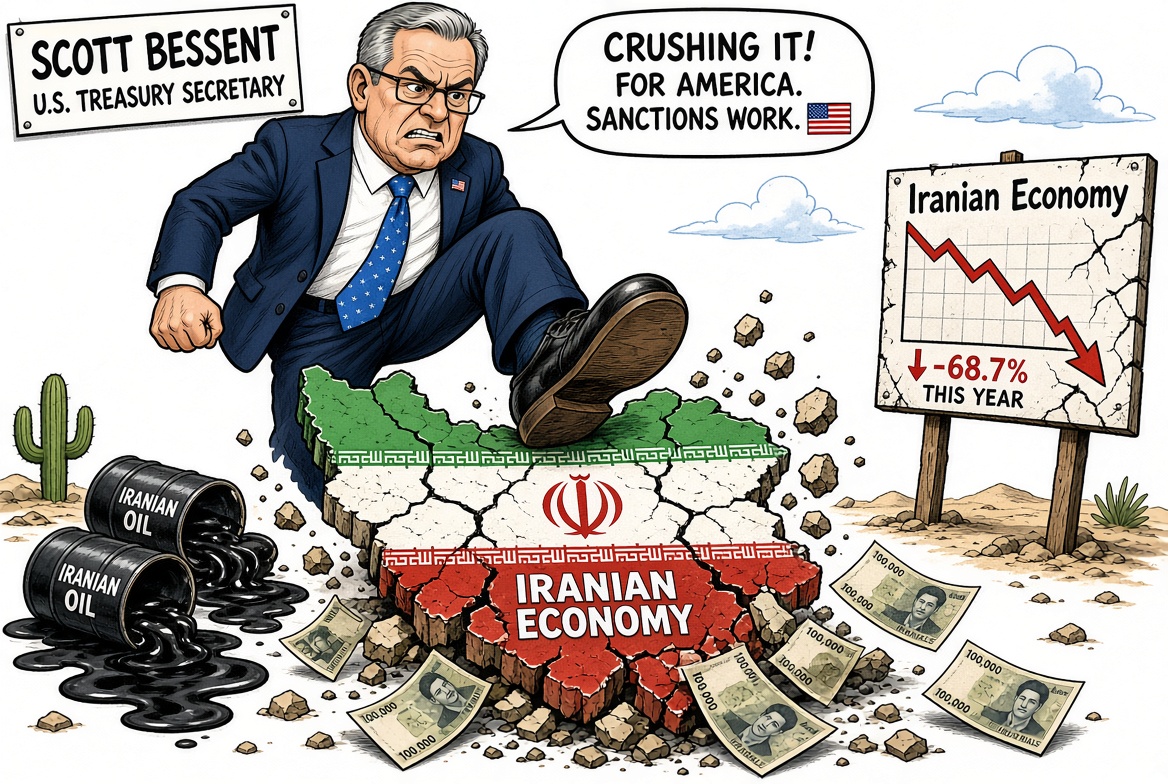
Treasury Secretary Scott Bessent is the central architect of this strategy under the banner of “Operation Economic Fury” and maximum pressure. On August 20, 2026, Bessent announced that the United States will impose “the toughest sanctions in history” on Iran, with details to be unveiled at a press conference the following Monday. He described the approach as a “one-two punch”: the existing naval blockade of Iranian ports combined with unprecedented secondary sanctions. “It is going to work in Iran, and we are going to collapse this regime,” Bessent told CNBC. The measures target any country or entity providing a “lifeline” to Tehran—oil purchases, money transfers, seaborne ship-to-ship operations, currency swaps, shadow fleets, or front companies—with the full force of the U.S. Treasury. Allies face a binary choice: “You are either with us or against us.” China, which sources roughly half its energy from the Gulf, has been specifically urged to cooperate. Bessent emphasized that sustained maximum economic pressure makes a large-scale kinetic restart unlikely for now, shifting the burden away from kinetic operations while still leaving that option at the president’s discretion.
These financial and maritime tools build on earlier steps. A temporary 60-day general license in June 2026 under a short-lived memorandum of understanding had briefly allowed Iranian oil production, delivery, and dollar-denominated sales, unlocking potential billions in revenue and easing pressure on storage. When that framework collapsed, the blockade and sanctions were reimposed, cutting off the regime’s primary hard-currency artery. Treasury actions have also targeted IRGC-linked oil sales networks, the so-called Persian Gulf Strait Authority, shadow banking, and crypto channels, freezing hundreds of millions in regime-linked assets.
Is the Blockade Working?
Evidence shows the blockade is inflicting real pain, particularly on oil exports—the regime’s main foreign-exchange earner. Pre-war exports hovered around 1.8–2.1 million barrels per day. During peak enforcement periods, loadings and exports have collapsed toward zero or low hundreds of thousands of barrels per day. Storage is filling rapidly (usable capacity estimated at roughly 12–22 days in some assessments), production has fallen, and revenue losses have been estimated in the range of hundreds of millions of dollars daily at times. The International Monetary Fund projects a GDP contraction exceeding 5 percent for 2026—the worst in decades. Year-on-year inflation has reached 80–90 percent in recent readings, with food inflation exceeding 128 percent. Unemployment has risen, industrial capacity has been damaged by both strikes and input shortages, and the rial has depreciated sharply. Gasoline rationing and higher import costs for food and other essentials compound household hardship.
Yet the pressure is neither instantaneous nor total. Iran has drawn down floating and onshore stockpiles during temporary easings, utilized alternative land routes and covert ship-to-ship transfers, and maintained some residual exports. Higher global oil prices during the conflict have partially offset volume losses relative to budgeted revenue in some analyses. The regime has adapted over decades of sanctions, prioritizing strategic imports and the security apparatus while allowing ordinary citizens to absorb the brunt. Inflation and currency depreciation rates have shown signs of slowing in certain periods, and the economy has not reached the threshold of state inability to pay salaries or deliver basic services. Global energy markets feel the effects too: reduced Hormuz transits, higher oil prices, and elevated U.S. gasoline costs create domestic political friction.
Internal Hopes of Overthrowing the IRGC?Economic misery has repeatedly fueled protests in Iran. Waves in late 2025 and early 2026—sparked by currency collapse and inflation—spread widely before being met with lethal force by the Islamic Revolutionary Guard Corps (IRGC) and Basij. Thousands were reportedly killed or arrested; the security apparatus demonstrated its willingness and capacity to crush dissent. Public polling and anecdotal evidence suggest deep dissatisfaction with the regime over living standards, water and electricity shortages, and mismanagement. Some analysts argue that intensified pressure could reignite unrest capable of threatening the system, especially given leadership losses and the IRGC’s expanded wartime economic and political role.
However, the IRGC has emerged stronger, not weaker.
The war elevated its position in governance, reconstruction, sanctions-evasion networks, and potential revenue from Strait of Hormuz control schemes. It prioritizes its own survival and the coercive apparatus over popular welfare. There is no unified domestic opposition with the organizational capacity or elite fractures needed for rapid regime change. Historical precedent—decades of sanctions, previous protest cycles, and the current wartime cohesion—suggests the regime’s pain threshold remains high. Overthrow remains a possibility if economic freefall accelerates dramatically and security forces fracture, but current indicators point to resilience through repression rather than imminent collapse.
A Long Shot Until After the Midterms?
U.S. midterm elections are scheduled for November 2026, roughly three months from the current date. The war is unpopular with American voters; polls show low approval of Trump’s handling of Iran, and economic spillover (higher energy prices, fiscal costs) ranks as a top voter concern. Some Republicans openly worry that a prolonged conflict could jeopardize the party’s slim majorities. Trump has downplayed the midterm linkage, stating he is prepared to continue pressure regardless of the electoral calendar and insisting Iran is “on the ropes.” Bessent’s intensified campaign is framed as a way to force a resolution—or at least avoid large-scale combat—before or through the election period. Whether the economic squeeze can deliver decisive results on that timeline is the open question. Historical patterns of Iranian endurance and the regime’s demonstrated ability to prioritize survival over popular welfare suggest it could be a longer struggle.
Blas’s assessment captures the dilemma: economic choking is the least-bad available tool after military options have proven limited and costly. Bessent’s financial and blockade measures are demonstrably hurting Iran’s oil revenues, inflation, and living standards. Yet Iran’s adaptive capacity, the IRGC’s entrenched power, and the absence of a clear internal tipping point leave open the possibility that the regime can outlast the pressure—at least through the immediate political calendar in Washington. Energy markets, ordinary Iranians, and regional stability will continue to bear the costs while the experiment unfolds.
We in the West don’t comprehend the mind of the IRGC leaders. The willingness to inflict pain on their citizens is very much like our current Congress and Senate. More concerned about power rather than taking care of American legal citizens.
- Javier Blas, “Choking Iran’s Economy Is the Least Bad Way to End the War,” Bloomberg Opinion, August 20, 2026: https://www.bloomberg.com/opinion/articles/2026-08-20/choking-iran-s-economy-is-the-least-bad-way-to-end-the-war
- Reuters, “Bessent says US will impose toughest ever sanctions on Iran, urges China to cooperate,” August 20, 2026: https://www.reuters.com/world/middle-east/us-treasury-secretary-bessent-hold-press-conference-iran-on-monday-2026-08-20/
- CNBC, “Bessent: Iran economy attacks mean U.S. likely won’t restart combat,” August 20, 2026: https://www.cnbc.com/2026/08/20/bessent-economy-iran-war-trump.html
- CNBC Exclusive Transcript: U.S. Treasury Secretary Scott Bessent, August 20, 2026: https://www.cnbc.com/2026/08/20/cnbc-exclusive-transcript-us-treasury-secretary-scott-bessent-speaks-with-cnbcs-sara-eisen-on-squawk-on-the-street-today.html
- Al Jazeera, “Iran prepares to keep economy alive as US threatens further sanctions,” August 18, 2026: https://www.aljazeera.com/news/2026/8/18/iran-prepares-to-keep-economy-alive-as-us-threatens-further-sanctions
- Responsible Statecraft, “How Iran has staved off economic collapse despite the US-Israeli war,” August 18, 2026: https://responsiblestatecraft.org/iran-economy-war/
- The New York Times, “Iran war: Trump tries economic pressure — again,” August 19, 2026: https://www.nytimes.com/2026/08/19/world/europe/iran-trump-economic-sanctions-leverage.html
- Clingendael, “The wartime economic takeover of the Iranian state,” August 20, 2026: https://www.clingendael.org/publication/wartime-economic-takeover-iranian-state
- U.S. News / Reuters reporting on Iranian rulers wary of unrest, August 2026 context: https://www.usnews.com/news/world/articles/2026-08-17/battered-by-war-irans-rulers-wary-of-more-economic-pain-and-unrest-if-us-tightens-pressure
- Newsweek, “Iran’s Defeat to Trump in 3 Devastating Charts—and What Happens Next,” August 20, 2026: https://www.newsweek.com/iran-trump-war-economy-charts-rial-usd-oil-12341288
- CNN, “Trump is squeezing Iran’s economy and oil sales. It may still have the upper hand in Hormuz,” August 20, 2026: https://www.cnn.com/2026/08/20/business/iran-economy-war-leverage-intl
- POLITICO, “‘There is no breaking point’: The problem with Trump’s plan to economically strangle Iran,” August 18, 2026: https://www.politico.com/news/2026/08/18/there-no-breaking-point-problem-with-trumps-plan-teconomically-strangle-iran-01040781
- Newsweek, “After Iran, Trump and His Republicans Face Their Own Economic D-Day,” August 20, 2026: https://www.newsweek.com/trump-iran-threat-economy-republicans-midterms-12347040
- CNN Politics, “Republicans worry Trump’s war in Iran could cost them in midterms,” August 18, 2026: https://www.cnn.com/2026/08/18/politics/republicans-iran-war-donald-trump
- The Telegraph, “Trump targets Iran’s economy as military campaign falters,” August 12, 2026: https://www.telegraph.co.uk/us/politics/2026/08/12/trump-scott-bessent-end-iran-war/
- U.S. Department of the Treasury, “Economic Fury Targets Illicit Oil Revenue Fueling Iran’s Military,” May 28, 2026: https://home.treasury.gov/news/press-releases/sb0510
- Additional contemporaneous reporting from Reuters, CNBC, Al Jazeera, Kpler analyses, Foundation for Defense of Democracies, and Iranian statistical releases on inflation, oil loadings, and employment (cross-referenced across 2026 coverage).