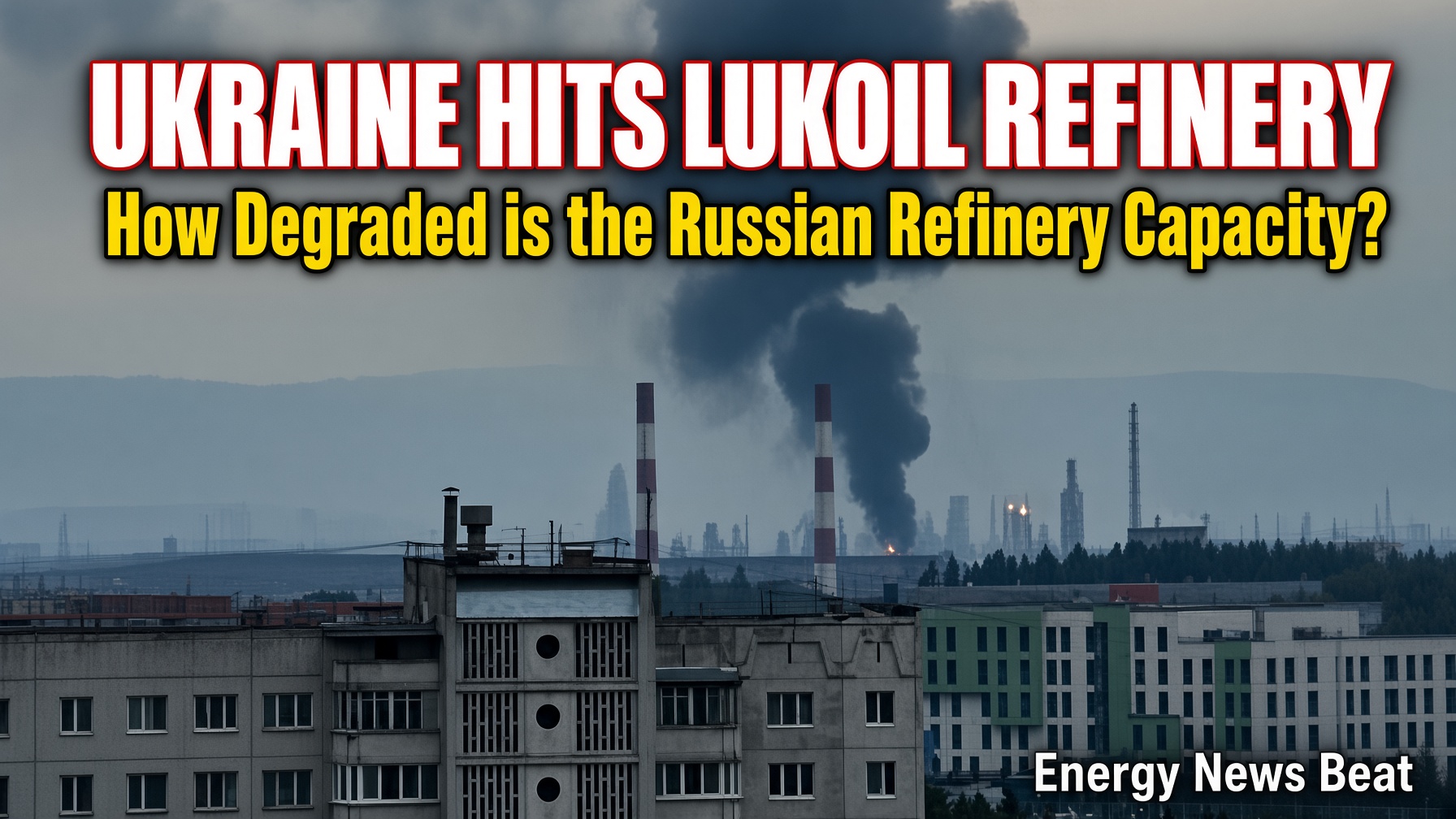
On the morning of August 21, 2026, Ukrainian drones struck the Lukoil-Permnefteorgsintez oil refinery in Russia’s Perm Krai, more than 1,500 kilometers from the Ukrainian border. Thick black smoke rose over the facility, one of Russia’s 10 largest refineries with a design capacity of around 13 million metric tons of crude per year (approximately 262,000 barrels per day). The plant produces gasoline, diesel, jet fuel, and lubricants, supplying both domestic markets and the Russian military.
Commodity trader Jack Prandelli highlighted the strike in a post that morning, noting the refinery was “burning again” after a prior hit in late July. Footage and photos circulating from the scene showed a large plume of dark smoke billowing from industrial stacks amid residential areas, consistent with a significant fire at the processing units.
We have scheduled Jack Prandelli on the Energy News Beat podcast next week.
Ukrainian President Volodymyr Zelenskyy and the General Staff confirmed the attack, stating a fire was recorded on the premises. Russia reported intercepting hundreds of drones overnight across multiple regions, but local authorities acknowledged damage to an industrial facility in Perm and suspended airport operations. The extent of the latest damage is still being assessed.
Bomb Damage Assessment
The Perm refinery has been hit multiple times in 2026, including on May 7–8 and July 29. In the July strike, industry sources told Reuters that a Ukrainian drone caused a fire and forced the shutdown of the CDU-5 primary crude distillation unit. That unit has a throughput of about 12,930 metric tons per day—roughly 34% of the plant’s total capacity. Remaining units could theoretically allow operations at around 75% of nameplate capacity, but repair timelines for specialized equipment under sanctions are often measured in months.
Satellite and thermal imagery analyses of other recent strikes (such as at Lukoil’s Kstovo refinery) have shown primary processing units remaining offline for weeks or longer, with measurable drops in nighttime temperatures and exchange trading volumes. Cumulative damage from repeated hits compounds problems: emergency repairs, deferred maintenance, and shortages of Western-sourced parts slow recovery. Full independent bomb damage assessment for the August 21 strike is pending, but the visible fire and prior pattern indicate further disruption to primary refining trains.
Years of Escalating Attacks
Ukraine’s campaign against Russian energy infrastructure began modestly after the February 2022 full-scale invasion, with only a handful of strikes in the first two years. It accelerated sharply in 2024 and especially from mid-2025 onward, shifting from export terminals to refineries themselves to squeeze both revenue and domestic fuel supplies.
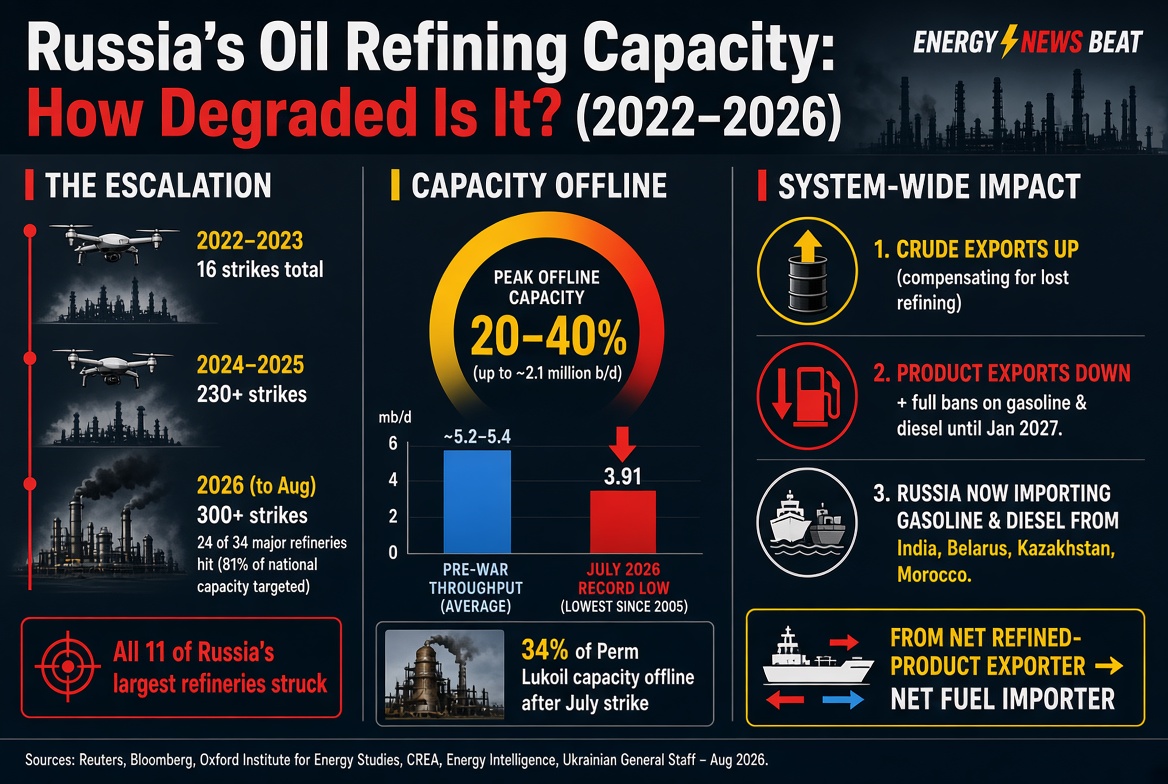
By mid-2026, Ukraine had conducted more than 300 confirmed or suspected strikes on Russian oil facilities. In 2026 alone, at least 24 of Russia’s 34 major refineries—covering about 5.1 million barrels per day, or 81% of national capacity—have been attacked, many repeatedly. All 11 of Russia’s largest refineries have been hit. Intensity peaked in periods such as April–June 2026, with dozens of successful hits in single months.
Independent estimates of offline capacity have ranged from 20–25% (over 60 million tons per year) to roughly one-third (around 2 million b/d) at peaks, with some Ukrainian analysts claiming higher temporary losses. Refinery throughput fell to multi-decade lows—below 4 million b/d in early June and averaging around 3.9 million b/d in July 2026, more than 1.4 million b/d below year-earlier levels and the lowest since 2005. Production of refined products dropped sharply, with gasoline output lagging summer demand.
From Oil Exporter to Fuel Importer
Russia remains a major crude exporter. Seaborne crude shipments have often risen as refining capacity declined, with four-week averages reaching post-invasion highs near 4.1 million b/d at points in 2026. This shift helps preserve some wellhead tax revenue but reduces higher-value product exports and margins.
Oil product exports, however, have collapsed. Seaborne loadings hit record lows amid domestic shortages, and Russia imposed temporary bans on gasoline, diesel, jet fuel, marine fuel, and gasoil exports—extended through January 31, 2027 (with some producer exemptions from September). Product export volumes fell sharply, contributing to tighter global diesel markets.
The reversal is stark: Russia, long a net exporter of refined fuels, has begun importing gasoline and diesel. Deputy Prime Minister Alexander Novak confirmed imports in August 2026. Cargoes have arrived from India (including via ship-to-ship transfers), Belarus (record volumes by rail), Kazakhstan, and even Morocco. Asian refined products are now flowing back toward Russian ports while Russian crude continues eastward—an extraordinary trade-flow inversion driven by the refining crisis. Rationing, long queues at pumps, and regional restrictions have become widespread.
Russian Economy Outlook for 2026
The refining degradation compounds broader pressures. Russia’s war-driven growth has slowed markedly. Official and independent forecasts for 2026 GDP growth cluster around 0–1%, with some central bank and analyst estimates at 0.0–1.0% or as low as 0.4–0.7%. Inflation is projected at 6–7% (partly fueled by higher fuel prices), with the key interest rate remaining elevated near 14%.
Budget deficits are widening as military spending stays high and oil-related revenues face volatility from discounts, logistics costs, and lower product exports. Labor shortages, deferred investment, and high real interest rates constrain the civilian economy. While crude export volumes and higher commodity prices provide some buffer, the cumulative impact of sanctions, technology restrictions, and infrastructure damage is eroding the energy sector’s long-term foundations and limiting overall growth potential to well below pre-war trends.
Ukraine’s sustained long-range campaign has not collapsed Russian refining overnight, but it has degraded capacity enough to force export bans, fuel rationing, and imports—turning a petrostate’s strength into a vulnerability. Repairs continue, yet repeated strikes on critical units keep systems under chronic stress. As of late August 2026, the Perm fire is the latest reminder that Russia’s refining network remains under active pressure.
Sources and links (selected key references):
- Jack Prandelli X post: https://x.com/jackprandelli/status/2090728842658812320
- Bloomberg: https://www.bloomberg.com/news/articles/2026-08-21/ukraine-strikes-major-oil-refinery-deep-inside-russia
- Kyiv Post: https://www.kyivpost.com/post/82804
- Reuters (July Perm damage): https://www.reuters.com/business/energy/drone-strike-lukoil-refinery-causes-fire-damages-distillation-unit-sources-say-2026-07-30/
- Oxford Institute for Energy Studies analysis: https://www.oxfordenergy.org/wpcms/wp-content/uploads/2026/07/Comment-The-Impact-of-Ukraine-attacks-on-Russian-energy-infrastructure.pdf
- Carnegie Endowment: https://carnegieendowment.org/russia-eurasia/politika/2026/06/russia-new-refinery-strike
- Kyiv Post (imports analysis): https://www.kyivpost.com/analysis/82788
- Reuters (export bans): https://www.reuters.com/business/energy/russia-extends-diesel-gasoline-export-bans-until-end-january-2027-2026-07-30/
- Interfax / Central Bank surveys and growth forecasts: various 2026 reports
- Additional reporting from AP, Meduza, Energy Intelligence, CREA, and Ukrainian General Staff statements.