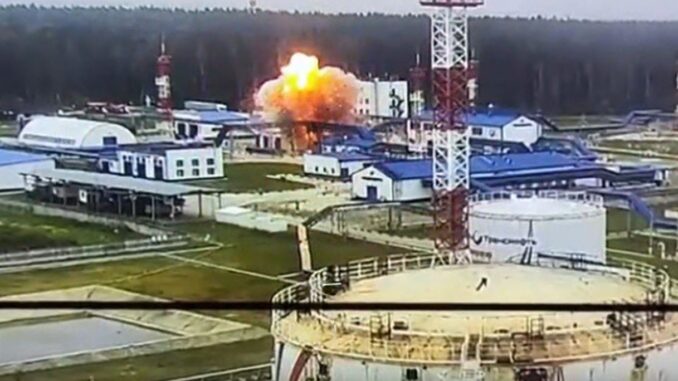
In a dramatic escalation of the energy war tied to the Russia-Ukraine conflict, Ukrainian drones struck a critical Russian pumping station feeding the Druzhba oil pipeline on the night of February 22-23, 2026. The attack on the Kaleykino facility in Tatarstan — more than 1,200 km (750 miles) inside Russia — has further disrupted supplies to Hungary and Slovakia, the last two EU countries still heavily reliant on Russian crude via the Soviet-era pipeline.
Ukrainian security service (SBU) sources confirmed the strike, describing it as targeting a key hub where oil from Western Siberia and the Volga region is aggregated and pumped into the Druzhba southern branch. Multiple explosions rocked the Transneft-operated site near Almetyevsk, igniting fires at pump lines and crude storage tanks. Geolocated footage showed thick black smoke and orange flames visible for kilometers. Russia’s air defenses claimed to have downed several drones, with falling debris sparking the blaze, but independent reports and Ukrainian statements indicate substantial damage to critical infrastructure.
Russia’s pipeline monopoly Transneft responded by cutting crude intake into its system by approximately 250,000 barrels per day (bpd). While the full extent of operational downtime remains unclear, the strike adds a new layer of pressure on the already halted southern Druzhba route.
Background: A Pipeline Already in Crisis
The Druzhba (Friendship) pipeline, with a total capacity of 1.2–1.4 million bpd across its network, has long been a lifeline for Central European refineries. Its southern branch, which splits in Ukraine near Uzhhorod before heading to Slovakia and Hungary, normally delivers 300,000–400,000 bpd of Russian Urals crude to these two countries combined.
Hungary: The MOL Danube refinery (165,000 bpd capacity) relies on Druzhba for 60–70% of its feedstock — roughly 100,000–115,000 bpd under normal conditions. Industry estimates suggest Hungary sources 80–90% of its total crude imports via this route.
Slovakia: The Slovnaft Bratislava refinery (120,000 bpd) has similar heavy dependence, with Druzhba supplying the bulk of its needs.
Flows stopped on January 27, 2026, after a Russian drone strike damaged pumping equipment at the Brody station in western Ukraine’s Lviv region. Ukraine has maintained that repairs are underway but complex; Hungary and Slovakia accuse Kyiv of deliberate delays for political leverage, claiming (with Russian confirmation) that the line is technically ready. As of February 24, Ukraine informed Slovak operators that resumption is now pushed to February 26 at the earliest.
Retaliation and Retribution from Budapest and Bratislava
Hungary and Slovakia have already taken strong reciprocal measures:Both suspended diesel exports to Ukraine, prioritizing domestic stocks.
Slovakia halted emergency electricity supplies to Ukraine after issuing a two-day ultimatum.
Hungary blocked EU approval of a new sanctions package against Russia and a €90 billion ($106 billion) loan package for Ukraine.
Slovak Prime Minister Robert Fico has warned of further steps, including reconsidering support for Ukraine’s EU accession path. Hungarian Foreign Minister Péter Szijjártó and Prime Minister Viktor Orbán have repeatedly called the situation “political blackmail” by Kyiv and vowed to maintain pressure until flows resume.
The Kaleykino attack — widely viewed in Budapest and Bratislava as direct retaliation for their threats — has intensified the rhetoric. Ukrainian statements appeared to anticipate backlash, noting expectations of “whining” from Orbán and Fico. Hungary has already received Russian assurances that any Kaleykino-related damage was quickly mitigated, but the broader disruption compounds the pain.
Economic Impact: Reserves Draining, Costs Rising
The shutdown has forced both countries into emergency mode:Slovakia declared an oil emergency on February 18 and began drawing down ~250,000 tons from strategic reserves.
Hungary’s MOL has released about 1.8 million barrels from stocks; the country held reserves covering roughly 96 days of consumption as of late January.
Refineries optimized for cheap Russian Urals crude now face higher costs for alternatives (sea imports via Croatia’s Adria pipeline, rail, or reverse flows from the Czech Republic). Fico has warned Adria could cost “five times higher” than Druzhba.
Short-term impacts include potential 5–10% spikes in fuel prices and reduced refinery throughput. Prolonged disruption risks 0.5–1% GDP hits through higher energy and transport costs in these landlocked economies. While reserves provide a buffer, sustained reliance on costlier non-Russian crude will strain budgets and refiners’ margins. Broader EU energy security is also under strain, highlighting the vulnerabilities of exemption-dependent infrastructure.
Ukraine has blown up the Druzhba-1 station at Kaleikino,the critical hub of the Druzhba oil pipeline.
This strike disrupts a line supplying 86% of Hungary’s oil and 100% of Slovakia’s.
In response, Slovakia has announced it will cut off electricity exports to Ukraine…… pic.twitter.com/IHztzQTAar
— Richard (@ricwe123) February 24, 2026
Repair Outlook and Costs
No official repair cost estimates have emerged for the Kaleykino strike yet, given its recency. Major pumping stations involve complex pumps, storage tanks, and control systems; similar past incidents suggest damages could run into the tens of millions of dollars, depending on the extent of fire damage to reservoirs and piping. Russia appears to have stabilized intake quickly in some reports, but full restoration of pre-attack throughput to the southern branch could take weeks if deeper infrastructure was hit.
On the Ukrainian side, the January 27 Brody damage repair timeline has slipped repeatedly, fueling accusations from Budapest and Bratislava. The European Commission has been pressing Kyiv for a clear schedule, emphasizing member-state energy security.
Broader Implications for Energy Security
This latest Druzhba incident underscores how the Russia-Ukraine war continues to ripple through European energy markets nearly four years in. For Hungary and Slovakia, the attacks — one Russian on Ukrainian soil, one Ukrainian deep in Russia — have turned a critical supply artery into a geopolitical flashpoint. As winter ends and the fourth anniversary of the full-scale invasion passes, the standoff tests EU unity and forces a reckoning with lingering Russian energy dependence in the east.
Should Zelensky sell his ski resort or his wife’s expensive car to pay for the damage they are imposing on innocent countries? Just asking as a US taxpayer tired of the expenses that we are paying.
Energy News Beat will continue monitoring developments, including any resumption of flows or further retaliatory steps. The situation remains fluid, with energy markets watching closely for price volatility in European refined products.
Get your CEO on the #1 Energy Podcast in the United States: https://sandstoneassetmgmt.com/media/
Is oil and gas right for your portfolio? https://sandstoneassetmgmt.com/invest-in-oil-and-gas/