


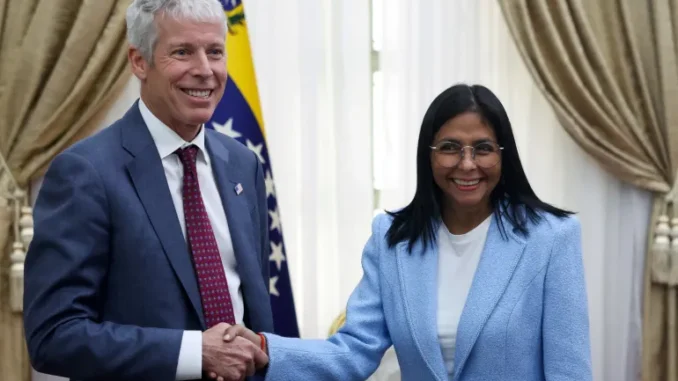
In a remarkable turnaround for Venezuela’s beleaguered oil sector, crude exports surged in February 2026, doubling from January levels amid a U.S.-supervised deal that has reshaped the country’s energy trade. This development not only boosts volumes but also enhances revenue, marking a shift from the discounted, shadow-market sales that dominated under previous sanctions. As the global energy landscape evolves, similar mechanisms could transform Iran’s oil economy, potentially freeing up billions for its citizens if diverted from funding regional militias.
Surging Export Volumes
Venezuela’s oil exports hit approximately 800,000 barrels per day (bpd) in January 2026, totaling around 24.8 million barrels for the month.
By February, under the U.S.-Venezuela agreement, shipments effectively doubled, with roughly 40 million barrels sold by month’s end.
This equates to an average of about 1.43 million bpd over February’s 28 days, a significant leap driven by the release of stored crude and renewed access to international markets.
The deal, which routes sales through U.S.-controlled channels, has unlocked stranded inventories and attracted buyers from the U.S., Europe, and Asia. U.S. refiners like Valero and Chevron have ramped up intakes, while Indian and European firms negotiate larger cargoes.
This oversight ensures transparent transactions, contrasting with the opaque, sanction-evading shipments that previously limited output to around 500,000-900,000 bpd in late 2025.
Revenue Boost: $2 Billion and Counting
The financial impact is equally striking. February sales under the pact are projected to generate $2 billion, with barrels fetching around $50 each—aligned with Merey heavy crude pricing under improved market access.
This revenue flows into U.S.-managed accounts, aimed at benefiting Venezuela’s population through humanitarian and reconstruction efforts.
Compared to prior years, this is a windfall. In 2023, Venezuela exported just $4 billion worth of oil annually, hampered by mismanagement and sanctions.
Projections suggest output could rise by hundreds of thousands of bpd in the near term, potentially yielding $12.6–$13.5 billion annually at $70–$75 per barrel.
Better Than Discounted Sales to China?
Historically, Venezuela relied heavily on China, shipping 50-90% of its exports there in 2025 at steep discounts.
Merey crude traded $14-21 below Brent, often netting $40-47 per barrel when Brent hovered around $60-70.
In November 2025, exports hit 921,000 bpd, with 80% to China at these reduced rates, yielding lower effective revenue due to shadow fleets, transshipment costs, and quality penalties.
Under U.S. oversight, prices have improved. Merey is now offered at just $6 below Brent for U.S. deliveries, versus the prior $14-21 gap.
With February’s Brent averaging around $70-72, the $50 per barrel realized under the deal represents a premium over previous China-bound sales. Net of logistics, this could add 20-30% more revenue per barrel, translating to billions annually if sustained. The shift reduces reliance on discounted, risky trades, stabilizing finances and curbing evasion costs.
Lessons for Iran: Billions More for the People?
Iran’s situation offers a compelling parallel. Despite sanctions, Tehran exported 1.3-1.6 million bpd in 2025, generating $35-53 billion in revenue.
However, steep discounts—$11-12 below benchmarks—erode earnings, with 80-90% going to China via shadow networks.
If a similar U.S.-style oversight lifted sanctions, allowing full-price sales, Iran could gain $5-8 billion extra annually from closing the discount gap alone, assuming 1.5 million bpd at $70-80 Brent. Broader access might boost volumes to 3-4 million bpd, potentially doubling revenue to $70-100 billion.
Critically, Iran allocates $1-2 billion yearly to proxies like Hezbollah ($700 million), Houthis ($100-300 million), Hamas ($100-350 million), and others in Iraq/Syria.
Redirecting this could fund domestic needs: education, healthcare, or subsidies amid 40% inflation and economic strain.
Ending proxy support might add $10-20 billion cumulatively for Iranians, fostering stability and reducing regional tensions—though geopolitical hurdles remain.
Outlook: A New Era for Sanctioned Oil?
Venezuela’s February surge underscores how oversight can revitalize sanctioned producers, prioritizing transparency and public benefit. For Iran, emulating this could unlock prosperity, but requires curbing militia funding. As energy markets adapt, these shifts highlight the interplay between geopolitics, prices, and people.
Sources: forbes.com, iranintl.com, usnews.com, forbes.com

Be the first to comment