As Winter Storm Fern barrels across the United States, blanketing much of the country in snow, ice, and record-low temperatures, the nation’s power grid is under immense pressure.
This massive weather event, impacting over 170 million Americans from the Northern Plains to the East Coast, has already led to widespread disruptions, including flight cancellations, hazardous roads, and significant power outages.
With wind chills dropping to 40-50 degrees below zero in some areas and sub-zero temperatures spreading as far south as Texas and the Carolinas, energy demand is surging while supply faces challenges from frozen infrastructure and strained resources.
In this article, we’ll explore what powers the U.S. grid during such extreme conditions, focusing on the current generation mix across major regional grid operators. We’ll break down key sources like wind, solar, storage, coal, and hydro, and assess how the grid is performing amid the storm, including any major outages. Data is drawn from real-time dashboards as of late January 24, 2026, with the storm’s peak effects unfolding into January 25.
The Storm’s Impact on the Grid
Winter Storm Fern has strained the U.S. power grid, exposing vulnerabilities similar to past events like the 2021 Texas freeze.
Grid operators are scrambling to avoid blackouts as natural gas supplies tighten and demand spikes for heating.
The cold has caused issues like frozen power plants and ice buildup on transmission lines, which can delay restorations and prolong outages.
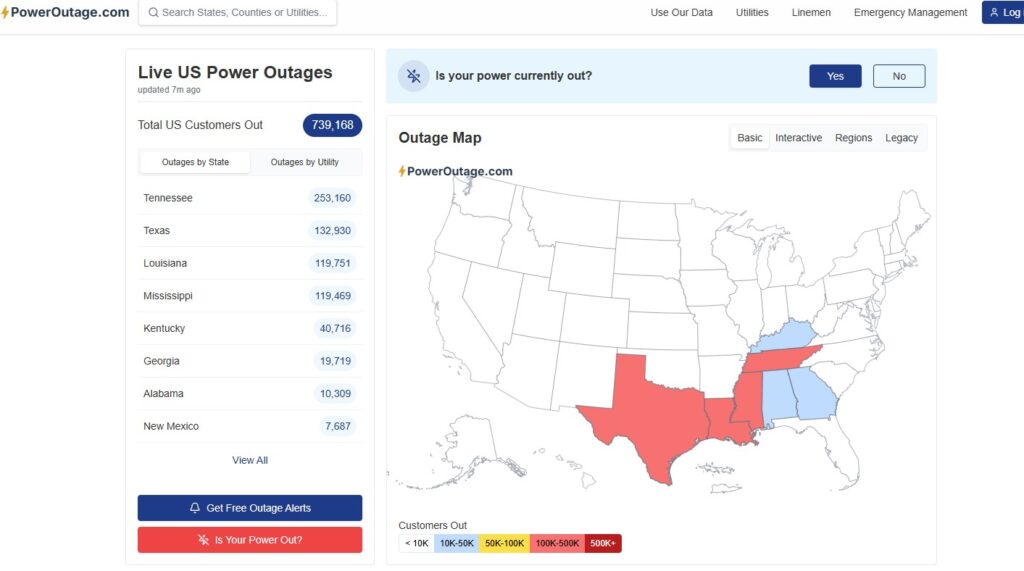
As of January 24, 2026, more than 600,000 households and businesses were without power, primarily due to the storm’s snow, ice, and high winds.
Other reports indicate over 500,000 outages nationwide, with additional figures around 135,000 tied directly to the weather event.
Major affected regions include the Midwest, Northeast, and parts of the South, where ice accumulation has led to tree damage and downed lines.
Texas’ grid, managed by ERCOT, is facing a critical test but has seen improvements since 2021, reducing blackout risks.
Overall, the grid is holding, but operators like PJM and ISO-NE have issued conservation alerts to manage escalating stress from the frigid blast.
FEMA is coordinating responses, and President Trump has emphasized federal preparedness to support state and local efforts.
While widespread blackouts have been averted so far, prolonged cold through early February could exacerbate issues, with another Arctic surge expected around January 29-31.
Current Power Generation Mix: A Breakdown
The U.S. power grid isn’t a single entity but a patchwork of regional operators, each with its own mix of energy sources. During storms, reliable baseload sources like natural gas and nuclear often dominate, while renewables like wind and solar can fluctuate due to weather. Storage (e.g., batteries) helps balance intermittency, but its role remains small.Below, we provide breakdowns for key grid operators: ERCOT (Texas), PJM (Mid-Atlantic and Midwest), and ISO-NE (New England). These represent major portions of the U.S. grid. Data reflects real-time snapshots from January 24, 2026, around evening hours when demand peaks. Note: Coal is phasing out in many regions, hydro varies with water levels, and solar output is minimal at night or under cloud cover. Storage is often net-negative during discharge.
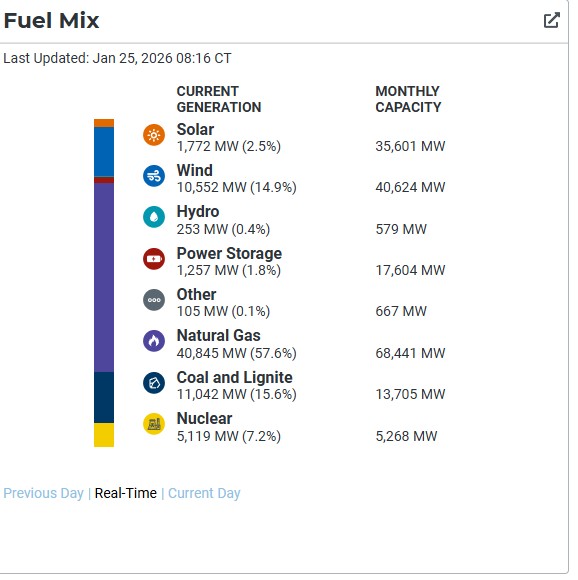
ERCOT, serving most of Texas, relies heavily on natural gas amid the cold snap. Total generation: ~67,613 MW (as of 22:26 CT).
|
Source
|
MW
|
Percentage
|
|---|---|---|
|
Natural Gas
|
40,157
|
59.4%
|
|
Wind
|
11,682
|
17.3%
|
|
Coal
|
10,978
|
16.2%
|
|
Nuclear
|
5,121
|
7.6%
|
|
Storage
|
-524
|
-0.8%
|
|
Hydro
|
94
|
0.1%
|
|
Solar
|
0
|
0.0%
|
|
Other
|
105
|
0.2%
|
Wind has held strong despite the storm, but solar is zero post-sunset. Storage is discharging to support the grid.
Texas’s ERCOT invested 150 billion in wind and solar, only to have insufficient base load. We are releasing a great podcast with Brent Bennett from the Texas Public Policy Foundation that covers the Texas ERCOT grid system.
Very timely considering the huge storm systems about… pic.twitter.com/aOhLLsiN6y
— STUART TURLEY – Energy Podcast Host (@STUARTTURLEY16) January 22, 2026
It made it to Oklahoma pic.twitter.com/nlAoO3c4uO
— STUART TURLEY – Energy Podcast Host (@STUARTTURLEY16) January 24, 2026
PJM covers 13 states and D.C., with a diverse mix. Total generation: 128,820 MW (as of 1:00 p.m. EPT). Renewables total 7,106 MW, but full breakdowns aren’t detailed; coal, gas, and nuclear dominate, with hydro and wind contributing to renewables.
|
Source
|
Estimated Contribution (Based on Typical Mix)
|
|---|---|
|
Natural Gas
|
High (40-50%)
|
|
Coal
|
Moderate (20-30%)
|
|
Nuclear
|
Significant (20-25%)
|
|
Wind
|
Part of renewables (~3-5%)
|
|
Solar
|
Low (daytime only, ~1-2%)
|
|
Hydro
|
Moderate (~2-4%)
|
|
Storage
|
Minimal
|
The grid is stressed but stable, with natural gas as the marginal fuel.
ISO-NE (New England) Generation Mix
ISO-NE is leaning on oil and gas for peaking power during the storm. Approximate evening snapshot: ~18,410 MW total.
|
Source
|
MW
|
Percentage (Est.)
|
|---|---|---|
|
Oil
|
7,489
|
27%
|
|
Natural Gas
|
5,169
|
40%
|
|
Nuclear
|
3,362
|
18%
|
|
Renewables (Total)
|
1,715
|
10%
|
|
– Wind
|
~1,028
|
~6%
|
|
– Solar
|
~5
|
<1%
|
|
Hydro
|
641
|
3%
|
|
Coal
|
1
|
<1%
|
|
Storage/Other
|
33
|
2%
|
Coal is nearly phased out here, and wind remains a key renewable despite the winds. Hydro provides stability.
41% as of 10:10 PM pic.twitter.com/fFcCA1facx
— George Regnery (@georgeregnery) January 25, 2026
How the Grid is Holding Up
Despite the challenges, the U.S. grid is demonstrating resilience. Improvements in Texas since 2021 have helped, and operators are using demand-response programs to conserve energy.
However, with the storm causing ice-related outages in the South and heavy snow in the Northeast, restorations could take days.
Natural gas, making up 40-60% in many regions, is the workhorse, but surging prices highlight supply vulnerabilities.
Renewables like wind are performing well in some areas (e.g., 17% in ERCOT), but solar is limited by the storm’s timing.
As the cold persists, monitoring tools like those from the EIA and regional ISOs will be crucial. Stay informed, conserve energy, and heed local warnings to help keep the lights on.
Stuart Turley is the host of the Energy News Beat podcast, bringing you the latest in energy developments.
Get your CEO on the podcast: https://sandstoneassetmgmt.com/media/
Is oil and gas right for your portfolio? https://sandstoneassetmgmt.com/invest-in-oil-and-gas/