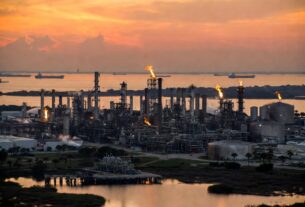
In a bold escalation of its campaign against Russia\’s shadow fleet, Ukraine has carried out its first drone strike on a Russian-linked oil tanker in the Mediterranean Sea, marking a significant expansion of the conflict beyond the Black Sea region.
The attack on the Oman-flagged tanker Qendil, which occurred off the Libyan coast on December 19, 2025, has ignited debates about the limits of warfare and the potential for broader international fallout.
As tensions rise, questions abound: How far is too far when targeting vessels in neutral waters, and what does this mean for global energy security?
The Strike: Details and Verification
Ukrainian security services confirmed the operation, stating that aerial drones disabled the 250-meter-long Qendil more than 1,200 miles from Ukraine\’s borders.
Sources familiar with the incident, including Ukrainian officials, have verified that the tanker was empty at the time of the strike, eliminating the risk of an environmental disaster such as an oil spill.
The vessel, part of Russia\’s infamous \”dark fleet\” or \”shadow fleet\”—a network of aging, often uninsured tankers used to evade Western sanctions—was en route from the Indian port of Jamnagar when it was hit.
This fleet has been instrumental in transporting oil from sanctioned nations like Russia, Iran, and Venezuela, bypassing restrictions imposed since Russia\’s invasion of Ukraine in 2022.
The strike represents a tactical shift for Ukraine, which has intensified drone attacks on Russian energy infrastructure throughout 2025, including over 100 strikes on refineries and storage facilities.
However, this is the first such operation in the Mediterranean, raising concerns about the potential for collateral damage to international shipping lanes and the involvement of third-party nations.
Sanctions\’ Limited Impact Until Now
Western sanctions, including the EU\’s price cap on Russian oil and restrictions on maritime services, were designed to cripple Russia\’s war machine by slashing its energy revenues. Yet, for much of the conflict, these measures have fallen short. Russia\’s shadow fleet enabled the country to maintain robust exports, reaching a record high in October 2025 despite ongoing pressures.
In November, Russia still exported around 4.5 million barrels per day (bpd) of crude to non-former Soviet Union states, primarily via Asia-focused routes, demonstrating the fleet\’s role in sustaining revenue streams.
The resilience of Russia\’s economy amid sanctions has been notable, with oil and gas revenues holding steady until recent escalations.
However, the tide is turning. Ukrainian drone strikes, combined with harsher weather and infrastructure damage, led to lower-than-planned exports from Black Sea terminals in November.
Tankers are now rerouting to avoid high-risk areas, adding hundreds of miles to journeys and increasing costs.
Experts warn that sustained drone interventions could reduce Russian exports to as low as 2.8 million bpd if sanctions tighten further.
U.S. Enforcement Signals a New Era
The U.S. has ramped up its own efforts against dark fleets, signaling a tougher stance on global sanction evasion. On December 10, 2025, U.S. authorities seized the Venezuelan-flagged tanker Skipper in the Caribbean Sea off Venezuela\’s coast, marking the first such action under the Trump administration\’s renewed focus.
This seizure, followed by President Trump\’s order for a blockade of over 30 sanctioned tankers, has paralyzed Venezuelan oil shipping, reducing exports by 76% in the immediate aftermath.
These moves extend beyond Venezuela, with the U.S. preparing additional seizures and the EU sanctioning 41 more tankers in December 2025.
The actions have shrunk the shadow fleet\’s capacity by about 46% through early 2025 measures, targeting not just Russian but also Iranian and Venezuelan vessels.
This coordinated enforcement is seen as a direct response to the fleet\’s role in funding regimes under sanctions, potentially setting a precedent for more aggressive interventions worldwide.
OPEC+ as the Unlikely Beneficiary
As disruptions mount, OPEC+ stands to gain from a tighter global oil market. Reduced supplies from Russia, Iran, and Venezuela—potentially cutting Russian exports by 0.5-1 million bpd in the short term—could drive up prices and allow OPEC+ members to capture greater market share.
The group\’s 2025 production capacity reassessment, with estimates showing increases of 0.22 million bpd in 2024 and 0.37 million in 2025, positions it well to offset losses and stabilize prices.
Analysts suggest that shadow fleet crackdowns could benefit OPEC+ by limiting non-OPEC supply growth, especially amid projections of a global oil surplus in 2026.
However, geopolitical risks, including potential regime changes or peace deals, could swing prices dramatically, from $40 per barrel in a glut scenario to higher levels if disruptions persist.
Projecting Russia\’s Revenue Impact in 2026
Assessing the long-term revenue impact on Russia requires examining current trends and forecasts. Russia\’s oil and gas revenues have already declined 23% in 2025, falling to levels not seen since the early days of the invasion.
Baseline projections indicate a further 12.5% drop in 2025 to around $206 billion, with 2026 potentially seeing revenues slide 50% to a five-year low due to sanctions, drone strikes, and market dynamics.
If stronger enforcement and a lower price cap (e.g., $30 per barrel) take hold, revenues could plummet to as low as $46 billion in 2026.
Sanctions alone may reduce oil and gas export revenues by 15% in 2026, compounded by a 10% price factor.
Dark fleet disruptions, including drone attacks, could exacerbate this by forcing higher transport costs and lower export volumes, though Russia\’s adaptive strategies—like rerouting and reserve capacity—may mitigate some losses.
To quantify precisely, ongoing monitoring of export data from sources like the International Energy Agency (IEA) and Russia\’s Finance Ministry will be essential, as global supply growth (projected at 2.4 million bpd in 2026) adds volatility.
Conclusion: A Precarious Balance
Ukraine's Mediterranean strike underscores a new phase in the energy war, where drones and seizures are bridging the gaps left by traditional sanctions. While the immediate environmental risks were averted with the empty tanker, the broader implications—escalation, market shifts favoring OPEC+, and Russia's looming revenue crunch—could reshape global energy dynamics in 2026. As the world watches, the question remains: Will these tactics force a reevaluation of "how far is too far," or merely entrench divisions further?
Sources: timesofindia.indiatimes.com, russiamatters.org, freepolicybriefs.org, energynewsbeat.co/, moderndiplomacy.eu

,