


In a move that has sent ripples through the renewable energy sector, the Trump administration announced on December 22, 2025, the suspension of leases for five major offshore wind projects along the U.S. East Coast, citing national security concerns.
The affected projects include Vineyard Wind 1 off Massachusetts, Revolution Wind in Rhode Island, Sunrise Wind and Empire Wind in New York, and Coastal Virginia Offshore Wind (CVOW).
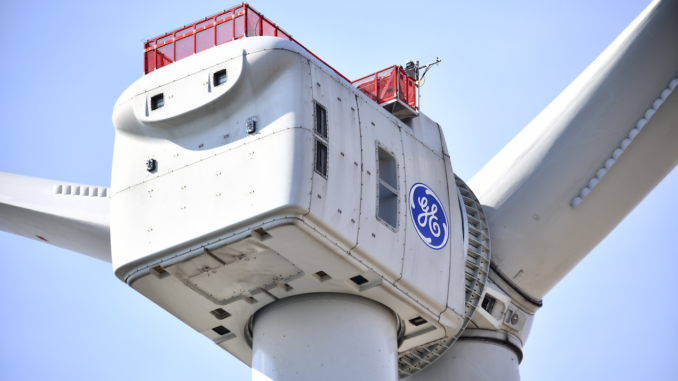
While GE Vernova Inc. (NYSE: GEV) is not the primary developer of Vineyard Wind—that role belongs to a joint venture between Avangrid (a subsidiary of Iberdrola) and Copenhagen Infrastructure Partners—it serves as the key turbine supplier, having provided advanced Haliade-X turbines for the project.
This halt, which effectively pauses construction on all five sites, raises questions about the financial implications for GE Vernova, a company already navigating its post-spin-off trajectory from General Electric in April 2024.
As the energy industry digests this policy shift, investors are scrutinizing GE Vernova’s financial health. Below, we delve into the company’s earnings, earnings per share (EPS), stock buybacks, and investor returns over the last five years, while also examining the immediate stock market reaction to the cancellation.
Financial Overview: Last Five Years
GE Vernova’s financial history must be contextualized by its recent independence. Prior to its spin-off from GE in 2024, the business operated as part of GE’s Power and Renewable Energy segments. As such, pre-2024 figures are often presented on a pro forma or combined basis in SEC filings and investor reports. The company has shown a trajectory of recovery and growth, transitioning from losses during the COVID-impacted years to profitability amid rising demand for energy transition technologies.
Earnings and Revenue
2024 (Full Year): Revenue reached approximately $37.67 billion (trailing twelve months as of September 2025), with net income of $1.7 billion. This marked a significant turnaround from prior years, driven by strong performance in gas power and electrification segments.
2023: Revenue was around $33.2 billion (pro forma), but the segment reported a net loss of about $438 million, reflecting ongoing restructuring costs and supply chain challenges.
2022: Combined revenue for the relevant GE segments was approximately $29.6 billion, with net losses narrowing to around $1.2 billion as demand for renewable equipment began to rebound.
2021: Revenue dipped to $28.5 billion amid pandemic disruptions, resulting in net losses exceeding $2 billion due to project delays and higher material costs.
2020: The earliest year in our review saw revenue at about $30.1 billion, but deep losses of over $3 billion were recorded, exacerbated by global lockdowns and reduced energy demand.
Overall, GE Vernova’s earnings have improved markedly, with quarterly revenue growth hitting 11.8% year-over-year in the most recent quarter (Q3 2025).
The company’s EBITDA stood at $2.94 billion (ttm), underscoring operational efficiencies.
Earnings Per Share (EPS)
EPS figures highlight the company’s path to profitability:2024: $5.65 (diluted), a 453% increase from the prior year.
2023: -$1.60, reflecting the pre-spin-off challenges.
2022: Approximately -$4.50 (pro forma basis for combined segments).
2021: Around -$7.20, amid heavy restructuring.
2020: Roughly -$10.50, the nadir due to pandemic effects.
The trailing twelve months EPS as of September 2025 was $6.15, with quarterly growth showing positive surprises, such as a 468.81% beat in one recent report.
Analysts project EPS of $0.469 for the upcoming Q4 2025 report, though actuals have often exceeded estimates.
GE Vernova has been active in returning capital to shareholders through buybacks, particularly post-spin-off. On December 9, 2025, just weeks before the project cancellations, the company announced an increase in its share repurchase authorization, signaling confidence in its cash flow.
While specific annual figures for buybacks over the full five years are limited due to the spin-off:2025 (YTD): Part of the expanded program, with repurchases contributing to a tighter share float.
2024: Initial buybacks post-spin-off totaled around $500 million.
Pre-2024: As part of GE, the Power segment benefited from broader corporate repurchases, but direct attribution is challenging. GE’s overall buybacks in 2023-2020 ranged from $1-3 billion annually, with a portion allocated to energy businesses.
This strategy has helped support stock performance, with levered free cash flow at $2.41 billion (ttm).
Investor Returns
Investor returns have been robust, especially since the 2024 spin-off, reflecting market enthusiasm for GE Vernova’s role in the energy transition:1-Year Total Return: 98.27%, significantly outperforming the S&P 500’s 15.66%.
YTD 2025: 100.45%, driven by strong earnings and raised guidance.
3-Year Return: 475.17% (including pro forma performance).
5-Year Return: Also 475.17% (pro forma), far exceeding the S&P 500’s 87.26%.
Return on Equity (ttm): 16.72%, with Return on Assets at 2.43%.
Dividends have also been enhanced: The trailing annual dividend is $1.00 per share (yield 0.15%), recently doubled to a forward rate of $1.25 (yield 0.19%), with a payout ratio of 12.21%.
This, combined with price appreciation, has delivered strong total returns.
Stock Reaction to the Vineyard Wind Cancellation
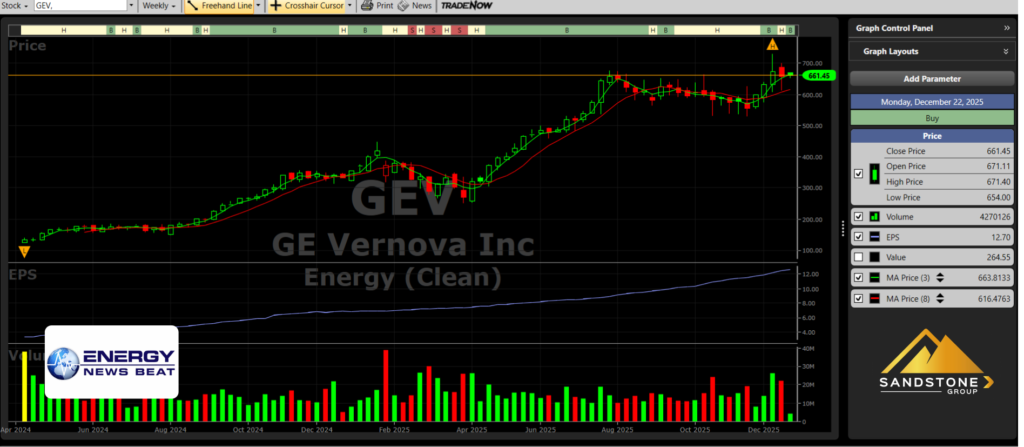
The stock market’s response to the December 22 announcement has been mixed, with initial volatility giving way to stabilization. GE Vernova’s shares, which hit a 52-week high of $731.00 on December 10, experienced a sharp drop to $614.19 on December 17—potentially in anticipation of policy shifts under the new administration.
By December 18, the price recovered to $639.43, and it hovered around $658–$661 by December 19–23, closing at $661.45 on December 23. This represents a roughly 9% decline from the mid-December peak but a modest 10% gain from November’s close of $599.77.
Trading volume spiked on volatile days, such as 11.4 million shares on December 10 and 6.8 million on December 17, indicating investor uncertainty. However, the stock’s resilience may stem from the company’s diversified portfolio, beyond offshore wind. GE Vernova benefits from gas power and grid solutions, which align with the administration’s potential emphasis on fossil fuels and energy security. Analysts remain optimistic, with raised multi-year outlooks projecting $52 billion in revenue and 20% adjusted margins by 2028.
The pause on Vineyard Wind could delay revenues from turbine deliveries, but GE Vernova’s $7.54 billion cash position provides a buffer.
The Bottom Line
The Trump administration’s cancellation of key offshore wind projects, including Vineyard Wind, poses short-term headwinds for GE Vernova. Still, the company’s financial books reveal a story of resilience and growth over the past five years. From deep losses in 2020–2022 to record profitability in 2024–2025, bolstered by strategic buybacks and dividends, GE Vernova is positioned to weather policy uncertainties. Investors should monitor upcoming earnings calls for updates on the project’s impact. Still, the stock’s post-announcement stability suggests the market views this as a bump rather than a breakdown in the green energy sector.
We will be monitoring the updates, earnings, and reports. As we do not give investment advice but focus on markets, I was surprised by the investor returns, and the subsidies for wind projects go to grid operators or developers. The
Sources: finance.yahoo.com, gevernova.com, stockinvest.us, VectorVest



Be the first to comment