By Stuart Turley, Energy News Beat
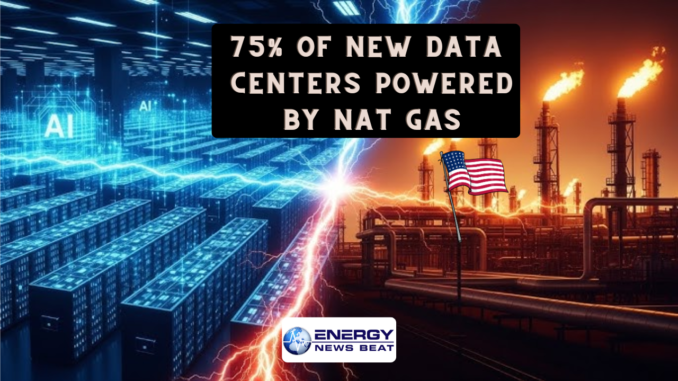
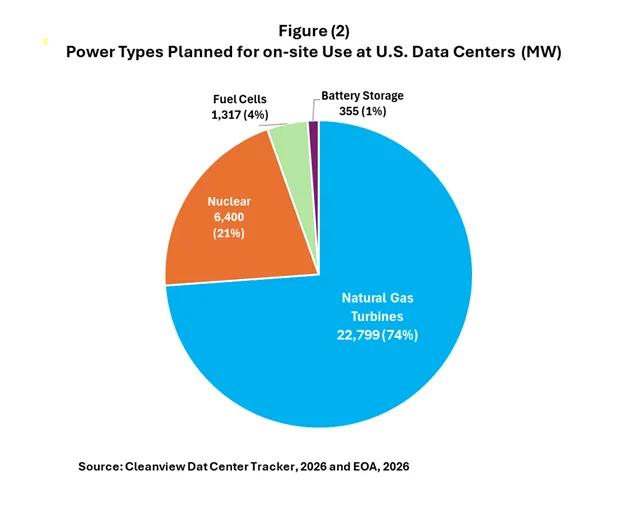
In a landscape where artificial intelligence and data processing demands are skyrocketing, data center operators are increasingly bypassing traditional grid connections to build their own power generation facilities. A recent report from Cleanview, a market intelligence platform focused on the energy transition, reveals a striking trend: nearly 75% of the identifiable on-site power equipment for these facilities is powered by natural gas. This shift underscores the reliability and speed-to-market advantages of natural gas amid grid delays that can stretch up to seven years.
We have a new series coming out on AI, Data Centers, and Power Impacts. Stu Turley has several CEOs and industry leaders committing, and we are in the process of scheduling those interviews for the Energy News Beat podcast.
The report, titled “Bypassing the Grid: How Data Centers Are Building Their Own Power Plants,” analyzes 46 data centers planning behind-the-meter (BTM) power generation, with a combined capacity of 56 gigawatts (GW).
This represents approximately 30% of all planned data center capacity in the United States, according to Cleanview’s project tracker.
Notably, 90% of these projects—accounting for about 50 GW—were announced in 2025 alone, highlighting the rapid acceleration driven by AI’s insatiable energy needs.
Of the 23 GW where generation equipment could be specified through permits and site plans, around 75% is natural gas-fired.
While developers often publicly emphasize renewables, hydrogen, or nuclear options, the short-term installations for 2026 and beyond are almost entirely gas-powered.
This reliance on natural gas stems from its ability to provide reliable, dispatchable power, contrasting with the intermittency of wind and solar. As Anas Alhajji, a prominent energy analyst, noted in a related discussion on X, natural gas complements data centers by offering the high-reliability supply they require, especially as operators seek to reduce flaring and market associated gas from oil fields.
Alhajji’s insights align with broader bullish sentiments on natural gas and LNG, reinforced by surging demand from AI and data infrastructure.
Breaking Down the Data: How Many Data Centers and Where?
Cleanview’s analysis identifies 46 specific data centers opting for on-site power to circumvent grid bottlenecks.
These projects are not evenly distributed; instead, development is heavily concentrated in regions with abundant natural gas resources and developer-friendly regulations. Just five states account for 83% of the proposed BTM capacity:
Texas: Leading the pack with the highest number of projects, thanks to its proximity to the Permian Basin—the largest oil and gas-producing region in the U.S.—and an extensive pipeline network. Texas alone is seeing proposals for nearly 58 GW of new natural gas power in various stages, much of it tied to data centers.
Examples include OpenAI’s Stargate facility in Abilene, which plans to incorporate 10 natural gas turbines totaling 361 MW.
New Mexico: Also benefiting from the Permian Basin’s gas supplies, with projects leveraging existing pipeline infrastructure for quick deployment.
Pennsylvania: Home to the Marcellus Shale, one of the world’s largest natural gas fields. A standout project is the Homer City Energy Campus, a proposed 4.5 GW natural gas plant dedicated entirely to an on-site data center, with permits already secured and operations expected by 2027.
Utah and Wyoming: These Rocky Mountain states are attracting developments due to their natural gas fields, such as the Jonah Field in Wyoming and various basins in Utah, combined with conducive policies that enable rapid infrastructure build-out.
This geographic clustering is no coincidence. Proximity to major natural gas hubs like the Permian (Texas/New Mexico), Marcellus (Pennsylvania), and Rocky Mountain fields (Utah/Wyoming) minimizes transportation costs and ensures fuel availability.
Extensive pipelines, including those operated by major players like Kinder Morgan and Energy Transfer, facilitate direct connections, allowing data centers to tap into reliable supplies without relying on overburdened grids.
Implications for Natural Gas Infrastructure
The surge in on-site natural gas generation highlights creative—and sometimes unconventional—solutions to turbine shortages. Lead times for traditional gas turbines have ballooned to 5-7 years, prompting developers to source alternatives like mobile generators on semitrucks, repurposed aircraft or cruise ship turbines, and even a $1.25 billion deal with Boom Supersonic for jet-engine-derived units.
Elon Musk’s xAI, for instance, famously trucked in natural gas generators for its Memphis facility, which briefly held the title of the world’s largest data center.
However, this rush comes with trade-offs. Many of these setups use less efficient technologies, potentially increasing emissions and operational costs.
Still, for energy stakeholders, the trend signals a boon for natural gas demand, which could drive up Henry Hub prices while keeping global LNG competitive, as Alhajji has pointed out in his analyses.
Investment Opportunities: Companies to Watch
For investors eyeing the intersection of AI-driven energy demand and natural gas, several companies stand out based on their roles in production, transportation, equipment supply, and development:
Natural Gas Producers: Look to majors in key regions like ExxonMobil and Chevron in the Permian Basin, or EQT and Chesapeake Energy in the Marcellus Shale. These firms benefit from increased demand for associated gas and reduced flaring incentives.
Pipeline Operators: Companies such as Kinder Morgan, Williams Companies, and Energy Transfer own critical infrastructure in Texas, Pennsylvania, and the Rockies, positioning them for higher throughput and potential expansions.
Equipment Suppliers: Turbine and generator manufacturers are seeing a windfall. GE Vernova, Caterpillar, Siemens Energy, and Doosan have secured deals for two-thirds of the projects analyzed.
Additionally, innovative players like Boom Supersonic are entering the fray with specialized offerings.
Data Center Developers and Tech Giants: Firms like Crusoe Energy (partnering with OpenAI) and xAI are directly involved in BTM projects, while hyperscalers such as Microsoft, Google, and Amazon may indirectly boost the sector through their AI expansions.
This natural gas renaissance, fueled by data centers, could reshape U.S. energy markets. As Alhajji emphasizes, the synergy between reliable power and gas resources makes this a compelling space for long-term investment.
Stay tuned to Energy News Beat for more updates on how AI is transforming the energy landscape.
Sources: cleanview.co, @anasalhajji on X, blackmon.substack.com
In a landscape where artificial intelligence and data processing demands are skyrocketing, data center operators are increasingly bypassing traditional grid connections to build their own power generation facilities
Get your CEO on the podcast: https://sandstoneassetmgmt.com/media/
Is oil and gas right for your portfolio? https://sandstoneassetmgmt.com/invest-in-oil-and-gas/