


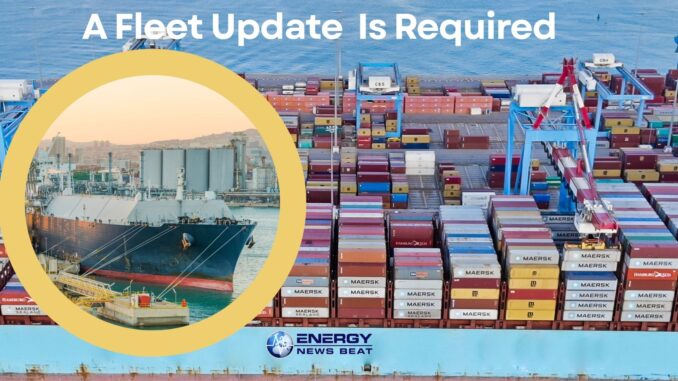
In an era where energy security underpins national strength, the U.S. Merchant Marine Fleet stands as a critical yet underappreciated asset. Once a powerhouse of global trade, the fleet has dwindled, leaving America vulnerable in an increasingly contested maritime landscape. With only around 80 to 90 U.S.-flagged vessels engaged in international commerce, the fleet represents a fraction of the global total of over 110,000 merchant ships.
This decline not only hampers economic resilience but also threatens energy dominance, as the U.S. relies heavily on foreign-flagged ships to export record levels of oil, natural gas, and LNG. As Stuart Turley, host of the Energy News Beat podcast, aptly puts it: “Energy security starts at home, but your energy dominance is demonstrated through your exports.” Revitalizing the Merchant Marine is essential to safeguarding these exports amid rising geopolitical tensions, shadow fleets, and insurance challenges.
The Current State: A Fleet in Decline
The U.S. Merchant Marine Fleet, vital for commercial trade and military sealift, faces severe shortages in both ships and qualified mariners. As of 2026, the fleet’s international trading capacity is limited to fewer than 90 vessels, dwarfed by China’s over 5,500.
A 2020 report highlighted the need for at least 250,000 additional workers in shipyards over the next decade, while aging infrastructure and regulatory hurdles exacerbate the issues.
Domestically, the fleet supports critical energy transport, but its diminishment means reliance on foreign vessels for 99% of international maritime trade, posing risks to supply chains and national security.
The Trump administration’s Maritime Action Plan (MAP), released in February 2026, diagnoses this as a core vulnerability, noting only 66 shipyards nationwide, with just eight active in building.
The plan calls for urgent expansion, including a 20% increase in cadet enrollment at the U.S. Merchant Marine Academy and streamlined Coast Guard credentialing to address mariner shortages.
Trump’s Vision: Transforming Shipping, Oil, and Gas Markets
President Trump’s strategy emphasizes “energy dominance” through exports, with MAP as the blueprint for revitalizing shipping. Key proposals include fees on foreign-built vessels entering U.S. ports to generate billions for a Maritime Security Trust Fund, expanded cargo preferences for U.S.-flagged ships, and incentives like tax credits for domestic shipbuilding.
This aims to add 250 U.S.-flagged ships in a decade via a Strategic Commercial Fleet program.
In oil and gas, Trump has prioritized LNG exports, authorizing over 17.6 Bcf/d in 2025—70% more than current global second-place volumes.
Amid the 2026 Iran conflict, a $20 billion maritime reinsurance program through the U.S. International Development Finance Corporation (DFC) provides war-risk coverage and naval escorts for Gulf shipping, countering Hormuz disruptions.
This ensures U.S. energy flows, with crude production hitting 13.6 million b/d in 2025 and projected growth.
Trade policies, including tariffs, aim to boost domestic production while pressuring adversaries. For instance, sanctions on Venezuelan and Iranian oil have disrupted shadow fleets, indirectly supporting OPEC+ limits by sidelining illicit exports.
I am grateful to @POTUS and @SecScottBessent for their support and approval of @DFCgov‘s plan to restore confidence in maritime trade and stabilize international markets.
Working alongside @CENTCOM, DFC coverage will offer a level of security no other policy can provide.
We…
— Ben Black (@DFC_CEO) March 6, 2026
Curbing Dark Fleets: Enforcing OPEC Limits and Sanctions
Dark or shadow fleets—aging, uninsured tankers evading sanctions—transport millions of barrels of oil from Russia, Iran, and Venezuela outside OPEC/OPEC+ quotas. In 2025, these fleets moved $90 billion in Russian oil, with Iran’s exports at 3.2 million b/d despite sanctions.
Over 1,900 vessels now operate in this network, comprising 10-20% of global tankers.
Trump’s approach includes sanctions on 183 tankers, seizures (e.g., Venezuelan vessels), and interdictions to raise costs and enforce compliance.
In the Baltic, U.S. actions have forced Russia to go on the defensive, with Europe sanctioning hundreds of vessels.
Implementation involves boarding suspicious ships and leveraging UNCLOS for seizures, aiming to sideline illicit flows and stabilize prices.
LNG Shipping on Uninsured Carriers: Risks and Regulations
Shipping LNG on uninsured carriers, often part of shadow fleets, poses severe risks: environmental spills, safety hazards, and financial liabilities. Without insurance, operators evade scrutiny, increasing accident probabilities in high-traffic areas.
Regulations via IMO’s Net Zero Framework and EU ETS impose emissions penalties, making non-compliant vessels unviable by 2035.
Overcapacity from 320+ new carriers risks stranded assets amid climate goals, with freight rates plummeting.
Trump’s reinsurance counters this for legitimate trade, but shadow LNG persists, undermining dominance.
LNG Growth considering Qatar’s Shut-in – Projected US LNG Export Capacity by Year
Based on Incorrys data, which aligns closely with EIA and IEA estimates, here’s a breakdown of cumulative US LNG export capacity. These figures aggregate contributions from major terminals like Sabine Pass, Corpus Christi, and emerging projects.
|
Year
|
Projected Capacity (Bcf/d)
|
Key Additions/Notes
|
|---|---|---|
|
2026
|
17.9
|
Golden Pass ramps to 1.6 Bcf/d; Corpus Christi to 3.2 Bcf/d; Plaquemines to 2.7 Bcf/d. Total adds ~2.5 Bcf/d from 2025. incorrys.com
|
|
2027
|
18.7
|
Golden Pass expands to 2.4 Bcf/d (+0.8 Bcf/d). incorrys.com
IEA notes CP2 Phase 1 (1.9 Bcf/d equivalent) and Port Arthur Phase 1 (1.8 Bcf/d) online. iea.org
|
|
2028
|
22.0
|
Port Arthur Phase 1 at 1.8 Bcf/d; Rio Grande initial 1.6 Bcf/d. Adds ~3.3 Bcf/d. incorrys.com
|
|
2029
|
23.5
|
Calcasieu Parish at 0.7 Bcf/d; Rio Grande to 2.4 Bcf/d (+0.8 Bcf/d). Louisiana LNG (2.2 Bcf/d equivalent) per IEA. |
|
2030
|
23.5
|
Stable from 2029; Port Arthur Phase 2 (1.8 Bcf/d) and Rio Grande Train 4 (0.8 Bcf/d) per IEA. Higher scenarios (e.g., ETF Trends) project up to 30 Bcf/d with all sanctioned projects. etftrends.com
|
Breaking Lloyd’s of London’s Stranglehold
Lloyd’s, founded in 1688, has dominated marine insurance for centuries, insuring everything from ships to slaves—drawing criticism for its “shameful” historical role.
In 2026, amid Gulf tensions, Lloyd’s withdrawal from Hormuz coverage highlighted vulnerabilities.
Trump’s DFC reinsurance challenges this, offering U.S.-backed alternatives to reduce dependence and ensure energy flows.
Implementation via fees and funds aims to foster domestic insurers.
How Trump Will Implement These Changes
Execution relies on MAP’s pillars: prosperity zones for investment, streamlined procurement, and a trust fund from foreign vessel fees (potentially $1.5 trillion over 10 years).
Congressional support via the SHIPS Act would create incentives and a revolving Title XI fund.
Naval escorts and reinsurance provide immediate relief amid the Iran war.
Insights from Key Sources
The gCaptain article reveals Iranian shadow fleets and Greek ships dominating Hormuz transits, with 90% tonnage drop due to attacks and insurance gaps. Sanctioned vessels disable AIS for evasion, heightening risks.
The X post by @shanaka86 details China’s aid to Iran for safe Hormuz passage, establishing bilateral deals that challenge U.S. maritime order. With 90% of Iran’s oil going to China, this “proof of concept” for post-American hegemony involves missile parts for transit rights.
Other Key Challenges for Energy Shipping
Beyond fleets, challenges include tariffs inflating costs (4-40% on components), geopolitical disruptions (e.g., Panama/Suez avoidance), and overcapacity in LNG shipping.
AI/data center demand strains grids, while shadow fleets risk supply crunches.
Guaranteeing shipping without tankers or insurance? Trump’s escorts and DFC coverage provide a path, but long-term dominance requires fleet revival.
In conclusion, updating the Merchant Marine isn’t optional—it’s imperative for exporting U.S. energy supremacy. As Turley says, dominance shines through exports; without secure shipping, it’s dimmed. Trump’s bold steps could light the way, but execution amid global shadows will define success.
Sources: maritimesailin.org, energynewsbeat.co, gcaptain.com, X, Grok, X post by @shanaka86, breakingdefense.com, maritime-executive.com, energy.gov
Get your CEO on the #1 Energy Podcast in the United States: https://sandstoneassetmgmt.com/media/
Is oil and gas right for your portfolio? https://energynewsbeat.co/invest/




Be the first to comment