


By Stuart Turley, Energy News Beat ChannelMarch 7, 2026 –
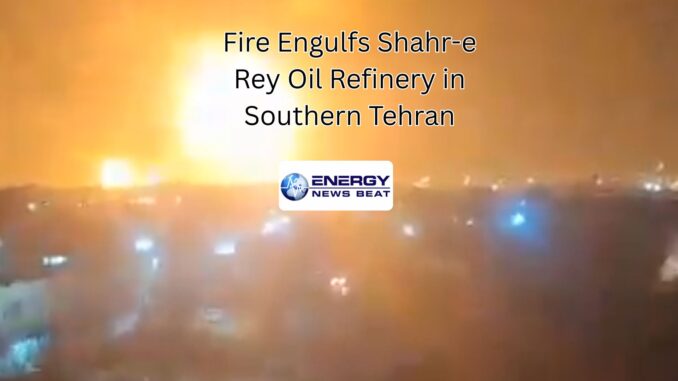
In a dramatic escalation of the ongoing conflict in the Middle East, a massive fire has broken out at the Shahr-e Rey oil refinery, also known as the Tehran Oil Refinery, located approximately 15 kilometers south of central Tehran.
Eyewitness videos and satellite imagery show flames shooting high into the sky, with thick plumes of smoke blanketing the area and turning the night sky crimson over southern Tehran.
This incident, reported late Saturday evening local time, marks a significant blow to Iran’s energy sector amid a broader war involving the United States, Israel, and Iran.
Who Struck the Refinery?
Multiple sources, including local reports and international media, attribute the fire to wide-scale Israeli airstrikes.
Israeli forces have been conducting targeted operations against Iranian infrastructure, with the Shahr-e Rey refinery emerging as a key hit in the latest wave of attacks.
The strikes are part of Israel’s broader campaign, codenamed Operation Rising Lion, which has expanded to include civilian and industrial targets following initial assaults on military and nuclear sites.
While the United States has been involved in joint operations with Israel, including strikes on Iranian nuclear facilities, the specific attack on the refinery appears to be led by Israeli forces.
Iranian officials have condemned the strikes as acts of aggression, with hardliners vowing continued retaliation.
No official confirmation from Israel has been issued, but the pattern aligns with recent escalations, including U.S.-Israeli airstrikes on Tehran that have caused widespread explosions and smoke across the capital.
The conflict, which intensified after U.S. and Israeli preemptive strikes on February 28, has now entered its eighth day, with both sides exchanging waves of missiles and drones.
Damage Assessment and Impact on Iran’s Gasoline and Diesel Supply
The Shahr-e Rey refinery is one of Iran’s oldest and most critical facilities, with a refining capacity of nearly 225,000 barrels per day (bpd).
It plays a vital role in distributing petrol, diesel, and aviation fuel to northern Tehran and surrounding regions.
Reports indicate that multiple storage tanks are burning, leading to a complete shutdown of operations.
The fire has consumed an estimated 19.5 million liters of fuel, equivalent to about 6% of Iran’s daily gasoline and diesel consumption during peak demand periods.
This loss could strain Iran’s already pressured fuel logistics, potentially leading to shortages in Tehran, the country’s most populous and economically vital region.
Iran produces around 3.3 million bpd of crude oil, plus 1.3 million bpd of condensate and other liquids, accounting for about 4.5% of global supplies.
Disruptions here could exacerbate domestic fuel price spikes and supply issues, especially if repairs are delayed amid ongoing hostilities.
Globally, the attack has contributed to oil price volatility, with Brent crude surging toward $80 per barrel in recent trading sessions.
Analysts predict that prolonged damage could push U.S. gasoline prices higher, potentially adding 20 cents per gallon if crude holds at current levels.
Iran’s Retaliatory Strikes on Key Targets in Other CountriesIn response to the U.S.-Israeli offensive, Iran has launched widespread retaliatory attacks on energy and military infrastructure across the Gulf and beyond. Tehran has targeted U.S. bases and allied facilities in at least six countries, including Bahrain, Kuwait, Qatar, Saudi Arabia, the UAE, and Iraq.
Look at the skyline tonight. A 360-degree view of Tehran, and everywhere you turn, the horizon is bleeding fire.
The Army refinery, Nobonyad, Shahr Rey, the Shahran oil depot
all of them burning in the dark.But understand this: when we see their infrastructure going up in… pic.twitter.com/YhagbgihL9
— 🇮🇷Decado🇮🇷 (@ItsDecado) March 7, 2026
Key strikes include:
Saudi Arabia’s Ras Tanura Refinery, one of the world’s largest, processing 550,000 bpd, was hit by Iranian drones, causing a fire and temporary shutdown. This facility is a major exporter of diesel to Europe and has driven outsized gains in diesel futures.
Bahrain’s Main Refinery: A missile strike sparked a blaze at the state-owned facility, escalating tensions in the region.
Qatar’s Energy Infrastructure: QatarEnergy halted production at Ras Laffan and Mesaieed after attacks, impacting nearly 20% of global LNG exports.
U.S. Bases: Iran has fired missiles and drones at sites like Al Udeid in Qatar, Ali Al Salem in Kuwait, and the U.S. Navy’s Fifth Fleet in Bahrain, resulting in casualties and damage.
Iranian forces have also struck civilian targets, including airports, ports, and hotels in the UAE, Bahrain, and Kuwait, as well as oil tankers and data centers.
These actions have killed at least 1,230 in Iran, 290 in Lebanon, and 11 in Israel, with broader regional casualties mounting.
Water Purification Stations: Hits and Potential High-Impact Targets
While the focus has been on energy, water infrastructure in the Middle East remains a vulnerable “soft target.” No major desalination plants have been directly destroyed yet, but attacks on supporting facilities are raising alarms.
Iran has struck a power station in Fujairah, UAE, which supports one of the world’s largest desalination plants, and damaged a desalination facility in Kuwait.
In Oman, a drone hit the port of Duqm, injuring workers near water infrastructure.
The Middle East hosts over 400 desalination plants, accounting for nearly half of global capacity.
Gulf nations rely heavily on these: Kuwait sources 90% of its drinking water from desalination, Oman 86%, Saudi Arabia 70%, and the UAE 42%.
High-impact targets include:
Jubail Desalination Plant (Saudi Arabia): Supplies Riyadh via a 400-km pipeline; a hit could devastate the capital’s water supply for millions.
Ras Laffan (Qatar): Critical for Qatar’s water and LNG; already impacted by nearby energy strikes.
Fujairah and Taweelah (UAE): Serve Dubai and Abu Dhabi; disruptions could trigger humanitarian crises in these urban hubs.
Experts warn that a direct strike could turn arid Gulf states “back into desert,” causing rapid shortages, health crises, and economic fallout far beyond oil disruptions.
Closing the Strait of Hormuz or further attacks on transport hubs could exacerbate this, spiking food and water import costs.
As the conflict shows no signs of abating, the Energy News Beat Channel will continue monitoring developments in this volatile region. The shift from military to critical infrastructure targets underscores the high stakes for global energy markets and human security alike. Stay tuned for updates.
Sources: aljazeera.com, X, Grok, middleeasteye.net, chosun.com
Get your CEO on the #1 Energy Podcast in the United States: https://sandstoneassetmgmt.com/media/
Is oil and gas right for your portfolio? https://energynewsbeat.co/invest/


Be the first to comment