In the heart of America\’s energy landscape, California stands as a cautionary tale of ideological overreach. Under Governor Gavin Newsom\’s aggressive push toward net zero emissions, the state has waged an unrelenting war on its own oil and gas industry. This crusade, framed as a bold step against climate change, has instead crippled domestic production, shuttered refineries, and left California dangerously dependent on foreign oil imports. As global tensions escalate—particularly with the recent closure of the Strait of Hormuz amid the U.S.-Israel-Iran conflict—California\’s vulnerabilities are laid bare. The state\’s economy, from gasoline pumps to manufacturing floors, is teetering on the edge of disaster. Worse still, this self-inflicted wound poses a national security risk, as California\’s outsized role in U.S. fuel consumption could ripple across the country.
The Net Zero Assault on Oil and Gas
Governor Newsom\’s administration has positioned California as a global leader in the transition to renewables, but at what cost? Since taking office, Newsom has championed policies like extending the cap-and-trade program and imposing stringent low-carbon fuel standards, all under the banner of achieving net zero by 2045. These measures, including executive orders phasing out gasoline-powered vehicles by 2035 and aggressive greenhouse gas reduction targets, have effectively declared war on fossil fuels. The California Air Resources Board (CARB), empowered by Newsom\’s agenda, has rolled out amendments to the cap-and-invest regulations that dramatically increase the cost of emissions allowances. Chevron\’s Upstream President Andy Walz warned in a letter to Newsom that these changes could force the shutdown of the state\’s remaining refineries, labeling the policy an \”adversarial\” shakedown of the energy sector.
This isn\’t hyperbole: the regulations threaten to hike gasoline prices by over a dollar per gallon while eliminating more than 500,000 jobs tied to the industry.
Newsom\’s approach has also included special legislative sessions targeting \”price gouging\” by oil companies, but critics argue this distracts from the real culprit: state policies that make refining unprofitable. By prioritizing renewables like solar and wind—subsidized at taxpayer expense—the administration has starved the oil and gas sector of investment, leading to a precipitous decline in in-state production. California\’s crude output has plummeted 65% since 2001, from over 760,000 barrels per day to just 250,000 in 2025.
From Refinery Powerhouse to Ghost Town: The Collapse from 30 to 7
California was once a refining giant. In the 1980s, the state boasted over 40 operable refineries.
By the 1990s, that number hovered around 30, processing heavy crude tailored to the state\’s unique CARBOB gasoline and ultra-low-sulfur diesel requirements.
Fast-forward to 2026, and only seven remain operational, with closures accelerating under Newsom\’s watch. The latest blows came in late 2025 and early 2026: Phillips 66 shuttered its massive Los Angeles refinery in December 2025, citing unviable economics amid regulatory pressures.
Valero followed suit, announcing the idling of its Benicia facility by April 2026.
These closures alone slash refining capacity by about 18%, dropping total throughput from 510 million barrels in 2024 to under 490 million.
Industry experts predict one or two more refineries could exit by 2032 if CARB\’s proposed rules pass, potentially driving in-state refining to zero.
Why the exodus?
CARB\’s new cap-and-invest amendments impose crushing compliance costs, making it impossible for refineries to compete.
Chevron has explicitly stated it would close its last two facilities if these rules are enacted.
The result is a state once self-sufficient in refining now importing record volumes of gasoline—from as far as the Bahamas, India, and South Korea—to meet demand.
Marathon Petroleum\’s Letter to the Governor Is Critical
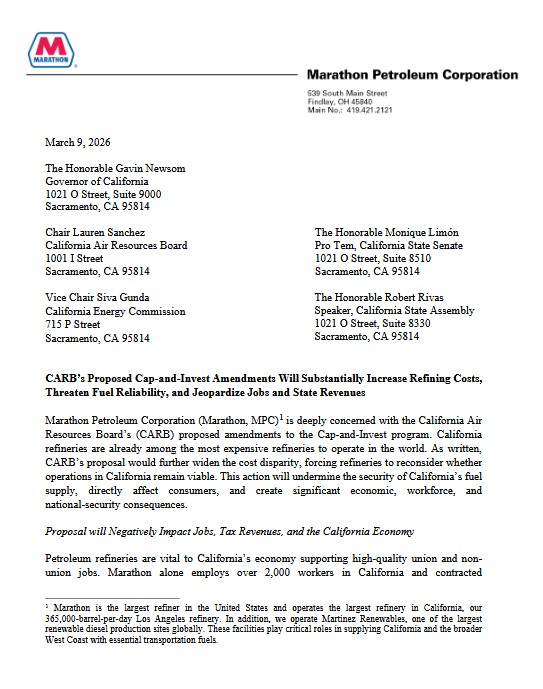
Summary of Marathon Petroleum Corporation\’s Letter to Governor Gavin Newsom (March 9, 2026)
Marathon Petroleum Corporation (MPC), the largest U.S. refiner and operator of California\’s largest refinery (365,000 barrels per day in Los Angeles), plus a major renewable diesel facility, expresses deep concerns over the California Air Resources Board\’s (CARB) proposed amendments to the Cap-and-Invest program. Addressed to Governor Newsom, CARB Chair Lauren Sanchez, CEC Vice Chair Siva Gunda, Senate Pro Tem Monique Limón, and Assembly Speaker Robert Rivas, the letter argues that the amendments would dramatically increase operating costs for refineries, making them unviable and leading to widespread negative consequences.
Key Concerns:Economic Impacts: Refineries like MPC\’s support over 2,000 direct employees and 5,300 contractors in California, contributing to taxes, community programs, and industries like agriculture, manufacturing, and logistics. The proposals could drive refineries out, resulting in irreplaceable job losses, reduced tax revenues, and economic harm, including disruptions to jet fuel supply for travel and tourism.
National Security Risks: California refineries provide significant fuel to the U.S. military for West Coast operations. Declining in-state production already increases reliance on volatile imports, which could create unpredictable supply issues during emergencies or geopolitical tensions, compromising defense readiness.
Environmental Backfire: California\’s refineries are among the world\’s lowest-emitting due to strict regulations. Curtailing operations (as carbon capture isn\’t feasible short-term) would shift production to higher-emitting foreign refineries, increasing global greenhouse gas emissions and undermining the state\’s climate goals while raising consumer costs and supply risks.
Potential Outcomes if Amendments Proceed:
Higher transportation fuel prices for residents.
Loss of high-quality jobs.
Declines in state and local tax revenues.
Greater dependence on imports reduces the reliability of gasoline, diesel, and jet fuel.
Jeopardized military fuel availability and national security.
MPC urges revisions to the proposals, referencing their detailed comment letter to CARB, and offers to collaborate to protect California\’s workforce, economy, environment, and energy security. Signed by Michael Henschen, Executive Vice President of MPC Refining.
Download the complete letter here
Eviscerating the Economy: Gasoline, Diesel, Plastics, and Beyond
The fallout from this refinery purge is devastating California\’s economy. Gasoline and diesel prices, already the nation\’s highest at over $1.50 above the national average, are poised to skyrocket further.
The state consumes 36-40 million gallons of gasoline daily, but with reduced capacity, supply shortages are inevitable.
Beyond fuels, the ripple effects hit plastics and manufacturing hard. California\’s refineries produce feedstocks essential for petrochemicals, and closures mean importing these too, inflating costs and disrupting supply chains. The manufacturing sector, already strained, faces higher energy bills and raw material shortages, potentially shedding jobs in a state where energy policy has become a \”tyranny\” on industry.
Overall, the economic toll could exceed half a million lost jobs, with broader impacts on transportation and agriculture.
Pipeline Shutdowns: More Trucks, Higher Costs, and Irony
Compounding the crisis, key pipelines have shut down due to underutilization from declining production. The San Pablo Bay Pipeline, which carried crude from Kern County to Bay Area refineries, closed in December 2025, forcing 15,000 barrels per day onto roads.
This shift requires nearly 100 trucks daily rumbling through Kern County highways, adding $5-10 per barrel in transport costs—passed directly to consumers.
The irony is stark: Newsom\’s green policies aimed at cutting emissions have instead increased them through truck exhaust and congestion.
Regulators temporarily hiked pipeline rates by 59% to keep it afloat, but the damage is done—highlighting how anti-oil measures are backfiring spectacularly.
China\’s Export Ban and the Global Squeeze
Enter global headwinds. In early March 2026, China—facing its own crude shortages from the Middle East conflict—ordered its top refiners to halt diesel and gasoline exports.
This suspension, effective immediately, prioritizes domestic supply amid disrupted Persian Gulf shipments.
For California, which has increasingly turned to Asian imports to fill refinery gaps, this is a body blow. Combined with a \”crashing\” global market—where diesel prices are surging 22% faster than gasoline due to pre-existing shortages—the state faces acute fuel scarcity.
Analysts forecast U.S. diesel averaging $3.50 in 2026, but California\’s premiums could push it higher.
With global supply in surplus overall but disrupted by geopolitics, import prices for California could balloon.
Hormuz Closure: California\’s Achilles\’ Heel
The Strait of Hormuz closure, triggered by the Iran war, exposes California\’s import addiction. While the U.S. imports only about 2% of its oil from the Persian Gulf overall, much of that flows to West Coast refineries. California imports an estimated 70% of its crude from abroad, with 21% from Iraq, 5% from Saudi Arabia, and 4% from the UAE in 2024—regions directly impacted by the strait.
The strait\’s near-total shutdown cuts 20% of global oil flows, sending Brent crude above $100 per barrel.
For California, this means scrambling for alternatives in a tightening market. If disruptions persist, gas prices could hit $6-7 per gallon statewide,
with imports potentially exceeding $15 per gallon in worst-case scenarios amid global shortages and shipping premiums. Diesel, already climbing faster, could reach $5 nationally—but California\’s isolation amplifies the pain.

A National Security Time Bomb
California\’s predicament isn\’t just local—it\’s a national security risk. As the U.S.\’s largest economy and fuel consumer, shortages here could strain federal reserves and disrupt interstate commerce. Newsom\’s policies have transformed an energy powerhouse into a beggar at foreign doors, vulnerable to adversaries like Iran or supply chain foes. The state\’s reliance on imports from unstable regions undermines U.S. energy independence, turning climate virtue-signaling into a strategic liability.
We have several key interviews lined up on the Energy News Beat podcast. Ronald Stein, author and outspoken energy leader, on Wednesday, Mike Ariza, key industry expert with boots on the ground, who has been quoted at the California Globe, and we are working to get Steve Hilton back on the podcast. Steve is running for Governor and has a plan.
We are also recording a podcast with the former Prime Minister of the UK, Liz Truss, this week, to air on Friday. Net Zero was always Gavin Newsom\’s plan, but it honors China, moves all the jobs there, and is basically a wealth transfer.
It\’s time for a reckoning. California must balance its green ambitions with pragmatic energy security, or risk dragging the nation into an avoidable crisis. Governor Newsom\’s making? Absolutely.
Sources: gaspriceguy.substack.com, cbsnews.com, energy.ca.gov, ttnews.com, reuters.com, bloomberg.com, subscriber.politicopro.com, foxbusiness.com, californiaglobe.com
Get your CEO on the #1 Energy Podcast in the United States: http://energynewsbeat.co/energy-news-beat-media-kit/
Is oil and gas right for your portfolio? http://energynewsbeat.co/invest/