

In a fluid and confusing situation that has maritime operators on edge, several tankers and cargo vessels executed abrupt U-turns in the Strait of Hormuz over the past 48 hours after Iran’s Islamic Revolutionary Guard Corps (IRGC) signaled a return to tight control of the waterway. While Iran’s foreign minister declared the strait “completely open” to commercial traffic on April 17 amid a fragile ceasefire linked to the Lebanon truce, the IRGC quickly clarified that passage would be under strict Iranian oversight — and state media later announced the strait was reverting to its “previous state” of armed-forces control in response to the ongoing U.S. naval blockade of Iranian ports.
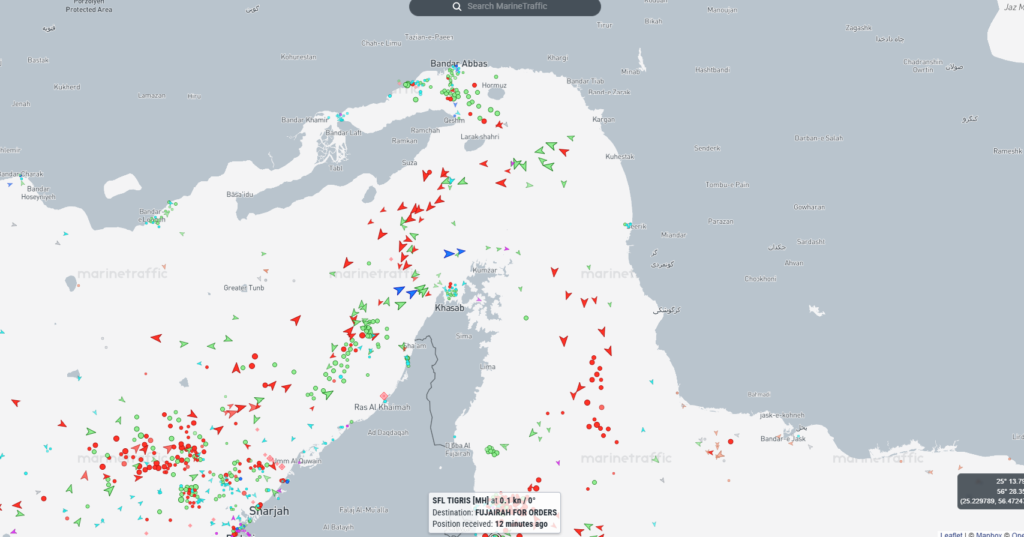
Ship-tracking data captured the chaos in real time. Kpler video footage showed multiple tankers and cargo ships suddenly reversing course as they attempted to exit the strait after the “open” declaration. Pole Star Global AIS data identified at least seven vessels that U-turned or stopped short of westbound transit by early April 18, including Greek- and Indian-flagged tankers and the Greece-flagged crude carrier Minerva Evropi. Earlier examples from April 12 included the Iraq-bound Agios Fanourios I and Pakistan-flagged Shalamar, both of which turned back near Iran’s Larak Island checkpoint; a third VLCC, Mombasa B, successfully navigated the Iran-approved northern corridor.
Overall tanker traffic through the strait remains a shadow of its former self. Pre-war volumes averaged roughly 100–130 ships per day. Since the conflict escalated on February 28, 2026, only 279 vessels have transited the strait through April 12 — a plunge of more than 95 percent. Even after the April 8 ceasefire, just 45 ships had entered or exited by mid-April. On individual days, transits have ranged from single digits to the low teens, with many vessels anchoring, drifting, or going dark to avoid risk. Some Iranian-linked or sanctioned tankers (including vessels carrying approximately 5 million barrels in recent exits) have continued limited movements, but commercial operators without explicit IRGC coordination are largely staying clear.
What the Iranians Have Said
Iranian messaging has been deliberately layered and at times contradictory:
IRGC position: The Revolutionary Guard has repeatedly asserted “complete control” of the strait, warning that vessels linked to the U.S., Israel, or their allies would face “firm and forceful response.” In late March, the IRGC declared the strait closed to traffic to or from ports of those nations and threatened to “set those ships ablaze.” More recently, the Guard has insisted that ships must follow designated routes around Larak Island, obtain coordination/permission, and that military vessels are prohibited. On April 18, IRGC-linked outlets announced the strait would “return to its previous state” under armed-forces control, citing continued U.S. “piracy” via the port blockade.
Foreign Ministry / civilian government: Foreign Minister Abbas Araqchi posted on April 17 that passage for all commercial vessels was “completely open” for the remainder of the Lebanon-linked ceasefire, to be handled via coordinated routes announced by Iran’s Ports and Maritime Organization.
The mixed signals have left shipowners and charterers guessing whether the strait is truly reopening or whether IRGC oversight effectively maintains a chokehold.
U.S. Government and President Trump Response
President Trump and the U.S. military have maintained a firm line. The administration imposed a naval blockade on Iranian ports effective April 13–14 following the collapse of U.S.-Iran talks in Islamabad. U.S. Central Command (CENTCOM) has reported directing or turning back at least 21 vessels attempting to enter or leave Iranian waters since the blockade began; the president himself confirmed the figure and stated the blockade “will remain in full force” until Tehran reaches a comprehensive deal that includes nuclear concessions.
Trump has simultaneously welcomed Iranian “open” announcements on Truth Social, claiming Iran has “agreed to never close the Strait of Hormuz again” and noting that Chinese President Xi Jinping is “very happy” with the prospect of normalized flows. However, he has repeatedly emphasized that U.S. forces will stay positioned until full compliance, underscoring that the blockade is leverage, not a permanent closure of the international waterway itself.
Short-Term Oil Price Impact: Volatility Expected to Be Temporary
Oil markets reacted sharply to the news flow. On April 17, Brent crude plunged more than 9 percent to around $90.38 per barrel (with intraday lows near $86) and WTI fell roughly 11 percent to the low $80s after Iran’s foreign minister declared the strait open. Prices had already been elevated throughout the crisis, having spiked above $100–$126 earlier in the conflict due to supply fears.
Analysts and traders view the current price action as classic short-term volatility driven by headline risk rather than a fundamental shift in supply. With hundreds of tankers still backed up in the Persian Gulf and war-risk insurance premiums remaining sky-high, any sustained reopening would ease the “Hormuz premium.” Conversely, renewed IRGC enforcement or escalation could quickly reverse gains. Most market participants expect this round of volatility to prove short-lived unless the U.S.-Iran standoff materially deteriorates in the coming days.
What happens next is anyone’s guess. Shipping companies are watching Kpler, Vortexa, and AIS feeds minute by minute while waiting for clearer guidance from Tehran, Washington, and the IRGC. Until commercial flows normalize and the U.S. blockade is lifted or modified, the world’s most critical energy chokepoint will remain a high-wire act.
Appendix: Sources and Links
- CNBC (Apr 17, 2026) – Kpler video of tankers U-turning: https://www.cnbc.com/video/2026/04/17/watch-tanker-and-cargo-ships-fail-to-transit-strait-of-hormuz-after-iran-declares-it-open.html
- Bloomberg (Apr 18, 2026) – Greek/Indian tankers U-turn: https://www.bloomberg.com/news/articles/2026-04-18/greek-indian-tankers-u-turn-before-hormuz-amid-reopening-doubt
- BBC Live (Apr 18, 2026) – IRGC closure announcement and Trump response: https://www.bbc.com/news/live/cqxdg17yr2wt
- Al Jazeera (Apr 14, 2026) – Transit and attack statistics: https://www.aljazeera.com/news/2026/4/14/how-many-ships-have-passed-the-strait-of-hormuz-and-how-many-were-attacked
- Reuters, Fortune, NYT, Wikipedia 2026 Strait of Hormuz crisis page, Windward Maritime Intelligence, and additional reporting from Kpler, LSEG, Pole Star, and Vortexa (various April 2026 dates).
- Oil price data: Trading Economics, NYT, Euronews (Apr 17–18 settlements).
All data is current as of April 18, 2026. Energy News Beat will continue monitoring developments in real time.