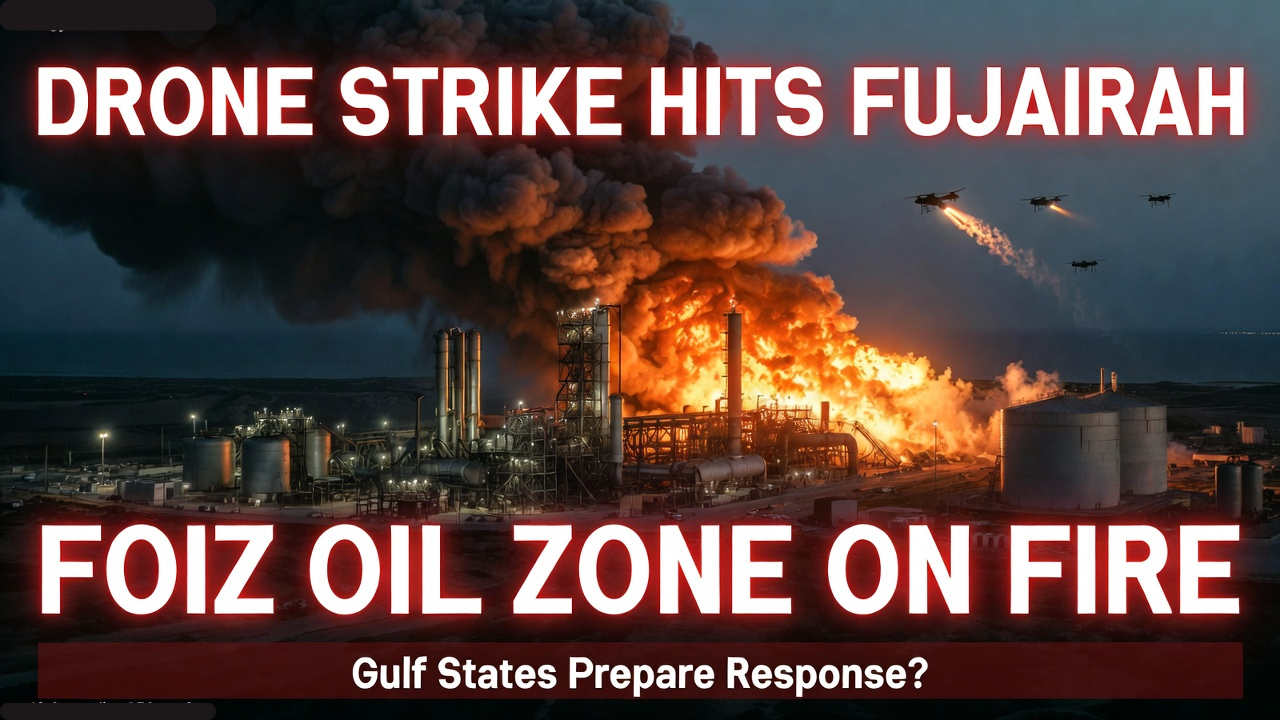
Authorities in the United Arab Emirates’ Fujairah emirate have confirmed that a fire broke out at the Fujairah Oil Industries Zone (FOIZ) following a drone strike originating from Iran. Civil defense teams responded immediately and continue to contain the blaze, with no injuries reported. The incident comes amid heightened regional tensions, as Gulf states weigh stronger collective action against Iranian aggression while the Strait of Hormuz remains a flashpoint for global energy security.
According to the Fujairah Media Office, the fire was directly linked to the drone attack. The UAE Ministry of Defense reported detecting four cruise missiles launched toward the UAE from Iran. Three were successfully intercepted over territorial waters, while the fourth fell into the sea. Officials urged the public to rely solely on verified government statements and avoid spreading unconfirmed information.
Fujairah serves as a critical oil trading and bunkering hub outside the Strait of Hormuz, handling significant volumes of crude exports and refined products. Past similar incidents in March 2026 led to temporary suspensions of oil-loading operations, highlighting the vulnerability of this key bypass route when Iranian strikes target Gulf energy infrastructure.


Gulf States Shift Toward Stronger Response
This latest strike on FOIZ is part of a pattern of Iranian drone and missile attacks on the UAE and other Gulf energy facilities since the escalation of the broader US-Israel-Iran conflict in late February 2026. The Gulf Cooperation Council (GCC) has issued joint statements condemning Iran’s actions as “blatant” and “criminal,” affirming the right to self-defense under international law. Leaders have signaled that an attack on one member state will be treated as an attack on all, with explicit warnings that responses will follow.
While no formal declaration of war has been issued, sources indicate growing frustration among the UAE, Saudi Arabia, and other Gulf nations. Some are pressing the United States to neutralize Iran’s ability to threaten regional oil lifelines permanently rather than pursue limited ceasefires. The UAE has already closed its embassy in Tehran, withdrawn staff, and stated it will take “all necessary measures” to protect its sovereignty. Diplomats note a pivot from earlier diplomatic engagement with Iran toward a harder line focused on long-term security.
Gulf states have so far avoided direct military retaliation to prevent wider economic fallout, prioritizing defense of their territories and support for international efforts to secure shipping lanes. However, repeated strikes—including on Fujairah and other facilities—have shattered the perception of the Gulf as a stable energy hub, potentially raising long-term investment risk premiums.
Implications for the Strait of Hormuz and Global Energy Markets
The Strait of Hormuz, through which roughly 20% of global oil trade flows, has been largely blocked or heavily restricted by Iran since late February 2026 as part of its retaliation strategy. Iran has threatened commercial shipping, imposed tolls on some vessels, and attacked tankers, including an empty ADNOC-linked vessel. This closure has forced reliance on alternative routes like Fujairah’s terminals and Saudi Red Sea pipelines—routes now themselves under threat.
A stronger Gulf states response—whether through coordinated self-defense operations, joining US-led efforts to reopen the strait, or escalation toward direct conflict—carries major risks for energy markets:
Further disruption rather than reopening: Escalation could prompt Iran to intensify attacks on shipping, mines, or coastal targets, turning the strait into an even “hotter” conflict zone. Insurance premiums for tankers have already surged dramatically, and analysts warn that full-scale involvement by Gulf forces might prolong instability instead of quickly restoring flows.
Oil price volatility: Brent crude has already climbed above $115 per barrel in recent spikes tied to these incidents. Prolonged Hormuz restrictions combined with compromised bypass infrastructure could trigger sustained higher prices, supply shortages for Asia and Europe, and knock-on effects on global inflation and refining margins.
Strategic alternatives strained: Saudi Arabia and the UAE have invested heavily in pipelines bypassing Hormuz. Attacks on Fujairah undermine these diversification efforts, increasing pressure on Red Sea routes (already vulnerable to other threats) and forcing OPEC+ production adjustments for market stability.
In short, while a unified Gulf response could bolster deterrence and support US-led operations to secure the strait (such as escort missions), it risks transforming a tense standoff into a broader conflagration. The region could become significantly hotter, with cascading effects on energy supply chains, rather than achieving a swift reopening of Hormuz. Markets are watching closely for any GCC summit outcomes or joint military signals in the coming days.
Energy News Beat will continue monitoring developments, including any impact on crude loadings, bunker operations, and global oil benchmarks.
Appendix: Sources
- Gulf News: “Fujairah confirms FOIZ fire after drone strike, response ongoing” (Last updated May 04, 2026) – https://gulfnews.com/uae/fujairah-confirms-foiz-fire-after-drone-strike-response-ongoing-1.500528829
- Reuters: Multiple reports on Fujairah operations suspension and Iranian missile interceptions (March–May 2026) – https://www.reuters.com/world/middle-east/fire-occurred-uaes-fujairah-after-debris-fell-during-interception-drone-no-2026-03-14/ and related May 4 coverage.
- CNBC: Coverage of Fujairah strike and Gulf states’ statements (March 16–19, 2026).
- Bloomberg: Fujairah oil operations and Hormuz context (March 14, 2026).
- Wall Street Journal: Gulf states’ shift toward neutralizing Iran (March 17, 2026).
- Al Jazeera and other regional outlets: GCC joint warnings and ongoing strikes (March–May 2026).
- Wikipedia and analytical briefings on 2026 Strait of Hormuz crisis for background on blockade timeline and impacts.
Additional corroborating reports from WAM, Al Arabiya, Atlantic Council, and Reuters Gulf sources were reviewed for context on regional dynamics and energy infrastructure risks. All information is based on official statements and verified news outlets as of May 4, 2026.