
In a dramatic escalation announced today, Iran’s top joint military command — the Khatam al-Anbiya Central Headquarters — declared the Strait of Hormuz closed to all vessel traffic. The move was framed as the “first step” in response to alleged breaches of a recent ceasefire/MOU agreement by the United States and Israel, specifically tied to ongoing Israeli military actions in Lebanon.
Much like “Groundhog Day,” we are here again.
As of 12:14 Central U.S. CENTCOM says the Strait of Hormuz is open.
State media reported the command warned that further measures would follow if “aggression” continues. This marks the latest twist in a volatile saga that began with the effective closure of the strait in late February/early March 2026 amid the broader U.S.-Israel-Iran conflict.
Recent Tanker Traffic Before Today’s Closure Announcement
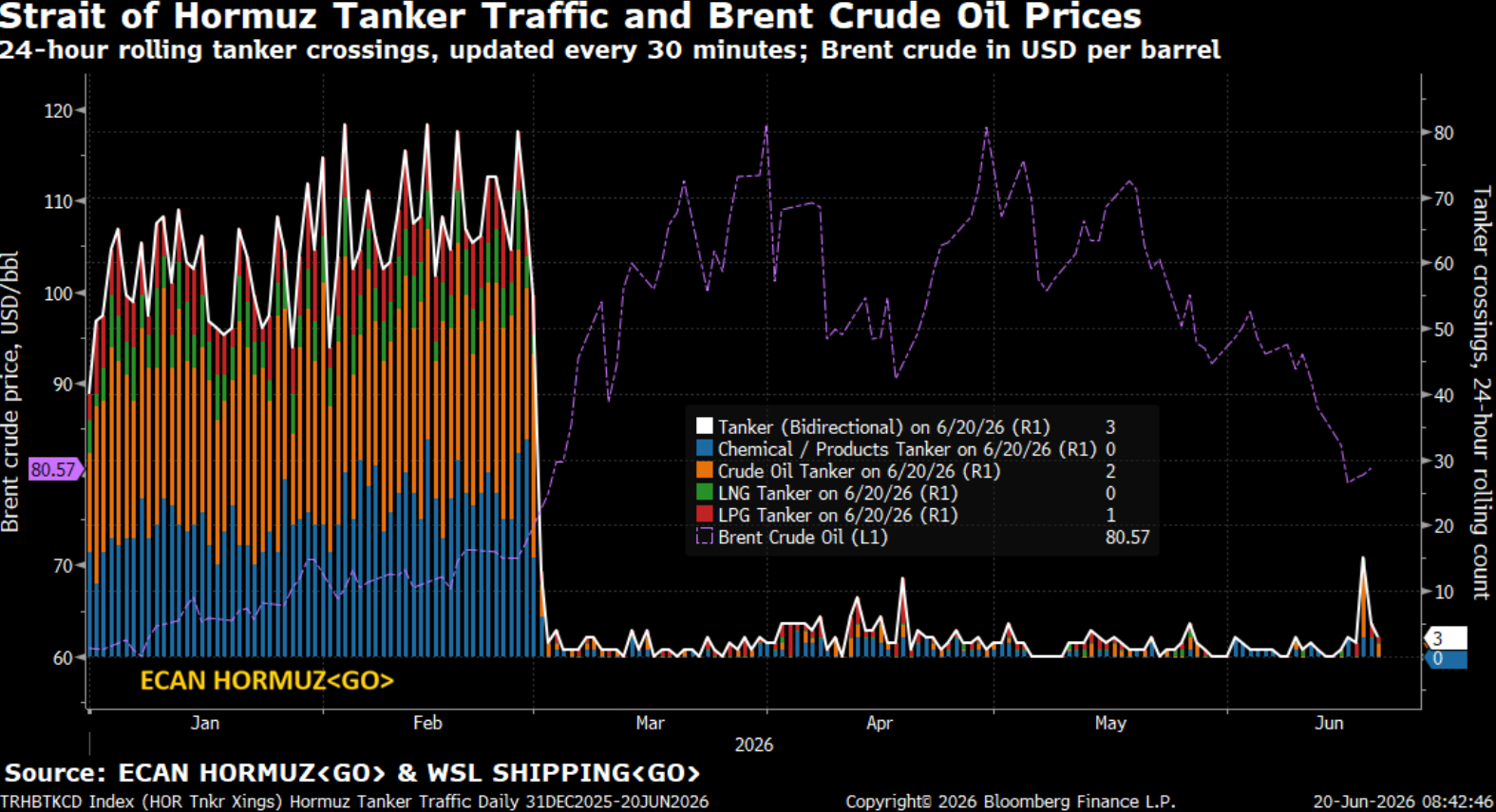
Prior to today’s announcement, shipping had seen a modest surge following the mid-June U.S.-Iran memorandum of understanding aimed at pausing hostilities and reopening the waterway.
Key recent figures (June 18–19, 2026):
June 18: 25 commercial crossings — the highest single-day total since mid-April and more than five times the average daily level in early June (AXS Marine data).
Multiple reports documented at least 12–20+ major tankers transiting in the immediate post-deal window, including very large crude carriers (VLCCs).
Three Saudi-flagged VLCC supertankers alone carried approximately 6 million barrels of crude through the strait.
U.S. Vice President JD Vance highlighted that more than 12.5 million barrels of oil passed through the strait in a single overnight period shortly after the deal.
Iranian-flagged supertankers were also moving significant volumes (one flotilla reportedly carrying close to 20 million barrels toward Asia).
Pre-conflict baseline: Roughly 120–140 vessels per day transited the strait, with tankers accounting for the bulk of ~20–21 million barrels per day (bpd) of oil and products — about 20% of global seaborne oil trade.
During the height of earlier closures, traffic had plummeted to a trickle — often averaging just 3 tankers per day, with many vessels operating in “dark” mode (AIS transponders off) or remaining stranded. Hundreds of tankers and up to ~2,000 ships were reported trapped in the Persian Gulf at various points.
Millions of Barrels in Transit or Stranded
Exact real-time “barrels in transit” figures fluctuate with loading, waiting, and dark shipping, but the picture is clear:
Post-MOU surge allowed tens of millions of barrels to begin moving out in a short window (e.g., the 12.5M+ barrels cited overnight and the ~20M barrels on Iranian tankers alone).
Earlier in the conflict, vast inventories remained trapped inside the Gulf. One analysis noted roughly 15+ million bpd of supply effectively stranded at peak disruption periods.
The waterway normally handles ~20 million bpd of oil; even partial flows represent critical relief for global markets.
Saudi Arabia and UAE Continue Shipping via Bypass Pipelines — Keeping Markets Moving
While the strait faces renewed restrictions, Saudi Arabia and the United Arab Emirates — the two Gulf producers with major bypass infrastructure — have been able to sustain substantial exports without relying on Hormuz.
Saudi Arabia:
The East-West Crude Oil Pipeline (Petroline) to the Red Sea port of Yanbu has been operating at or near its full expanded capacity of ~7 million bpd.
This has allowed Saudi Aramco to redirect a large share of its exports (crude + refined products) via Yanbu, keeping a significant portion of the kingdom’s pre-war production flowing to global markets.
Yanbu loadings reportedly reached ~5 million bpd of crude plus additional products at times.
United Arab Emirates:
The Habshan-Fujairah pipeline (Abu Dhabi Crude Oil Pipeline) delivers up to 1.5–1.8 million bpd directly to Fujairah on the Gulf of Oman, completely bypassing the Strait of Hormuz.
ADNOC has been accelerating a new parallel pipeline project expected to roughly double capacity to ~3.6 million bpd by 2027.
Combined bypass capacity from Saudi and UAE pipelines has been estimated to offset 13–28% (or more in optimistic scenarios) of normal Hormuz flows, providing a vital buffer.
Other producers (Iraq, Kuwait, Qatar, etc.) remain far more dependent on the strait and have faced greater disruption.
Combined bypass capacity from Saudi and UAE pipelines has been estimated to offset 13–28% (or more in optimistic scenarios) of normal Hormuz flows, providing a vital buffer.
Other producers (Iraq, Kuwait, Qatar, etc.) remain far more dependent on the strait and have faced greater disruption.lvivherald.com
Market and Strategic Implications
Today’s closure announcement introduces fresh uncertainty just days after signs of thawing. Oil markets will watch closely for actual enforcement (past “closures” have sometimes allowed limited or “dark” transits) versus rhetoric. The involvement of the IRGC-linked command and explicit linkage to Lebanon operations underscore the interconnected nature of the conflicts.
Saudi and UAE bypass routes demonstrate strategic foresight and are currently the primary mechanism keeping meaningful volumes of Gulf crude moving to Asia and beyond. However, they cannot fully replace the strait’s capacity.
Bottom line: While the strait faces another closure threat, dozens of tankers (including major Saudi and other VLCCs) successfully transited in the days immediately preceding today’s announcement, carrying tens of millions of barrels. Saudi Arabia’s 7 million bpd East-West pipeline and the UAE’s ~1.8 million bpd Fujairah route continue to provide critical alternative export capacity, preventing a total shutdown of Gulf supply.
Appendix: Sources and Links
- Reuters (June 20, 2026): Iran closes Strait of Hormuz over ceasefire violations — https://www.reuters.com/world/middle-east/iran-closes-strait-hormuz-over-ceasefire-violations-mehr-2026-06-20/
- Reuters (June 19, 2026): Oil shipments rise in Hormuz — https://www.reuters.com/business/energy/oil-shipments-rise-hormuz-although-questions-grow-over-irans-transit-terms-2026-06-19/
- Al Jazeera / multiple outlets on Saudi tankers (~6M barrels) and Vance 12.5M barrels comment.
- Kpler, AXS Marine, Lloyd’s List Intelligence, and MarineTraffic data (via Reuters, CNBC, NY Post reports).
- CSIS, Wikipedia summaries, and industry analyses on pipeline capacities (Saudi East-West ~7M bpd; UAE Habshan-Fujairah 1.5–1.8M bpd).
- IEA and other maps for pipeline routes.
All information is drawn from publicly reported data as of June 20, 2026. Shipping numbers can vary by source and real-time conditions; “dark” shipping adds uncertainty. Markets should monitor official statements and tracking data closely.For Energy News Beat Channel — stay tuned for live updates on tanker tracking and oil flow data.