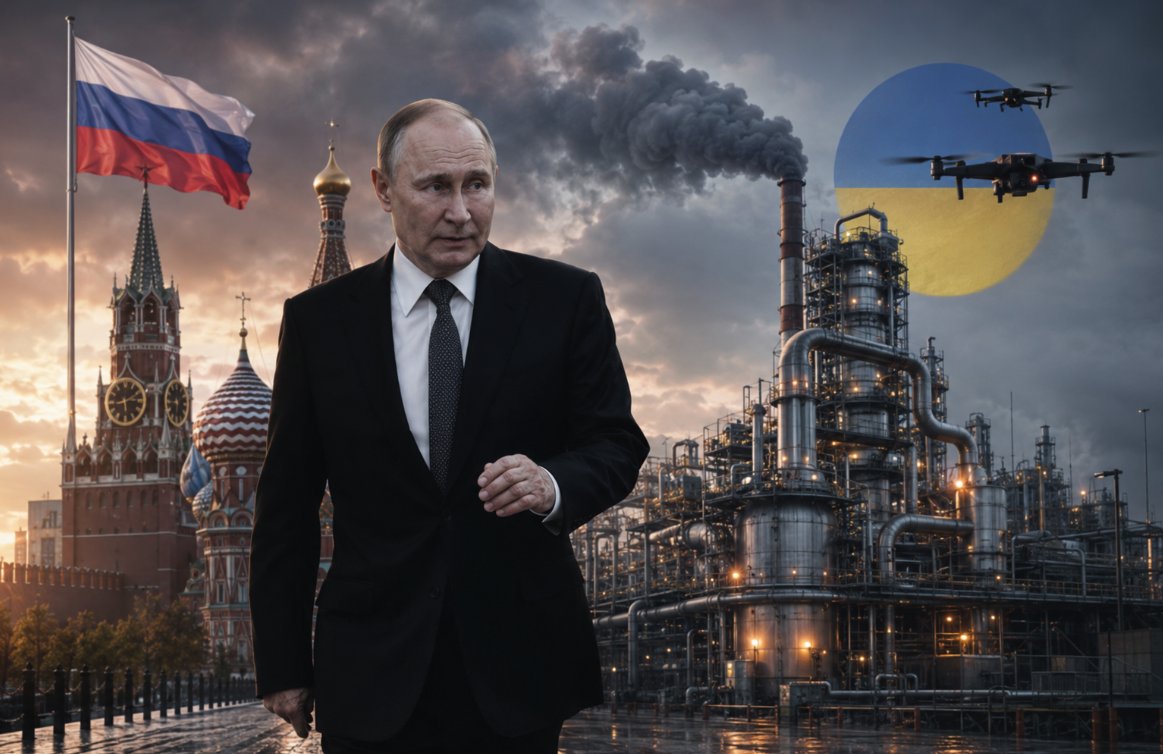
In a striking demonstration of how modern warfare has evolved, Ukrainian forces once again reached deep into Russian territory on July 25, 2026, hitting the Antipinsky (Tyumen) oil refinery more than 2,000 kilometers from the Ukrainian border. The attack sparked a significant fire at the facility in western Siberia, underscoring Ukraine’s expanded long-range drone capabilities that no longer stop at Russia’s border regions.
Videos circulating online captured flames engulfing what appears to be a diesel fuel cleaning unit, with the fire spreading amid highly flammable materials at the plant. Tyumen region Governor Alexander Moor confirmed that emergency services were responding to the scene. President Volodymyr Zelenskyy publicly confirmed the strike as part of a broader overnight operation that also targeted a weapons manufacturing facility in Kirov, logistics infrastructure in Yekaterinburg, a fuel depot in Rostov-on-Don, and vessels in the Caspian Sea.
The Antipinsky refinery is one of Russia’s largest privately owned (independent) refining facilities. Industry estimates place its nominal annual crude processing capacity at approximately 8–9 million metric tons (roughly 160,000–180,000 barrels per day). It produces gasoline, diesel, and other petroleum products primarily for the domestic market, with processing depth reported as high as 98% in some assessments.
As of the latest available reports on the day of the attack, precise quantification of offline capacity from this specific strike remains preliminary. Russian authorities have limited details, while Ukrainian sources and open-source footage indicate impact on key processing units. Any sustained disruption would add pressure to Russia’s already strained domestic fuel market, which has faced shortages since intensified Ukrainian attacks began escalating in 2025 and continued through 2026. This follows an earlier Ukrainian drone strike on the same Tyumen facility in June 2026, which also produced reports of fire and operational interruptions.
The Broader Campaign Against Russian Energy Infrastructure
This latest deep strike fits into a systematic Ukrainian campaign targeting Russian oil refining and export infrastructure. By early July 2026, Ukraine’s General Staff estimated that approximately 42.7% of Russia’s designed oil refining capacity had been disabled through repeated drone attacks. The International Energy Agency assessed the figure as more than 20% offline at similar points, while other analyses noted peaks of around 20% capacity offline in late 2025, translating into lower but still significant volume reductions due to spare capacity and repairs.
Every one of Russia’s 11 largest oil refineries has now been hit. Since the beginning of 2026 alone, drones have attacked Russian refineries at least 194 times. Cumulative strikes on oil facilities since February 2022 exceeded 300 by late June 2026. Major facilities such as the Moscow refinery, Omsk (Russia’s largest), Ryazan, Kstovo, Novokuibyshevsk, and others have seen units destroyed or operations halted for months, with some projected offline into 2027.
Fuel production in June 2026 fell by about 25% year-over-year in some estimates, with output running roughly 20% below domestic demand. This has produced Russia’s worst domestic fuel crisis in decades: restrictions affecting around 50 million people (about 35% of the population), sales limits or odd-even rationing in dozens of regions, states of emergency in several areas, and temporary export bans on gasoline, diesel, and jet fuel.
Damage to Russian Tankers and Maritime Assets in the Caspian, Black Sea, and Mediterranean
Ukraine has extended the campaign beyond fixed refineries to mobile and offshore energy assets. In the Caspian Sea, strikes have targeted Russian naval vessels, sanctioned cargo ships used for military logistics (including Iran-Russia routes), and oil platforms. On July 25, 2026, operations hit a Project 12418 Molniya-class missile boat, the cargo vessels Port Olya 2 and Begey (both under international sanctions for military cargoes), and the Filanovsky oil platform. Earlier 2025–2026 actions damaged missile boats, minesweepers at bases such as Kaspiysk, and multiple drilling platforms (including at the Korchagin and other fields).
In the Black Sea and Mediterranean, Ukraine has systematically targeted Russia’s “shadow fleet” of tankers used to evade sanctions. Notable incidents include critical damage to the Kairos and Virat (Black Sea, November 2025), the Qendil (Mediterranean, December 2025—first confirmed aerial drone strike on a shadow fleet tanker in that theater, leaving it critically damaged and largely inoperable), and the LNG tanker Arctic Metagaz (Mediterranean, March 2026, severe fire and structural damage). Additional hits on vessels such as the Elbus, WEST Horizon, and others, plus broader operations damaging over 100 vessels in areas like the Sea of Azov in mid-2026, have raised insurance costs, disrupted loadings, and forced operational changes.
These maritime strikes complement land-based refinery attacks by disrupting export routes, storage, and logistics that fund and sustain Russia’s war effort.
Economic Cost to the Russian Economy
The cumulative effect has been substantial. Total losses for Russia’s refining sector since August 2025 are estimated at approximately $13.5 billion. Oil companies have faced direct damage, lost production, and reduced export revenues for refined products even as crude exports sometimes rose (as damaged refineries left more unprocessed oil available for shipment). Russia has been forced to import expensive refined products while selling crude at discounts, straining the budget amid high defense spending.
Oil and gas revenues form a critical pillar of the Russian federal budget and overall economy. The fuel crisis has driven inflation pressures, disrupted agriculture and industry (including harvests and tourism), and contributed to broader economic strain. Analysts note that the campaign reduces Moscow’s ability to fully capitalize on global oil price spikes, forces subsidies and rationing, and compounds other wartime economic challenges. While exact GDP percentage losses attributable solely to these strikes vary by model and are not uniformly quantified in open sources as a single definitive figure, the combination of capacity reductions (hundreds of thousands of barrels per day offline at peaks), revenue shortfalls, and domestic disruption represents a meaningful drag on Russia’s wartime economy.
A New Reality in Modern Warfare
The Tyumen strike—and the wider campaign—illustrates a fundamental shift. Inexpensive, mass-produced long-range drones now allow a defender to hold an aggressor’s critical economic infrastructure at risk thousands of kilometers inland and at sea. What once required expensive missiles or air superiority is increasingly achievable with attritable systems. Russia’s rear areas, previously considered sanctuaries, are no longer safe. Energy infrastructure that funds the war has become a primary battlefield, forcing Moscow into costly air defenses, rapid repairs, fuel rationing, and import dependencies.
As emergency crews continue working at the Tyumen site and assessments of exact downtime emerge, one fact is already clear: the geography of vulnerability has expanded dramatically. Modern warfare is no longer confined to the front lines.
Appendix: Sources and Links
- Jack Prandelli X post (original referenced post): https://x.com/jackprandelli/status/2080932881883410833
- Reuters: “Ukrainian drone strike sparks fire at Russia’s Tyumen oil refinery” (July 25, 2026): https://www.reuters.com/world/europe/ukrainian-drone-strike-sparks-fire-russias-tyumen-oil-refinery-2026-07-25/
- Kyiv Post: Zelensky confirms strikes including Tyumen and Caspian targets: https://www.kyivpost.com/post/81060
- United24 Media: Coverage of Tyumen and broader refinery campaign, including $13.5 billion losses estimate: https://united24media.com/war-in-ukraine/drones-reach-tyumen-oil-refinery-nearly-2000-kilometers-from-ukraine-20019 and https://united24media.com/war-in-ukraine/ukraine-hits-all-11-of-russias-largest-oil-refineries-in-long-range-drone-campaign-20523
- Wikipedia: 2025–2026 Russian fuel crisis (capacity offline figures, population affected, strike counts): https://en.wikipedia.org/wiki/2025%E2%80%932026_Russian_fuel_crisis
- Wikipedia: Ukrainian attacks on the Russian shadow fleet (tanker details in Black Sea/Mediterranean): https://en.wikipedia.org/wiki/Ukrainian_attacks_on_the_Russian_shadow_fleet
- Institute for the Study of War / related analysis on economic impacts: https://understandingwar.org/research/russia-ukraine/ukraines-strike-campaigns-will-likely-continue-to-hurt-russias-economy-and-military-operations-in-ukraine/
- Additional reporting on Caspian strikes and platforms (various 2025–2026): Euromaidan Press, Militarnyi, Jerusalem Post, RFE/RL, and open-source confirmations referenced in the above.
- Capacity and operational details cross-referenced from Reuters, industry estimates, and prior Tyumen coverage (June 2026 strikes).
All figures are drawn from contemporaneous reporting and official statements as of July 25, 2026; damage assessments for the latest strike remain fluid.