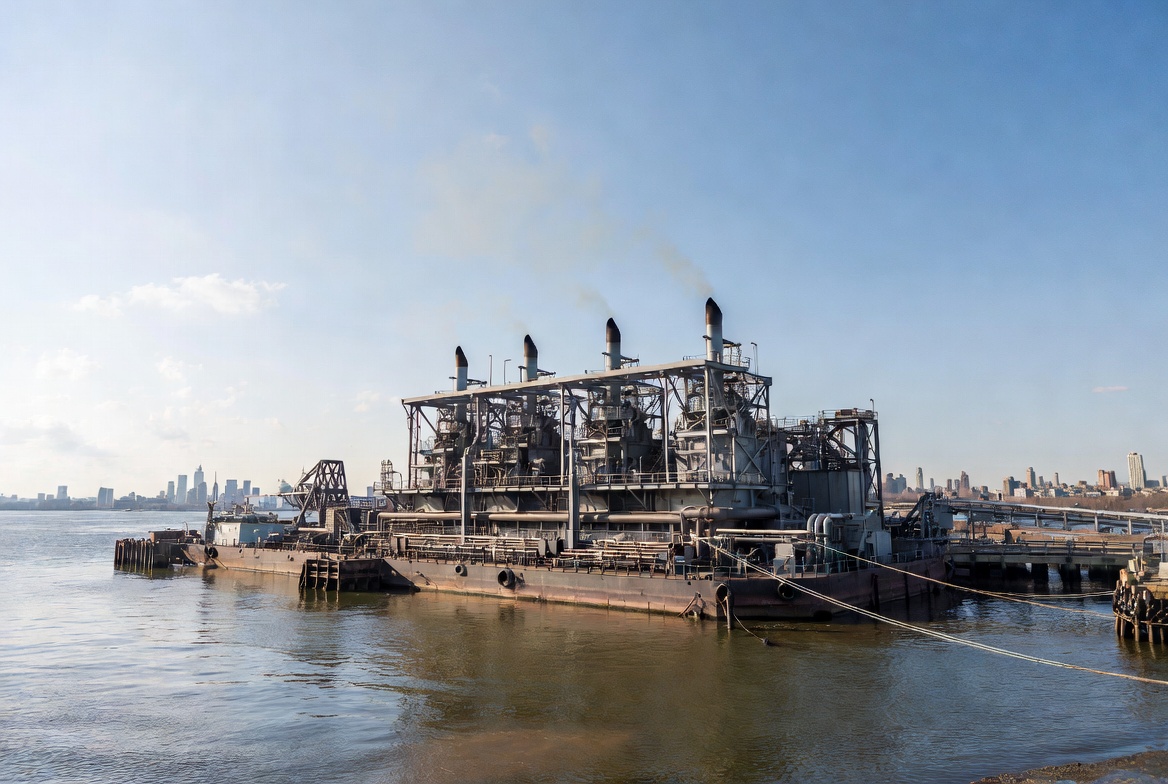
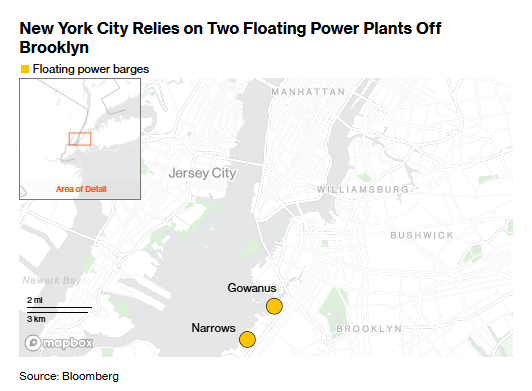
New York City’s lights increasingly depend on a pair of half-century-old floating power plants that were never meant to run this hard. The Gowanus and Narrows barge-mounted generating stations, moored off Brooklyn in the Upper Bay, serve as the city’s last line of defense against blackouts. As intense heat waves and rising demand strain the grid, these 1970s-era dual-fuel peaker plants fire up constantly—with no meaningful relief in sight.
A Bloomberg feature published August 1, 2026, captured the reality: during recent heat spells, the Narrows and Gowanus plants “heaved into life.” Meant as a backstop, they now operate far more frequently because power demand is surging while the rest of the system remains constrained.
The Barges: Specifics and Strain
The Gowanus Generating Station (commissioned around 1971) and Narrows Generating Station (1972) consist of multiple floating barges equipped with simple-cycle combustion turbines capable of burning natural gas or fuel oil. Capacities are commonly cited in the range of roughly 640 MW for Gowanus (across four barges historically) and about 320 MW for Narrows, though operational contributions to New York City’s transmission security margin have been reported near 500+ MW for key units kept online for reliability.
These units are classic peaker plants—fast-start but inefficient, higher-emitting, and aging. Many of New York’s fossil resources are over 50 years old. NYISO has repeatedly flagged reliability needs that require keeping portions of the Gowanus and Narrows fleet operating past earlier planned retirement dates (originally tied to state Peaker Rule emissions limits). The owner, AlphaGen (formerly associated with Astoria Generating), has proposed repowering with newer, lower-emitting barges (three new units potentially delivering around 819 MW total of fast-start capacity) while noting the existing units are authorized through at least 2027 and may be needed longer.
Repowering attempts have faced permitting hurdles under New York’s Climate Leadership and Community Protection Act (CLCPA). The plants remain essential because New York City (NYISO Zone J) is a constrained load pocket with limited transmission into the city.
New York City’s Power Picture
New York City consumes a large share of the state’s electricity yet has historically relied heavily on in-city fossil generation. Prior to recent additions, clean/zero-emission sources (hydro, nuclear, solar, wind) supplied only about 20% of the city’s needs; the rest came largely from natural gas and dual-fuel plants.
The biggest near-term change is the Champlain Hudson Power Express (CHPE). This 1,250 MW high-voltage direct-current transmission line—fully buried/underground and underwater for much of its 339-mile route—began commercial operation in spring/early summer 2026. It delivers hydropower from Hydro-Québec directly into the Astoria area of Queens. Officials and project backers project it can meet up to 20% of New York City’s annual electricity needs (roughly 10.4 TWh per year). During a July 2026 heat wave, Canadian imports (including via CHPE) set records and supplied a meaningful share of statewide demand.
Even with CHPE online, local dispatchable resources—including the aging barges—remain critical for peak periods, contingencies, and transmission security. Offshore wind projects (such as Empire Wind) are expected later, but delays and the inherent intermittency of renewables mean the city still leans on gas turbines and dual-fuel peakers. Downstate capacity is dominated by dual-fuel and gas resources.
New York State Energy Mix (Recent Data Reflecting 2025–2026 Conditions)
Statewide generation remains diverse but still fossil-heavy, especially for reliability services:
- Natural gas / dual-fuel: roughly 39–47% of energy production in recent data.
- Nuclear: ~17–21.5%.
- Hydroelectric: ~15–19.5%.
- Wind: ~4–5%.
- Solar (utility-scale plus behind-the-meter contributions): several percent, growing.
- Smaller shares from biomass, petroleum, and other.
- Net imports can reach double-digit percentages in high-demand periods.
NYISO’s Power Trends 2026 report highlights the core problem: generator retirements (especially older fossil and the earlier Indian Point nuclear closure) have outpaced new resource entry. Reserve margins have tightened. The system is shifting toward winter-peaking due to building electrification and electric vehicles, while large loads (data centers, manufacturing) add uncertainty. Aging fossil units that still provide essential reliability services face higher outage risks. Renewables and shorter-duration storage help with decarbonization but do not yet fully replace the multi-hour, dispatchable attributes of traditional plants during extended stress events.
Summer 2026 installed capacity was in the high 30s of GW range, with dual-fuel units forming a large share downstate.
Net-Zero Policies, High Prices, and Parallel Risks in California
New York’s CLCPA sets aggressive targets: 70% renewable electricity by 2030 and a zero-emission grid by 2040. California has pursued similarly ambitious net-zero and renewable mandates. Both states now rank among the highest electricity prices in the United States. Recent residential rates show California often exceeding 33–35 cents per kWh and New York around 29–30 cents per kWh—well above the national average near 18–19 cents.
High prices reflect a combination of policy-driven retirements of reliable capacity, expensive transmission and renewable buildouts, permitting barriers to new dispatchable generation, and the costs of maintaining aging assets as a bridge. Consumers in both states face elevated bills while reliability margins shrink. NYISO has warned that an “all-of-the-above” approach—including timely investment in resources that can actually keep the lights on—is essential.
The Canada Connection: A Single Point of Geopolitical Vulnerability
The new CHPE line is a major reliability and decarbonization asset—until it isn’t. It is a direct physical and contractual link to a foreign government (Canada via Hydro-Québec). Power flows can be interrupted by technical issues (the line experienced outages shortly after startup in 2026) or, more concerningly, by political decisions.
A foreign government displeased by U.S. tariffs, trade disputes, or even domestic political rhetoric and social media posts could theoretically restrict or cut exports. Energy interdependence cuts both ways. Relying on a single major intertie for up to one-fifth of New York City’s power introduces a risk that pure domestic generation does not.
Consumers Must Prepare—and Vote Accordingly
Blackout risk is no longer theoretical. Surging demand from electrification and data centers, retiring dispatchable plants, aging infrastructure like the Gowanus and Narrows barges, transmission constraints into New York City, and dependence on weather-dependent resources plus a foreign hydropower line create a brittle system.
Households and businesses should prepare: maintain backup power options where feasible, understand critical medical and communication needs during outages, and support local resilience measures. More importantly, voters need to examine the energy policies of elected officials. Aggressive net-zero timelines that force premature retirements without adequate, reliable replacements have contributed to the highest electricity prices in the country in New York and California—and to the very reliability pressures that keep 50-year-old barges running hard.
Reliable, affordable power is not optional. New York City’s floating peakers are a visible warning that the transition must be grounded in engineering and economics, not just targets.
Reliable, affordable power is not optional. New York City’s floating peakers are a visible warning that the transition must be grounded in engineering and economics, not just targets.
- Bloomberg feature: https://www.bloomberg.com/news/features/2026-08-01/new-york-s-50-year-old-power-barges-show-blackout-risk-is-real
- NYISO Power Trends 2026 and related materials: https://www.nyiso.com/documents/d/guest/2026-power-trends ; https://www.nyiso.com/power-trends
- Champlain Hudson Power Express details and operations: https://chpexpress.com/ ; EIA reports on 2026 Canadian imports
- Urban Green Council on NYC grid transition: https://www.urbangreencouncil.org/nyc-grid-in-transition/
- Wikipedia list of New York power stations (capacities, in-service dates for Gowanus/Narrows and generation mix): https://en.wikipedia.org/wiki/List_of_power_stations_in_New_York
- AlphaGen repowering proposals (2026): PR Newswire and RTO Insider coverage
- Electricity price data: EIA Electric Power Monthly; ElectricChoice and similar 2026 state rate compilations
- Additional context on barge history and earlier repowering attempts: Power Magazine, Utility Dive, and New York DPS documents
Data on exact real-time mixes and capacities can shift; readers should consult the latest NYISO Gold Book, Power Trends, and EIA reports for updates.