How high they go from here, and how long they stay elevated, depends less on crude alone than on a global refining system that is already running near its limits.
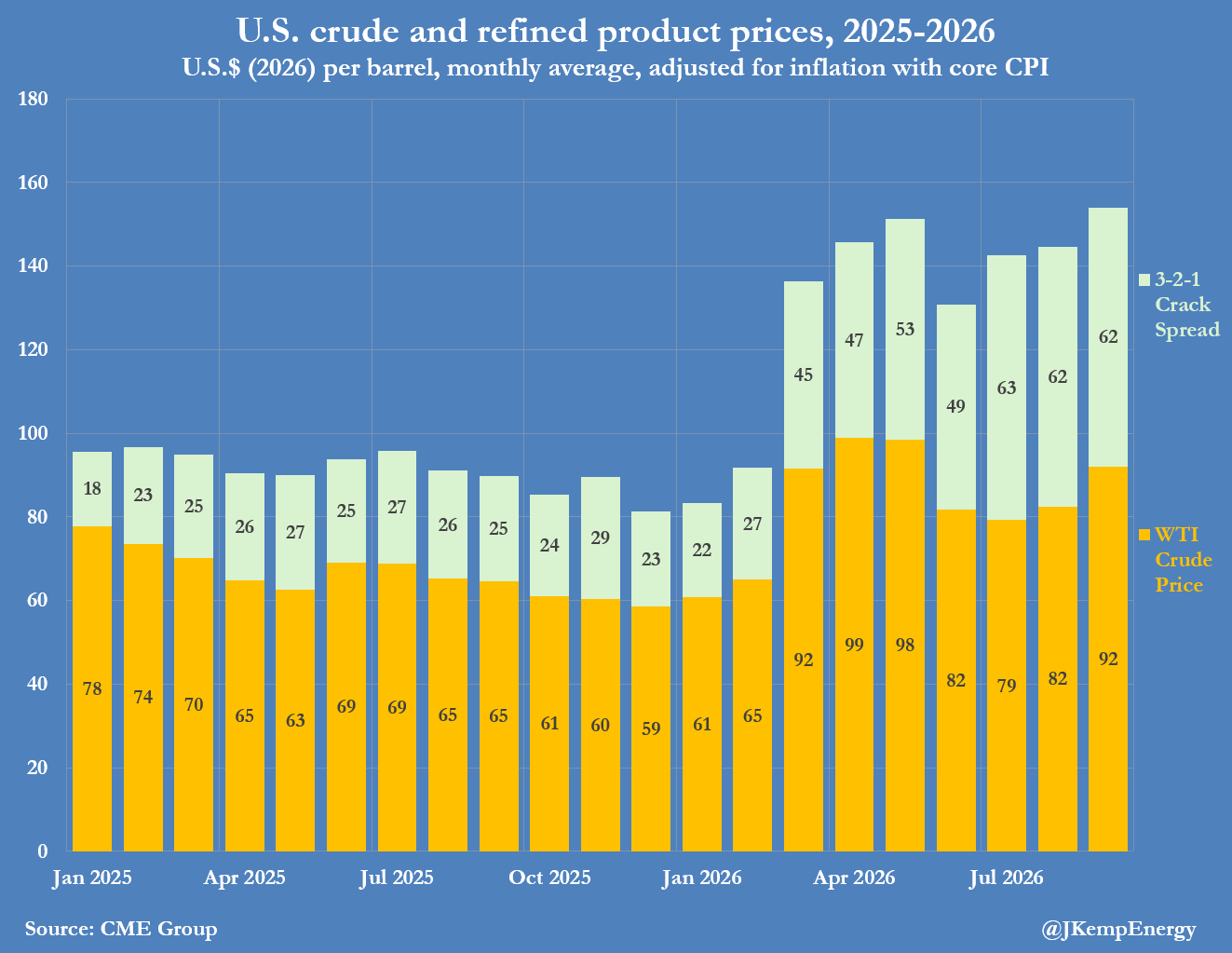
Energy analyst John Kemp noted Wednesday that the combined cost of U.S. crude and refining margins is now higher than in early April. So far this month, WTI around $92 per barrel plus a 3-2-1 crack spread near $62 produces a combined figure above May ($98 crude and $53 crack) and April ($99 and $47). That wholesale pressure is flowing through to the pump and into broader cost-of-living discontent.
As of September 9, AAA put the national average for regular gasoline at $4.22 per gallon and diesel at a record $5.94. California remains an outlier: regular gasoline near $5.88 and diesel at a record $7.87. Gasoline is still below its June 2022 national peak of $5.02, but diesel has broken through prior highs. Year-over-year, diesel is up roughly 60 percent.
The global refining bottleneck, not just crude
The real stress is in middle distillates. Industry officials at the Asia Pacific Petroleum Conference in Singapore this week warned that the diesel crunch has not yet peaked. Vitol CEO Russell Hardy said global fuel markets remain “very tight and inflexible” despite some increase in crude flows out of the Persian Gulf. Only about 1 million barrels per day of the estimated 10 million bpd leaving the region are refined products; the rest is crude. “We’re still not running enough refining capacity to prevent those draws, and we keep eating into the surplus that exists around the world,” Hardy said.
Two large sources of product supply are impaired at once. Iranian strikes and restricted Hormuz traffic have constrained Middle East refining and product exports. Ukrainian drone strikes have hammered Russian refineries, and Moscow has banned diesel exports at least through September. Combined product losses from those two regions have been estimated around 2 million barrels per day each. China has also been conservative with product exports. The result is that the world is processing several million barrels per day less crude into fuels than a year ago.
Kuwait Petroleum’s Shaikh Khaled Ahmad Al Sabah said sustaining elevated global refining rates through year-end “would be an achievement” and that Northwest Europe faces “a very difficult winter.” This is “only the beginning.” Delayed maintenance, high utilization, and the approach of heating season leave little spare capacity if another major unit trips offline.
Live 3-2-1 crack spreads remain near $60–$63 per barrel. Diesel cracks have led the move. That is why pump prices can rise even when crude is not at its spring highs.
How the U.S. market is holding up
The United States is the world’s largest diesel producer and has responded as a market system should: refiners have run hard. Utilization recently reached 97–98 percent of operable capacity, among the highest readings in decades, with crude runs near 17.5 million barrels per day. Distillate production has been strong, and U.S. product exports have helped Europe.
That is not the same as comfort. Distillate inventories remain well below the five-year average (roughly 10–14 percent short in recent EIA weeks). East Coast (PADD 1) stocks have been especially tight, at times near multi-decade lows even while the national system ran at 98 percent. Refineries delayed turnarounds through summer; autumn maintenance and hurricane risk now coincide with harvest and the start of heating demand. U.S. refiners cannot raise runs much further without raising the odds of mechanical failure.
The U.S. market is therefore more resilient than import-dependent Europe, but it is not insulated. High cracks and export demand keep pulling product toward the highest-paying markets. Domestic diesel balances stay tight unless crude processing or imports rise, or demand destruction appears.
Other prices tied to diesel
California: isolated, import-dependent, and likely to stay expensive
California’s problem is structural as well as cyclical. The state has lost a large share of local refining capacity in recent years, has no major product pipelines from the Gulf Coast, and requires specialized gasoline blends. It has long relied on waterborne imports from Asia and workarounds such as shipments via the Bahamas. When Asian and Middle East product flows tightened, the West Coast felt it first and hardest.
Diesel in California is now about $2 per gallon above the national average. Analysts have flagged the possibility of $8 diesel in parts of the state as harvest demand peaks. Regular gasoline remains below its 2022 state record but is still far above the rest of the country. Further pressure is plausible if winter heating demand, another foreign-supply disruption, or delayed Gulf shipments coincide. The Jones Act waiver has reduced—but not eliminated—that isolation.
How the Jones Act waiver is helping
On March 17, 2026, DHS issued the broadest Jones Act waiver in decades so foreign-flag vessels could move energy products and fertilizers between U.S. ports. It has been extended, most recently through mid-November, with a narrower product list and voyage review. The purpose was to keep military and civilian fuel moving after Hormuz disruptions.
The effect on paper and on the water has been large. Gulf Coast-to-West Coast waterborne shipments of crude and products jumped several-fold versus 2025. In the waiver’s early months, more gasoline and jet fuel moved that route than in years of normal Jones Act trade combined. California and New England, both short of local refining and pipelines, were the biggest beneficiaries. Energy Secretary Chris Wright has said the waiver lowered prices in California and on the East Coast. Independent estimates put shipping savings on the Gulf-to-West Coast haul on the order of several cents per gallon, with aggregate freight-cost savings in the tens to low hundreds of millions of dollars over the waiver window.
The waiver is not a substitute for lost California refining capacity or restored Middle East product exports. It reallocates existing U.S. barrels more cheaply than Jones Act-only shipping would allow. When it expires in November, unless renewed, West Coast and Northeast premiums could widen again just as winter demand rises.
What investors should watch
The trade is still a products-and-margins story more than a crude-only story.
- Crack spreads and diesel/heating-oil futures. The 3-2-1 and ULSD cracks are the cleanest real-time signal of tightness. Sustained diesel cracks above historical norms support refining equities even if WTI chops.
- U.S. refiners with complex, high-utilization Gulf and Midcontinent assets (Valero, Marathon Petroleum, Phillips 66 and peers). High utilization and export optionality are earnings tailwinds until maintenance or demand destruction hits.
- EIA weekly inventories, especially PADD 1 distillates, national distillate days of supply, and utilization. Draws into October–November would confirm the winter squeeze industry executives describe.
- Product tanker rates and Gulf-to-West Coast/East Coast freight. Waiver volumes and any expiry risk show up here.
- Geopolitics and Russian run rates. Hormuz product flows versus crude flows, and whether Russian export bans and refinery outages persist.
- Second-order names: trucking and parcel carriers (fuel-surcharge lag), agricultural input and grain-transport names, and fertilizer (already covered by the waiver).
- High diesel is an inflation vector that can keep the Fed cautious.
A durable ceasefire that restores Middle East product exports and Russian runs would compress cracks faster than crude. Until then, refiners capture the scarcity rent.
Second-order impacts: how consumers should think about high diesel
Diesel is the workhorse fuel of the physical economy. It powers the majority of freight trucks, much of rail and barge movement, farm tractors and combines, irrigation pumps, and a large share of construction equipment. Gasoline pain is visible at the pump. Diesel pain shows up weeks later in the grocery aisle, the delivery fee, and the cost of a bushel of corn.
A Joint Economic Committee analysis found farmers spent about $1.4 billion more on diesel during the 2026 planting season than a year earlier—a 63 percent increase for major crops. Harvest now layers another surge in field and hauling demand on record pump prices. Farmers pay twice: once in the tank and again in custom rates, grain freight, and weaker basis when elevators face higher outbound costs. Livestock and perishable produce are especially exposed because refrigeration and tight delivery windows cannot wait.
Trucking fleets pass costs through fuel surcharges, typically with a short lag. Those charges become part of the landed cost of everything that moves: food, packages, building materials, retail inventory. Smaller carriers feel cash-flow stress first. Consumers should treat elevated diesel as a broad inflation input, not a niche trucking story. Demand destruction—fewer miles, consolidated shipments, deferred non-essential freight—is the mechanism that eventually caps prices, but it is painful and slow.
How high and how long?
Industry messaging from Singapore is unambiguous: the market has not seen the worst of the diesel tightness, winter in Europe will be difficult, and keeping the global refining system at current rates through year-end would itself be an achievement. U.S. refiners are already near the mechanical ceiling. California’s import dependence and boutique specs keep a structural premium in place. The Jones Act waiver is a partial offset that expires in November unless extended.
Prices can still move higher if another large refinery outage, a hurricane, or a further squeeze on Hormuz product flows hits before stocks rebuild. They can ease if crude processing in the Middle East and Russia recovers, if U.S. turnarounds are modest, and if high prices finally cut demand. The base case from traders and refiners is tightness through winter, not a quick return to 2025 pump prices.
The question for households and businesses is not only the next dime at the pump. It is how long diesel stays expensive enough to keep freight, food, and farm costs elevated after the headlines move on.
Appendix: Sources and links
- John Kemp, X post, September 9, 2026: https://x.com/JKempEnergy/status/2097625001948013023
- Tsvetana Paraskova, “Diesel Crunch Set to Worsen as Refining Capacity Falls Short, Industry Warns,” OilPrice.com, September 9, 2026: https://oilprice.com/Latest-Energy-News/World-News/Diesel-Crunch-Set-to-Worsen-as-Refining-Capacity-Falls-Short-Industry-Warns.html
Prices and market data
- AAA Daily Fuel Gauge Report: https://gasprices.aaa.com/
- EIA Weekly Petroleum Status Report: https://www.eia.gov/petroleum/supply/weekly/
- EIA U.S. Refinery Utilization and Capacity: https://www.eia.gov/dnav/pet/pet_pnp_unc_dcu_nus_m.htm
- Live 3-2-1 crack spread (OilPriceAPI computation): https://www.oilpriceapi.com/crack-spread
- California AAA averages and diesel records (examples): https://gasprices.aaa.com/?state=CA ; San Francisco Chronicle diesel report: https://www.sfchronicle.com/california/article/diesel-prices-record-22420315.php
Global refining and diesel tightness
- Bloomberg / Yahoo recap of APPEC comments: https://finance.yahoo.com/energy/articles/diesel-crunch-threatens-lasting-price-053420958.html
- BOE Report on industry executives: https://boereport.com/2026/09/07/global-diesel-supply-to-stay-tight-through-winter-industry-execs-say/
- API, “Inside the Global Squeeze on Diesel”: https://www.api.org/news-policy-and-issues/news/2026/08/26/inside-the-global-squeeze-on-diesel
- Columbia SIPA CGEP, “Beyond Crude: Iran War Reveals Refined Products as an Energy Security Blind Spot”: https://www.energypolicy.columbia.edu/publications/beyond-crude-iran-war-reveals-refined-products-as-an-energy-security-blind-spot/
- Wood Mackenzie / Guardian on Q4 processing losses: https://guardian.ng/energy/tougher-times-ahead-as-meast-crisis-cuts-crude-processing-by-1-4m-bpd/
Jones Act waiver
- AP News on the August extension: https://apnews.com/article/trump-jones-act-foreign-ships-waiver-7047dd11fcbbc647e6d33cc73a9220e6
- American Action Forum cost-savings analysis: https://www.americanactionforum.org/insight/the-jones-act-petroleum-waiver-assessing-flows-and-cost-savings/
- Cato Institute Jones Act Waiver Tracker and shipment analysis: https://www.cato.org/jones-act-waiver-tracker ; https://www.cato.org/blog/shipping-records-break-under-jones-act-waiver
- API on waiver flows: https://www.api.org/news-policy-and-issues/news/2026/06/17/how-jones-act-waivers-keep-energy-moving
- National Interest on waiver renewal: https://nationalinterest.org/blog/energy-world/why-the-jones-acts-temporary-waiver-was-renewed-again
U.S. and California context
- TT News / Labor Day price records: https://www.ttnews.com/articles/labor-day-record-gas
- U.S. News on Labor Day highs and Iran war: https://www.usnews.com/news/business/articles/2026-09-07/fuel-prices-at-record-labor-day-high-in-us-thanks-to-iran-war-and-refinery-issues
- IER on California imports and refinery closures: https://www.instituteforenergyresearch.org/fossil-fuels/gas-and-oil/california-turns-to-imports-as-its-refineries-close/
Second-order impacts (transport, delivery, agriculture)
- Transportation Energy Institute on trucks and diesel: https://www.transportationenergy.org/resources/blog-post/the-economy-runs-on-trucks-and-trucks-run-on-diesel/
- Joint Economic Committee (Minority) planting-season diesel cost analysis: https://www.jec.senate.gov/public/_cache/files/37b255b8-91d9-43b0-8041-6b0d90cd150f/final—jec-fact-sheet-on-diesel-farming-costs.pdf
- Los Angeles Times on California diesel impacts: https://www.latimes.com/california/story/2026-09-04/record-high-diesel-fuel-prices-slam-california-economy
- Atlantic Council on state-level diesel shock: https://www.atlanticcouncil.org/blogs/energysource/the-diesel-shock-is-here-which-us-states-will-be-hit-the-hardest/
- Harvest-cost reporting: https://www.agrolatam.com/usa/news/record-diesel-prices-us-farmers-harvest-costs-2026/ ; https://www.kttc.com/2026/09/07/diesel-prices-drive-up-harvest-costs-minnesota-iowa-farmers/
Prices and utilization figures are as reported on or immediately before September 9, 2026, and will move with the next EIA weekly release and AAA daily survey.