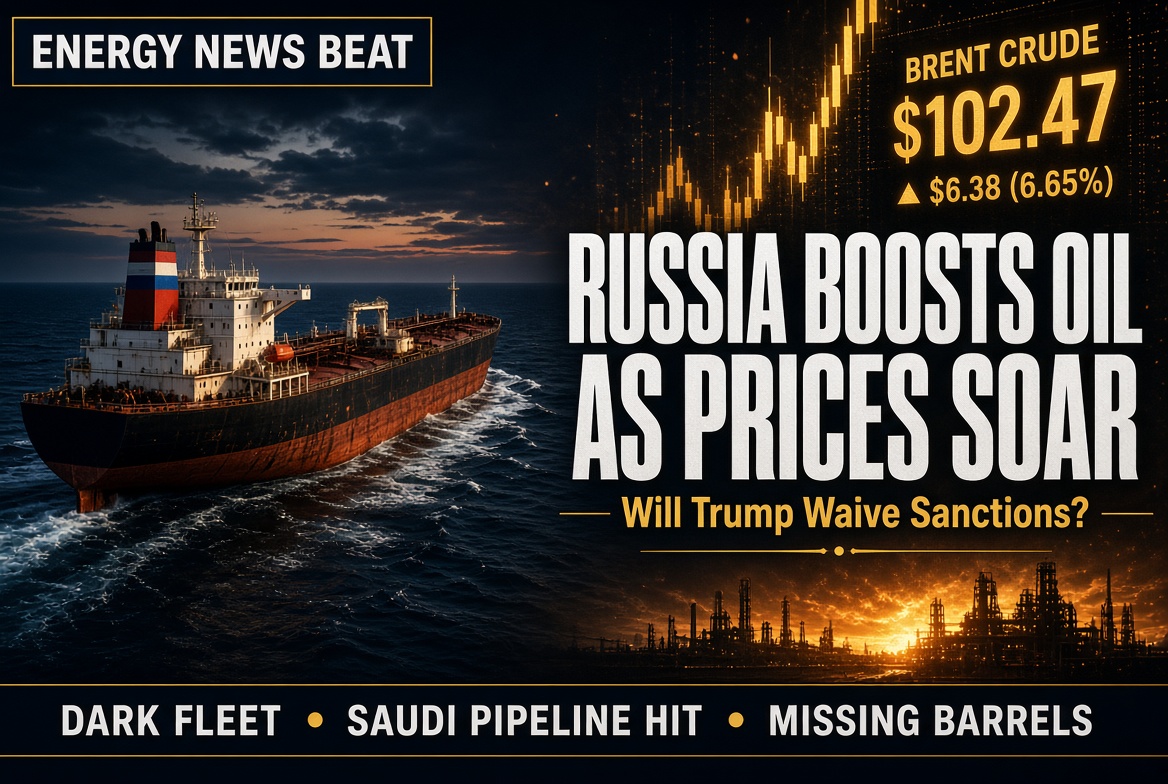
The question in Washington is whether President Trump will treat that extra Russian oil as a problem to sanction—or as barrels he can use to keep gasoline and diesel from becoming a midterm disaster.
That is the market story of September 15, 2026. It is also a political story.
Prices jumped because Saudi’s safety valve failed
Bloomberg’s tanker-tracking data show Russia’s overseas crude flows averaged 3.54 million barrels a day in the four weeks through September 13, after the largest weekly increase since May. Export value on that same four-week basis rose to about $1.9 billion a week. Moscow lifted loadings from the Baltic port of Ust-Luga by roughly a third this month by pushing Kazakh barrels onto the more exposed Black Sea route.
The timing is not luck. Drone strikes forced Saudi Arabia to shut the East-West pipeline that moves crude from the Gulf coast to Yanbu on the Red Sea—the route Riyadh has used to keep oil flowing while Iran’s campaign has throttled the Strait of Hormuz. Analysts put 2.6–4 million barrels a day at risk. That is about 4 percent of global supply. Yanbu inventories were described as a five-to-seven-day cushion.
Saudi output had already collapsed. The kingdom reported August production near 6.24 million b/d, the lowest since 1990, after pre-war levels near 10–11 million b/d. Observed exports fell to multi-year lows. Brent traded in the high $100s to around $108–109; WTI was near $104. Diesel is the tighter product, because Ukrainian strikes have hammered Russian refining and the Gulf’s seaborne diesel trade has been gutted.
The “missing barrels” are real. They are not only Saudi barrels. They are Gulf barrels that cannot move, Russian products that cannot be made, and inventories that have already been drawn hard.
What Russia can actually put on the market
Russia is not a spare-capacity giant sitting on 3–4 million idle barrels. It is a producer whose upstream is aging, whose refiners are under drone fire, and whose official 2026 outlook was just cut.
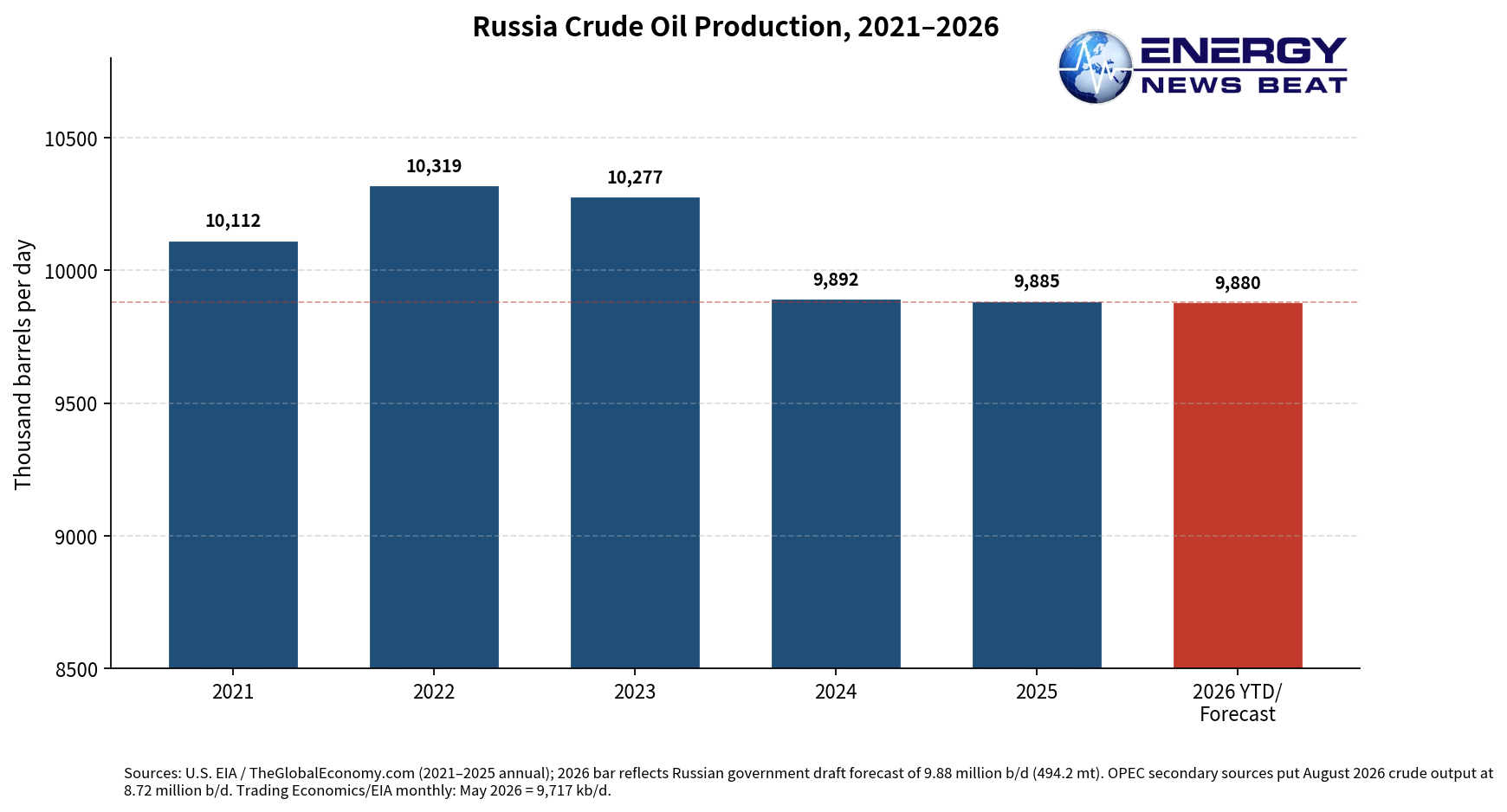
Russian government draft forecasts seen by Reuters in early September put 2026 crude output at 494.2 million tons, or about 9.88 million b/d—the lowest since 2009. That is the planning number. Secondary sources tell a harsher near-term story: OPEC cited August crude at 8.72 million b/d, more than a million barrels below Russia’s OPEC+ required level, after a ninth month of decline. EIA-style monthly data were still higher earlier in the year (May around 9.72 million b/d). The gap between official capacity talk and observed output is the story of 2026.
Five-year context matters. EIA-linked annual crude figures show Russia near 10.1–10.3 million b/d in 2021–2023, then sliding to about 9.89 million b/d in 2024 and 9.89 million b/d in 2025. Production did not collapse after 2022 the way many sanctions advocates predicted. It has eroded under quotas, mature West Siberian decline, tighter financing, and now physical attacks.
Exports are the piece that can help the market tomorrow. Seaborne crude around 3.5 million b/d plus pipeline volumes to China (ESPO and other Pacific grades) and remaining overland flows still leave Russia as one of the few large suppliers that can raise loadings when prices spike. Ukraine’s refinery campaign has a perverse side effect: crude that cannot be processed at home is pushed into the export stream. That is why crude shipments can rise even while total liquids production slips and product exports (especially diesel) collapse.
Russia cannot replace 4 million Saudi pipeline barrels by itself. It can cover a slice—perhaps a few hundred thousand barrels a day of incremental seaborne crude on a good week, plus the barrels already moving to India and China. That is material in a market this tight. It is not a substitute for a functioning Gulf.
The dark fleet already serves China
A U.S. sanctions waiver is not the only pipe from Primorsk and Kozmino to Shandong.
The shadow or “dark” fleet—older tankers, opaque ownership, flags of convenience, ship-to-ship transfers—remains the workaround. CREA estimated that in August 52 percent of Russia’s seaborne oil moved on sanctioned shadow tankers, with another large share on G7-owned or insured ships. China has been the single largest buyer of Russian crude in recent months; India is close behind. ESPO into northern China still has a short-haul advantage when Hormuz and Red Sea routes are chaos. Arctic loadings to China via the Northern Sea Route have also set records this year.
So the commercial reality is already there: China can get Russian oil without a White House blessing. India has done the same for years. A waiver changes the legal and banking risk for Western service providers, insurers, and some traders. It does not invent a trade that the dark fleet has not already been running.
That is why a waiver is less about “can the barrels move?” and more about “who gets political credit, who gets cheaper freight and insurance, and how much extra volume shows up in official channels instead of the gray market?”Will Trump waive sanctions to cap prices?
He has already used this tool—and taken it back.
After the U.S.-Israel war with Iran shut Hormuz flows, Treasury issued 30-day general licenses so Russian oil already on the water could be sold. Those waivers were renewed in April and May, then allowed to expire on June 17, 2026. Trump said at the time that Middle East oil was “flowing” again and the United States could put more pressure on Moscow. Prices did not stay low. The latest Saudi pipeline outage has put the affordability problem back on his desk weeks before the November midterms.
This week he floated an energy-infrastructure truce between Russia and Ukraine and blamed diesel prices mainly on Ukrainian refinery strikes. Neither Kyiv nor Moscow confirmed a deal. The Kremlin called the idea “very good” and immediately attached conditions: protect tankers and lift energy sanctions. That is Moscow’s bid. It is not a concession.
A limited waiver—oil already at sea, or a short license for vulnerable Asian buyers—would be the politically easiest version. A broader easing of measures on Rosneft, Lukoil, and shipping services would be the version that actually adds barrels and cuts the dark-fleet premium. It would also be the version European allies and Ukraine would treat as a gift to the Russian budget.
The political win, if there is one, is narrow and domestic: show voters that the administration will use every barrel, including Russian barrels, to keep U.S. pump prices from exploding. The dark-fleet trade to China continues either way. The incremental barrels that matter for New York Harbor and the Midwest diesel rack are the ones that move with fewer legal frictions and fewer Ukrainian drones hitting Russian plants.
The trade-off Energy News Beat readers should watch
Three facts sit together:
- Saudi Arabia just lost its best remaining export workaround; several million barrels a day are in play.
- Russia can raise seaborne crude in the short run and already sells heavily to China and India through official and shadow channels.
- Russian production is not rising; it is slipping under attacks and field decline. Extra exports come partly from crude that is no longer being refined at home.
A Trump waiver would not “solve” the missing Saudi barrels. It could take some heat out of a $100-plus crude market and a diesel crunch that is already feeding inflation politics. It would also put more cash in Moscow’s war chest at the exact moment prices are soaring because of a Middle East war the Kremlin did not start but is happy to monetize.
That is the choice, not a slogan. The barrels are moving. The only open question is whether Washington wants them moving with a U.S. license attached—or only with a Cameroon flag and a darkened AIS transponder.
We’ll cover this on the Energy News Beat Stand Up on Friday.
Making Appendices Great Again
Appendix: Sources and Links
- Bloomberg, “Russia Boosts Oil Flows as Middle East War Sends Prices Soaring,” September 15, 2026: https://www.bloomberg.com/news/articles/2026-09-15/russia-boosts-oil-exports-as-middle-east-war-sends-prices-soaring
- Transport Topics / Bloomberg reprint with additional loading and revenue detail: https://www.ttnews.com/articles/russia-boosts-oil-flows
Saudi disruption and prices
- CNBC, East-West pipeline and 4 million b/d at risk: https://www.cnbc.com/2026/09/15/oil-prices-saudi-arabia-east-west-pipeline-iran.html
- Reuters, supply concerns and pipeline outage: https://www.reuters.com/business/energy/oil-prices-rise-saudi-pipeline-outage-fresh-attacks-raise-supply-concerns-2026-09-15/
- Reuters, pipeline outage threatens ~4% of global supply: https://www.reuters.com/business/energy/saudi-pipeline-outage-threatens-loss-4-global-oil-supply-2026-09-13/
- Al-Monitor, Saudi August output lowest since 1990: https://www.al-monitor.com/originals/2026/09/saudi-arabias-oil-production-slumps-lowest-36-years-war-bites
- The National, oil near $108 after pipeline shutdown: https://www.thenationalnews.com/business/energy/2026/09/14/oil-nears-108-after-saudi-arabia-shuts-pipeline-amid-attacks/
- Business Standard / Rystad Yanbu loadings: https://www.business-standard.com/world-news/what-closure-of-saudi-s-east-west-pipeline-means-for-global-oil-supplies-126091500042_1.html
Russian production and 2026 outlook
- TheGlobalEconomy / EIA annual oil production: https://www.theglobaleconomy.com/Russia/oil_production/
- Trading Economics, Russia crude oil production (May 2026): https://tradingeconomics.com/russia/crude-oil-production
- Reuters exclusive, 2026 output cut to 17-year low / 9.88 million b/d: https://www.reuters.com/business/energy/russia-cuts-expected-2026-oil-output-17-year-low-war-fallout-draft-forecasts-2026-09-01/
- Bloomberg / Rigzone, August crude 8.718 million b/d (OPEC secondary sources): https://www.rigzone.com/news/wire/russias_crude_output_fell_in-august-10-sep-2026-184586-article/
- Worldometer, Russia oil production statistics: https://www.worldometers.info/oil/russia-oil/
- Carnegie paper on Russian oil decline and field structure (2026): https://assets.carnegieendowment.org/files/Vakulenko_Russian%20Oil.pdf
Sanctions waivers, Trump, and energy truce
- S&P Global, U.S. lets Russian oil sanctions waiver expire (June 17, 2026): https://www.spglobal.com/energy/en/news-research/latest-news/crude-oil/061726-us-lets-russian-oil-sanctions-waiver-expire-amid-iran-deal
- Reuters, U.S. quietly allows waiver to expire: https://www.reuters.com/business/energy/us-quietly-allows-waiver-russian-oil-expire-2026-06-17/
- Reuters, Kremlin welcomes energy truce idea, demands sanctions removal (September 15, 2026): https://www.reuters.com/business/energy/kremlin-welcomes-trumps-idea-energy-truce-with-ukraine-calls-for-sanctions-removal-2026-09-15/
- Reuters analysis, energy truce will not fix diesel crunch: https://www.reuters.com/commentary/reuters-open-interest/trumps-ukraine-energy-truce-wont-fix-global-diesel-crunch-2026-09-15/
- The New York Times, no confirmed energy truce: https://www.nytimes.com/2026/09/15/world/europe/trump-energy-truce-ukraine-russia.html
- NYT, diesel prices and two wars: https://www.nytimes.com/2026/09/14/business/energy-environment/trump-diesel-russia-ukraine-iran.html
Dark fleet, China, and export structure
- CREA, August 2026 monthly analysis of Russian fossil fuel exports: https://energyandcleanair.org/august-2026-monthly-analysis-of-russian-fossil-fuel-exports-and-sanctions/
- KSE Institute Russian Oil Tracker (July 2026 PDF): https://institute.kse.ua/wp-content/uploads/2026/08/rot_eng_july_2026.pdf
- PISM, China and Iranian/Russian shadow fleets: https://pism.pl/publications/china-and-the-iranian-and-russian-shadow-fleets
- MarineTraffic, shadow fleet June 2026 overview: https://www.marinetraffic.com/ir/maritime-news/34/risk-and%20compliance/2026/13063/the-rise-of-the-shadow-fleet-a-june-2026-overview
- ArcticToday, record Russian Arctic oil exports to China: https://www.arctictoday.com/russian-arctic-oil-exports-to-china-beat-records/
Price snapshots (September 15, 2026)
- GuruFocus WTI-linked oil price print: https://www.gurufocus.com/economic_indicators/4510/oil-price
- Tindex / market prints for Brent around the same session: https://tindex.app/en/indicators/stock-energy/brent-oil/
Chart data compiled from EIA-linked annual series (TheGlobalEconomy), Trading Economics monthly EIA figures, the Russian government 2026 draft forecast reported by Reuters, and OPEC secondary-source August 2026 output reported by Bloomberg/Rigzone. Annual bars for 2021–2025 are EIA-style crude; the 2026 bar uses the official draft forecast and should be read against the lower August secondary-source print.