Moscow is keeping diesel at home through the end of October. That decision lands on a European market that has already lost its old Russian supply line, is watching Saudi crude and product routes seize up, and is about to hear from the Bank of England on interest rates. The combination is not a single shock. It is three shocks stacked on top of each other: missing Russian barrels of finished diesel, missing Saudi barrels of crude that European refiners need to make diesel themselves, and tighter money that makes the resulting inflation harder to finance.
Vedomosti reported on September 15 that the Russian government will extend the diesel export ban for all fuel producers through October 31, following a meeting chaired by Deputy Prime Minister Alexander Novak. The current producer ban had been due to expire on September 30. Russia’s Energy Ministry said the restrictions “may be adjusted” once supply volumes stabilize, and reserves are rebuilt ahead of winter. As of September 16, the government had not posted a formal decree, but Reuters, OilPrice, and multiple industry sources treated the extension as the working baseline.
This is not a new policy. It is the latest stretch of a ban that began on July 8, was widened from traders and small plants to every producer, and has already been rolled forward twice. Gasoline exports remain banned until January 31, 2027. Jet fuel restrictions run through the end of November. Non-producers are locked out of diesel exports into early 2027. Humanitarian and intergovernmental cargoes are the main exemptions.
The reason is damage, not strategy. Ukrainian drone strikes have taken a large slice of Russia’s diesel complex offline. Russia’s six largest diesel refineries account for roughly half of national output. Kirishi is fully shut. Volgograd and NORSI have been running near 25 percent of capacity. Taneco was hit on September 13. Delayed maintenance and the need to restock before winter did the rest. Russian seaborne diesel exports, once close to 800,000–900,000 barrels per day in healthier months, fell below 1 million metric tons in June from about 2.5 million tons a month a year earlier. Vortexa put August seaborne diesel and gasoil loadings near 150,000 barrels per day in the first 25 days of the month, down about 610,000 barrels per day year on year and 81 percent below the five-year seasonal average. Russia is normally the world’s second-largest diesel exporter after the United States. Those missing cargoes used to go to Turkey, Brazil, and, before 2023, Europe.
Domestic prices show why the Kremlin will not reopen the tap. Diesel on the St. Petersburg exchange traded at 70,546 rubles a ton in early September. Retail diesel hit 88.44 rubles a liter on September 7, up 18.4 percent since the start of the year. President Donald Trump has already tied Ukrainian refinery strikes to U.S. pump prices and urged Kyiv to stop “knocking out” Russian plants. U.S. diesel printed a record $6.27 a gallon this week. The shortage is no longer a Russian problem. It is a global middle-distillate problem.
The Saudi shock hits Europe from the other side
If Russia is withholding finished diesel, Saudi Arabia is withholding the crude Europe needs to refine its own.
Drone attacks last week forced a precautionary shutdown of Saudi Arabia’s East-West pipeline, the 1,200-kilometer line that moves crude from the Eastern Province to the Red Sea port of Yanbu. That line had become the main bypass around a constrained Strait of Hormuz and was recently carrying an estimated 4–5 million barrels per day. Loadings at Yanbu were suspended. Argus reported that at least three European refiners had late-September cargoes canceled or postponed, in some cases into November. Poland’s Orlen, which takes about 40 percent of its crude from Aramco across plants in Poland, Lithuania, and the Czech Republic, has already been buying North Sea grades, U.S. WTI Midland, and Kazakh CPC Blend on the spot market.
Futures prices understate the physical tightness. Brent futures were near $107 a barrel on Wednesday after a modest pullback. Dated Brent, the physical benchmark, has traded above $130 as refiners fight for barrels that can actually load. Saudi output reported to OPEC for August was 6.238 million barrels per day, the lowest since 1990. Kpler put August crude exports at 3.2 million barrels per day, the lowest in 13 years. The IEA’s September Oil Market Report said Gulf diesel and gasoil net exports averaged only 390,000 barrels per day in August, just over a quarter of pre-war levels. A KSE Institute study cited by OilPrice put Gulf-related export losses at 152 million barrels between March and August, more than double Russia’s 68-million-barrel drop over the same window.
That is the “Saudi oil crisis” in practical terms for Europe. It is not only fewer Saudi diesel cargoes. It is fewer Saudi crude cargoes into European stills at the exact moment those stills are being asked to replace Russian diesel that is no longer coming.
How much diesel Europe and the UK actually import
Europe is structurally short diesel. It has been since the post-2022 rupture with Russia, and the deficit has widened as European plants closed.S&P Global Energy documented the redrawn map. Europe imported 29.9 million metric tons of Russian diesel in 2022. By 2024, that had collapsed to 2.9 million tons, cutting Russia’s share from nearly 50 percent to about 5 percent. The Middle East stepped into the gap: exports to Europe rose from 18.1 million tons in 2022 to 22.9 million tons in 2024. The United States shipped 16.5 million tons and India 7.1 million tons in 2024. In 2025, Middle East diesel exports to Europe averaged 519,000 barrels per day, with Saudi Arabia alone at 311,000 barrels per day. France was the top destination.
Those replacement barrels are now under stress. EuroOilWatch estimated European diesel imports fell from about 1.97 million barrels per day in January to 1.56 million barrels per day in July. Vortexa data showed the United States supplying about 520,000 barrels per day of Europe’s seaborne extra-regional diesel in August, roughly half the outside-region total, before shipments dropped to about 350,000 barrels per day in the second half of the month. About 200,000 barrels per day of diesel bound for Europe still moved through the Bab-el-Mandeb in August; India supplied roughly 60 percent of that eastern route. Russia’s seaborne diesel, once a pillar of the European balance, has been largely absent.
The EU’s 18th sanctions package adds another cut. From 2026, it bans imports of refined products made from Russian crude, targeting the “back door” through India, Turkey, and China. S&P estimated that measure could remove as much as 250,000 barrels per day of diesel from the European market. That rule was designed for a world in which the Gulf and the U.S. Gulf Coast could fill the hole. That world is not the one Europe is in this September.
The United Kingdom is thinner than the continent. Two refineries, Grangemouth and Lindsey, closed in 2025. UK refinery output stayed near 48 million tonnes, only marginally above the 2020 pandemic low. The Digest of UK Energy Statistics shows the UK was a net importer of petroleum products by about 15.5 million tonnes in 2025, the highest since the country became a net product importer in 2013. Just under 40 percent of those product imports were diesel. The United States (31 percent), the Netherlands (26 percent), and Belgium (11 percent) together supplied just under 70 percent of UK diesel imports. The Netherlands and the United States provided 58 percent of white diesel imports and met about 32 percent of UK diesel demand. Russia used to cover a fifth of UK diesel demand and a third of diesel imports in 2020–21. That pipe is gone. What remains is a UK system that now depends on U.S. Gulf cargoes, ARA blending barrels, and whatever Middle East and Indian product can still clear the Red Sea.
How bad it is going to get
Bad enough that diesel has decoupled from crude.
Argus Media recorded the European diesel crack above $100 a barrel for the first time in early September, $104.08 for southern Europe. Josh Michalowski, European head of diesel pricing at Argus, called it “truly unprecedented.” Wholesale diesel in southern Europe traded near $199 a barrel against North Sea crude that was not even close to that level. S&P Global Energy now expects global diesel crack spreads to average about $84 a barrel through the rest of 2026, $31 a barrel above its previous forecast. Karim Fawaz, executive director at S&P Global Energy, put the seasonal warning in one line: “Winter is coming for diesel markets.” Inventories are low, spare refining capacity is scarce, and harvest plus heating demand is about to rise at the wrong moment. S&P cut its outlook for fourth-quarter global refining runs to 79.4 million barrels per day, more than 2 million barrels per day below the previous view. West Asian crude runs are expected to average about 7.7 million barrels per day in 2026, roughly 2 million barrels per day below 2025.
Morgan Stanley made the same call in July, and it has not aged poorly. Analysts including Martijn Rats wrote that “the picture is genuinely tight” and that “the epicenter of all this is the diesel market, and Europe in particular.” Their balances pointed to European diesel inventories falling toward about 299 million barrels in November, the lowest for the season since at least 2015. They also warned the tightness was already in the price: “fully priced — don’t chase.” That was before the East-West pipeline went down and before Moscow extended the export ban into October.
Frank Walbaum at Naga.com framed the double hit cleanly after Wednesday’s session: “Diesel’s strength reflects a product-specific shortage layered on top of expensive crude. Europe has lost substantial diesel and jet-fuel supply from the Middle East, while ongoing tensions in Eastern Europe have disrupted output at several major Russian refineries and prompted Moscow to restrict fuel exports.” UBS’s Giovanni Staunovo noted that reports of Saudi loadings via Oman eased the fear of an even larger crude disruption. That is cold comfort for diesel. Extra crude off Sohar helps Asian refiners. It does not put ultra-low-sulfur diesel into Rotterdam next week.
What “how bad” means on the ground: freight and farming first, then heating oil in northern Europe, then industrial users. Road diesel in the EU was already around €2.04 a liter in early September, only about 3 percent below the April peak. UK pump prices will follow U.S. and ARA wholesale with a lag. The harvest window cannot be postponed. Neither can a cold November. Demand destruction will do some of the balancing. That is another way of saying activity gets rationed by price.
Where the swing refiners sit
The crude swing producer is still Saudi Arabia. The product swing producers are not.
India is the clearest refined-product swing supplier left. OilPrice and Kpler tracked Indian product exports near 1.4 million barrels per day in July. Reliance’s Jamnagar complex can flip barrels toward Europe when the crack pays the freight. Indian diesel exports to Europe were estimated around 120,000 barrels per day in August after the Jazan refinery outage and the Russian ban opened the arb. India supplied about 60 percent of Europe-bound diesel moving through the Bab-el-Mandeb in August. The constraint is crude. Indian crude and condensate imports fell to about 3.8 million barrels per day in August from 4.8 million a year earlier. A swing refiner that cannot get feedstock is not a swing refiner. EU rules against Russian-origin molecules also cap how much Indian diesel Brussels will accept.
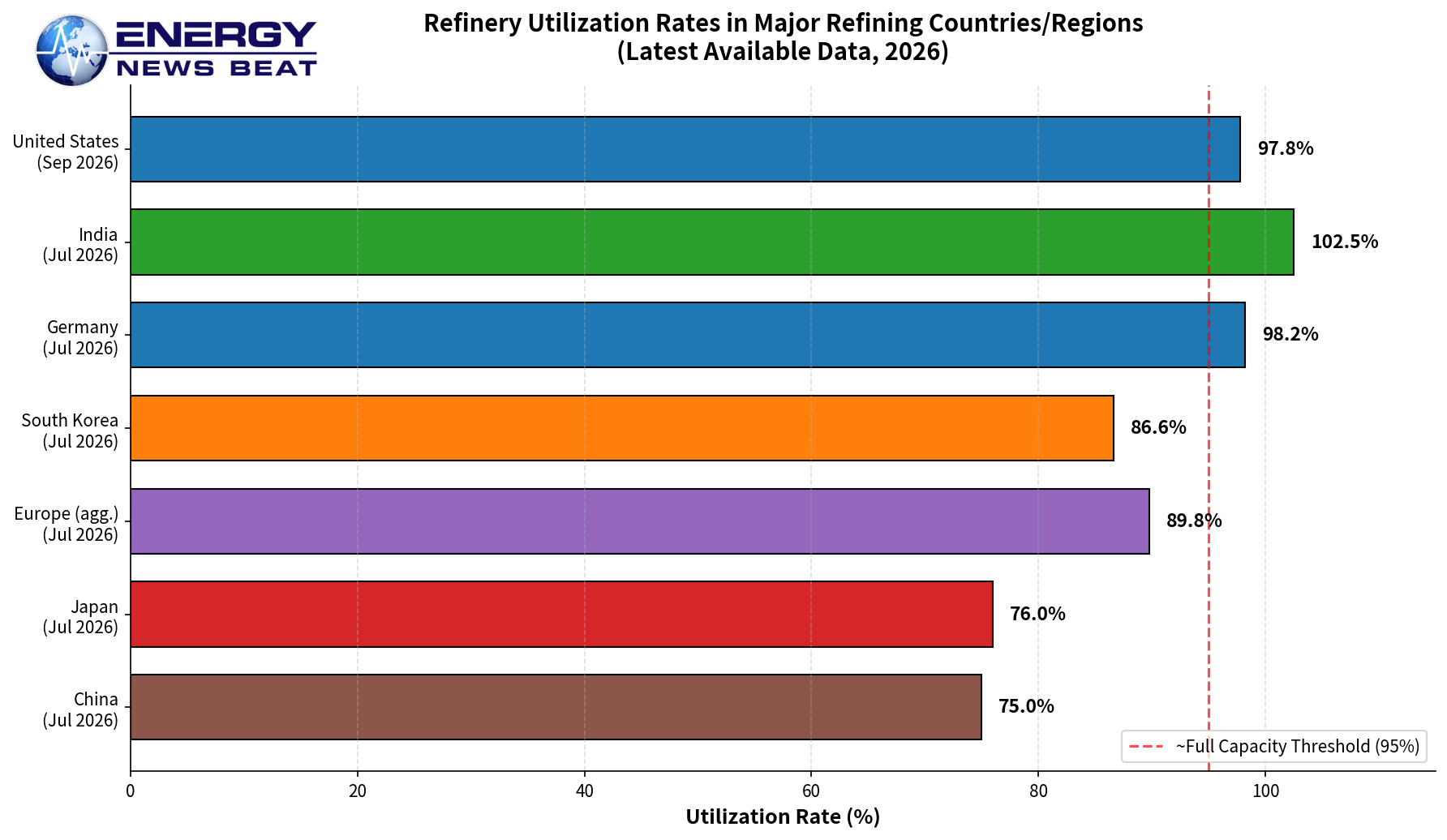
The United States, specifically the Gulf Coast, remains the world’s largest diesel exporter and Europe’s most important Atlantic supplier. August flows near 520,000 barrels per day showed what the system can do when the arb is wide. The second-half slide to 350,000 barrels per day showed the limit. U.S. distillate stocks are about 13 percent below the five-year average. Refinery utilization has been near 97 percent. Washington has already floated the politics of a diesel export ban; the White House denied any plan in August, but a record $6-plus pump price keeps the idea alive. If the United States keeps more diesel at home, Europe loses its last large, flexible supplier.
Saudi Arabia, Kuwait, and the UAE were supposed to be the product backstop after Russia. New Gulf capacity underpinned the 2024–25 surge into Europe. That system is now impaired by war risk, Hormuz disruption, the East-West outage, and plant-level problems such as Jazan. They remain the swing producers on paper. They are not swinging this month.
South Korea, Japan, and China can redirect barrels when cracks go vertical. Asian 10-ppm diesel margins printed an all-time high above $87 a barrel on September 16, according to LSEG data, versus about $22 before the war. Abhisek Kumar of Sparta Commodities noted that earlier support from Chinese, Korean, and Japanese exports is fading as crude-availability risk lifts Asian diesel itself. China has already restricted product exports during the crisis. Those countries are defending their own balances first.
Turkey used to take Russian diesel and re-export or absorb it. Russia supplied about 281,000 barrels per day in 2025, roughly 85 percent of Turkey’s imported diesel. That flow collapsed toward 80,000 barrels per day in August. Turkey is now a competitor for the same scarce Atlantic and Indian barrels, not a buffer for Europe.
The uncomfortable conclusion is that the swing capacity that exists is already running hot, already claimed by multiple regions, and already short of secure crude.
The Bank of England adds a financial shock to a physical one
The user asked about the “Bank of London.” The institution that matters is the Bank of England.
Bank Rate sits at 3.75 percent. The next decision is Thursday, September 17. Consensus, including Goldman Sachs, is for a hold this week. That is not the end of the story. Three MPC members have already voted to hike to 4 percent. Goldman this week shifted to a 25-basis-point hike in November, citing higher wholesale energy prices, a larger inflation overshoot than the Bank expected, and firmer growth. Traders, per LSEG, have priced about 47 basis points of hikes by year-end. The ECB has already hiked twice this year. UK CPI is still above the 2 percent target. The Bank itself has said Middle East energy disruption will push inflation higher in the second half of 2026.
A hold on Thursday does not cancel the tightening already in the gilt curve. A November hike would raise the cost of working capital for fuel importers, freight firms, and farmers at the same moment diesel invoices are setting records. It would also send another ripple through global rates just as the Federal Reserve and Bank of Japan deliver their own decisions this week. Energy inflation plus policy tightening is the classic squeeze: physical shortage in the real economy, dearer money in the financial one. Importers who must finance $200-a-barrel wholesale diesel on a stronger dollar and a higher sterling funding rate will pass that through or cut volume. Either outcome is contractionary.
That is how a Russian export ban, a Saudi pipeline outage, and a Threadneedle Street decision become one story. Europe has no diesel surplus to absorb any of the three.
Bottom line
Russia is holding diesel through October because its refineries are damaged and winter is coming. Saudi Arabia cannot fully replace those barrels, or even fully replace the crude Europe needs to make its own, while the East-West line is down and Gulf product exports remain a fraction of normal. India and the U.S. Gulf Coast are the only swing refiners still able to move meaningful volume, and both are bumping into feedstock, domestic tightness, and politics. Europe and the UK import the bulk of the diesel they cannot refine at home. That import machine is already running below winter requirements.
How bad it gets from here depends on three clocks: how fast Yanbu loadings resume, how much Russian capacity comes back before the ban’s next expiry, and whether Atlantic refiners keep exporting or start hoarding. None of those clocks is under Brussels’ or Whitehall’s control. The price is already telling the market that the safety margin is gone.
As mentioned in the article Why Banning Diesel Exports Will Hurt the US Rather Than Help, President Trump has one option that would help the global market politically. He could release temporary sanctions relief for Russian Crude oil to ship to India or China, as they have the spare capacity, and right now they are paying about $120 for Singapore or Dark Fleet Crude due to tanker rates. He gets the political win for doing something without banning US diesel exports.
Making Appendices Great Again
Appendix: Sources and links
Russia diesel ban and refinery damage
- Charles Kennedy, “Russia Extends Diesel Export Ban Through October,” OilPrice.com, September 16, 2026. https://oilprice.com/Latest-Energy-News/World-News/Russia-Extends-Diesel-Export-Ban-Through-October.html
- Reuters, “Russia set to extend diesel export ban until end of October, Vedomosti reports,” September 16, 2026. https://www.reuters.com/business/energy/russia-set-extend-diesel-export-ban-until-end-october-vedomosti-reports-2026-09-16/
- Vedomosti source report referenced by OilPrice: https://www.vedomosti.ru/business/articles/2026/09/15/1229127-pravitelstvo-prodlit-zapret
- Reuters, “Russia extends ban on diesel exports until September 30,” August 29, 2026. https://www.reuters.com/business/energy/russia-extends-ban-on-diesel-exports-until-september-30-2026-08-29/
- Bloomberg, “Russia Extends Diesel-Export Ban as Ukraine Ramps Up Attacks,” August 29, 2026. https://www.bloomberg.com/news/articles/2026-08-29/russia-extends-diesel-export-ban-as-ukraine-ramps-up-attacks
- Interfax, “Russian govt extends diesel fuel export ban…,” July 30, 2026. https://interfax.com/newsroom/top-stories/118566/
- NV Ukraine, “Russia extends diesel export ban through October as shortages persist,” September 16, 2026. https://english.nv.ua/business/russia-extends-diesel-export-ban-through-october-as-shortages-persist-50641922.html
- OilPrice related refinery piece: https://oilprice.com/Latest-Energy-News/World-News/Drone-Strikes-Cripple-Half-of-Russias-Top-Diesel-Refineries.html
Saudi pipeline, crude cancellations, Gulf losses
- Ole Hansen, “Saudi pipeline outage sends physical crude and diesel into scarcity pricing,” Saxo, September 16, 2026. https://www.home.saxo/content/articles/commodities/saudi-pipeline-outage-sends-physical-crude-and-diesel-into-scarcity-pricing-16092026
- Reuters, “Oil slips as Saudi Arabia offers more crude via Oman; diesel near record high,” September 16, 2026. https://www.reuters.com/business/energy/oil-falls-us-crude-inventories-rise-despite-saudi-supply-concerns-2026-09-16/
- Julianne Geiger, “Saudi Aramco Cancels European Crude Cargoes as Key Pipeline Stays Shut,” OilPrice.com, September 15, 2026. https://oilprice.com/Latest-Energy-News/World-News/Saudi-Aramco-Cancels-European-Crude-Cargoes-as-Key-Pipeline-Stays-Shut.html
- Euronews, “No word from Riyadh on oil delivery cancellations…,” September 16, 2026. https://www.euronews.com/2026/09/16/no-word-from-riyadh-on-oil-delivery-cancellations-as-scale-of-disruption-remains-unclear
- IEA, Oil Market Report, September 2026. https://www.iea.org/reports/oil-market-report-september-2026
- Al-Monitor, “Saudi Arabia’s oil production slumps to lowest in 36 years…,” September 10, 2026. https://www.al-monitor.com/originals/2026/09/saudi-arabias-oil-production-slumps-lowest-36-years-war-bites
- KSE Institute study referenced via Kyiv Independent: https://kyivindependent.com/theres-one-massive-problem-with-trumps-ukraine-diesel-price-theory/
Europe and UK diesel trade
- S&P Global Energy, “European diesel trade map redrawn following Russia-Ukraine conflict.” https://www.spglobal.com/energy/en/news-research/latest-news/refined-products/090225-european-diesel-trade-map-redrawn-following-russia-ukraine-conflict
- S&P Global Energy, “Middle East diesel exports to Europe hit record high in 2025,” January 7, 2026. https://www.spglobal.com/energy/en/news-research/latest-news/crude-oil/010726-middle-east-diesel-exports-to-europe-hit-record-high-in-2025
- EuroOilWatch, “The Diesel Is Still Arriving. The Safety Margin Isn’t.” https://eurooilwatch.com/analysis/the-diesel-is-still-arriving
- Vortexa / PTI via Economic Times, “India emerges as key diesel supplier to Europe as Russian, US flows falter,” September 6, 2026. https://m.economictimes.com/news/economy/foreign-trade/india-emerges-as-key-diesel-supplier-to-europe-as-russian-us-flows-falter/articleshow/133826348.cms
- Digest of UK Energy Statistics (DUKES) 2026, Chapter 3 and annexes, Department for Energy Security and Net Zero. https://assets.publishing.service.gov.uk/media/68dbe4c7c487360cc70c9f5f/DUKES_2025_Chapter_3.pdf
- Energy Trends March 2026, UK government. https://assets.publishing.service.gov.uk/media/69cd13235cf899414a0bc616/Energy_Trends_March_2026.pdf
- Eurostat, imports of oil and petroleum products by partner country (nrg_ti_oilm). https://ec.europa.eu/eurostat/databrowser/product/page/nrg_ti_oilm
Prices, cracks, analyst comments
- Financial Times, “Diesel premium in Europe jumps to record high,” September 3, 2026. https://www.ft.com/content/f117f347-e1e0-457c-83fc-ba4745581bb2
- Business Today / S&P Global Energy, “Winter is coming for diesel, warns S&P Global Energy,” September 16, 2026. https://www.businesstoday.in/latest/economy/story/winter-is-coming-for-diesel-warns-sp-global-energy-555966-2026-09-16
- Reuters, “Asia diesel refining margins at record high of more than $87 a barrel,” September 16, 2026. https://www.reuters.com/business/energy/asia-diesel-refining-margins-record-high-more-than-87-barrel-data-shows-2026-09-16/
- Bloomberg / Energy Connects, “Diesel Squeeze in Europe Set to Deepen, Morgan Stanley Says,” July 20, 2026. https://www.energyconnects.com/news/oil/2026/july/diesel-squeeze-in-europe-set-to-deepen-morgan-stanley-says/
- Transport Topics / Bloomberg, “Diesel crack spread surges to record $106 a barrel,” September 1, 2026. https://www.ttnews.com/articles/diesel-crack-spread-record
- MarketWatch, U.S. diesel prices and export-ban discussion: https://www.marketwatch.com/story/top-senate-republican-floats-a-diesel-export-ban-as-prices-soar-it-might-not-work-45966943
Swing refiners
- Julianne Geiger, “India Is Becoming the World’s Refining Swing Producer,” OilPrice.com, July 16, 2026. https://oilprice.com/Energy/Crude-Oil/India-Is-Becoming-the-Worlds-Refining-Swing-Producer.html
- Hindu Business Line, “Indian exports surge in August as Jazan Refinery outage opens up EU diesel market,” September 9, 2026. https://www.thehindubusinessline.com/companies/indian-exports-surge-in-august-as-jazan-refinery-outage-opens-up-eu-diesel-market/article71447796.ece
- Columbia SIPA Center on Global Energy Policy, “Beyond Crude: Iran War Reveals Refined Products as an Energy Security Blind Spot,” August 28, 2026. https://www.energypolicy.columbia.edu/publications/beyond-crude-iran-war-reveals-refined-products-as-an-energy-security-blind-spot/
Bank of England
- Bank of England, interest rate page and next decision date (September 17, 2026). https://www.bankofengland.co.uk/monetary-policy/the-interest-rate-bank-rate
- Bank of England, July 2026 Monetary Policy Summary. https://www.bankofengland.co.uk/monetary-policy-summary-and-minutes/2026/july-2026
- Reuters, “Goldman Sachs sees BoE rate hike in November amid inflation concerns,” September 14, 2026. https://www.reuters.com/business/goldman-sachs-sees-boe-rate-hike-november-amid-inflation-concerns-2026-09-14/
- RLAM, “BoE: On hold and keeping its options open,” September 15, 2026. https://www.rlam.com/uk/intermediaries/our-views/2026/boe-on-hold-and-keeping-its-options-open/