
The United States is not short of crude oil. It is short of spare refining capacity, spare distillate inventory, and spare time. Diesel is the pressure point. National retail diesel is printing all-time highs near $6.40 a gallon. California is above $8.30. Midwest pump prices are breaking state records after ExxonMobil’s Joliet refinery in Illinois stayed offline following a Sunday power trip and a subsequent flood that overwhelmed a pump.
That local outage is not the origin of the crisis. It is the latest proof that the system is running with almost no margin for error. Harvest season is underway. Heating-oil demand on the East Coast is weeks away. Global distillate markets are already tight because of Middle East product-export losses and Ukrainian strikes on Russian refining. U.S. refiners have been running near 97 percent utilization. When one 275,000-barrel-per-day plant in the Midwest goes dark, prices move first where the pipelines already run lean.
The Joliet outage: what happened and who feels it first
ExxonMobil’s Joliet facility in unincorporated Channahon Township, about 40 miles southwest of Chicago, is one of the Midwest’s most important diesel plants. Nameplate crude capacity is about 275,000 barrels per day, roughly 6 percent of PADD 2 refining capacity. The company says the site can produce about 11 million gallons a day of gasoline and diesel. Product moves by pipeline into Illinois, Indiana, Iowa, Michigan, Ohio, Pennsylvania, and Wisconsin. Asphalt and petroleum coke move by truck, barge, and rail.
- Timeline as of Friday, September 18, 2026:Sunday, September 13, about 3:30 p.m. CT: ComEd feeder issues knock out power for roughly 3½ hours. Safety flares trip. The plant shuts down.
- Power is restored that evening. Production does not resume.
- Wednesday: renewed flaring, a sign the restart is not complete.
- Thursday, September 17: a regulatory filing reports floodwater overwhelmed a pump. A containment boom is deployed.
- Friday: still offline. No public restart date. IIR Energy had expected a return by week’s end; flood damage and unit-by-unit safety checks can stretch that into a longer sequence.
Immediate state-level impact is concentrated in PADD 2. AAA and GasBuddy readings on September 17 already showed Michigan at a new state record near $6.54, Ohio near $6.48, Indiana near $6.43, Illinois jumping overnight to about $6.41, Pennsylvania near $6.51, with Wisconsin and Iowa lower because of taxes but still rising. GasBuddy’s Patrick De Haan warned some Great Lakes stations could approach $7 a gallon if the outage stretches. Wholesale moves first; retail lags by days. Even a weekend restart would not reverse posted pump prices immediately.
The freight effect is the larger consumer story. Diesel is the fuel of food, harvest, construction, and retail restocking. An extra 40–60 cents a gallon on Midwest diesel shows up as fuel surcharges, higher grocery logistics, and delayed rural deliveries. Iowa and Illinois farmers heading into harvest are the first commercial buyers who cannot wait.BP’s nearby Whiting, Indiana, plant has also been constrained by maintenance at points this month. Two Midwest problems at once is how a regional tightness becomes a national headline.
Regional diesel balance: inventories versus demand and supply
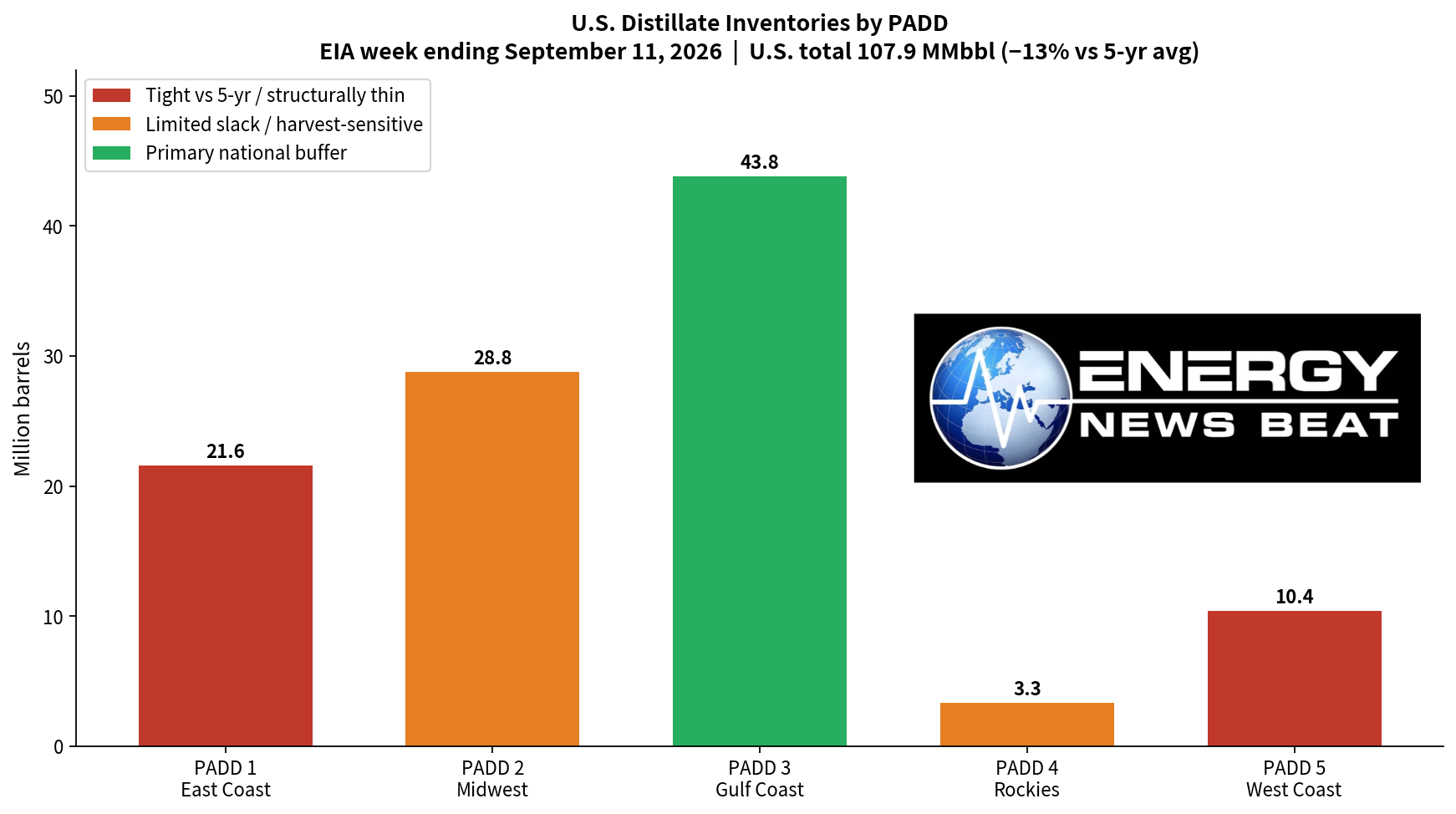
EIA data for the week ending September 11, 2026 — the latest full weekly snapshot — show national distillate stocks at 107.9 million barrels, up 1.6 million on the week but still about 13 percent below the five-year average. Distillate production ran near 5.2 million barrels a day. Four-week average product supplied (the demand proxy) is near 3.6–3.7 million barrels a day, down year over year because prices are already destroying some use. Exports remain heavy. The national build last week was almost entirely a Gulf Coast story. That is the wrong place if you live in Chicago, Boston, or Los Angeles.
East Coast — PADD 1 (New England, Central Atlantic, Lower Atlantic)
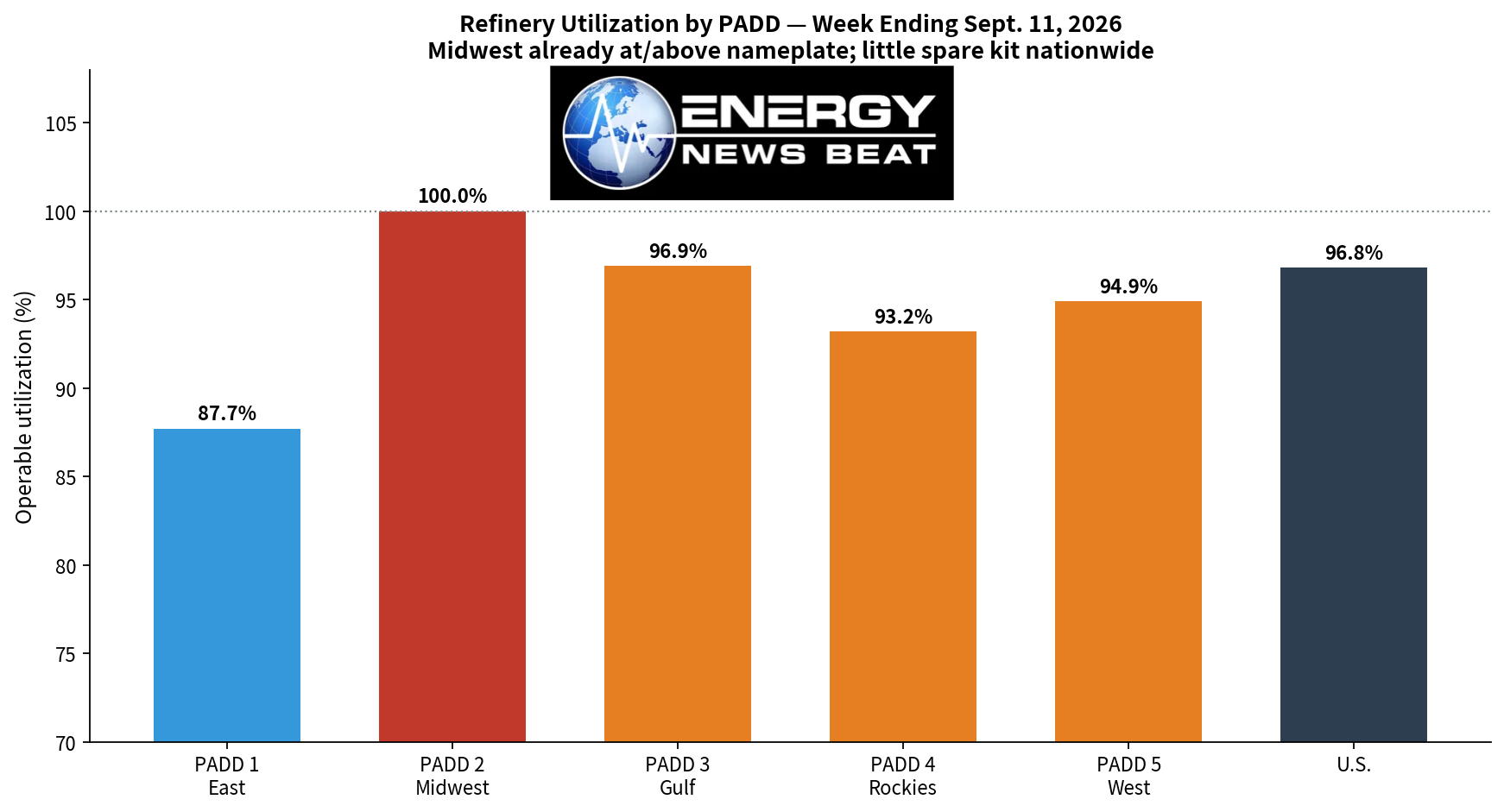
This is the structurally weakest large market. Distillate stocks were 21.6 million barrels as of September 11. Earlier in the late-August report, they had fallen to about 19.3 million barrels, among the lowest East Coast readings in the modern weekly series. New England and the Central Atlantic are heating-oil territory. Winter demand will compete directly with on-road diesel for the same molecules. PADD 1 refining capacity is small (operable capacity about 928,000 bpd) and utilization last week was only 87.7 percent — not because the region is comfortable, but because it does not have enough metal. It lives on Colonial Pipeline barrels from the Gulf and on imports. A Gulf storm, a Colonial constraint, or another Midwest outage that pulls product inland instead of east is how Northeast heating-oil headlines start.
States most exposed: Massachusetts, Connecticut, New York, New Jersey, Pennsylvania, Maryland, Maine. Pennsylvania sits on both the Joliet distribution list and the East Coast heating-oil complex.
Midwest — PADD 2 (Illinois, Indiana, Ohio, Michigan, Wisconsin, Minnesota, Iowa and neighbors)
Stocks were 28.8 million barrels, roughly in line with last year and better than the coasts on a year-ago basis. That relative comfort is gone the moment Joliet stays dark. Midwest refiners had been running at or above nameplate — 103.5 percent utilization in late August, still 100.0 percent in the September 11 week. There is no idle unit to turn. Harvest diesel demand is seasonal and inelastic. Pipeline logistics from the Gulf into the Upper Midwest are slower and more expensive than a working Joliet. Illinois, Indiana, Michigan, and Ohio are the first-round price states. Iowa and Minnesota feel it through farm diesel and rail. Wisconsin is cushioned only by lower state tax.
Gulf Coast — PADD 3 (Texas, Louisiana, Mississippi, Alabama, New Mexico)
This is the only real national buffer. Stocks were 43.8 million barrels, the week’s build. Utilization was 96.9 percent. The Gulf exports diesel to Latin America and Europe and ships north on Colonial and other systems. That is why an export-ban debate keeps returning to Washington: those export barrels are also the only flexible supply the East Coast and, via water, parts of the West Coast can tap. A hurricane in the Texas-Louisiana refining belt remains the single domestic event that would turn a price crisis into a physical shortage on multiple coasts at once.
Cheapest pump prices in the country are still here — Oklahoma, Texas, and Louisiana clustered near $5.94–$6.02 on recent AAA/Gasolytics prints — because the molecules are made next door. That advantage does not travel cheaply to California or Michigan.
Rocky Mountain — PADD 4
Stocks were only 3.3 million barrels. Utilization has swung from above 100 percent down to 93.2 percent as fall work starts. The region is small, isolated, and pipeline-constrained. A single plant problem in Montana, Wyoming, Utah, or Colorado tightens local racks quickly. Colorado and Wyoming pump prices have been among the lower inland prints, but the inventory cushion is measured in days, not weeks.
West Coast — PADD 5
(California, Washington, Oregon, Nevada, Arizona, Hawaii, Alaska)
Stocks were 10.4 million barrels, about 13 percent below the five-year norm. Utilization was 94.9 percent. This region was already a fuel island before Joliet went down. Joliet does not pipe to California. The West Coast impact from Joliet is indirect: higher national crack spreads, competition for waterborne barrels, and more Gulf product staying inland or heading to Europe instead of making the long haul west.
Current diesel prices: the 15 most expensive statesRetail diesel is a tax, spec, and logistics map as much as a crude map. California’s CARB diesel, high state taxes, and lost in-state capacity put it in a class by itself. Washington and Oregon follow because PADD 5 has few alternative suppliers. Hawaii and Alaska pay isolation premiums. The Great Lakes cluster — Michigan, Ohio, Indiana, Illinois, Pennsylvania — is the Joliet fingerprint on this week’s list.
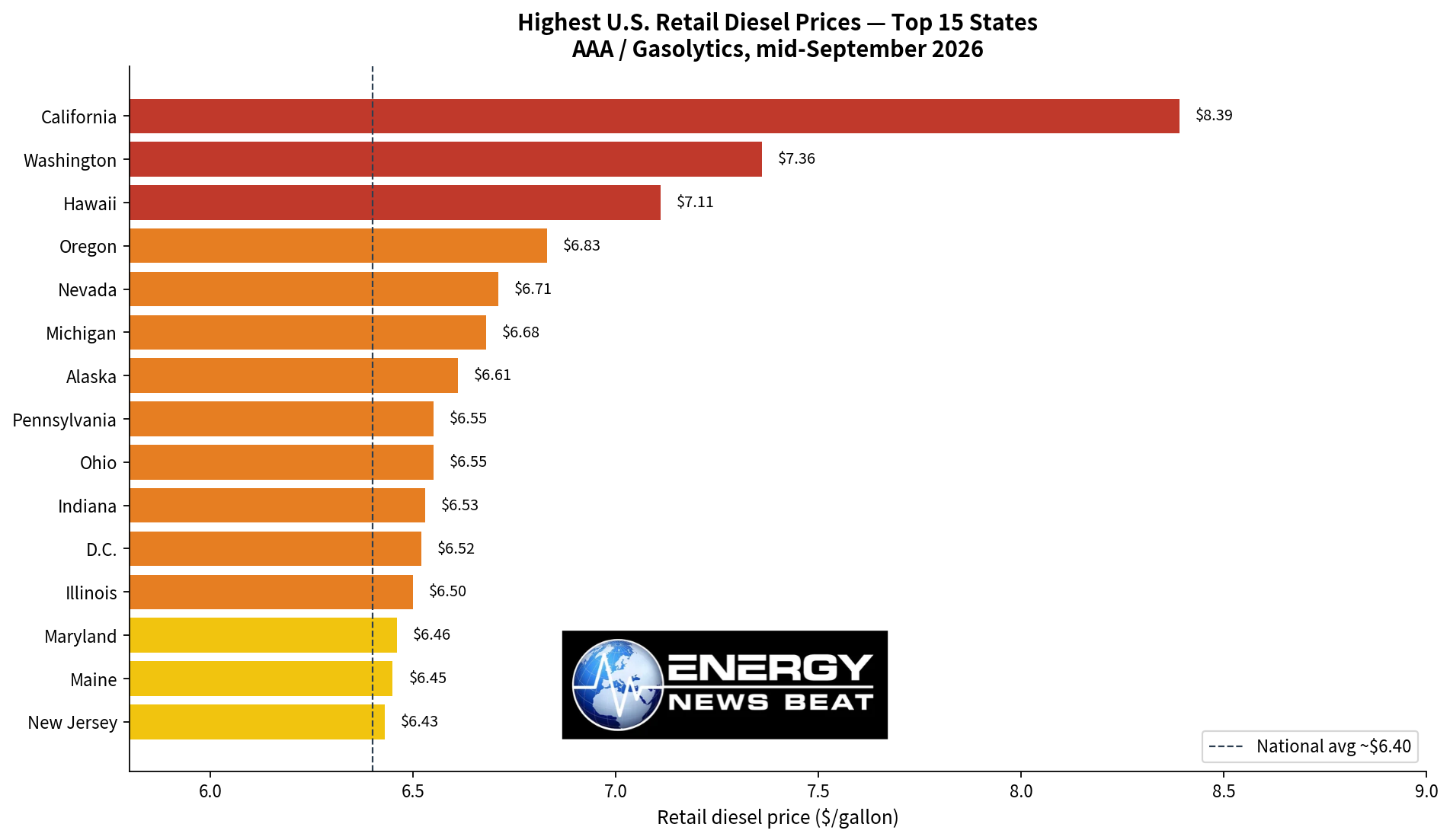
National AAA gasoline is also elevated (about $4.47 on September 18) but has not broken the 2022 record the way diesel has. That split matters. Households see gasoline. The economy runs on diesel. Food, parcel freight, municipal fleets, and farm diesel are already embedding the $6-plus number.
Where shortages are most likely — and what “weakest area if one refinery fails” means
Physical station outages are still sporadic, not national. Reports have flagged tight racks and isolated station problems in parts of California, Florida, and Texas at various points this month, but the binding constraint today is price and days-of-cover, not empty tanks in every county. The risk ranking if another large plant trips:
- Midwest / Great Lakes if Joliet stays down or Whiting deepens maintenance. Highest utilization, harvest pull, limited inbound pipes. This is the live event.
- East Coast if Colonial or a Gulf Coast major goes down. Inventories are already historically thin into heating season. PADD 1 cannot refine its way out.
- West Coast if another California plant has an unplanned outage. After Phillips 66 Wilmington (late 2025) and Valero Benicia (spring 2026), in-state capacity is a much smaller club. CARB diesel cannot be freely substituted with off-spec Gulf barrels without blending, waivers, or imports of on-spec product.
- Rockies on any single-plant failure, because stocks are tiny.
- Gulf Coast is the last to feel a single-plant loss and the first to feel a hurricane.
U.S. operable utilization was 96.8 percent in the latest week, down from 97.8 percent as fall turnarounds begin. Midwest still at 100 percent. That is not a resilient configuration. Analysts have been blunt: you cannot run 97 percent for months without something breaking.
How California handles this — and why the West Coast is not insulated
California is already living the import model. CEC and S&P Global work this year documents the shift: in-state refining has lost roughly 30 percent of capacity over five years. Wilmington and Benicia closures removed a large slice of gasoline and distillate cover. Remaining plants make CARB gasoline and CARB diesel, which are not fungible with the rest of the country’s pool. The state meets demand with a mix of remaining in-state runs, renewable diesel, and marine imports. Record import months were already being called in spring 2026 as inventories in PADD 5 ran low.
What that means in a global distillate squeeze:
- California must bid against Europe and Latin America for on-spec or blendable barrels.
- Jones Act waiver earlier in 2026 unlocked more Gulf-to-West waterborne diesel than the old cabotage rules allowed. That is one of the few working domestic bridges. It does not create new molecules; it only lets existing Gulf barrels move west on foreign-flag ships when U.S.-flag tankers are fully employed.
- High LCFS, cap-and-trade, and unique specs keep a structural premium in the price even when the rest of the country eases.
- If another in-state unit fails, the state cannot “borrow” Joliet barrels. It borrows Korean, Indian, or Gulf cargoes — if those cargoes exist. Middle East product exports are the other missing piece of that puzzle.
Washington and Oregon import the same regional tightness without California’s tax stack, which is why they sit just below California on the price board rather than next to Texas.
What analysts are saying about the global diesel crisis
The U.S. problem is a slice of a world problem.
Gulf Oil chief energy advisor Tom Kloza has put the lost global refining capacity near 7 million barrels a day — Russia, the Persian Gulf, and now additional Red Sea-related damage — and noted that diesel is the product the world uses most, on the order of 30 million barrels a day. He has said $3 diesel is gone for well over a year and that prices can keep working higher over the next 100 days as Northeast heating oil competes for distillate.
Goldman Sachs has called diesel “the epicenter” of the fuel squeeze. The bank more than doubled its 2027 diesel-margin forecasts (about $63 a barrel in the U.S. and $49 in Europe in the late-August revision) and, this week, began pivoting a trading call toward gasoline as well because refiners maximizing diesel yields are tightening the gasoline pool. Goldman’s team has described refinery outages running about 60 percent above seasonal norms and Persian Gulf fuel exports far weaker than crude flows. They see tightness extending into 2027, not just through winter 2026.
Patrick De Haan at GasBuddy has said 2026 is on track to be the most expensive year for U.S. diesel on record and that 44 states have already printed all-time highs at various points this month.University of Chicago energy analyst Sam Ori captured the domestic micro version: the U.S. is operating with “so little margin for error” that a Joliet-sized outage has an outsized impact until the plant returns.IEA messaging through the year has been consistent with that picture: crude can be available while refined-product markets stay tighter than crude markets. Russia’s producer diesel export ban has been extended through October 31. Seaborne Russian diesel loadings have collapsed from a five-year average near 800,000–900,000 bpd toward a small fraction of that. Europe’s diesel futures have traded at records near $210 a barrel. That is the bid U.S. Gulf exporters see.
Next steps and the levers still on the table
Several levers have already been pulled. Several that poll well would likely backfire. That is the same conclusion Energy News Beat has laid out in recent diesel pieces: the shortage is conversion capacity, not a lack of American crude.
Already used or in motion
- Temporary Jones Act waiver for energy products and fertilizer, which multiplied Gulf-to-West diesel waterborne movements.
- A 90-day hours-of-service waiver for fuel-truck drivers (up to 16 hours in a 24-hour window) announced this week by Transportation Secretary Sean Duffy to keep gasoline and diesel moving into harvest and fall demand.
- White House meetings with refiners on expanding capacity.
- Public pressure on Ukraine to stop striking Russian energy infrastructure, and talk of an energy-infrastructure ceasefire, on the theory that Russian diesel returning to the world market would cool U.S. pump prices faster than any domestic edict.
- Broad deregulatory work on vehicle GHG rules that may support long-run diesel truck supply but does nothing this harvest.
Still available, with sharp trade-offs
Diesel or distillate export restrictions. Senate and House Republicans have floated the idea. Interior Secretary Doug Burgum has said the administration would consider a ban only if it actually lowered prices — and has indicated it would not. ENB’s own analysis is that the U.S. is the world’s largest diesel exporter at 1.5–1.9 million bpd, refiners are already at 96–98 percent utilization, and trapping barrels at home would strand the Gulf Coast industry, invite retaliation, and starve the very waterborne supply California and the East Coast sometimes need. A short, partial cut in authorized exports is the version still being gamed in Washington. It would be a political release valve, not a new refinery.
SPR product or crude releases. SPR crude is about 285 million barrels, far below authorized capacity and no longer a deep cushion. The reserve is crude, not CARB diesel. Releasing light crude does not instantly become Midwest ULSD or California CARB distillate. Prior war-related draws already cut the buffer.
- Targeted sanctions relief so Russian crude can reach Indian and Chinese plants that still have spare runs, as ENB has argued, rather than stacking more secondary sanctions onto a market that is short refined product. Delay of additional Russia sanctions packages is the near-term version of that argument.
- California spec or blending waivers in a true PADD 5 emergency. Politically radioactive in Sacramento; mechanically one of the few ways to let more off-spec molecules into the state quickly.
- New refining capacity. Brownsville and other announced projects matter in 2028–2030, not in October 2026. Permitting relief changes the slope, not this winter.
- Not really a lever: “Drill, baby, drill” does not refine. The U.S. has crude. It does not have idle hydrocrackers.
- Talking down prices without restoring Russian or Gulf product supply has already been tried.
The honest next step for consumers is defensive: fleets should treat $6.00–$6.50 diesel as the planning case through winter, not a spike that fades next week. Farmers should lock harvest fuel where they can. East Coast heating-oil buyers should not assume October will be cheaper than September. West Coast shippers should assume CARB diesel stays in a different price universe from Oklahoma.If Joliet is back by early next week, Midwest racks stabilize first and the national average still leaks higher on global tightness and heating demand. If Joliet assessment work slips into a multi-week unit-by-unit restart, Michigan, Ohio, Indiana, and Illinois become the face of the midterm-year fuel problem, and the East Coast enters heating season with even less ability to bid barrels away from the Midwest.
The consumer impact is already here. It will not show up only at the truck stop. It will show up in freight surcharges, food margins, municipal budgets, and the cost of every pallet that moves between a warehouse and a store. The inflationary impact the Fed, nor the U.S. Treasury, can fix. President Trump can waive oil sanctions on Russia is about the only thing he can do besides invoking the Defense Production Act and helping refineries. How he articulates those two levers will help win the MidTerms. Without proper framing, it will be spun by the Democrats and RINOS.
We will be covering this on the Energy News Beat Stand Up Today with Rey Trevino, President, Pecos Operating and Host of the Crude Truth Podcast.
Making Appendices Great Again
Check out the World’s Greatest Podcast Show Notes at EnergyNewsBeat.co or EnergyNewsBeat.com.
Subscribe to our Substack: https://theenergynewsbeat.substack.com/
Appendix: Sources and links
Energy News Beat / primary outage piece
- ExxonMobil Joliet Refinery Floods and Stays Offline as Midwest Diesel Hits Records: https://energynewsbeat.co/diesel/exxonmobil-joliet-refinery-floods-and-stays-offline-as-midwest-diesel-hits-records/
- Why Banning Diesel Exports Will Hurt the US Rather Than Help: https://energynewsbeat.co/diesel/why-banning-diesel-exports-will-hurt-the-us-rather-than-help/
- Russia Extends Diesel Export Ban Through October: https://energynewsbeat.co/diesel/russia-extends-diesel-export-ban-through-october-the-eu-about-to-get-hit-by-the-saudi-oil-crisis/
- Russian Sanctions Package Should Be Delayed to Help U.S. Consumers: https://energynewsbeat.co/crude-oil/russian-sanctions-package-should-be-delayed-to-help-u-s-consumers/
- Global Diesel Shortage on the Horizon: https://energynewsbeat.co/diesel/global-diesel-shortage-on-the-horizon/
- The EIA Snapshot: Crude Draws, Products Build, Distillate Still Tight: https://energynewsbeat.co/crude-oil/the-eia-snapshot-crude-draws-products-build-distillate-still-tight/
- The U.S. Strategic Petroleum Reserve is no longer a deep cushion: https://energynewsbeat.co/crude-oil/the-u-s-strategic-petroleum-reserve-is-no-longer-a-deep-cushion/
- Jones Act Waiver Data Makes The Case For FULL REPEAL — NOW: https://energynewsbeat.co/big-oil-companies/jones-act-waiver-data-makes-the-case-for-full-repeal-now/
- U.S. Refinery Utilization Hits 96.2% as Global Markets Tighten: https://energynewsbeat.co/downstream/u-s-refinery-utilization-hits-96-2-as-global-markets-tighten/
EIA
- Weekly Petroleum Status Report (week ending Sept. 11, 2026; released Sept. 16): https://www.eia.gov/petroleum/supply/weekly/
- Stocks of Distillate Fuel Oil by PADD: https://www.eia.gov/dnav/pet/pet_stoc_wstk_a_epd0_sae_mbbl_w.htm
- Refinery operable utilization by PADD (weekly): https://www.eia.gov/dnav/pet/pet_sum_sndw_a_%28na%29_yup_pct_w.htm
Joliet / Reuters and local
- Reuters, floodwater overwhelmed pump, Sept. 17, 2026: https://www.reuters.com/business/energy/exxon-mobil-says-floodwater-overwhelmed-pump-at-joliet-illinois-refinery-2026-09-17/
- Reuters, Joliet shutdown after power outage, Sept. 14, 2026: https://www.reuters.com/business/energy/exxon-mobils-joliet-refinery-reports-upset-due-to-power-outage-2026-09-14/
- CBS Chicago / NBC Chicago local outage coverage (linked from ENB piece)
Prices
- AAA state averages: https://gasprices.aaa.com/state-gas-price-averages/
- Gasolytics diesel by state (Sept. 17, 2026): https://www.gasolytics.com/diesel-prices-by-state
- EIA California on-highway diesel weekly: https://weeklydiesel.com/region/california/
Policy / administration
- Reuters, U.S. eases hours-of-service for fuel truck drivers: https://www.reuters.com/business/energy/us-temporarily-eases-curb-working-hours-fuel-truck-drivers-2026-09-17/
- Reuters, Record diesel prices could be Trump’s Achilles’ heel: https://www.reuters.com/commentary/reuters-open-interest/record-diesel-prices-could-be-trumps-achilles-heel-2026-09-18/
- WSJ via TradingView, fuel-export ban as last option: https://www.tradingview.com/news/DJN_DN20260917005415:0/
- Bloomberg, what U.S. fuel-export controls would mean: https://www.bloomberg.com/news/articles/2026-09-11/here-s-what-us-export-controls-on-fuel-would-mean-for-prices-and-markets
California / West Coast
- S&P Global, California refinery closures and supply gaps: https://www.spglobal.com/energy/en/news-research/latest-news/crude-oil/052026-californias-refinery-closures-create-volatile-fuel-prices-supply-gaps
- California Energy Commission fuels system materials (CEC e-filing / June 2026 presentation referenced in reporting)
Global analysts
- OilPrice / Goldman Sachs diesel and gasoline notes: https://oilprice.com/Latest-Energy-News/World-News/Goldman-Sachs-Sees-More-Upside-in-Gasoline-as-Diesel-Crunch-Deepens.html
- CNBC Television, Tom Kloza on lost global refining capacity: https://www.youtube.com/watch?v=Cr2C6SNdE6U
- AGBI, diesel prices likely high into next year: https://www.agbi.com/analysis/oil-and-gas/2026/09/diesel-prices-likely-to-stay-high-into-next-year/
Charts: constructed for this article from EIA weekly stocks and utilization (week ending Sept. 11, 2026) and AAA/Gasolytics retail diesel prints for mid-September 2026.