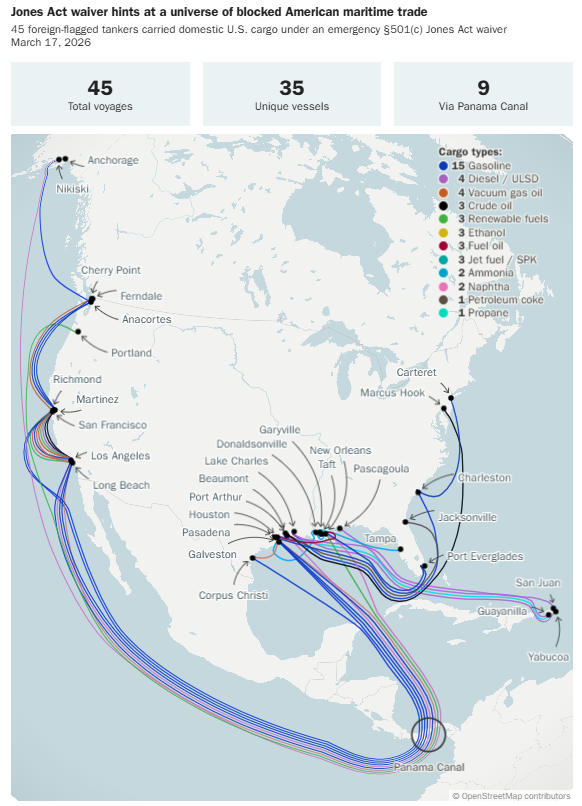
The numbers don’t lie. In just the first ~50 days after the Trump administration’s March 17, 2026, Jones Act waiver for energy products and fertilizer, 45 voyages moved cargo on 35 foreign-flagged vessels across more than 30 U.S. ports and a dozen-plus cargo types.
This wasn’t foreign ships stealing work from American ones. The Jones Act-compliant tanker fleet was already fully employed. These voyages unlocked suppressed domestic trade that the 1920 law had blocked for decades.
Gulf Coast to West Coast diesel shipments exploded to 1.59 million barrels — roughly 4x the total moved by water all of last year. Reverse naphtha shipments from California to Texas went from zero to happening. Puerto Rico finally received U.S. propane (America is a top global exporter, yet no Jones Act LPG tankers existed — islanders had been importing from Chile instead). California alone accounted for 21 of the 45 voyages. Bakken crude moved to Pennsylvania, displacing imports.
This is the smoking-gun data the Cato Institute analyzed and energy commentator David Blackmon highlighted. Latent demand was massive. The Jones Act wasn’t protecting American commerce — it was strangling it.
California’s Self-Inflicted Energy Crisis — Made Worse by the Jones Act
Governor Gavin Newsom’s policies have created a genuine national security and economic crisis in California. Refinery count has collapsed from 43 in the early 1980s to just 7–11 today. The Phillips 66 Los Angeles refinery closure (end of 2025) and Valero Benicia shutdown (April 2026) alone wiped out ~20% of in-state gasoline supply.
Gas prices in California are already running ~$1.60+ above the national average (often $6+/gallon). Projections from USC Professor Michael Mische warn of $8.43/gallon by late 2026 without intervention. Chevron has repeatedly warned Newsom that his cap-and-trade tightening, Low Carbon Fuel Standard, EV mandates, and regulatory assault are driving refining capacity out of the state and threatening energy reliability and jobs.
California has become a “fuel island.” It increasingly relies on Asian imports for refined products — exactly the wrong time as global disruptions (including the Iran conflict) squeeze supply. The Jones Act made a bad situation worse by making it nearly impossible to move abundant Gulf Coast refined products to the West Coast efficiently. Waivers provided critical relief, but vessel availability limited how much help arrived.
New York and other Northeast states face parallel vulnerabilities: high energy costs, reliance on constrained pipelines or expensive imports, and the same structural shortage of flexible domestic tanker capacity. When the next disruption hits — hurricane, pipeline issue, or geopolitical shock — the Jones Act will again turn a manageable problem into a crisis.
The Jones Act’s Tanker Failure
The law requires vessels moving cargo between U.S. ports to be U.S.-built, U.S.-owned, U.S.-flagged, and U.S.-crewed. Noble intent in 1920 after World War I. Disastrous outcome today.
The Jones Act oceangoing fleet has only ~54 tankers total (roughly 3.7 million DWT capacity). Many are locked into Alaska-to-West Coast crude runs or limited Atlantic routes. There is essentially no scalable Jones Act product tanker capacity for robust Gulf-to-West Coast or flexible nationwide movements. There are virtually no Jones Act LPG or LNG tankers.
The result: shipping costs are often 3–5x higher than foreign equivalents. The fleet is small, older in key segments, and cannot meet demand. The waiver proved the fleet was maxed out — foreign vessels supplemented, they didn’t replace.
National Security Irony
The Jones Act was sold as essential for national security and a strong merchant marine. Instead, it helped hollow out U.S. shipbuilding and the U.S.-flag fleet. The U.S. now builds a tiny fraction of global commercial ships — single-digit large commercial vessels in recent years, in some counts — while China holds 200x+ the shipbuilding capacity. Even India is building more ships and ramping up capacity faster than the United States in key areas, with ambitious targets under its Maritime Vision.
America’s merchant fleet is a shadow of its former self. This directly undermines military sealift readiness and our ability to sustain logistics in a crisis. The very law meant to protect us has left us more vulnerable.
If Full Repeal Is Politically Blocked — Buy Tankers NOW
Let’s be realistic. Repealing the Jones Act faces fierce opposition from unions and shipyard interests protecting a few hundred jobs in key districts. We couldn’t even pass the Save America Act. Full repeal may take time.
There is no excuse for inaction.
While we fight for repeal or major reform, the United States must immediately acquire or finance a fleet of modern tankers — product carriers, chemical tankers, and eventually LNG/LPG vessels. This means:
Aggressive federal incentives, direct purchases, or public-private partnerships to build in U.S. yards at wartime speed.
Temporary measures to integrate capable foreign-built tonnage under the U.S. flag/crew where legally feasible, paired with a crash program to expand domestic shipbuilding capacity.
Massive investment in U.S. shipyards — training, infrastructure, and contracts — modeled on the scale needed for true energy and national security resilience.
We cannot wait. Every month of delay costs California drivers, farmers, and businesses real money and increases risk. The waiver data proved the demand and the economic win. Now we need the hardware to capture it permanently.
The Path Forward
The March 2026 waiver data is the clearest evidence in a century that the Jones Act is counterproductive. It blocks American energy from reaching American consumers. It raises costs. It weakens our industrial base. It hurts the very states — California under Newsom’s policies and others — that need a reliable, affordable domestic supply the most.
Full repeal remains the cleanest, most pro-American solution. But if politics blocks that, we must buy and build tankers aggressively while we fix shipbuilding. American families in California, New York, and across the country deserve lower energy costs and genuine energy security — not protectionism that protects failure.
The data is in. The crisis is real. The solution is clear.
Time to act — repeal or replace the Jones Act’s stranglehold. Now.
- David Blackmon (
@EnergyAbsurdity
) X post (May 20, 2026): “Jones Act Waiver Data Makes The Case For FULL REPEAL” — https://x.com/EnergyAbsurdity/status/2057063182124954098?s=20 (includes image and thread with key stats).
- Cato Institute: Colin Grabow, “Waiver Data Reveal How the Jones Act Blocks American Trade” (May 13, 2026) — https://www.cato.org/blog/jones-act-waiver-data-reveals-universe-blocked-american-trade (detailed analysis of the 45 voyages, interactive data).
- U.S. Maritime Administration (MARAD) domestic shipping/waiver voyage data.
- California refinery and gas price reporting: USC Professor Michael Mische analysis; Chevron warnings to Gov. Newsom; Argus Media and Institute for Energy Research coverage on refinery closures (Phillips 66 LA, Valero Benicia) and import surge.
- Jones Act fleet data: Balsar Research, CRS reports, MARAD fleet statistics (~54 Jones Act tankers).
- Broader shipbuilding context: Reports on China (~200x+ U.S. capacity), U.S. commercial output, India’s Maritime Vision 2030/2047 and capacity expansion efforts.
- Additional context: CFCA.energy press releases on waivers; WSJ/Chevron commentary on vessel availability limits during waiver.
All data is current as of mid-May 2026. The waiver was extended (e.g., an additional 90 days reported in various coverage). For the latest MARAD voyage details, check maritime.dot.gov.