By Stuart Turley, host of the Energy News Beat podcast • Published Oct. 10, 2026 • Strike, reactions, prices and storm data as of 6:30 a.m. CT, Sat., Oct. 10, 2026 • Follows our Friday report, Trump Says Russia Will Supply Diesel
If you haul freight, plant wheat or heat a house with oil, this weekend’s news lands on the same number: the price of a gallon of diesel. AAA had it at $6.2824 on Saturday morning, up less than half a cent from Friday (AAA). “Every $1 increase per gallon in fuel costs our members around $400 more per week,” said Todd Spencer, president of the Owner-Operator Independent Drivers Association (Truckers News).
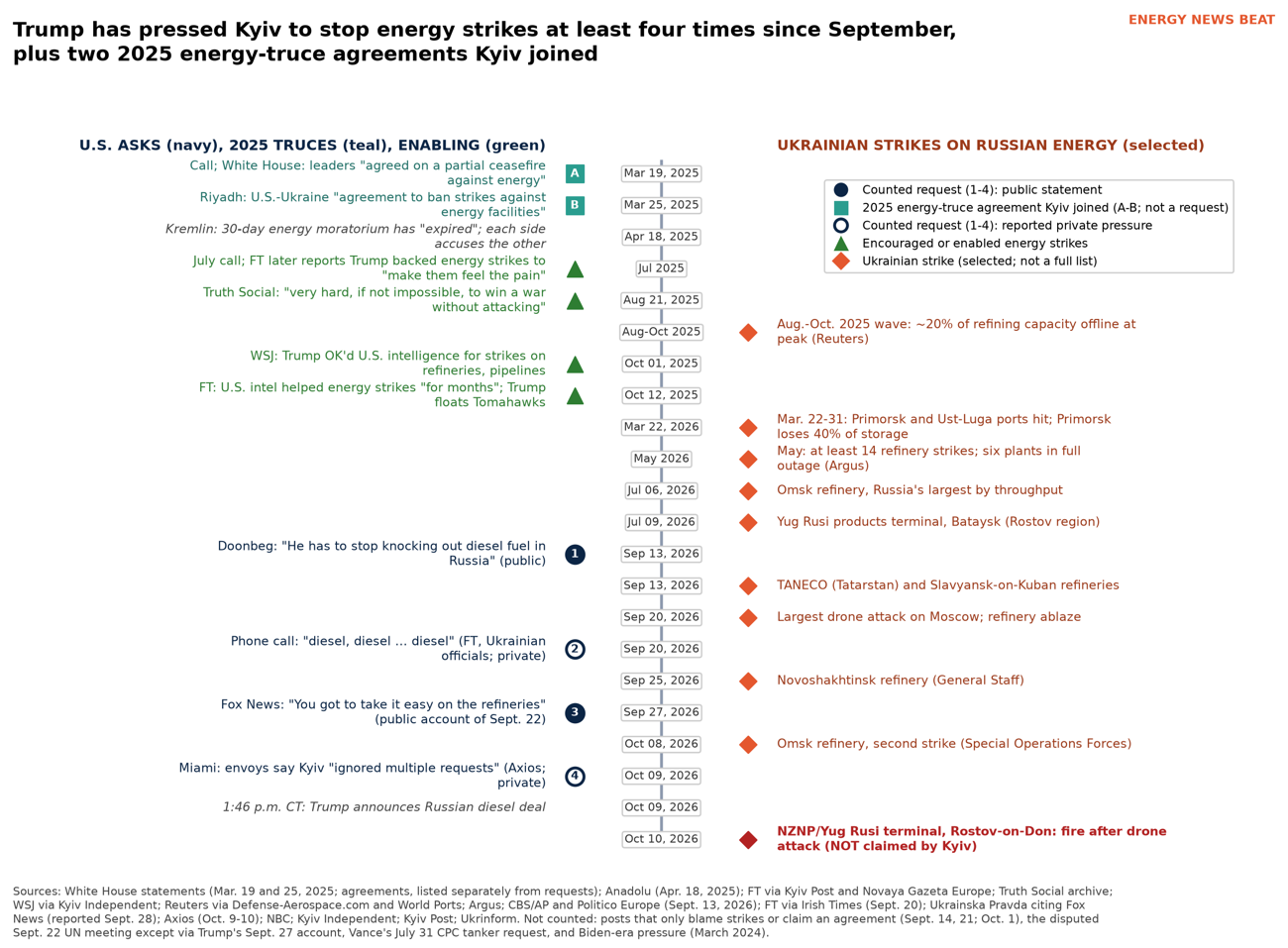
On Friday, President Trump said Russia would sell diesel to the U.S. and world markets, starting with about 300,000 tons, and Treasury issued a license to allow it (last night’s report). A few hours later, drones hit Rostov-on-Don, and a fuel terminal there caught fire. Then Axios reported that Trump made the deal after Kyiv ignored his requests to stop hitting Russian refineries (Axios). ENB counted those requests. We found at least four since September, plus two 2025 energy-truce agreements Kyiv joined.
Stu’s Take
I have said for years that energy is national security, and this weekend proves it from both ends. Washington wants Russian diesel to keep American trucks rolling. Kyiv says those barrels pay for the missiles hitting its power grid.
Here is the point: one terminal fire in Rostov does not move your pump price today. Markets were closed when it happened; the terminal is not on the Baltic route Moscow’s recent diesel exports have used, and nobody has shown how bad the damage is. What does matter is the pattern. Four documented U.S. requests since September, and the strikes keep coming. If Moscow’s promised cargoes depend on refineries Ukraine keeps hitting, the deal is only as good as the next night’s air defense.
My advice: budget for diesel above $6 through the fall, and watch the first tanker loadings, not the press releases.
And it is not just 6 days’ worth of diesel that could hit the US market; it is a carrot to end the war. Make no mistake: Zelensky sees it as a way to end the war, and you see all the signs of the EU prepping for a war the people don’t want but the leaders need to stay in power. I hope President Trump gets the US out of NATO before that happens – just saying.
This brings up bigger questions. Why is the US still supporting Zelensky when he canceled all elections? Well, it makes sense, as we can’t have fair elections in the US without millions of illegals voting, so something reeks of corruption. And you notice I said Zelensky and not Ukraine. I vote to get rid of all corrupt politicians regardless of country.
I will be covering this on the next Energy News Beat Stand Up
What happened in Rostov
As of 6:30 a.m. CT Saturday. Rostov and Moscow time is CT plus 8 hours.
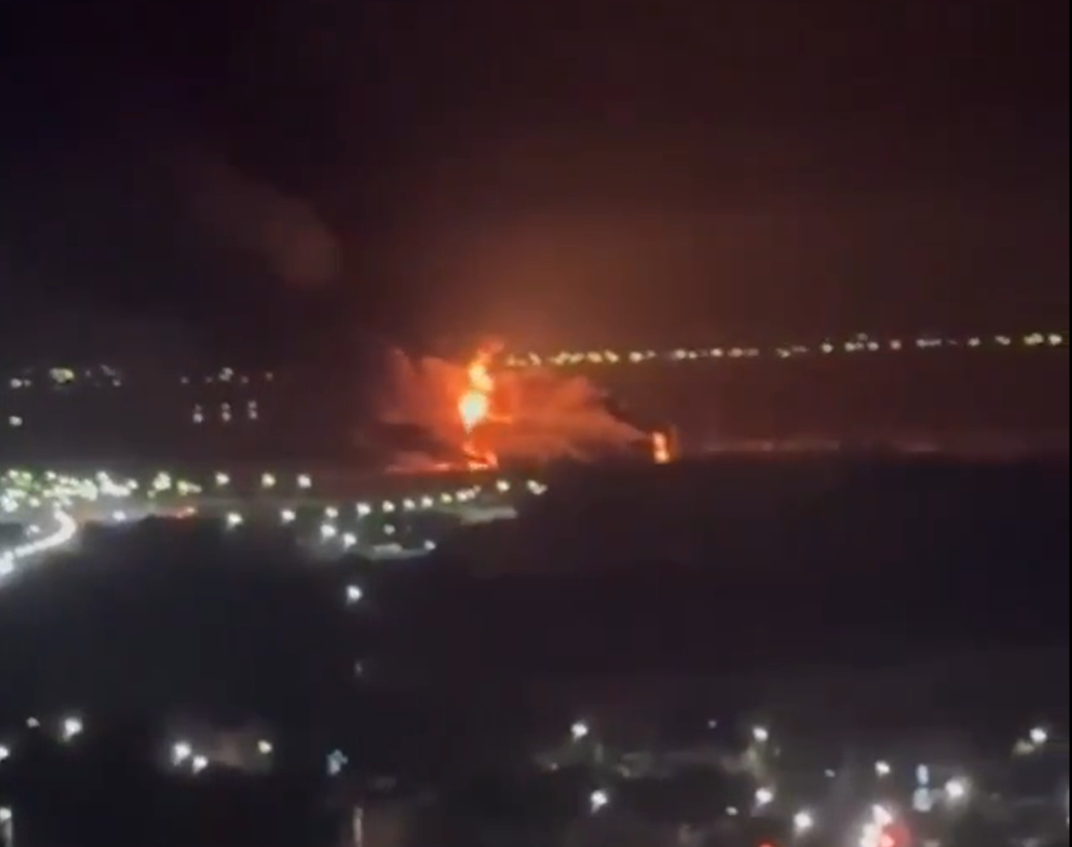
Rostov Gov. Yuri Slyusar posted at 3:36 a.m. local time (7:36 p.m. CT Friday) that air defenses were repelling an attack on the city, that “a fire broke out,” and that no one was hurt (Slyusar via TVGram). By morning he said more than 100 drones had been destroyed or suppressed across the region, six people were injured, homes and a railway bridge were damaged, two vessels were hit at Azov, and a fire at “warehouse industrial facilities” was being put out (RTVI; Kommersant; RIA Novosti, state media). He did not name the terminal. Russia’s Defense Ministry said it downed 560 Ukrainian drones over 17 regions overnight, Rostov among them (Kommersant; Sputnik, state media).
Which facility burned comes from independent analysts, not officials. An OSINT analyst at the Russian outlet ASTRA geolocated resident videos to the Yug Rusi oil-loading terminal, the Rostov branch of the Novoshakhtinsk refinery (NZNP), in the city’s Zheleznodorozhny district. The Kyiv Independent said it “could not independently verify the footage or determine the extent of the damage” (Kyiv Independent; UNN). NASA’s public fire data show heat detections in southwest Rostov-on-Don from 6:44 p.m. CT Friday, still there at 1:48 a.m. CT Saturday (NASA FIRMS; Appendix F). That fits a fire in the area but does not by itself pin it to the terminal. ENB found no Maxar, Planet or Airbus imagery, and Ukraine’s military has not claimed the attack.
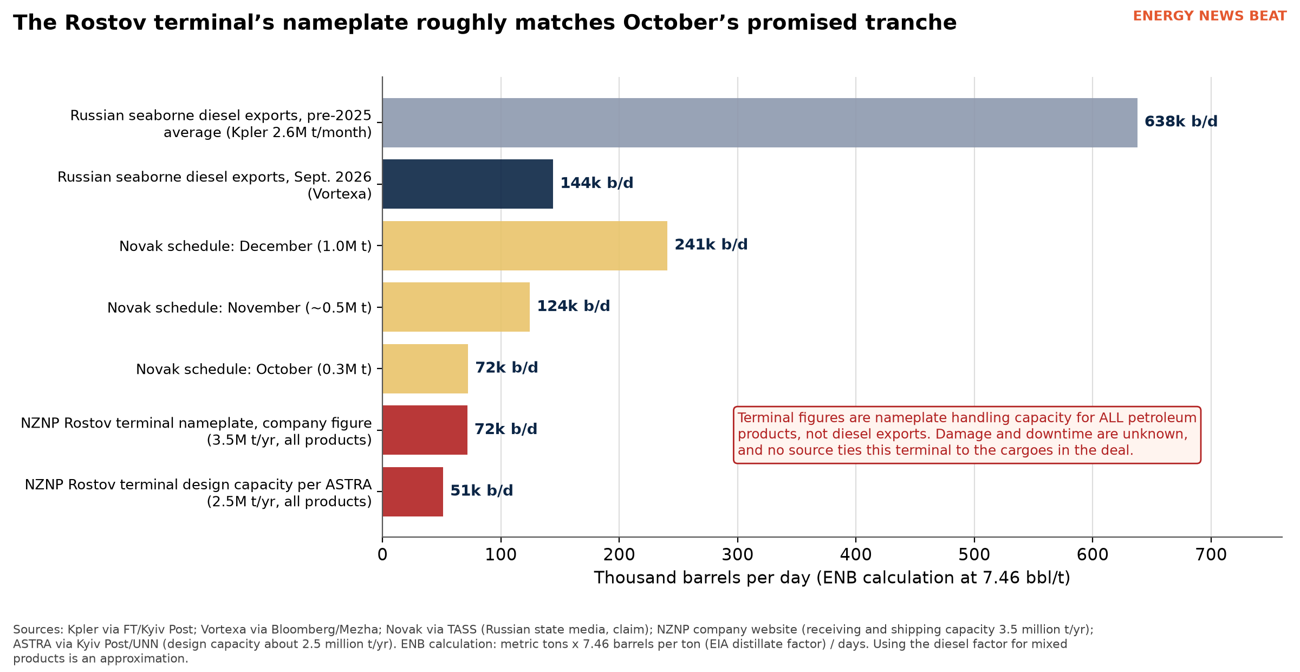
The company lists the terminal at 3.5 million tons a year of receiving and shipping capacity, served by five river-sea tankers. NZNP says this fleet ships only about 1.5 million tons a year; it also has three Aframax storage tankers (NZNP). ASTRA, as reported by Ukrinform and Kyiv Post, put its design capacity near 2.5 million tons (Ukrinform; Kyiv Post). Both figures cover all petroleum products, not diesel alone.
Is this the deal’s diesel?
As of 6:30 a.m. CT Saturday. No source ties this terminal to the cargoes in the deal.
Probably not. Reuters calls the Baltic port of Primorsk “one of the country’s largest export gateways” (World Ports, Reuters). Rostov is a river and Azov Sea terminal that ships toward the Black Sea, and S&P Global found Russia’s Black Sea diesel exports fell to zero in the week to Sept. 24, with that week’s 81,000 tons all leaving from Primorsk (Hellenic Shipping News, Platts, Oct. 1). Russia also bans diesel exports by producers through Oct. 31 (Anadolu).
Still, the size comparison is striking. Converted at EIA’s diesel factor, the terminal’s 3.5 million tons a year works out to about 71,500 barrels a day. Deputy Prime Minister Alexander Novak’s October tranche of 300,000 tons works out to about 72,200 b/d (TASS, state media; ENB calculation). But that is nameplate for mixed products, and the damage is unknown, so it is not lost diesel supply (Chart 4)
Chart 4. Novak’s promised tranches, Russia’s recent seaborne diesel exports and the Rostov terminal’s nameplate, in barrels per day. Sources: Kpler via FT/Kyiv Post; Vortexa via Bloomberg/Mezha; TASS (state media); NZNP; ASTRA via Kyiv Post. ENB calculation at 7.46 bbl/t.
How many times has Trump pressed Kyiv?
As of 6:30 a.m. CT Saturday. Full table with quotes and links in Appendix D.
A U.S. official told Axios Zelensky ignored “half a dozen” requests, without listing them (Axios). ENB can document at least four times since September that Trump or his envoys pressed Ukraine to stop energy strikes, two in public and two reported in private:
13, 2026 (public). In Ireland: “Mr. Zelenskyy has to do one thing. He has to stop knocking out diesel fuel in Russia” (CBS/AP; Politico Europe).
20, 2026 (reported private). On a call, a senior Ukrainian official told the FT, Trump’s message was “diesel, diesel … diesel” (Irish Times, FT).
27, 2026 (public). In a Fox News interview reported Sept. 27–28, Trump recounted telling Zelensky at the U.N., “You got to take it easy on the refineries.” Zelensky said after that Sept. 22 meeting there were “no requests” for a unilateral halt, so ENB counts the exchange once (Ukrainska Pravda; Ukrinform).
9, 2026 (reported private). In Miami, envoys Steve Witkoff and Jared Kushner told Ukraine’s team Trump would act because Kyiv “ignored multiple requests,” Axios reported (Axios; Kyiv Post).
Two earlier entries are agreements, not requests. In March 2025, Kyiv joined two U.S.-brokered energy truces: after a Trump-Zelensky call, the White House said “the two leaders also agreed on a partial ceasefire against energy,” and after the Riyadh talks it cited Trump and Zelensky’s “agreement to ban strikes against energy facilities” (White House; White House).
ENB did not count posts that blame the strikes or announce an agreement, such as Trump’s Sept. 14 claim that “Ukraine has agreed not to hit Russian Energy targets,” which Ukrainian officials disputed (Truth Social archive). The pressure is not new: under President Biden, the FT reported in March 2024 that Washington urged Kyiv to stop hitting refineries (Kyiv Independent). Trump has also encouraged the campaign at times. He posted in August 2025 that it is “very hard, if not impossible, to win a war without attacking an invader’s country,” and the WSJ and FT reported U.S. intelligence support for energy strikes (Truth Social archive; Kyiv Independent, WSJ; Kyiv Post, FT).
Chart 1. Documented U.S. requests (numbered 1–4), the two 2025 energy-truce agreements (A–B), encouraging or enabling moves, and selected Ukrainian strikes on Russian energy. Sources: White House; Anadolu; CBS/AP; Politico Europe; FT via Irish Times and Kyiv Post; Ukrainska Pravda; Axios; WSJ via Kyiv Independent; Truth Social archive; Reuters; Argus.
Can Russia deliver?
As of the latest monthly tanker-tracking data (September 2026). Estimates differ by method.
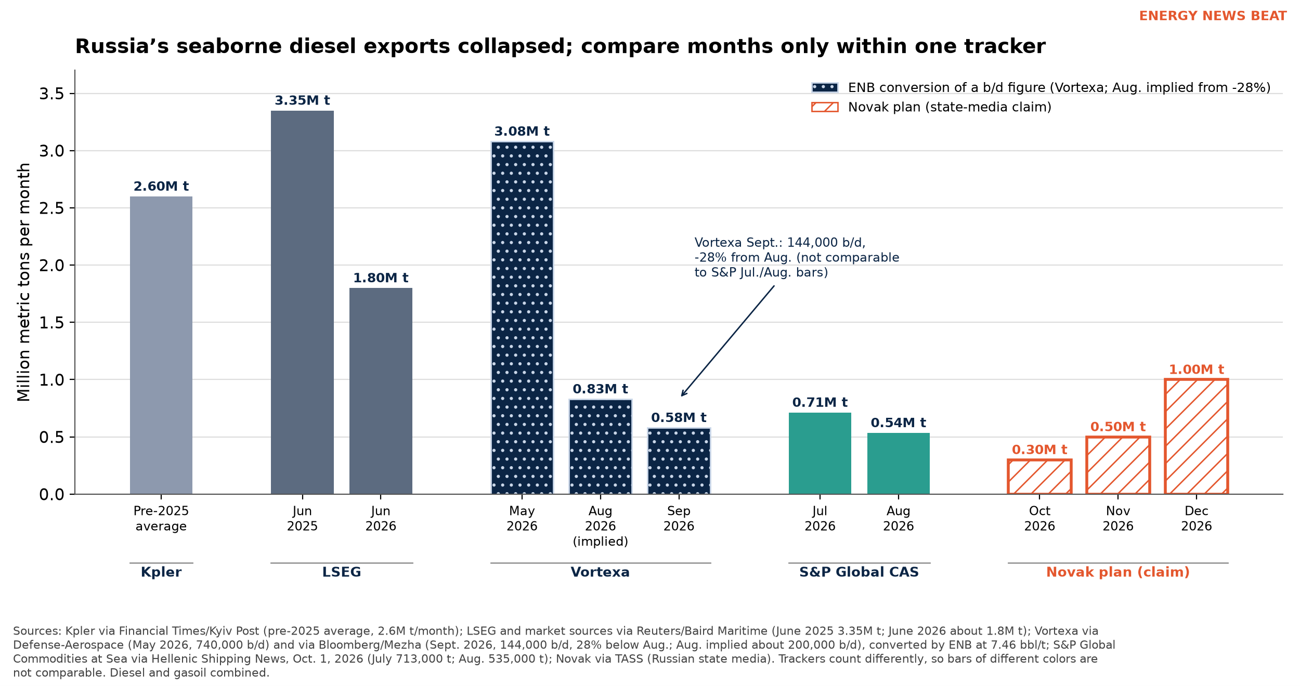
“Russia does not have an export problem. It has a refining problem,” Kpler’s Michelle Brouhard told the FT. “The biggest question for me is: where are they going to get the diesel from?” (Kyiv Post, FT). Vortexa put September seaborne diesel and gasoil exports at 144,000 b/d, down 28% from August and the lowest in a decade (Mezha, Bloomberg). That implies about 200,000 b/d in August on Vortexa’s count. Kpler’s pre-2025 average was about 638,000 b/d (Chart 3).
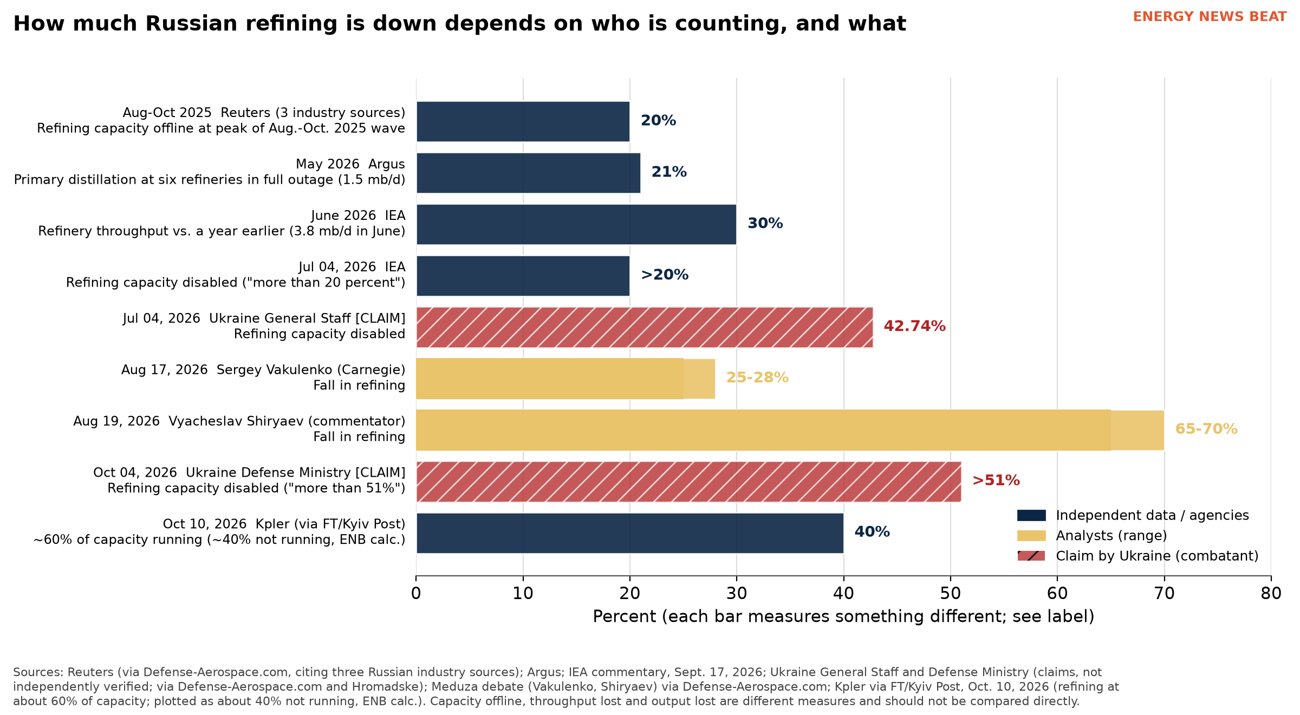
How much refining is down depends on who is counting. Reuters sources said about 20% of capacity was offline at the peak of last year’s wave, the IEA said runs in June were about 30% below a year earlier, and Ukraine’s Defense Ministry claims more than 51% is disabled (Defense-Aerospace; IEA; Kyiv Independent). Those measure different things (Chart 2).
Chart 2. Estimates of Russian refining losses; each bar measures something different. Sources: Reuters and Argus via Defense-Aerospace; IEA; Ukraine General Staff and Defense Ministry (claims); Meduza debate; Kpler via FT/Kyiv PostChart 3. Russian seaborne diesel and gasoil exports and Novak’s plan, million metric tons per month, grouped by tracker; compare months only within one tracker. Sources: Kpler via FT/Kyiv Post; LSEG via Reuters/Baird Maritime; Vortexa via Defense-Aerospace and Bloomberg/Mezha (ENB conversion; August implied from the 28% drop); S&P Global via Hellenic Shipping News; TASS (state media).
Ships, insurance and the Baltic
As of the latest published figures, no new war-risk quotes found for this weekend
Reuters, using Vantor satellite imagery, reported in April that Primorsk lost at least 40% of its storage, including two diesel tanks, in March strikes (World Ports, Reuters). Black Sea war-risk premiums rose to about 1% of a ship’s hull value in January, from 0.6% to 0.8% (Beinsure).
At the pump, and what Isaias left
As of AAA “Price as of 10/10/26” (checked about 6 a.m. CT); futures last traded Friday afternoon; NHC final advisory 4 a.m. CDT; MMA operator data 11 a.m. CDT Friday; NHC and MMA rechecked 6:30 a.m. CT, nothing newer
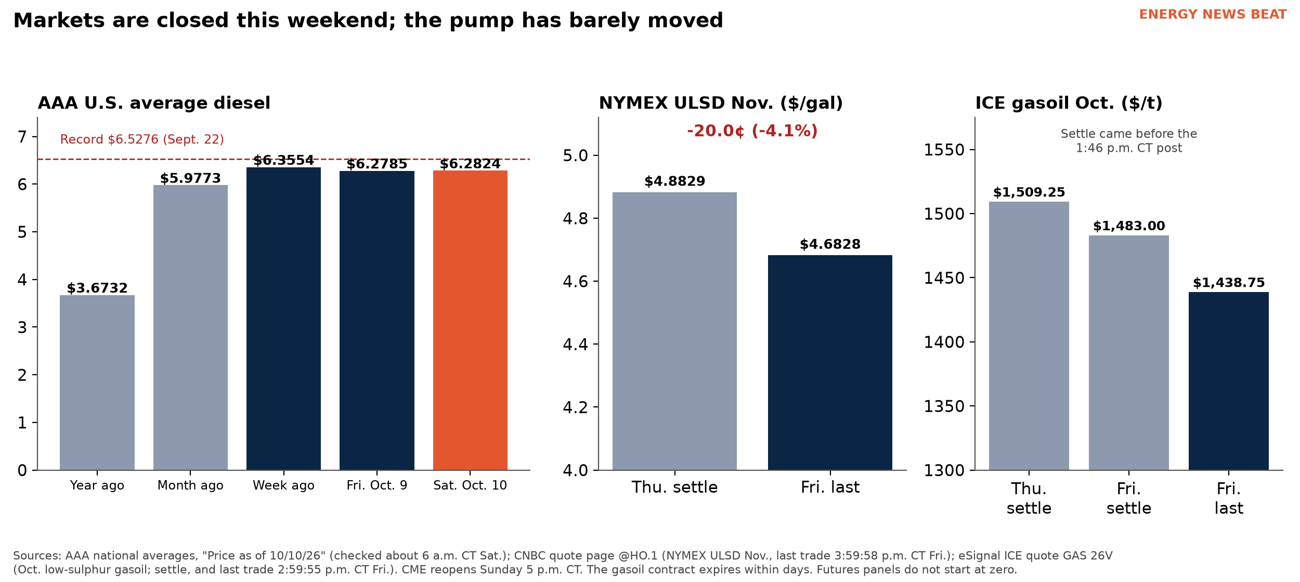
Markets were closed when the terminal burned; CME reopens Sunday at 5 p.m. CT. Friday’s last trade for November diesel futures was $4.6828 a gallon, down 20 cents, or 4.1% (CNBC). London gasoil settled at $1,483 a ton before Trump’s post and last traded at $1,438.75 (eSignal; insigtX). The U.S. pump average of $6.2824 is down from a week ago but up about 30 cents in a month (AAA). East Coast distillate stocks were about 30% below normal in the latest EIA week (EIA; see our heating oil report).
Hurricane Isaias made landfall near Destin, Fla., at 8:30 p.m. CT Friday as a 90-knot hurricane, about 105 mph (NHC). By 4 a.m. it was post-tropical near Montgomery, Ala., at 35 mph, with flash-flood risk and NHC’s final advisory (NHC). The latest Gulf count, from Friday morning, had 71.51% of oil output shut in (MMA). Analyst Andy Lipow told CNBC refineries near the path total 466,000 b/d, and Chevron said Thursday its Pascagoula refinery was operating (CNBC). More in our Isaias update.
Chart 5. AAA U.S. diesel average, NYMEX ULSD and ICE gasoil. Sources: AAA; CNBC; eSignal (ICE data). Futures panels do not start at zero.
Peace signals and reactions
As of 6:30 a.m. CT Saturday. Full tracker in Appendix E.
Kyiv is not backing off. “Gifts to Putin will not bring peace,” Zelensky wrote Friday, adding that Ukraine “will not set Russian oil refineries on fire if Russia does not destroy our energy infrastructure” (X; Interfax-Ukraine). He told Axios the deal was “not fair and not honest” but that “if the price is energy ceasefire, this negotiation is good” (Axios). A senior Ukrainian official told the FT, “We will burn [Russian] refineries” (Kyiv Post, FT).
In Moscow, aide Yuri Ushakov said Friday that Kyiv had disrupted an immediate return to talks (Kremlin). ENB found no Kremlin comment on the Rostov fire by 6:30 a.m. CT. The White House has made no on-record statement about the strike; a U.S. official told Axios Zelensky “is misreading the room” (Axios). ENB found no on-record EU, German or French response.
How consumers and investors see it
As of 6:30 a.m. CT Saturday. Only on-record views are quoted.
Consumers. Trucking and farm groups have spoken about the Oct. 5 red-dyed diesel order, not the Russia deal. OOIDA called it “minimal relief” and said “market stability is essential to bring down costs for the long haul” (Truckers News). American Farm Bureau President Zippy Duvall applauded it (AFBF).
Investors. In September, IG’s Chris Beauchamp said a halt in Ukrainian attacks “might bring the price down slightly and in the short term,” but warned that “with the main driver unresolved, that move would rapidly be reversed” (Al Jazeera). On the storm, Enverus analyst Carl Larry said that if Gulf refineries such as Chevron’s shut down completely, diesel “already above $6 could start approaching $7”; with minimal impacts, he expected a rise of just a few cents (Transport Topics). ENB found no analyst note on the Rostov fire by press time.
Corrections to early reports
As of 6:30 a.m. CT Saturday
“Set ablaze,” not “blown up.” Officials confirmed a fire; no source has shown the terminal was destroyed (Kyiv Independent).
Not claimed by Ukraine. The terminal ID comes from ASTRA’s geolocation; Russian officials did not name it (UNN; RTVI).
5 million tons is all products, not diesel, and ASTRA cites 2.5 million tons of design capacity (NZNP; Kyiv Post).
“The day after” is Moscow time only. In CT, the first heat detections came about five hours after Trump’s 1:46 p.m. post (NASA FIRMS).
The video is unverified. The X clip has not been independently geolocated; ASTRA used other resident footage (X; Kyiv Independent).
“Half a dozen” is one U.S. official’s count (Axios). ENB documents at least four since September, plus two 2025 energy-truce agreements Kyiv joined.
Isaias did make landfall, at 8:30 p.m. CT near Destin. Our Friday report said none had been announced as of 8:20 p.m. (NHC).
What to watch
A Ukrainian General Staff claim or satellite imagery showing the terminal’s damage.
CME reopening Sunday at 5 p.m. CT, and the expiring October gasoil contract.
Russian word on lifting the export ban early, and the first diesel tanker loadings.
MMA’s next Gulf shut-in count and restart news from Pascagoula and Mobile-area plants.
A downloadable data file with the request tables, strike tracker, satellite detections, export and price data, and ENB’s calculations is available with this post.
At Energy News Beat we Make Appendices Great Again. Times are U.S. Central (CDT, UTC−5) unless noted; Rostov, Moscow and Kyiv are all UTC+3 (CT plus 8 hours). Fast-moving items are current as of 6:30 a.m. CT, Sat., Oct. 10, 2026. Labels: [STATE MEDIA] = Russian state-controlled outlet; [RUSSIAN GOVERNMENT] / [RUSSIAN OFFICIAL] = Kremlin, ministry or governor statements; [CLAIM] = a party’s assertion not independently verified; [LEAD] = social post treated as a tip, not confirmation; [AGGREGATOR] = secondary compilation.
>100 drones destroyed/suppressed; 6 injured (2 moderate, 1 emergency surgery); homes damaged; uninhabited new building hit in Bataysk; 2 vessels damaged at Azov; railway bridge damaged, traffic later restored; fire at “warehouse industrial facilities” being extinguished
Receiving 3.5 Mt/yr and shipping 3.5 Mt/yr of petroleum products; own fleet of five 5,000-t river-sea tankers able to ship about 1.5 Mt/yr; three Aframax storage tankers
NOAA-20 VIIRS 23:44 UTC Oct. 9 (6:44 p.m. CT) at ~47.164N 39.640E, FRP 6.2 MW; NOAA-21 00:28 UTC (7:28 p.m. CT), FRP up to 34.2 MW; Terra MODIS 06:48 UTC Oct. 10 (1:48 a.m. CT), FRP up to 53.5 MW
Selected Ukrainian strikes on Russian energy relevant to the diesel deal; not a complete list. “Confirmed by” means the source that confirmed the event, not the damage.
Rostov-on-Don, Zheleznodorozhny district, left bank of the Don
Night of Oct. 9–10; first heat detection 6:44 p.m. CT (2:44 a.m. local); governor’s fire post 7:36 p.m. CT (3:36 a.m. local)
No one. Not claimed by Ukraine’s General Staff, SBU, HUR or Zelensky as of 6:30 a.m. CT
Fire and drone attack confirmed by Gov. Slyusar (facility not named); facility ID by ASTRA geolocation; heat by NASA FIRMS
3.5 Mt/yr receiving and shipping, all products (company); ~2.5 Mt/yr design (ASTRA)
Fire reported; governor says “warehouse industrial facilities” fire being extinguished; damage unknown
6:30 a.m. CT Oct. 10
Railway bridge
Rail
Rostov region
Night of Oct. 9–10
—
Gov. Slyusar; RIA [STATE MEDIA]
—
Damaged; traffic “fully restored”
Oct. 10 a.m.
Two vessels
Shipping
Port of Azov
Night of Oct. 9–10
—
Gov. Slyusar
—
Damaged
Oct. 10 a.m.
Novoshakhtinsk refinery (same owner)
Refinery
Rostov region
Sept. 25, 2026
Ukraine General Staff
General Staff [CLAIM]; reported by Kyiv Independent
—
Fire reported
Sept. 25
Yug Rusi products terminal, Bataysk
Products terminal
Rostov region
July 9, 2026
Ukraine General Staff
General Staff [CLAIM]; Ukrinform
—
Struck
July 9
Omsk refinery (second strike)
Refinery
Omsk
Oct. 8, 2026
Ukraine Special Operations Forces
SSO [CLAIM]; Kyiv Post
Russia’s largest by throughput
Reported
Oct. 8
Moscow refinery
Refinery
Moscow
Sept. 20, 2026
—
FT (via Irish Times)
—
“ablaze”
Sept. 20
TANECO; Slavyansk-on-Kuban
Refineries
Tatarstan; Krasnodar
Sept. 13, 2026
Ukraine military, HUR
Ukrainian claims [CLAIM]; NBC/AP
—
Reported
Sept. 13
Primorsk and Ust-Luga
Baltic export ports
Leningrad region
Mar. 22–31, 2026
Not documented in ENB sources
Reuters, Vantor satellite imagery
Primorsk: “one of country’s largest export gateways” (Reuters)
≥40% of Primorsk storage lost incl. 2 diesel tanks
Apr. 3, 2026
Appendix D. Trump requests to Kyiv, and related actions
Counted: at least four documented requests or pressure by Trump or his envoys since September 2026 (2 public statements; 2 reported private), plus two 2025 energy-truce agreements Kyiv joined (listed separately). ENB counts an item when Trump’s own words or a named outlet’s sourced report describes Trump or his envoys asking or pressing Ukraine to stop or curb energy strikes. Agreements announced as reached (including the March 2025 White House texts and the Sept. 14, 2026 post), blame without an ask, and requests about non-refinery targets are listed separately. Repeated accounts of the same conversation count once. The U.S. official’s “half a dozen” (Axios) is a separate, unitemized claim.
#
Date
Type
Quote or paraphrase
Source
1
2026-09-13
Direct public statement
Doonbeg, Ireland: “Mr. Zelenskyy has to do one thing. He has to stop knocking out diesel fuel in Russia … Let him go after targets but not diesel fuel.”
Direct public statement (Fox News interview, reported Sept. 27-28)
“I said, ‘You got to take it easy on the refineries as much.’ He said, ‘Well, we’ll probably do that.'” Describes the Sept. 22 UN meeting; Zelensky said that day there were “no requests” for a unilateral halt.
Witkoff and Kushner told Ukraine’s team Trump would move on diesel after Kyiv “ignored multiple requests” to stop refinery strikes; U.S. official says Zelensky ignored “half a dozen” requests.
Energy-truce agreement Kyiv joined (official U.S. statement, Riyadh talks)
U.S. and Ukraine “agreed to develop measures for implementing President Trump’s and President Zelenskyy’s agreement to ban strikes against energy facilities of Russia and Ukraine.”
Truth Social post (claim of agreement, not an ask)
“Ukraine has agreed not to hit Russian Energy targets. Russia has agreed to do, likewise!” Ukrainian officials later said no ceasefire had been agreed (FT)
Verified newsroom imagery; not embedded (copyright)
Other FIRMS detections at 46.92N 39.81E (Oct. 9 daytime) and 47.23N 39.45E are outside the terminal area and are not attributed to the attack.
Appendix G. Data gaps and conflicts
Who named the facility. APA reported that the governor named an oil products terminal; the governor’s posts ENB read refer only to a fire at “warehouse industrial facilities.” ENB relies on ASTRA’s geolocation, as reported by the Kyiv Independent and UNN.
Company site: 3.5 Mt/yr; ASTRA: ~2.5 Mt/yr design. Neither is diesel-specific, and no source gives the terminal’s diesel share or current throughput.
Damage and downtime. No satellite imagery, company statement or official damage assessment. One unsourced outlet said the fire was contained; ENB did not rely on it.
Ukraine has not claimed the attack. Russia’s MoD blames Ukrainian drones generally.
The count. The U.S. official’s “half a dozen” is not itemized; ENB documents four requests since September plus two 2025 agreements, and these may not match the official’s list. Request 3’s Fox News air date is not confirmed (reported Sept. 27–28). Private calls rest on single-sourced accounts (FT, Axios). Sept. 22: Trump’s account conflicts with Zelensky’s. Primorsk: ENB uses Reuters’ “one of country’s largest export gateways”; it could not confirm stronger wording.
Refining estimates. They range from ~20% to 65–70% and measure different things (capacity offline, throughput lost, output decline); Ukrainian figures are combatant claims.
Export trackers. Vortexa, Kpler, LSEG and S&P differ in coverage, so Chart 3 groups them by tracker. Vortexa’s implied August (~200,000 b/d, ~0.83 Mt) is higher than S&P’s 535,000 t.
No new war-risk quotes after the Rostov fire; latest figure is from January 2026.
Gulf shut-in and refineries. No MMA update for Saturday as of 6:30 a.m. CT (rechecked); no post-landfall refinery status from Chevron or Vertex.
Futures were closed during the event; first read Sunday 5 p.m. CT. ICE gasoil October settled before Trump’s post.
Not read directly: Ukrainian General Staff morning report (mirror unavailable; no claim found on its X account); Telegram channels (read via news outlets); Reuters, FT and WSJ originals (read via syndication or reporting outlets); Axios read via a text fetch.