
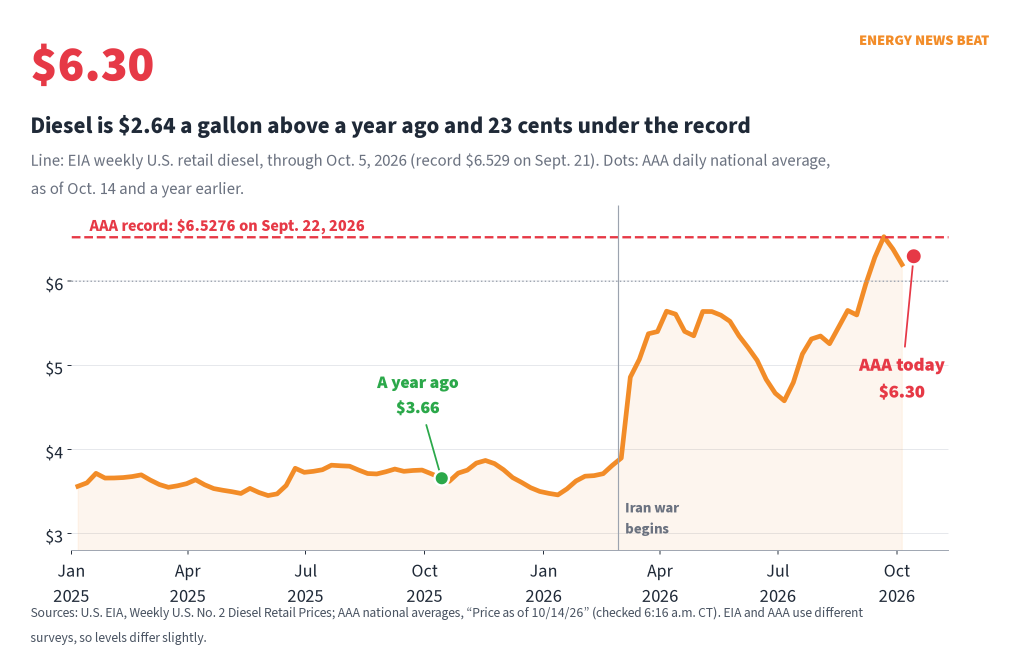
Diesel is $6.30 a gallon, $2.64 more than a year ago. The International Energy Agency now says the world’s diesel shortage runs “well into 2027.” We checked three clocks, the futures market, the government forecast and the IEA, to estimate how long $6 diesel can hang on, and who pays while it does. Our answer, about January, is ENB’s math on the futures, not a market quote.
By Stuart Turley, host of the Energy News Beat podcast • Published Oct. 14, 2026 • Prices as of 6:06–6:16 a.m. CT, Wed., Oct. 14, 2026 • Analysis and opinion: Stu’s views are labeled • Not investment advice
As of 6:16 a.m. CT Wednesday (AAA) and Oct. 5 (EIA heating oil)
If you filled a 30-gallon pickup tank with diesel this morning, it cost about $189. A year ago the same fill was about $110 (AAA; ENB calculation). The national average is $6.30 a gallon, up $2.64, or 72%, from a year ago, and just 23 cents under the record $6.5276 set on Sept. 22 (AAA). If your house heats with oil, 300 gallons at this week’s federal average of $6.04 runs about $1,813, against about $1,067 a year ago (EIA; ENB calculation).
So the question at every truck stop, farm office and Northeast kitchen table is simple: how long does this last? This morning the International Energy Agency gave its answer. The diesel market “will remain tight well into 2027,” the Paris-based agency said, and lost inventories are unlikely to be rebuilt before the second half of 2027 (IEA).
That is a long time. But it is not the same thing as $6 at the pump for a year. When we lined up the futures market, the government’s own forecast and the IEA, we got three different clocks. Add the usual pump markup to diesel futures, and you get about $6 diesel into January, easing under $6 in February and staying above $5 until roughly next November. That is an ENB estimate, not a market quote. January futures settled at $4.6766 a gallon, a wholesale price, and our $1.33 markup takes it to $6.0066, less than a penny of cushion (NYMEX futures; ENB calculation). EIA also expects retail margins, squeezed this year, to widen back above their five-year average in 2027 (EIA), which would put pump prices above our estimate. The U.S. Energy Information Administration is far more hopeful. The common thread is that nobody sees cheap diesel coming back soon.
| The 60-second version
Where we are: Diesel averages $6.30 a gallon, regular gasoline $4.33. Diesel futures closed Tuesday at $4.9344, up 21 cents on the day (ENB calc from FreightWaves and CNBC). What the IEA said today: gasoil and diesel stay tight “well into 2027,” and real restocking is “unlikely before 2H27” (IEA). How long $6 lasts (ENB estimate): Futures plus the usual pump markup put retail at about $6.26 in November, $6.11 in December and $6.01 in January, then $5.89 in February (ENB calc from futures). January futures settled at $4.6766, so the $6 call rests on less than a penny. EIA’s Oct. 6 forecast had October as the last month above $6 (EIA). Why it is sticky: U.S. distillate stocks are 105.1 million barrels, 11% below the five-year average and the lowest for early October in EIA records back to 1982 (EIA; ENB calc). The Russian deal: the first 300,000 tons is about 15 hours of U.S. use; the first three tranches about 3.7 days (ENB). The EU’s economy chief says the volumes are “not going to have any macroeconomic significance” (CNBC). Who pays: an OOIDA trucker about $995 more a week; a typical corn farm $2,227 more for harvest diesel; a heating oil home $2,115 for the winter (sources in the “Who pays” section). Stu will be covering this on the next Energy News Beat Stand Up. |
What the IEA said this morning
The IEA’s October Oil Market Report came out early Wednesday. The headline on its free summary: “Gasoil and diesel market tightness set to extend into 2027” (IEA). Gasoil is the trade name for the diesel and heating oil family.
“The gasoil market balance will remain tight well into 2027 and is dependent on a recovery of product supply from the Middle East. Failing this, further demand reductions and the high economic costs these will entail may be needed.” (IEA)
Here is what sits behind that line, all from the agency’s report (IEA):
- Exports are down. Global diesel exports in September were 700,000 barrels a day lower than a year earlier, with about 3 million barrels a day lost from Russia and the Middle East.
- Prices hit records, then eased. Wholesale diesel topped $200 a barrel in Singapore in mid-September and reached “all-time highs of around $220/bbl in Europe and the United States.” European diesel margins have since fallen from $100 a barrel to about $60 by early October, but diesel benchmarks are still “nearly double the price of crude.”
- Stocks are thin. Replenishing lost inventories, “outside of typical seasonal fluctuations, is unlikely before 2H27.” The IEA does expect a seasonal surplus in early 2027, which is why prices can ease this winter without the shortage being fixed.
- Demand is already being destroyed. The IEA sees world oil demand falling by 6 million barrels a day in 2026, with diesel about a quarter of the drop.
- Russia will not fix it. Easing on Russian product exports is “unlikely to materially alter the global gasoil market balance as the current export constraints stem from a lack of operational Russian refinery capacity.”
CNBC’s Chloe Taylor summed up the report the same way: a diesel squeeze set to last “well into 2027” as the Iran war disrupts supply (CNBC). The IEA also flagged two risks that could make it worse: renewed attacks on Gulf energy sites and the Atlantic hurricane season.
How long can $6 diesel last? Three clocks
As of Oct. 13 settlements, quoted 5:17–6:12 a.m. CT Oct. 14 (futures); Oct. 6 (EIA forecast)
Clock No. 1: the futures market. Traders buy and sell heating oil futures (the diesel contract) for delivery month by month into 2028. Those prices are not a forecast. They are what buyers will pay today to lock in fuel later. To turn them into a pump price, we added $1.33 a gallon, the average gap between EIA’s retail diesel price and New York Harbor wholesale diesel in 2025 (ENB calculation from EIA retail and EIA spot). That gap covers taxes, freight and station margins. Using Tuesday’s settlements (CNBC):
| Delivery month | Futures settle, $/gal | Implied pump price, $/gal |
| Nov’26 | 4.9344 | 6.26 |
| Dec’26 | 4.7766 | 6.11 |
| Jan’27 | 4.6766 | 6.01 |
| Feb’27 | 4.5643 | 5.89 |
| Apr’27 | 4.2707 | 5.60 |
| Jul’27 | 3.9112 | 5.24 |
| Oct’27 | 3.7359 | 5.07 |
| Nov’27 | 3.6704 | 5.00 |
| Dec’27 | 3.5877 | 4.92 |
By our estimate, that puts pump diesel at about $6 into January and a little under it from February. Be clear about what this is: the January contract settled at $4.6766, a wholesale price, and adding $1.33 gets $6.0066, less than one cent above $6. The markup is an assumption, not a law. EIA says retail and distribution margins “have been depressed because of surging wholesale prices, but we expect them to increase back above the five-year average in 2027 after wholesale prices begin to decrease” (EIA). Wider margins would mean higher pump prices than this table shows. Today’s actual gap is a touch wider, $1.37 (AAA minus Tuesday’s settle), and at that gap January comes out at $6.04. A dime either way on the gap moves the end of $6 by about a month (ENB calculation). The futures-implied pump price stays above $5 until about November 2027 and averages $5.38 for 2027. The futures themselves average about $4.05 a gallon for 2027 delivery, wholesale (ENB calculations).
Clock No. 2: the government forecast. EIA’s October Short-Term Energy Outlook, published Oct. 6, says retail diesel will “remain above $6/gal in October and then come down gradually with crude oil prices and a slight recovery in inventories.” It sees diesel averaging “about $4.50/gal next year,” but still above $4 “through 2027” because U.S. stocks stay below average for the whole forecast (EIA). By month, EIA has $5.79 in November, $5.06 in January, under $5 from February and $4.11 by December 2027 (EIA STEO data). One caveat: EIA locked its assumptions on Oct. 1, before the G7’s Oct. 2 stock-release pledge and before Tuesday’s 21-cent futures jump. Its next outlook is due Nov. 10.
Clock No. 3: the IEA. The agency does not forecast pump prices, but it does tell you when the cushion comes back: not before the second half of 2027, and only if Middle East supply recovers (IEA).
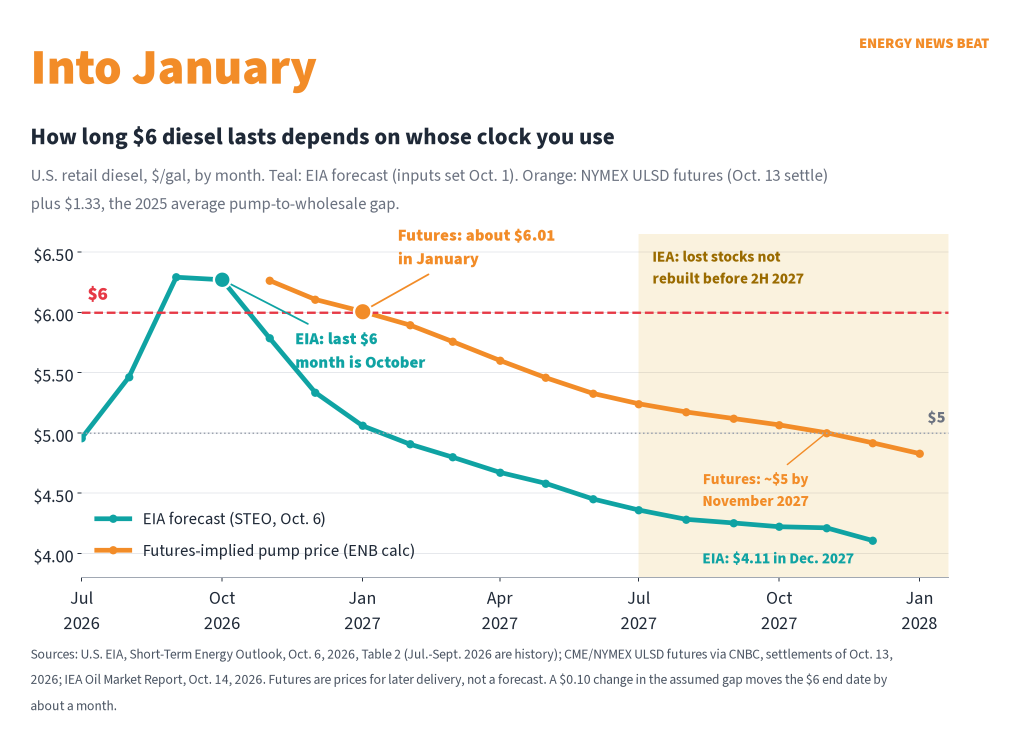
Our read [ENB analysis]: the honest answer is “about January, unless something breaks.” ENB’s futures-implied pump price for 2027 is about 89 cents above EIA’s forecast ($5.38 versus $4.49), built on 2027 futures that average about $4.05 wholesale. Somebody is going to be wrong, and with stocks this low, a cold snap, a hurricane or a new refinery strike pushes the date later, not earlier.
The stockpile problem
As of EIA data for the week ending Oct. 2; next update Thursday, Oct. 15, delayed by Monday’s federal holiday
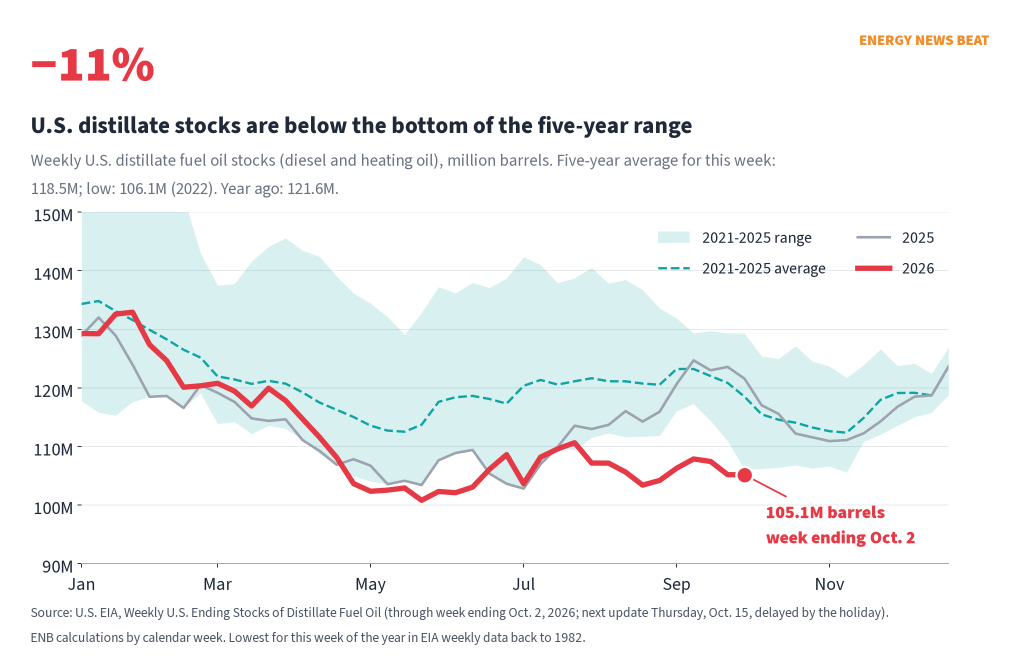
U.S. distillate stocks, which include diesel and heating oil, stood at 105.1 million barrels in the week ending Oct. 2. That is 11.3% below the 2021–2025 average for the week, 118.5 million, and below the bottom of that five-year range, 106.1 million in 2022. A year ago it was 121.6 million (EIA; ENB calculations). It is the lowest for that week of the year in EIA’s weekly data back to 1982 (ENB calculation).
At the latest four-week average of about 3.77 million barrels a day of distillate use, that is about 28 days of supply (EIA; ENB calculation). The East Coast, where most heating oil is burned, is tighter still. EIA says East Coast distillate stocks were 32% below the five-year average in September, will stay 20% to 30% below through the winter and will bottom at 22.6 million barrels in April 2027 (EIA).
The Russian deal, two days later
As of 6:06 a.m. CT Wednesday (futures)
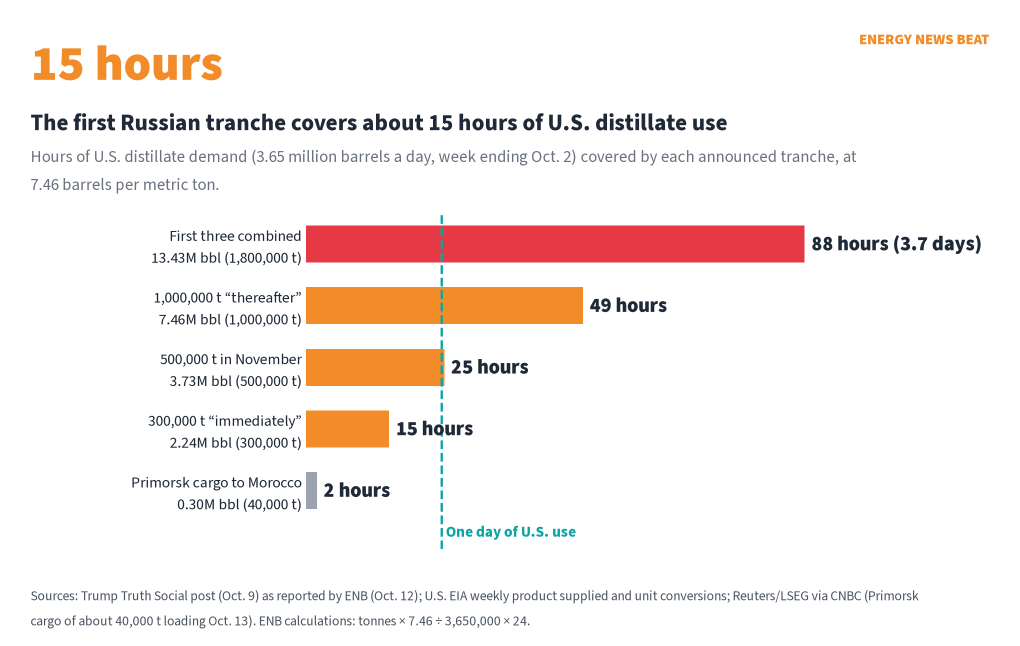
On Monday, ENB reported that the first 300,000 tons of Russian diesel President Trump announced Oct. 9 equals less than a day of U.S. demand, and that the first three shipments combined, 1.8 million tons, add up to about 3.7 days (ENB; ENB). The Daily Caller News Foundation picked that up, citing “an Energy News Beat analysis of Energy Information Administration data,” and quoted Stu (Daily Caller).
Two days later, the numbers have not changed, and neither has the market. Diesel futures rose 21 cents on Tuesday to settle at $4.9344, and were little changed early Wednesday at $4.9412 (CNBC; FreightWaves; ENB calc). The first actual cargo reported is not headed here. Reuters, citing LSEG data, said Russian diesel loadings at the Baltic port of Primorsk resumed Tuesday with a tanker of about 40,000 metric tons bound for Morocco (CNBC). That is about two hours of U.S. distillate use (ENB calculation).
Europe is not impressed either. Speaking at IMF meetings in Bangkok on Wednesday local time, EU economy commissioner Valdis Dombrovskis said, “the volumes which are being discussed are anyway not going to have any macroeconomic significance, and the big question mark if Russia is able to deliver them anyway.” He added, “now is not a time to ease sanctions on Russia” (CNBC; see also AFP). At home, a bipartisan group of 12 senators wrote on Tuesday that the deal offers “limited to no relief to Americans” (NPR).
Why diesel costs so much more than crude
As of EIA spot prices through Oct. 6
The gap between diesel and crude is called the crack spread. It is the refiner’s gross margin, and right now it is where most of the pain lives. In New York Harbor, wholesale diesel minus EIA’s Brent spot price ($125.44 that day) was $72.51 a barrel on Oct. 6, after averaging $93.50 in September. From 2021 through 2025 it averaged $31.50 (EIA; EIA; ENB calculations). Put another way, crude is not the whole story. You could hold oil flat and diesel would still be expensive because there is not enough refining capacity running to make it.
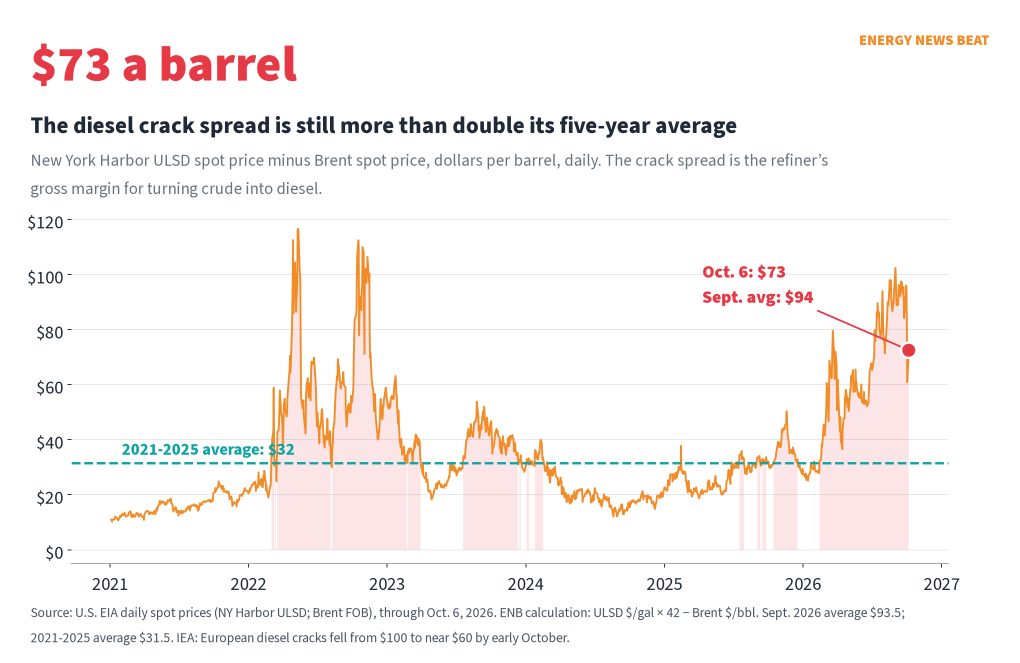
Crude is not cheap either. Brent for December delivery was $106.58 at 6:06 a.m. CT, and U.S. crude (WTI) for November $95.64 (CNBC; CNBC). The IEA notes that physical North Sea crude, Dated Brent, is around $134, well above futures, a sign of how tight prompt supply is (IEA).
Who pays
Truckers
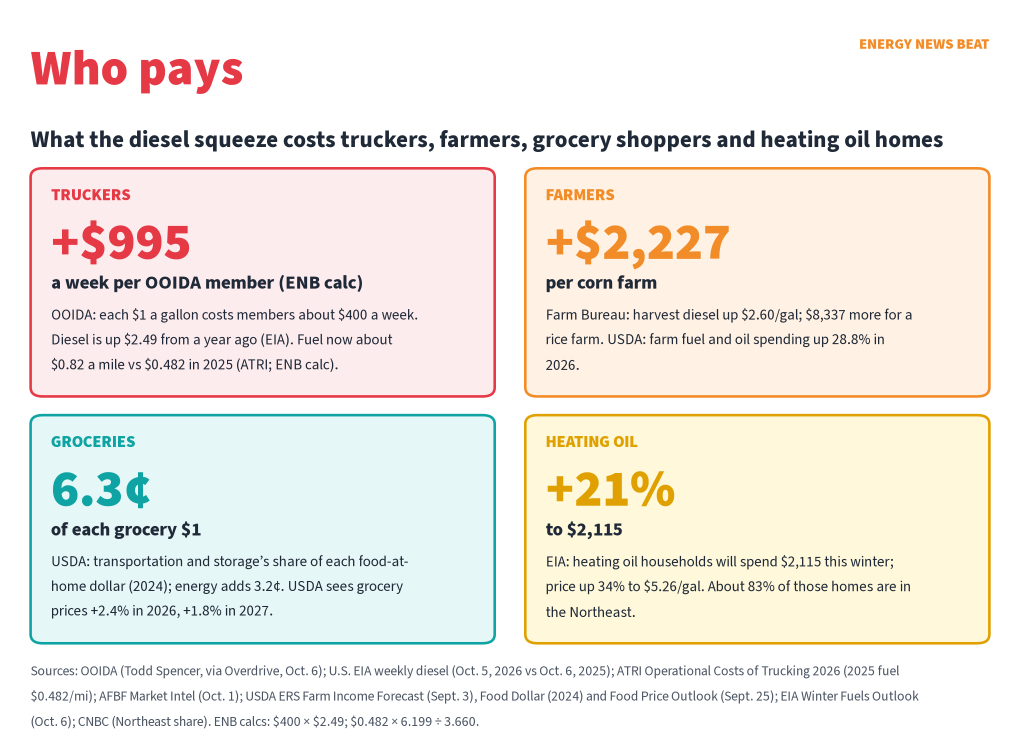
Todd Spencer, who runs the Owner-Operator Independent Drivers Association, put it plainly: “Every $1 increase per gallon in fuel costs our members around $400 more per week, and sustained high prices will put many truck drivers out of business” (Overdrive). With EIA’s weekly diesel price up $2.49 from a year ago, that rule of thumb works out to about $995 a week (ENB calculation from EIA).
The American Transportation Research Institute found fuel cost carriers $0.482 a mile in 2025, out of $2.336 a mile in total operating cost (ATRI). Scale fuel to today’s price and it is about $0.82 a mile, which lifts the total to roughly $2.67, up 14% (ENB calculation; it assumes the same 7.43 mpg ATRI reported). Spencer also noted that roughly 70% of domestic freight moves only by truck, and “the cost of fuel ultimately gets passed on” (Overdrive).
Farmers
Harvest is the worst time for this. The American Farm Bureau says farm diesel in Illinois went from $3.01 to $5.61 a gallon, citing USDA data. For a typical 279-acre corn farm, that adds about $2,227 to the harvest fuel bill; $2,861 for cotton and $8,337 for rice (AFBF). USDA expects farm fuel and oil spending to rise $4.8 billion, or 28.8%, this year (USDA ERS). Farm Bureau President Zippy Duvall told the president farmers “cannot postpone harvest or simply stop using diesel when prices rise” (AFBF).
Groceries
Diesel hauls almost everything you buy. USDA’s food dollar data say transportation and storage took 6.3 cents of every dollar spent on food at home in 2024, and energy another 3.2 cents (USDA ERS; ENB calculation from the data file). USDA’s latest outlook, from Sept. 25, still sees grocery prices up 2.4% this year and 1.8% in 2027, but its 2027 range runs from a 5% drop to a 9.2% rise, and the forecasts are statistical models built on recent trends (USDA ERS). ENB’s view: freight costs reach shelves with a lag, so the October outlook is the one to watch.
Heating oil
As of EIA weekly residential price for Oct. 5
About 3% of U.S. homes heat with oil, most of them in the Northeast. EIA expects those households to pay an average $5.26 a gallon this winter, up 34%, and spend about $2,115, up 21%, even while burning 9% less fuel (EIA). The current price is higher than that winter average: $6.04 a gallon, up 70% from $3.56 a year ago (EIA). CNBC found $6.12 in Massachusetts and $5.96 in Maine, and counted 3.4 million of the 4.1 million heating oil households in the Northeast (CNBC). “Shopping around does pay off,” said Mark Wolfe of the National Energy Assistance Directors Association (CNBC). More in ENB’s heating oil coverage.
How consumers and investors see it
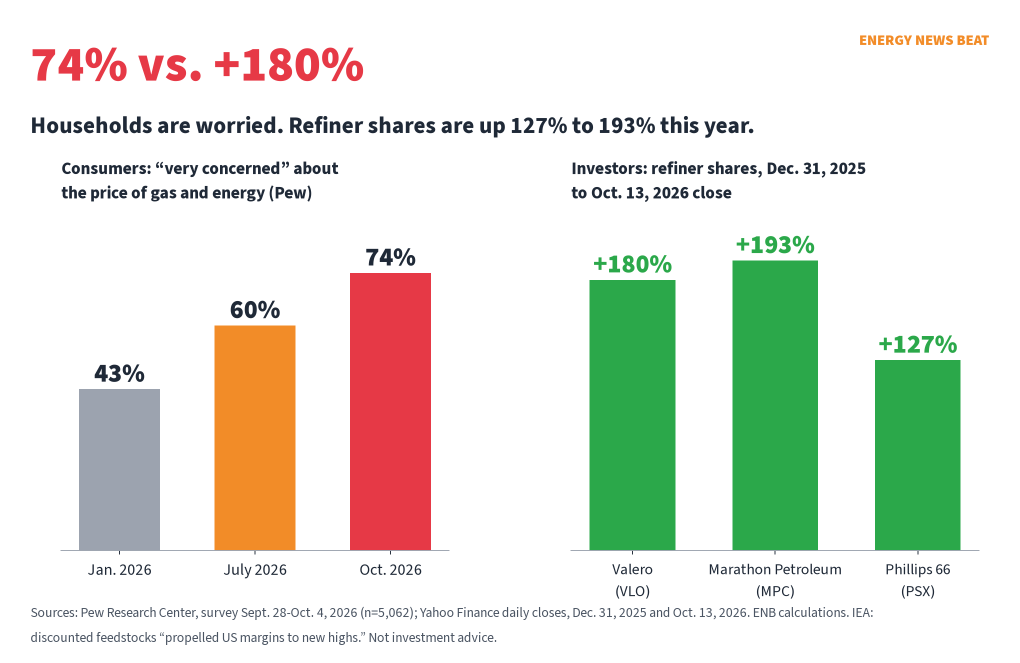
Consumers: 74% of Americans now say they are very concerned about the price of gas and energy, up from 60% in July and 43% in January, according to a Pew Research Center survey of 5,062 adults taken Sept. 28–Oct. 4 (Pew). GasBuddy’s Patrick De Haan sees a “fragile calm”: diesel fell about five cents in a week, but “it is far too early to declare the pressure on fuel prices resolved” (Rigzone). He told WBNG, “We’re already seeing some heating oil prices of over $7 a gallon” (WBNG).
Analysts: Ellen Wald of Transversal Consulting told CNBC, as quoted by FreightWaves, that “any attempts to bring them down that aren’t actual new sources of supply don’t really last” (FreightWaves). Jefferies’ Mohit Kumar wrote that Trump “is exploring all avenues to bring down diesel prices before the midterms,” and Singapore’s Quantum Strategy told clients, “We expect this deal to fail economically. We remain long distillates and crude” (CNBC).
As of Tuesday’s close, Oct. 13 (stock prices)
Investors: Wall Street is betting the margin lasts. Valero shares are up 180% this year, Marathon Petroleum 193% and Phillips 66 127% (Yahoo Finance; Yahoo Finance; Yahoo Finance; ENB calculations). The IEA said discounted feedstocks “propelled US margins to new highs” (IEA). That is not investment advice, just the scoreboard.
| Stu’s Take
Folks, I told Simon August at the Daily Caller that diesel and gasoline prices can only come down in two ways: demand destruction or more refineries. Read the IEA this morning, and you will find the same two doors. Either supply comes back from the Middle East, or “further demand reductions and the heavy economic costs” do the job. Demand destruction is a polite way of saying a trucker parks his rig or a farmer leaves a field. Look at the numbers. Diesel is $6.30, up $2.64 in a year. Our stockpile is 105.1 million barrels, the lowest for this time of year in EIA records going back to 1982. Diesel futures plus the usual markup put pump diesel near $6 into January, by our math, and the IEA says the cushion is not back before the second half of 2027. Meanwhile, the first Russian cargo, about 40,000 tons, is sailing to Morocco. That is why I keep pounding the table on refining. The deal gets Putin to the table, and that matters, but 3.7 days of diesel does not fix a refining problem. Use the Defense Production Act. Permit, build and expand. It takes years, which is exactly why we should have started yesterday. And remember who pays. An owner-operator is out about $995 a week. A corn farmer is out $2,227 at harvest. A heating oil family is looking at a winter bill around $2,115, EIA’s U.S. average. This is the inflation the Fed cannot control. Buckle up. As I said above, we will cover this on the next Energy News Beat Stand Up. |
Corrections to early reports
Several details in early accounts, including some that came to us second-hand, needed fixing:
- “The IEA said the Russian deal has little macroeconomic impact.” The “macroeconomic significance” words belong to the EU’s Valdis Dombrovskis, and he said “not going to have any” (CNBC) or “not of any” (AFP), not “little.” CNBC’s own summary attributes a “little macroeconomic impact” paraphrase to the IEA. The IEA’s published wording is that easing Russian exports is “unlikely to materially alter the global gasoil market balance” (IEA).
- “Diesel is at $220 a barrel.” That was September’s all-time high in Europe and the U.S., per the IEA. Prices have eased since; New York Harbor spot was about $198 a barrel on Oct. 6 (IEA; EIA; ENB calc).
- “Inventories won’t rebuild until the second half of 2027.” Close, but the IEA’s words are that replenishment “outside of typical seasonal fluctuations” is unlikely before 2H27. It expects a seasonal surplus in early 2027 (IEA).
- Brent “around $107” and “$134” are both right. The first is futures, the second is the physical Dated Brent benchmark (IEA).
- WTI “about $95.40.”S. crude was $95.64 at 6:06 a.m. CT; it moves all day (CNBC).
- “3.725 million b/d.” FreightWaves’ figure for the November tranche should read 3.725 million barrels, a one-time volume, not a daily rate (FreightWaves; ENB calc gives 3.73 million barrels at 7.46 barrels a ton).
- Dombrovskis’s timing. CNBC says he spoke Wednesday in Bangkok; AFP’s interview is dated Oct. 13. Bangkok is 12 hours ahead of Central time, so both can be right (CNBC; AFP).
Confirmed as reported: AAA’s $6.30 diesel, $4.33 gasoline and $6.5276 record; Brent near $106.50; the 700,000 barrel-a-day export drop; the first tranche at about 2.2 million barrels, less than a day of U.S. use; diesel futures rising Tuesday; and the Daily Caller citing ENB’s analysis and linking our Oct. 12 story (its link uses the energynewsbeat.com address).
What to watch
- Today, Oct. 14: EIA’s weekly retail diesel price, delayed a day by Monday’s federal holiday (EIA).
- Thursday, Oct. 15: EIA’s weekly stocks report, also delayed by the holiday (EIA). The test is whether distillate stocks climb back toward 106 million barrels, the bottom of the five-year range.
- 10: EIA’s next Short-Term Energy Outlook, the first to include the G7 stock pledge and the Russian deal (EIA).
- April 7, 2027: the Treasury license covering Russian diesel expires, according to the Daily Caller (Daily Caller).
- All winter: the Atlantic hurricane season’s tail, Gulf attacks and Ukrainian strikes on Russian refineries, the risks both the IEA and GasBuddy flagged. Follow along in ENB’s diesel coverage.
The bottom line
The IEA has put a date on the shortage: it lasts “well into 2027.” Futures plus the usual markup put a rough date on $6 diesel: about January, by ENB’s estimate, with pump prices still above $5 until late next year. That date could slip either way by a month for every dime of markup. EIA’s Oct. 6 forecast is kinder, with $6 gone after October and about $4.50 for 2027, but even EIA has diesel above $4 through 2027. Every forecast here lands on the same two doors Stu keeps naming, demand destruction or more refining, and right now the country is walking through the first one. For background, read Monday’s story, the first look at the Russian deal and the case for the Defense Production Act.
Check out the World’s Greatest Podcast Show Notes at EnergyNewsBeat.co or EnergyNewsBeat.com. And subscribe to: The Energy News Beat Substack.
Appendices
At Energy News Beat we Make Appendices Great Again.
. Times are U.S. Central (CDT, UTC−5) unless noted. Fast-moving items (futures, crude, pump prices, stock prices) are current as of 6:06–6:16 a.m. CT, Wed., Oct. 14, 2026 unless a different time is shown. Labels: [ENB CALC] = our arithmetic from the cited figures; [ENB READING] = our interpretation.
Download the data: every figure in the charts and tables is in the companion workbook, “IEA Says the Diesel Squeeze Lasts Well Into 2027 – Futures Imply About $6 Diesel Into January – Data.xlsx,” with a source and URL for each sheet.
Appendix A. Sources
Appendix B. Key figures
| Figure | Value | Source |
| AAA national diesel, Oct. 14 | $6.2997/gal (yesterday $6.2787; week ago $6.3015; month ago $6.2301; year ago $3.6574) | AAA |
| AAA diesel record | $6.5276 on 9/22/26; today 22.8¢ below [ENB CALC] | AAA |
| AAA regular gasoline | $4.3333 (year ago $3.0761) | AAA |
| Diesel vs year ago | +$2.64, +72% [ENB CALC] | AAA |
| EIA weekly retail diesel | $6.199 (Oct. 5); record $6.529 (Sept. 21); year ago $3.711; 2025 average $3.660 [ENB CALC] | EIA |
| NYMEX ULSD Nov. 2026 | $4.9412 at 6:06 a.m. CT (+0.68¢); Tue. settle $4.9344; Mon. settle $4.7232 | CNBC; FreightWaves |
| Tuesday ULSD change | +21.12¢ [ENB CALC] | CNBC; FreightWaves |
| Futures-implied pump diesel (ENB estimate) | Jan. settle $4.6766 + $1.33 = $6.0066 (under 1¢ above $6); raw 2027 futures avg ≈ $4.05; Nov $6.26; Dec $6.11; Jan $6.01; Feb $5.89; Jul 2027 $5.24; Nov 2027 $5.00; 2027 avg $5.38 [ENB CALC] | CNBC; EIA |
| EIA STEO retail diesel | Sept 2026 $6.29 (history); Oct $6.27; Nov $5.79; Jan 2027 $5.06; 2027 avg $4.49 (“about $4.50”); Dec 2027 $4.11 | EIA; EIA |
| Brent / WTI | Brent Dec $106.58 (+$0.89); WTI Nov $95.64 (+$1.50), 6:06 a.m. CT | CNBC; CNBC |
| U.S. distillate stocks | 105.1M bbl (week ending Oct. 2); 2021–25 avg 118.5M; 5-yr low 106.1M (2022); year ago 121.6M; −11.3% [ENB CALC] | EIA |
| Distillate product supplied | 3.650M b/d latest week; 3.77M b/d 4-week avg; ~28 days of supply [ENB CALC] | EIA |
| NYH ULSD crack vs Brent spot | $72.51/bbl Oct. 6 (Brent spot $125.44); Sept avg $93.50; 2021–25 avg $31.50; 2026 YTD $62.00 [ENB CALC] | EIA; EIA |
| Russian tranches | 300k t = 2.24M bbl ≈ 15 hrs; 500k t ≈ 25 hrs; 1M t ≈ 49 hrs; 1.8M t ≈ 3.7 days; Primorsk 40k t ≈ 2 hrs [ENB CALC] | ENB; EIA; CNBC |
| IEA: diesel exports | Sept −700 kb/d y/y; ~1.3 mb/d lost from Russia and Middle East | IEA |
| IEA: demand | World oil demand −2.6 mb/d in 2026; diesel ~25% of the drop | IEA |
| Trucking | ATRI 2025: $2.336/mi total, $0.482/mi fuel, 7.43 mpg; now ≈$0.82/mi fuel, ≈$2.67 total [ENB CALC]; OOIDA $400/wk per $1 → ≈$995/wk [ENB CALC] | ATRI; Overdrive |
| Farms | Illinois farm diesel $3.01→$5.61; corn farm +$2,227; cotton +$2,861; rice +$8,337; USDA fuel & oil +$4.8B (+28.8%) | AFBF; USDA ERS |
| Groceries | Transportation & storage 6.3¢ per food-at-home $ (2024); energy 3.2¢; food-at-home +2.4% (2026), +1.8% (2027; range −5.0% to +9.2%) | USDA ERS; USDA ERS |
| Heating oil | EIA winter: $5.26/gal (+34%), $2,115 (+21%), 402 gal (−9%); weekly residential $6.042 vs $3.555 (+70%) | EIA; EIA |
| Pew | “Very concerned” about “the price of gas and energy”: 43% (Jan.), 60% (July), 74% (Sept. 28–Oct. 4; n=5,062) | Pew |
| Refiner shares YTD | VLO +180%; MPC +193%; PSX +127% (Dec. 31, 2025 to Oct. 13, 2026) [ENB CALC] | Yahoo Finance |
Appendix C. Timeline
| Date | Event | Source |
| Feb. 28, 2026 | U.S.-Iran war begins; Hormuz flows disrupted | link |
| Sep. 11, 2026 | Saudi East-West Pipeline bombed (IEA) | link |
| Sep. 21, 2026 | EIA weekly diesel record: $6.529 a gallon | link |
| Sep. 22, 2026 | AAA daily diesel record: $6.5276 | link |
| Oct. 1, 2026 | EIA finalizes October STEO inputs | link |
| Oct. 2, 2026 | G7 pledges faster IEA stock releases, diesel first | link |
| Oct. 5, 2026 | Executive order on red-dyed diesel for highway use | link |
| Oct. 6, 2026 | EIA STEO and Winter Fuels Outlook | link |
| Oct. 9, 2026 | Trump announces Russian diesel deal | link |
| Oct. 12, 2026 | ENB: truce hinges on Russian refineries; Daily Caller cites ENB analysis | link |
| Oct. 13, 2026 | ULSD futures settle $4.9344, up 21 cents; 12 senators urge rescinding the deal | link |
| Oct. 14, 2026 | IEA October Oil Market Report: tight “well into 2027” | link |
| Oct. 14, 2026 | EIA weekly diesel price (delayed by holiday) | link |
| Oct. 15, 2026 | EIA Weekly Petroleum Status Report, 1 p.m. CT | link |
| Nov. 3, 2026 | Election Day | link |
| Nov. 10, 2026 | Next EIA STEO | link |
| Jan. 31, 2027 | ENB estimate: futures-implied $6 pump diesel ends (shifts about a month per 10¢ of markup) | link |
| Apr. 7, 2027 | Treasury General License 135 for Russian diesel expires | link |
| Apr. 30, 2027 | EIA: East Coast distillate stocks hit 2027 low, 22.6M bbl | link |
| Jul. 1, 2027 | IEA: inventory rebuild not before 2H27 | link |
Appendix D. Key passages, verbatim
“Replenishment of lost inventories, outside of typical seasonal fluctuations, is unlikely before 2H27.” (IEA Oil Market Report, Oct. 14)
“Easing … is unlikely to materially alter the global gasoil market balance as the current export constraints stem from a lack of operational Russian refinery capacity.” (IEA Oil Market Report, Oct. 14)
“We forecast retail distillate prices will remain above $6/gal in October and then come down gradually with crude oil prices and a slight recovery in inventories.” (EIA STEO, Oct. 6)
“We expect U.S. distillate fuel inventories to remain below the 2021–2025 average throughout the forecast period, however, keeping diesel crack spreads elevated and retail prices above $4/gal through 2027.” (EIA STEO, Oct. 6)
“The first three shipments Trump described, totaling 1.8 million tons, would cover about 3.7 days of U.S. diesel use, according to an Energy News Beat analysis of Energy Information Administration data.” (Daily Caller News Foundation, Oct. 12)
“There’s only two ways diesel and gasoline prices can come down. One, demand destruction. Number two, … more refineries. It takes decades to build refineries.” — Stuart Turley (Daily Caller News Foundation, Oct. 12)
“Households that rely on heating oil face higher prices because distillate markets remain tight.” — EIA Administrator Tristan Abbey (EIA press release, Oct. 6)
Appendix E. Methodology and conversions
Futures-implied pump price [ENB CALC]: NYMEX ULSD (heating oil) settlement for each delivery month on Oct. 13, 2026, plus $1.33/gal, the 2025 average of EIA weekly U.S. retail diesel minus the EIA New York Harbor ULSD spot price on the same week (matched to the nearest prior trading day). Futures are prices for later delivery, not forecasts. Each contract month is treated as that month’s pump price; in practice retail trails wholesale by a few weeks.
Margin risk: EIA expects retail and distribution margins to rise back above their five-year average in 2027 (EIA); a wider markup than $1.33 would push implied pump prices up. Sensitivity: using today’s gap ($6.2997 AAA − $4.9344 settle = $1.365), January is $6.04 and February $5.93. At a $1.23 gap, December ($6.01) is the last $6 month; at $1.43, February ($5.99) is right at $6. A $0.10 change moves the end date by about one month.
Five-year range: weekly distillate stocks for 2021–2025 grouped by ISO calendar week; min, max and mean for each week. The latest week (ending Oct. 2, 2026) is ISO week 40.
Record check: compared week-40 stocks across all years in EIA’s weekly series (1982 onward); 2026 is the lowest.
Days of supply: 105.138M bbl ÷ 3.7685M b/d (four-week average product supplied) ≈ 27.9 days.
Crack spread: EIA NYH ULSD spot ($/gal) × 42 − EIA Brent spot ($/bbl), daily, matched by date. 2021–2025 average is the mean of all daily values in those years.
Tonnes to barrels: 7.46 barrels per metric ton of distillate (EIA units table; same factor as ENB’s Oct. 12 story). Hours of U.S. use = barrels ÷ 3.65M b/d × 24.
Trucking: ATRI 2025 fuel cost per mile × (EIA weekly retail diesel Oct. 5, 2026 ÷ 2025 average) = $0.482 × 6.199 ÷ 3.660 ≈ $0.816. OOIDA: $400 × ($6.199 − $3.711) ≈ $995.
Fill-ups: 30 gal × AAA $6.2997 ≈ $189; × $3.6574 ≈ $110. Heating oil 300 gal × EIA $6.042 ≈ $1,813; × $3.555 ≈ $1,067.
Refiner shares: Yahoo Finance daily closing prices on Dec. 31, 2025 and Oct. 13, 2026.
Rounding: dollar figures per gallon to the cent in text; percentages to whole numbers unless a decimal matters.
Appendix F. Glossary
Distillate: The fuel family that includes diesel and heating oil; EIA reports them together as distillate fuel oil.
Gasoil: The international trade name for diesel and heating oil.
ULSD: Ultra-low sulfur diesel; the NYMEX heating oil futures contract is ULSD delivered in New York Harbor.
Futures strip / curve: The set of futures prices for successive delivery months.
Crack spread: The price of a refined product minus the price of crude, per barrel; a rough refining margin.
Brent / Dated Brent / WTI: Brent futures are the traded global crude benchmark; Dated Brent is the physical North Sea cargo price; WTI is the U.S. benchmark.
Product supplied: EIA’s proxy for U.S. consumption.
STEO: EIA’s monthly Short-Term Energy Outlook.
OMR: The IEA’s monthly Oil Market Report.
2H27: The second half of 2027.
kb/d, mb/d: Thousand and million barrels per day.
PADD 1: EIA’s East Coast region.
Demand destruction: Lower fuel use forced by high prices.
Appendix G. What ENB could not confirm
- The IEA’s full October report, which is paid; ENB relied on the agency’s free highlights page and press coverage.
- This week’s EIA retail diesel price (due later today) and Thursday’s stocks report; figures here are the latest published.
- How fast futures moves pass through to the pump; the $1.33 gap is an average, not a rule.
- Whether, when and where any Russian diesel under the Oct. 9 announcement will reach the U.S.; the first reported cargo is bound for Morocco.
- The April 7, 2027 license expiry, which ENB took from the Daily Caller and did not see in a Treasury document.
- Pew’s publication date (Oct. 8), which ENB took from the report’s URL.
- The exact day of USDA’s March 2026 Food Dollar update and the date of the next one.
- Grocery price effects of diesel specifically; USDA does not break them out.
Why refiner shares moved; ENB