
The Federal Reserve can raise rates. The Treasury can issue bills. Neither institution can weld a crude distillation unit back together after a drone strike, add inches to a California products pipeline, or refill Gatun Lake. That is the story of September 2026: crude is still findable; diesel is not. The constraint has moved downstream, into refining capacity that wars, drones, missile strikes, and policy-driven closures have already removed from the system.
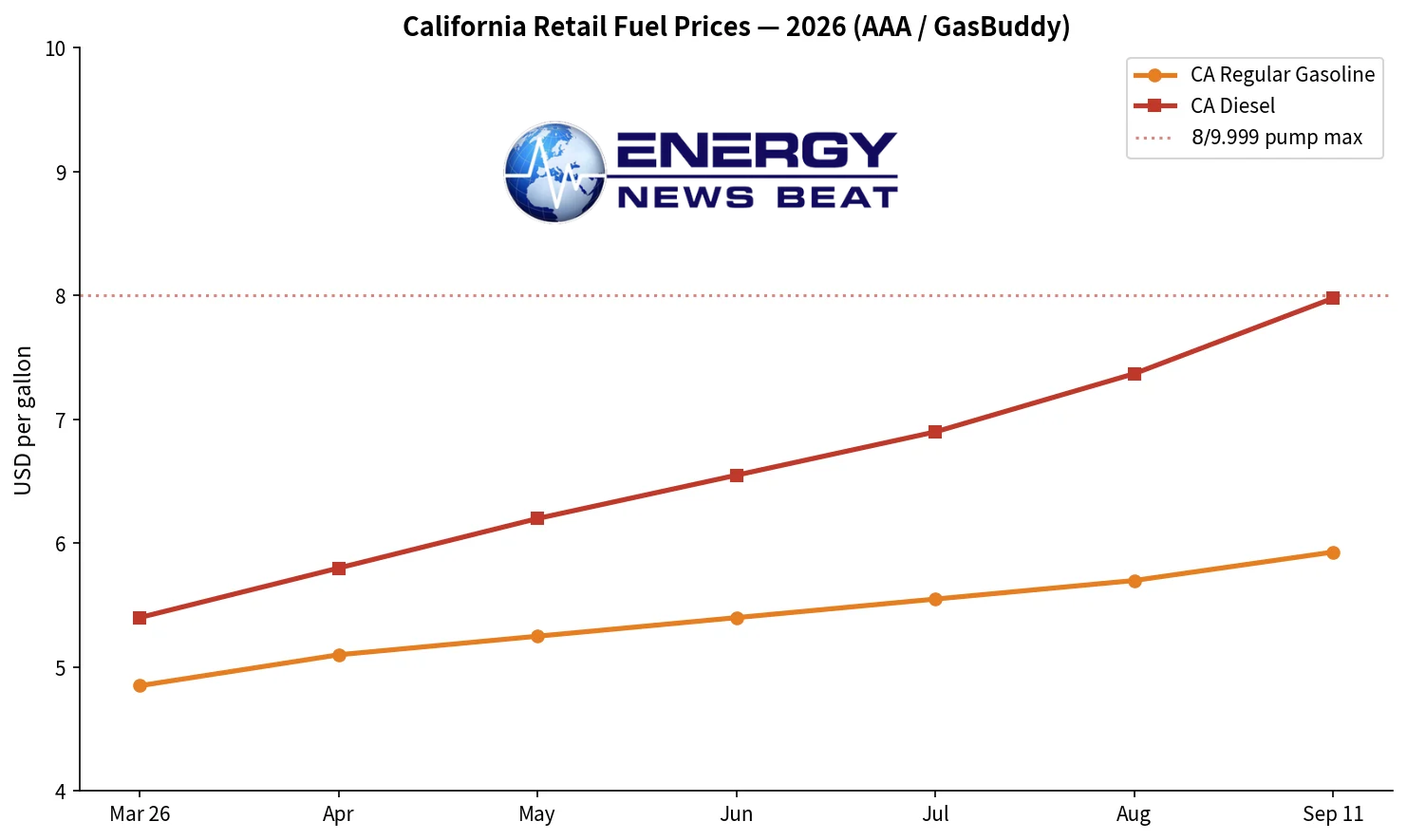
That constraint is now printing at the pump. On Friday, GasBuddy logged California diesel dispensers maxed out at $9.999 a gallon — the highest number the hardware can display. The state average sat near $7.98 for diesel and $5.93 for regular, while the national diesel average crossed $6 for the first time on record.
This is not a “gas price” story. Diesel is the fuel of freight, harvest, construction, and food distribution. When diesel cracks trade above $100 a barrel, every carton on a supermarket shelf is carrying a surcharge the Fed cannot vote out of existence.
The world still has crude. It does not have enough working stills.
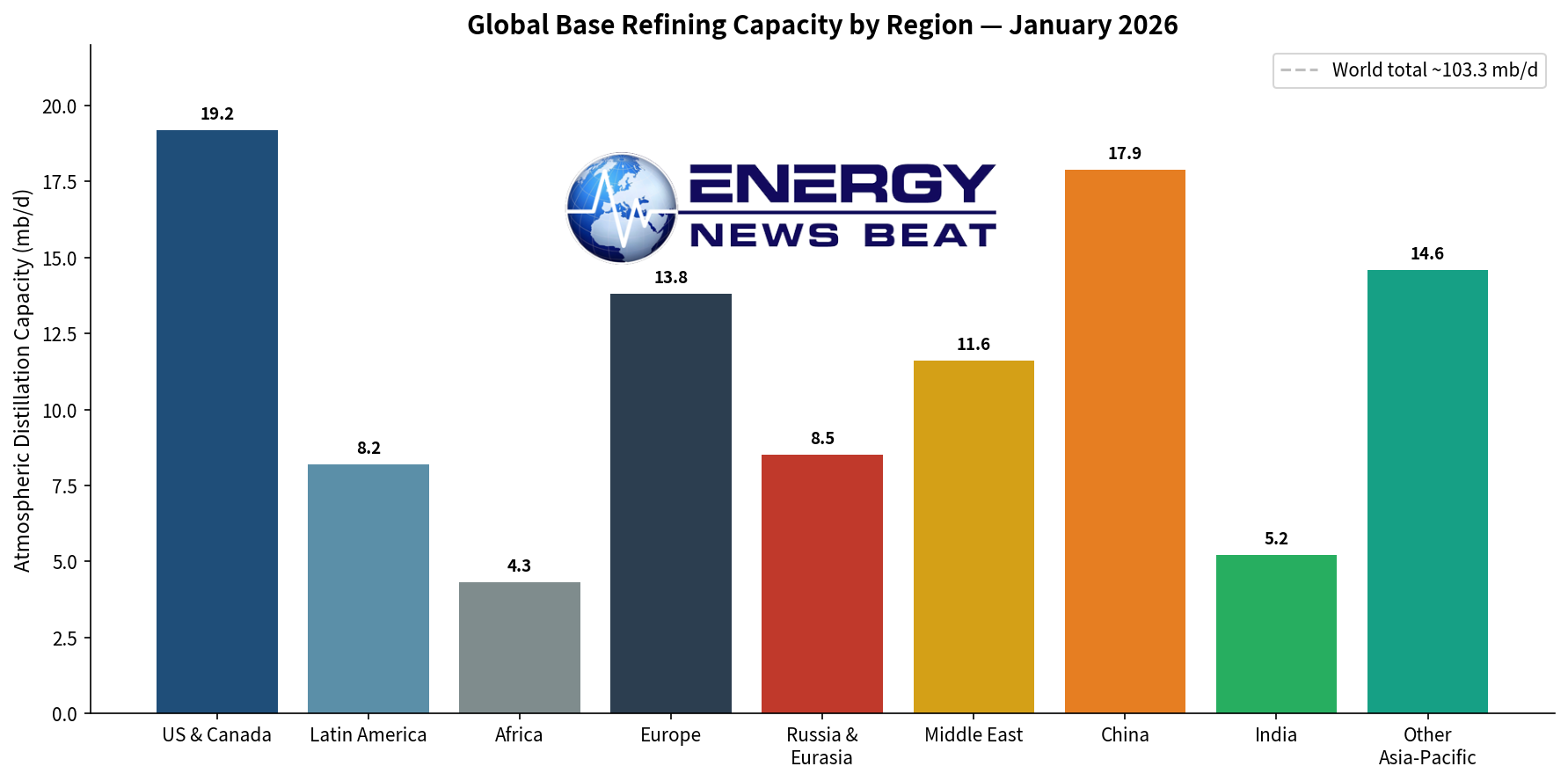
Global atmospheric distillation capacity sits around 103 million barrels per day, with OPEC putting the January 2026 base at 103.3 mb/d. The United States and Canada hold about 19.2 mb/d, China 17.9, Europe 13.8, and the Middle East 11.6. Nameplate and usable capacity are no longer the same number.
IEA-linked outlooks had already flagged a slow-growth refining world: net additions of only about 2.5 mb/d from 2024–2030, with OECD closures offsetting much of Asia’s build. Then the wars arrived. Reuters, citing industry monitor IIR, reported in May that attacks tied to the Iran and Ukraine conflicts had knocked out nearly 9% of global refining capacity — a hit that “likely delays recovery by months after fighting ends.
That is the inflation mechanism. Demand for liquid fuels is still north of 100 mb/d. The barrels that matter to consumers are gasoline, jet, and especially diesel. Those come from secondary units — crackers, hydrocrackers, cokers — that take longer to repair than a tank farm fire.
A global ledger of war, drones, and missile damage
No single official table exists. The picture has to be assembled from IEA revisions, IIR outage tallies, satellite assessments, and company-run cuts. The following is a conservative compilation of capacity hit, offline, or severely impaired in 2026 — not every barrel is gone on the same day, but the cumulative effect is what emptied diesel tanks.
Russia — Ukrainian long-range drone campaign
|
Item
|
Estimate
|
|---|---|
|
Plants attacked in 2026
|
22 of 34 major refineries
|
|
Capacity at attacked sites
|
~4.75 mb/d (~76% of Russian capacity)
|
|
IEA forward view (next 18 months)
|
Runs near 4.0 mb/d, ~30% below pre-invasion levels
|
|
June 2026 product output
|
~3.8 mb/d vs. ~5.2 mb/d pre-war average
|
|
August 2026 strike intensity
|
At least 22 refinery hits — highest monthly total of the war
|
|
Ukraine General Staff (early July)
|
Claimed 42.7% of design capacity disabled at that snapshot
|
The IEA’s September assessment is the one that should worry product markets: strikes are now hitting secondary processing units that can take six to eight months to replace, and sanctions block the spare parts. “Patchwork repairs” are compounding. Russia has also banned diesel exports into late September, removing a former top-three global diesel supplier from the seaborne market.
Middle East — Iran war, Houthi missiles, and the dual-chokepoint problem
|
Facility / system
|
What happened
|
Capacity / flow at risk
|
|---|---|---|
|
Ras Tanura (Saudi)
|
Drone hit early in the Iran war; temporary halt, later restart with units in turnaround
|
550,000 b/d
|
|
Jazan / Jizan (Saudi Aramco)
|
Repeated Houthi drone/missile strikes (July, September); IGCC and tank farm damage; offline
|
400,000 b/d
|
|
SATORP CDU (Saudi)
|
Extended repairs since April
|
~200,000 b/d
|
|
East-West Pipeline (Petroline)
|
Drones from Iraqi territory hit Riyadh and Medina sections Sept. 11; precautionary shutdown
|
4–5 mb/d of crude that had been the Hormuz workaround
|
|
Mina Al-Ahmadi & Mina Abdullah (Kuwait)
|
Drone attacks, fires, reduced rates
|
Combined with Al-Zour, a large share of Kuwait’s system
|
|
Bapco (Bahrain)
|
Damaged; force majeure
|
400,000 b/d
|
|
Ruwais (UAE)
|
Precautionary shutdown after nearby industrial-area fire
|
One of the world’s largest complexes
|
|
Gulf runs overall
|
IIR: Iran-war-related refining shut-ins peaked near 3.52 mb/d (early May)
|
Kpler: Saudi runs fell to ~2.2 mb/d in August
|
The latest Saudi strike is the one that closes the workaround. After the Hormuz disruption, the kingdom had pushed more crude west to Yanbu. On Friday, Riyadh shut the 1,200 km East-West pipeline after drones originating in Iraq’s Maysan province. Oil briefly printed near $110. Houthis, already hitting Jazan and southern Aramco sites, have also tightened the Red Sea. Saudi product is now exposed on both coasts.
Other impaired systems
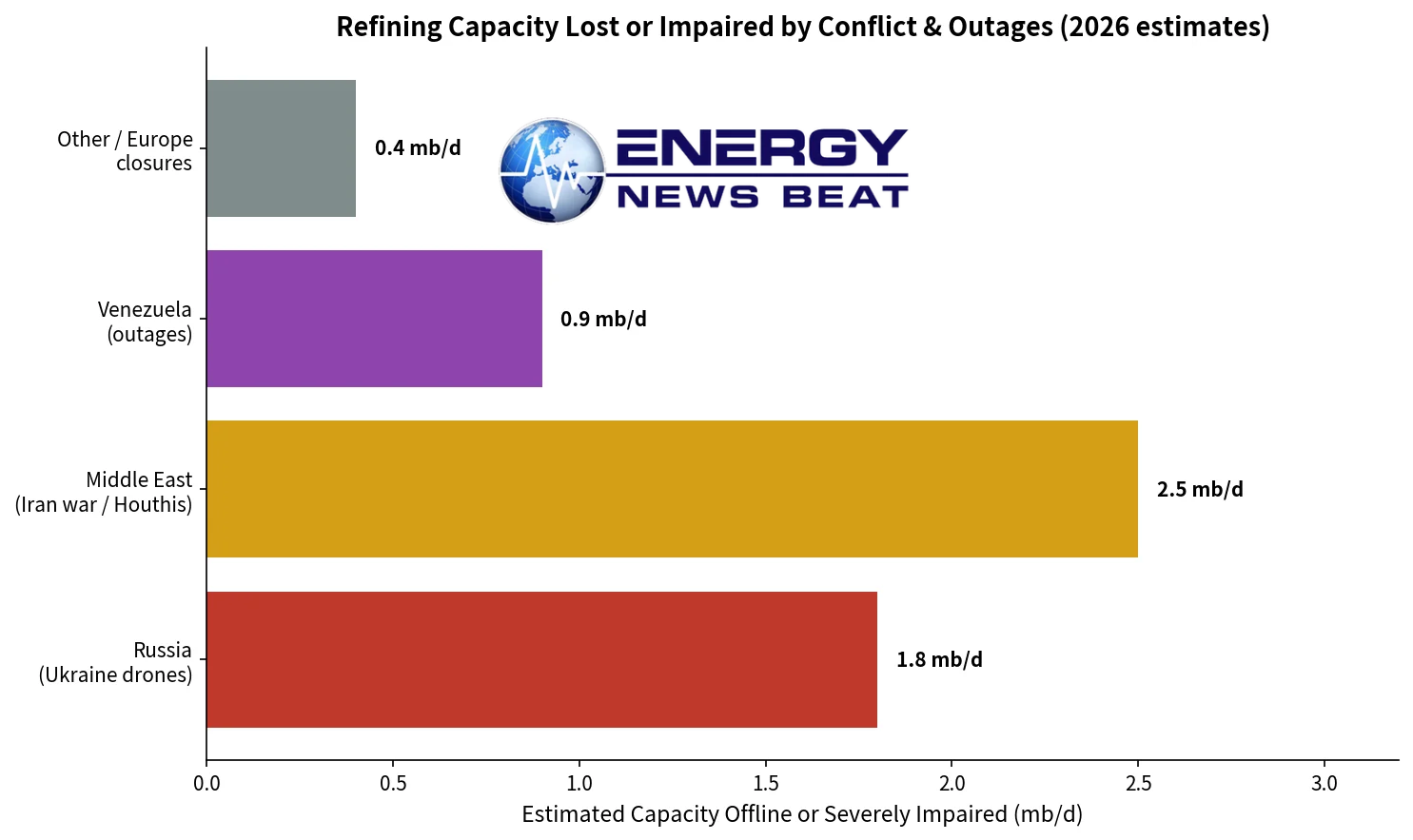
Venezuela: Installed capacity 1.29 mb/d, processing only ~399,000 b/d (31%) as of this week — power outages and failed FCC restarts, not drones, but the barrels are equally missing from the Atlantic Basin product pool.
OECD closures: Announced shutdowns of ~1.6 mb/d for 2025–30, concentrated in the U.S. and Europe — policy and economics, not missiles, with the same result at the rack.
Put the wartime pieces together, and you get the bar chart below: Russia and the Gulf account for most of the sudden hole in middle-distillate supply.
Industry voices are no longer subtle. At a September event, traders warned the diesel crunch will worsen because “we’re still not running enough refining capacity to prevent those draws.” Kuwait Petroleum’s international marketing chief said sustaining current global processing rates through year-end “is going to be an achievement.”
The United States: 130 plants, almost no spare room
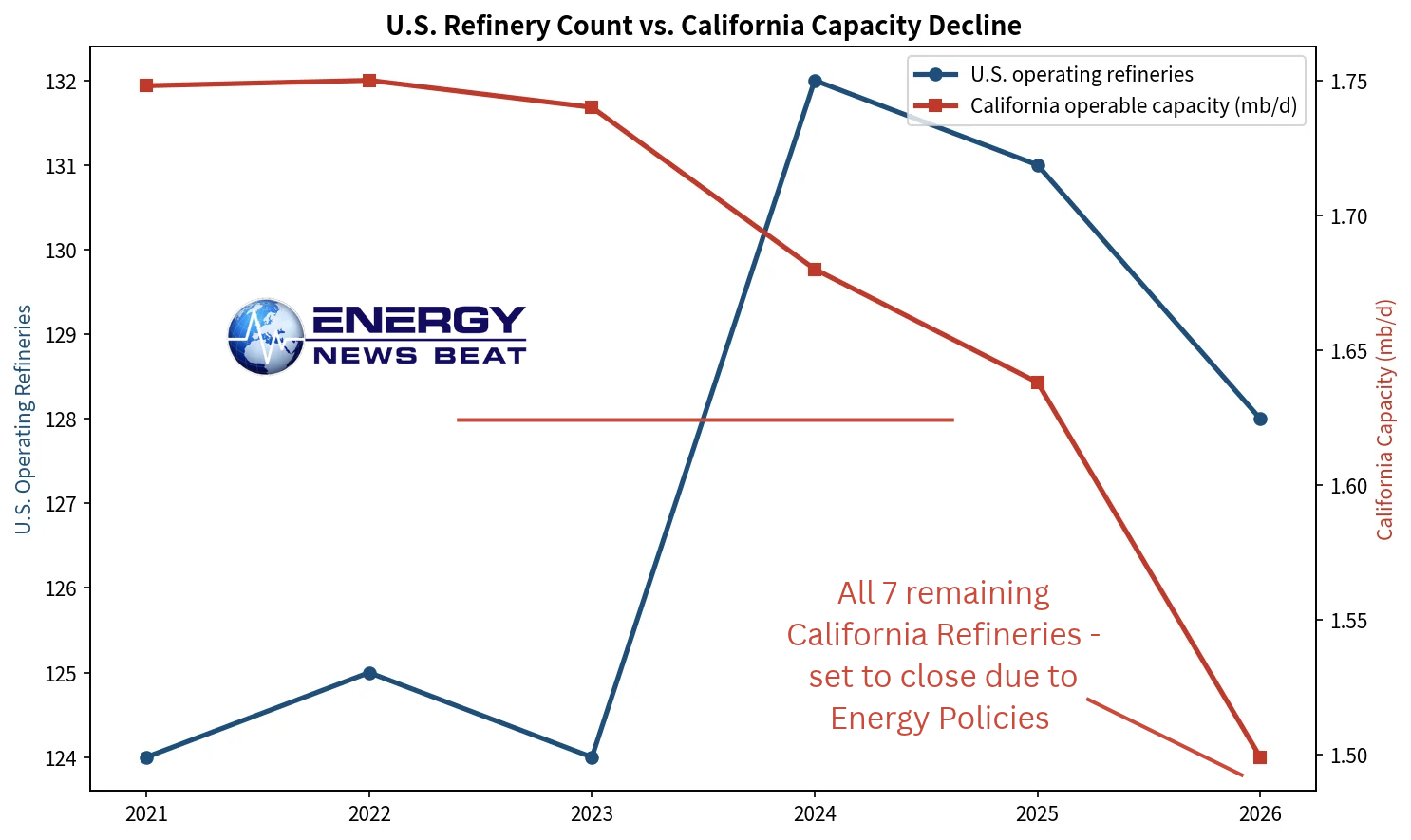
As of January 1, 2026, EIA counted 130 operable U.S. petroleum refineries and 128 operating, with operable atmospheric capacity of 18.16 million b/cd. That is down from 18.42 million a year earlier. The country lost LyondellBasell Houston (~264,000 b/d, March 2025) and Phillips 66 Los Angeles (~139,000 b/d, October 2025), only partly offset by expansions at existing Gulf Coast plants.
Utilization has been the tell. U.S. refiners have been running near 95–98% for months — the longest such stretch since 2000 — delaying maintenance to capture record distillate margins. There is no surge fleet sitting idle. When something trips, the product comes out of inventory. EIA now projects U.S. diesel stocks dipping below 100 million barrels this month, the lowest since 2003. Distillates sit about 14% below the five-year seasonal average.
California: an energy island losing its stills
California is the stress test for the entire thesis.
The state has already lost roughly 30% of refining capacity in five years. Phillips 66 ceased crude processing at Wilmington/Carson in late 2025. Valero idled Benicia by April 2026. Those two sites were on the order of 17–20% of remaining in-state capacity. CEC tables as of mid-2026 still list a handful of operating plants; CARB’s May update counted eight transportation-fuel refineries. The large CARB-gasoline/diesel slate is effectively seven names:
|
Refinery
|
Capacity (b/d)
|
Region
|
|---|---|---|
|
Marathon Los Angeles
|
365,000
|
South
|
|
Chevron El Segundo
|
269,000
|
South
|
|
Chevron Richmond
|
245,271
|
North
|
|
PBF Torrance
|
160,000
|
South
|
|
PBF Martinez
|
156,400
|
North
|
|
Valero Wilmington
|
85,000
|
South
|
|
Kern Energy, Bakersfield
|
26,000
|
Central
|
Plus smaller asphalt and specialty units that do not backstop the gasoline/diesel pool.
Why imports cannot simply replace those barrels
- Pipes and tanks on the coast are the bottleneck. Historic Bay Area plus Los Angeles bulk liquid movements have run around 225,000 b/d; even optimistic “theoretical maximum” clean-product import studies top out near ~394,000 b/d. That is a ceiling, not a spare warehouse. Storage and berth slots are already absorbing record import volumes after the 2025–26 closures.
- CARB gasoline and CARB diesel are not fungible with Gulf Coast barrels. You cannot drop a Houston cargo into a Los Angeles rack without blending, waivers, or a different molecule.
- Proposed pipelines (Western Gateway / Kinder Morgan–Phillips 66, HF Sinclair Rockies options, Magellan Sun Belt) are late-decade projects, not this winter’s solution.
The Panama Canal is now a second chokepoint for Gulf barrels
Even if Jones Act waivers let more Gulf product move to the West Coast, the waterway that also feeds Asia is tightening again. Watershed rainfall May–August ran about 34% below normal. Daily transits have been cut from the unrestricted ~40 toward 34, then 32 from September 15, with a modeled worst case near 27. Auction premiums have printed records — $5.3 million for a single guaranteed slot. MR product tankers are already waiting days on both sides. El Niño is strengthening into the December–April dry season.
Yesterday in California, by GasBuddy
- As of September 11:Statewide regular: about $5.93/gal (AAA/Gasolytics).
- Statewide diesel: about $7.98/gal.
- Multiple Bay Area stations — San Jose and Santa Clara — maxed diesel pumps at $9.999.
- National diesel: first print above $6.
- GasBuddy’s Patrick De Haan: record diesel “will impact every cargo, shipment, every delivery Americans are taking, and [is] likely to reignite inflation up and down the supply chain.”
The user’s “over $8” threshold is not a stretch. Diesel is already there across much of the state; some boards cannot physically show the real price.
Second-order inflation: diesel is a tax on everything that moves
Households see gasoline. The CPI sees diesel later, and in more places.
Diesel powers the tractor, the combine, the reefer truck, the container dray, the excavator, and the locomotive. U.S. commercial transport burns on the order of 120 million gallons a day. A $1/gallon move is roughly $120 million per day in direct surcharge. From late February through August, the war-era pump increase of about $1.61/gallon already implied something like $35 billion in extra commercial diesel cost — before Friday’s new highs.
americanactionforum.org
That cost does not stay at the truck stop:
- UPS and FedEx fuel surcharges have been reported as high as ~24%; some container fuel surcharges far higher.
- Kroger’s CEO said the pressure on food retail “is actually going to mount.” Smithfield’s CFO said the impact is “beginning to flow through in the second half.”
- PPI for Gulf Coast diesel was up ~44% year-over-year in mid-summer data; truck transportation PPI was already up ~8%. Core CPI has lagged because pass-through takes one or two inventory turns. That lag is closing.
- August CPI held at 3.4%, with gasoline a visible contributor. Producer prices accelerated. Markets have repriced the odds of a Fed hike. None of that adds a hydrocracker in Richmond or a berth in Long Beach.
How large an “uncontrollable” hit?
This is a supply shock in a specific molecule, not an overheating labor market.
Direct energy in CPI is only one slice. The dangerous piece is core goods and food-at-home once freight and farm diesel are embedded.
Oxford Economics and others still describe the core pass-through as “small but growing.” RSM has sketched a path toward ~4.5% headline if the energy shock persists, with the tail determined by Hormuz and how fast damaged stills return.
A useful bound: if national diesel stays $1.50–$2.00 above the pre-war baseline through winter, the freight-only surcharge is $180–$240 million per day. Annualized, that is $65–$90 billion before retail markup, agricultural yield effects, and jet-fuel bleed into ticket prices.
Rate hikes can crush demand for discretionary gasoline trips. They cannot make a Russian AVT unit restart, open Hormuz, or widen the All-American Pipeline. Treasury liquidity operations cannot dock an extra MR in San Pedro if the tank farm is full of the wrong spec. That is the definition of an inflation impulse outside the policy instruments.
What Washington can still do: the Defense Production Act
The Trump administration has already put refining inside the DPA perimeter.
April 20, 2026: Presidential determination under DPA Section 303 — domestic petroleum production, refining, and logistics (pipelines, storage, marine terminals) are “essential to the national defense.” DOE was authorized to make purchases, commitments, and financial instruments.
September 8: An order adjusting DPA delegations so Interior and Energy can act independently on energy authorities.
This week: Reuters, citing sources after a White House meeting with nearly a dozen refiners, reported the administration is weighing how to use the DPA to expand refining capacity. Executives’ message was blunt: federal dollars move more barrels, faster, if they go to efficiency, turnarounds, and expansions at existing plants — maintenance dollars — rather than a greenfield that takes years. Utilization is already ~98%.
That is the right sequencing. The constraint this winter is not a missing 200,000-barrel nameplate in 2029. It is deferred maintenance colliding with maxed units and a world short on diesel.
Brownsville helps Texas. It does not rescue California this year.
America First Refining’s Port of Brownsville project — about 168,000 b/d of Permian light crude into gasoline, diesel, and jet — has been billed as the first new U.S. Gulf Coast refinery in nearly 50 years. Fluor has the FEED. The political announcement was in March. The engineering reality is slower: construction start is targeted around late 2027 (the TCEQ permit dies if dirt is not turned by October 19, 2027), mechanical completion late 2028, first full year often described as 2029. Reliance is in talks on offtake — which means a slice of those barrels can leave the country.
Even on the optimistic path, Brownsville is a Texas and export-dock story unless those products move west by water or a pipeline that does not yet exist. It will not refill a Bakersfield rack in Q4 2026.
Crack spreads, empty tanks, and how long “zero-margin storage” lasts
This is the analyst consensus, stripped of adjectives:
The diesel crack has detached from crude. NY Harbor ULSD versus WTI printed about $107/bbl on September 1. Gulf Coast assessments were not far behind. Pre-war cracks were ~$15–$25. The 3-2-1 basket is elevated because one leg — distillate — is in a different market.
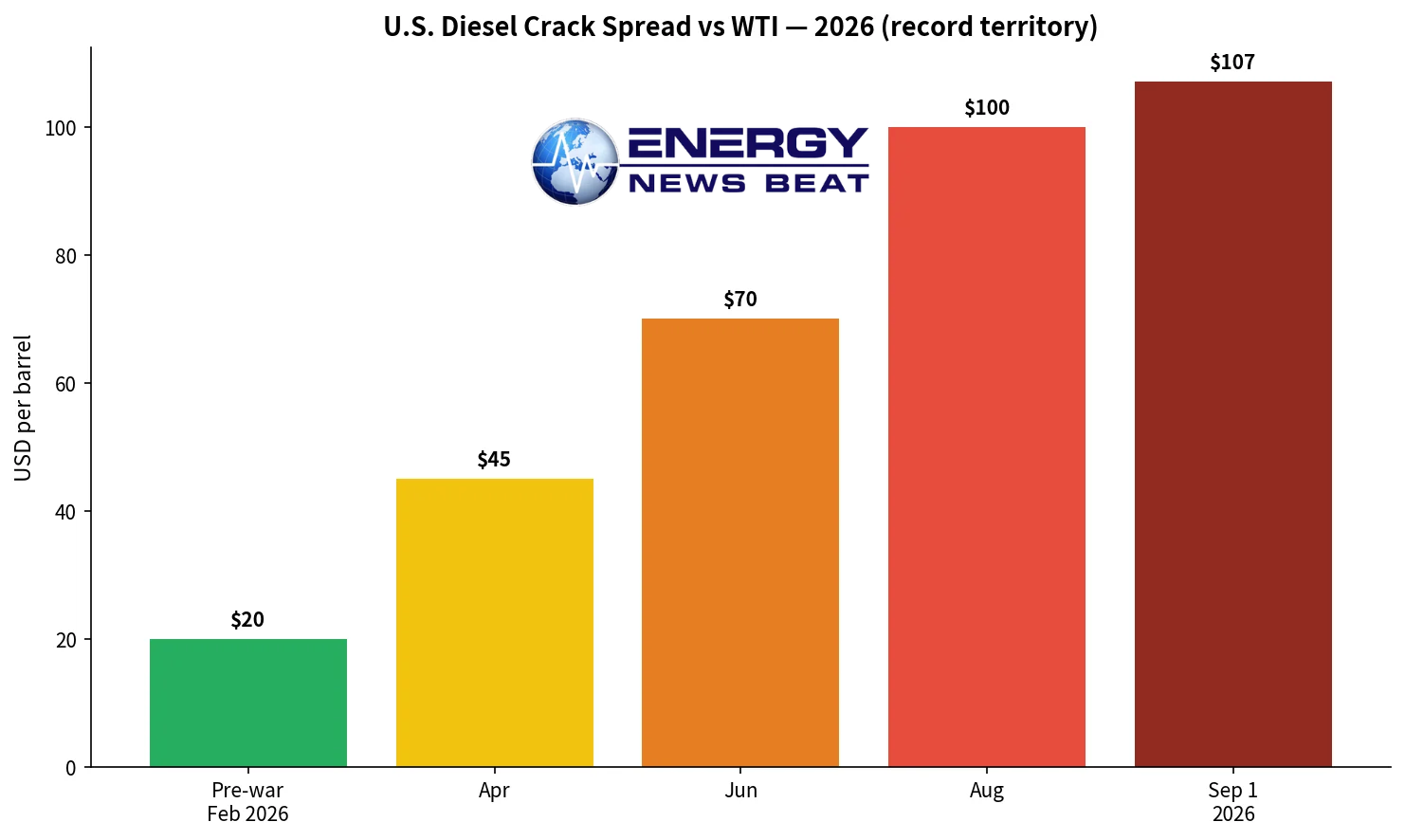
What they are saying about duration:Goldman Sachs more than doubled its 2027 diesel-margin forecasts, to about $63/bbl in the U.S. and $49 in Europe, citing outages 60% above seasonal norms and Russian export bans.
- EIA STEO (this week): diesel cracks stay above $2/gallon (~$84/bbl) through November, then ease through mid-2027. Retail diesel for Q4 was marked up 14% from the prior outlook. Inventories are the binding constraint, not crude.
- Jeff Currie and others: the crisis is in products, not the crude tape. High prices are already the cure — but diesel demand is inelastic in the short run. Trucks and combines do not switch fuels because Powell speaks.
RBN / trade desks: 2026 is the year the diesel crack cleared $100 and exposed how brittle the global refining system had become after a decade of closures and underinvestment.
When do “zero-margin storage supplies” get solved?
Not this heating season. Distillate stocks are already at 20-year seasonal lows before winter demand. Russian secondary units need half a year or more. Gulf plants damaged in the Iran war are on a Q4 2026–Q1 2027 restart glide path in the optimistic Kpler case, with full pre-war utilization later. New U.S. steel is 2028–29. The inventory rebuild that would crush cracks back to $20 requires either peace and parts or a demand crash. Rate hikes can contribute to the second. They cannot deliver the first.
Until stocks rebuild, every barrel of diesel in tank is priced as if it were the last one. That is what a zero-cushion market looks like.
Bottom line
The inflation the Fed can control comes from too much money chasing too many goods. The inflation arriving now is too few working refineries chasing a diesel system that still has to feed a continent.
Wars and drones took Russian and Gulf stills offline. California is retiring its own while Gavin Newsom brags about the war on oil and gas companies. The Panama Canal is rationing the detour. Pumps in the Bay Area have run out of digits. Crack spreads above $100 are the market’s way of screaming for capacity that policy, permitting, and geopolitics will not produce on a central-bank calendar.
DPA money for turnarounds and incremental barrels is the one tool that can add supply inside a year. Brownsville is welcome and insufficient. Until global runs recover and tanks refill — a 2027 story on the current analyst maps — diesel will keep leaking into freight, food, and core goods. That inflationary impact is beyond the Fed’s control. It can only decide how much of the rest of the economy to cool while the stills are down.
If the Fed raises rates, they will fail and bring the already stressed economy crashing. If the Fed lowers rates, they can help the home market, but the H-1 B visa scandal and the illegal migrant problem have set the stage for areas of a real estate crash that recover faster at a lower rate.
The bottom line. President Trump has assembled the greatest administration in U.S. History, and they are running out of runway, levers, and tricks to solve problems. The Fed is now in a no-win scenario, and it begs the question of why it is even in existence, as it is a drain on the US, and not a solution.
Appendix: Making Appendices Great Again
Global capacity and outlook
- OPEC World Oil Outlook — global base refining capacity, January 2026: https://publications.opec.org/woo/chapter/157/2945
- IEA / regulatory compilation on 2024–2030 net refining additions (~2.5 mb/d): https://downloads.regulations.gov/NHTSA-2025-0491-6064/attachment_134.pdf
- EIA Outlook on Global Refining to 2028: https://www.eia.gov/analysis/pdfpages/globalrefiningoutlook.php
- OilPrice — “Diesel Crunch Set to Worsen as Refining Capacity Falls Short,” Sept. 9, 2026: https://oilprice.com/Latest-Energy-News/World-News/Diesel-Crunch-Set-to-Worsen-as-Refining-Capacity-Falls-Short-Industry-Warns.html
- Thunder Said Energy — refining self-sufficiency by country: https://thundersaidenergy.com/downloads/refining-self-sufficiency-by-country/
- Wikipedia list of oil refineries (capacity rankings): https://en.wikipedia.org/wiki/List_of_oil_refineries
Russia / Ukraine drone campaign
- RBC-Ukraine / Bloomberg via IEA — Russian refining 30% below pre-war for 18 months, Sept. 11, 2026: https://newsukraine.rbc.ua/news/russia-s-oil-refining-could-fall-30-below-1789139720.html
- Rigzone — IEA on degradation of Russian refining, Sept. 11, 2026: https://www.rigzone.com/news/wire/iea_says_ukraine_strikes_degrade_russian_oil_refining_sector-11-sep-2026-184597-article/
- Oxford Institute for Energy Studies — impact of Ukraine attacks on Russian energy infrastructure: https://www.oxfordenergy.org/wpcms/wp-content/uploads/2026/07/Comment-The-Impact-of-Ukraine-attacks-on-Russian-energy-infrastructure.pdf
- UNITED24 — strikes on Russia’s 11 largest refineries: https://united24media.com/war-in-ukraine/ukraine-hits-all-11-of-russias-largest-oil-refineries-in-long-range-drone-campaign-20523
- Wikipedia — Deep strike campaign: https://en.wikipedia.org/wiki/Deep_strike_campaign
- Reuters — Iran and Ukraine wars, worst refining-output hit in years (~9% global), May 2026: https://www.reuters.com/business/energy/iran-ukraine-wars-deliver-worst-hit-years-oil-refining-output-2026-05-13/
Saudi Arabia / Middle East strikes
- Al Jazeera — East-West pipeline shutdown after Iraq-origin drones, Sept. 12, 2026: https://www.aljazeera.com/news/2026/9/12/saudi-arabia-shuts-critical-oil-pipeline-after-drone-attack-what-happened
- New York Times — Saudis shut crucial pipeline; oil to $110: https://www.nytimes.com/2026/09/11/business/diesel-fuel-prices-oil-iran-war.html
- OilPrice — Aramco shuts 400,000-bpd Jazan after Houthi strike: https://oilprice.com/Latest-Energy-News/World-News/Saudi-Aramco-Shuts-400000-Bpd-Refinery-After-Houthi-Strike.html
- Maritime Executive — Houthi attacks on Jazan: https://maritime-executive.com/article/houthi-forces-attack-saudi-aramco-s-jazan-refinery
- Kpler — Middle East refining under pressure (Saudi runs ~2.2 mbd August): https://www.kpler.com/blog/middle-east-refining-under-pressure-damage-export-disruption-and-a-two-speed-recovery
- Bloomberg — energy infrastructure damaged in Iran war (Ras Tanura, Samref, Bapco, Kuwait): https://www.bloomberg.com/news/articles/2026-03-19/here-s-a-list-of-energy-infrastructure-damaged-in-iran-war
- Al-Monitor — Houthi attacks disrupt Saudi energy facilities: https://www.al-monitor.com/originals/2026/09/houthi-attacks-disrupt-saudi-energy-facilities-wound-73-authorities-say
Venezuela
- World Energy News — Venezuelan refineries at 31% of 1.29 mb/d: https://www.worldenergynews.com/news/venezuelan-refineries-drop-crude-processing-capacity-773282
United States refining
- EIA Refinery Capacity 2026 (Table 5 / report): https://www.eia.gov/petroleum/refinerycapacity/table5.pdf and https://www.eia.gov/petroleum/refinerycapacity/refcap26.pdf
- EIA number of operating refineries: https://www.eia.gov/dnav/pet/PET_PNP_CAP1_A_(NA)_8OO_COUNT_A.htm
- EIA operable capacity: https://www.eia.gov/dnav/pet/pet_pnp_cap1_dcu_nus_a.htm
- EIA FAQ — last U.S. refinery built; 130 operable as of Jan. 1, 2026: https://eia.gov/tools/faqs/faq.php?id=29&t=9
- OGJ — U.S. capacity decline 2025 amid closures: https://www.ogj.com/refining-processing/refining/capacities/news/55387379/us-refinery-capacity-declines-in-2025-amid-plant-closures
- IER — U.S. refiners near capacity: https://www.instituteforenergyresearch.org/fossil-fuels/gas-and-oil/strong-demand-keeps-u-s-refiners-operating-at-near-capacity/
California plants, closures, import limits
- CEC — California oil refineries (capacities): https://www.energy.ca.gov/data-reports/energy-almanac/californias-petroleum-market/californias-oil-refineries
- CEC — refinery history / Benicia and Wilmington notes: https://www.energy.ca.gov/data-reports/energy-almanac/californias-petroleum-market/californias-oil-refineries/california-oil
- CARB — currently operating transportation-fuel refineries: https://ww2.arb.ca.gov/resources/documents/california-refineries
- S&P Global — California closures, 30% capacity loss, volatile prices: https://www.spglobal.com/energy/en/news-research/latest-news/crude-oil/052026-californias-refinery-closures-create-volatile-fuel-prices-supply-gaps
- Governor Newsom statement on Valero Benicia: https://www.gov.ca.gov/2026/01/06/governor-newsoms-statement-on-valeros-benicia-refinery-update/
- Bloomberg — Valero Benicia job cuts: https://www.bloomberg.com/news/articles/2026-01-15/valero-to-cut-more-than-200-jobs-as-california-refinery-closes
- Energy News Beat — California playbook and remaining plants: https://energynewsbeat.co/carbon-credit/uk-refineries-are-being-killed-off-by-high-carbon-costs-how-u-s-blue-states-are-following-the-same-playbook/
- CEC filings on import/port constraints: https://efiling.energy.ca.gov/GetDocument.aspx?tn=269790-1&DocumentContentId=106928
- Giannini Foundation — maritime import capacity bounds (~394 kb/d theoretical): related UC analysis PDF via https://giannini.ucop.edu/
- Forbes / Robert Rapier — California as energy island: https://www.forbes.com/sites/rrapier/2026/03/03/the-california-energy-island-why-hormuz-hits-the-west-coast-hardest/
- OPIS — Jones Act waiver and West Coast pipeline proposals: https://www.opis.com/resources/energy-market-news-from-opis/jones-act-waiver-helps-us-west-coast-fuel-supply-as-refiners-mull-product-pipeline-proposals/
- EIA California refinery count/capacity: https://www.eia.gov/dnav/pet/pet_pnp_cap1_dcu_sca_a.htm
Pump prices
- Gasolytics / AAA California averages Sept. 11, 2026: https://www.gasolytics.com/gas-prices/california
- NY Post — California diesel $9.999 at Bay Area stations, GasBuddy: https://nypost.com/2026/09/11/us-news/california-diesel-prices-hit-9-999-a-gallon-at-three-bay-area-stations/
- Benzinga — pumps maxed at $9.999: https://www.benzinga.com/markets/commodities/26/09/61731551/california-diesel-pumps-maxxed-out-at-9-999-as-us-prices-hit-record-high-analyst-says
Panama Canal
- Industrial Info — drought and transit cuts to 32/day: https://www.industrialinfo.com/news/article/panama-canal-faces-growing-drought-and-transit-curtailments–362420
- Wood Mackenzie — droughts and energy shipping: https://www.woodmac.com/press-releases/severe-droughts-affect-critical-shipping-arteries-sending-more-disruption-to-energy-markets/
- Splash247 — water squeeze, MR exposure, $5.3m auction: https://splash247.com/panama-canal-water-squeeze-reshapes-port-flows/
- Financial Times — possible cut toward 27 transits: https://www.ft.com/content/3ff1b017-00b9-47b2-83d1-67a1ef906915
- WSJ — new administrator, drought, slot bidding war: https://www.wsj.com/logistics-report/the-panama-canals-new-boss-inherits-a-drought-and-a-bidding-war-for-transit-slots-dc32dace
Inflation and second-order effects
- BBC — U.S. inflation 3.4%, diesel over $6: https://www.bbc.co.uk/news/articles/cly41rdkrleo
- American Action Forum — record diesel, $34.8B commercial cost estimate: https://www.americanactionforum.org/insight/u-s-diesel-prices-hit-record-high-factors-and-implications/
- Axios — diesel, food, transportation: https://www.axios.com/2026/09/11/diesel-fuel-prices-food-transportation
- Forbes — diesel crosses $6, inflation risk: https://www.forbes.com/sites/siladityaray/2026/09/11/diesel-prices-hit-record-6-per-gallon-it-could-worsen-inflation/
- Charles Schwab — diesel crunch and inflation pass-through: https://www.schwab.com/learn/story/diesel-supply-crunch-adds-to-inflation-pressures
- RSM — diesel, trucking, food prices: https://rsmus.com/insights/economics/diesel-trucking-food-prices-and-inflation.html
- WSJ via TradingView — how energy is (and isn’t) driving inflation: https://www.tradingview.com/news/DJN_DN20260911007733:0/
Defense Production Act and Brownsville
- Reuters exclusive — White House weighs DPA for refining, Sept. 11, 2026: https://www.reuters.com/business/energy/white-house-weighs-how-use-defense-production-act-expand-us-oil-refining-2026-09-11/
- White House — DPA Section 303 determination on petroleum production, refining, logistics, April 20, 2026: https://www.whitehouse.gov/presidential-actions/2026/04/presidential-determination-pursuant-to-section-303-of-the-defense-production-act-of-1950-as-amended-on-domestic-petroleum-production-refining-and-logistics-capacity/
- White House — adjusting DPA delegations, Sept. 8, 2026: https://www.whitehouse.gov/presidential-actions/2026/09/adjusting-certain-delegations-under-the-defense-production-act-e2de/
- OilPrice — DPA as refiners maxed out: https://oilprice.com/Latest-Energy-News/World-News/White-House-Weighs-Defense-Production-Act-as-US-Refineries-Maxed-Out.html
- Baker Institute — DPA’s expanding role in energy: https://www.bakerinstitute.org/research/defense-production-acts-expanding-role-energy
- Industrial Sage — Fluor FEED, Brownsville ~168 kb/d: https://www.industrialsage.com/brownsville-texas-refinery-fluor-feed-contract/
- MyRGV / Brownsville Herald — timeline, 2028–29 operations: https://myrgv.com/publications/the-brownsville-herald/2026/05/07/is-brownsville-getting-a-refinery-america-first-ceo-is-confident-industry-analyst-skeptical/
- Port of Brownsville announcement: https://texasborderbusiness.com/port-of-brownsville-unveils-first-new-gulf-coast-refinery-in-nearly-50-years/
Crack spreads and inventories
- Farm Progress / Bloomberg — diesel stocks to 2003 low; EIA crack path: https://www.farmprogress.com/farm-policy/u-s-sees-diesel-stocks-falling-to-2003-low-ahead-of-peak-demand
- Transport Topics — diesel crack $106/bbl record: https://www.ttnews.com/articles/diesel-crack-spread-record
- Yahoo / Goldman — 2027 diesel margin forecasts raised: https://finance.yahoo.com/energy/articles/goldman-sachs-sees-major-shift-191600936.html
- Energy News Beat — US diesel crack all-time high, what ends it: https://energynewsbeat.co/diesel/us-diesel-crack-spread-hit-an-all-time-high-whats-next/
- RBN Energy — diesel cracks above $100: https://rbnenergy.com/tags/crack-spread
- TOPONE Markets — crack vs. crude divergence: https://www.top1markets.com/news/diesel-crack-spread-exit-signals-2026
- SONAR — diesel vs. gasoline crack, winter risk: https://gosonar.com/freight-market-blog/why-diesel-is-outpacing-gas-in-2026-and-winter-could-make-it-worse
Charts in this piece were generated from the cited EIA, OPEC, IEA, AAA/GasBuddy, and market-print figures for Energy News Beat. Capacity-offline bars are compiled estimates, not a single official census — because no agency publishes a live global “barrels killed by drones” table, which is part of the problem.