
Data centers are being built where land, fiber and tax breaks are, not where the power plants are. Moving that power takes new capacity, new high-voltage lines and new substations. This report follows the money from the PJM capacity auction to the Dominion transmission rider, the MISO, SPP and ERCOT long-range plans, the FERC rules that decide who pays, and the state tariff fights that are trying to keep the bill off the family kitchen table.
This is another sample of requested information from the Energy News Beat Research Desk. For our paid subscribers we will be tracking state and federal energy policies, political leaders and their votes to make sure they can make informed voting decisions, and also follow up with their elected officials.
| Report field | Detail |
| Prepared by | Energy News Beat Research Desk, for Stu Turley |
| Data as of | Oct. 25, 2026 (CT). All web sources accessed Oct. 25, 2026 unless noted. Some figures were first gathered Oct. 20 to 25, 2026. |
| Claim tags | [THE RECORD SAYS] = what a regulator, grid operator, utility or company document says. [ENB ANALYSIS] = ENB calculation or comparison. [ENB OPINION] = ENB opinion (Stu’s Take and the verdict). |
| Related ENB work | Six Holes in Virginia’s Energy Plan, Starting With Your Power Bill (Oct. 23, 2026; also on Substack). The full ENB Virginia Energy Plan deep dive (“Inside the 2026 Virginia Energy Plan”) could not be found published on Substack Research as of Oct. 25, 2026; the teaser says it is coming. |
1. Bottom line up front
| The short version
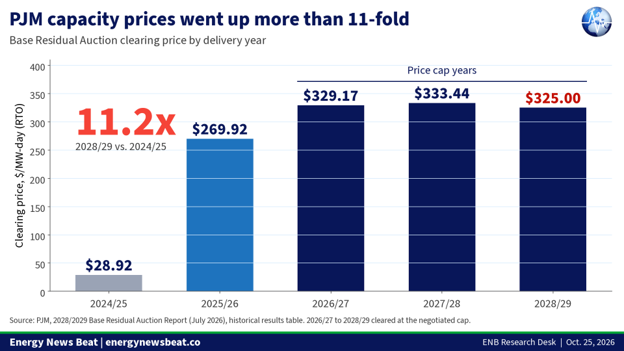
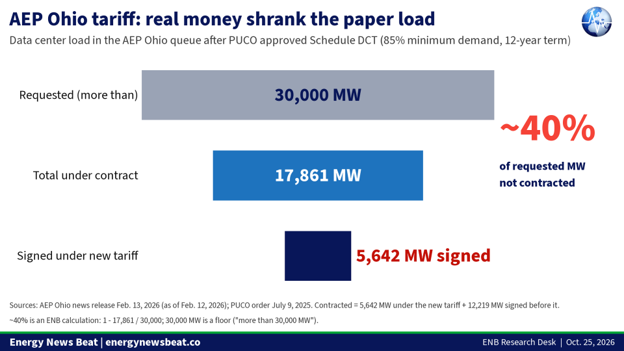
Verdict (ENB opinion). [ENB OPINION] Data centers are a real, large load, and most of the new grid is needed. But the bill is landing first on households, through capacity prices and transmission riders that were designed for a world of slow, shared growth. The fixes that work put the cost on the customer who causes it, up front, with money at risk: minimum-demand tariffs, collateral and direct assignment. The fixes that don’t work are promises of future savings that nobody is on the hook for. • [THE RECORD SAYS] PJM capacity prices rose from $28.92/MW-day (2024/25) to $325.00 (2028/29), and four auctions cost $63.6 billion (PJM BRA report). That is PJM’s cleared-MW × price total; PJM notes it is not the total cost to customers. • [THE RECORD SAYS] PJM’s Independent Market Monitor says data center load caused an “irreversible total increase in costs of $29.4 billion” (Monitoring Analytics). That is 46% of the $63.6 billion, Bowring told Utility Dive. • [THE RECORD SAYS] Virginia’s SCC cut the 2026 Rider T1 transmission increase for a 1,000-kWh household from $2.90 to $0.94 a month by reallocating cost toward large loads (SCC fact sheet). • [THE RECORD SAYS] AEP Ohio says more than 30,000 MW of data center requests shrank to 17,861 MW under contract: 5,642 MW signed under the new tariff plus 12,219 MW signed before it (AEP Ohio, as of Feb. 12, 2026). [ENB ANALYSIS] Roughly 40% of requested load has not contracted. • [THE RECORD SAYS] FERC Order 1920 makes each region file a default (“ex ante”) cost-allocation method that is “roughly commensurate” with benefits (FERC explainer). In PJM, the parties sought a fifth extension on Sept. 8, 2026, citing “significant progress toward a settlement in principle” (PARSEC motion). [ENB ANALYSIS] As of Oct. 25, 2026, ENB found no public settlement or cost-allocation filing. |
Stu’s Take
| Stu’s Take (ENB opinion)
[ENB OPINION] I’m not against data centers. I’m for whoever pays the bill. And right now, the family in Richmond or Columbus is paying for a race they didn’t enter. Look at the capacity market. PJM went from $28.92 a megawatt-day to $325 in four years, and the Market Monitor pins $29.4 billion of that on data center load. That isn’t my number. That’s the referee’s number. Households in Virginia (+11.2%), Maryland (+13.7%), Ohio (+11.9%) and Pennsylvania (+11.3%) saw residential prices jump year over year (July 2026 vs July 2025, cents/kWh), against 4.9% for the U.S. Now the good news. Regulators who make the big customer put money on the table get results. Ohio’s tariff shrank more than 30,000 MW of “maybe” to 17,861 MW under contract, 5,642 MW of it signed under the new rules. Virginia’s SCC moved the transmission rider so the typical home pays $0.94 a month instead of $2.90. Georgia got its utility to promise at least $15 a month of downward pressure for 2029 through 2031, if enough contracts are approved. Here’s where I get nervous. The long-range plans promise big savings: MISO says about $5 of cost for $10 to $18 of value a month, and SPP says $10.55 to $11.47 a month of net savings. Those are planners grading their own homework. And in Texas, the PUC picked 765 kV import paths at $10.1 billion versus $8.3 billion for 345 kV. That may be the right call, but nobody has published what it costs per Texas household. My bottom line: build the wires, but make the hyperscalers sign the check first. Bring-your-own-generation and a load queue, the Market Monitor’s own ideas, beat hoping the forecast is right. Build the Data Centers next to the power sources in modular formats as we have talked about on the podcast. The large Texas path does not math up, and we will be continuing to dig into the physics, and fiscal responsibility on that one. |
2. How it works
Three different bills get mixed up in this debate. Keeping them apart is the key to knowing who pays.
| Bill | What it pays for | Who sets it | How data centers raise it |
| Capacity | Power plants promising to be available at peak | PJM auction under FERC rules | More forecast load raises demand in the auction; prices rise for every customer |
| Regional transmission | High-voltage lines planned by the grid operator | RTO plan; FERC-approved cost allocation | Big new loads trigger new lines; costs spread by formula across zones |
| Local transmission and interconnection | Substations and lines that hook up a specific site | State commission (retail) and FERC (wholesale) | Can be charged directly to the customer, or rolled into rates for everyone |
[THE RECORD SAYS] Capacity. PJM’s 2028/29 auction cleared at the $325.00/MW-day cap and came in 6,831 MW short of the reliability requirement (PJM BRA report). The Market Monitor says that “but for data center growth” PJM “would not have seen the same tight supply demand conditions” (Monitoring Analytics).
[THE RECORD SAYS] Regional transmission in PJM. In February 2025 the PJM Board approved about $6 billion of new projects, including 765 kV lines from the AEP system east toward Virginia. PJM said demand growth is “driven in part by data center load additions,” and that reliability project costs are allocated by “a distribution factor methodology that allocates cost to the load zones most served by the new facility” (PJM Inside Lines). [ENB ANALYSIS] That means a household in a load zone gets a share of a line built for a data center campus in the same zone, unless the state moves the cost inside its retail rates.
[THE RECORD SAYS] FERC Order 1920. The rule requires long-term plans with at least three scenarios over a 20-year horizon, measures seven named benefits, and makes each region file one or more default cost-allocation methods “at least roughly commensurate with estimated benefits.” States get a six-month Engagement Period (extendable by up to six months under Order 1920-A) and an optional State Agreement Process that must finish within six months after a project is selected; otherwise the default applies. Costs may not be allocated by project type, such as reliability or public policy (FERC explainer).
[THE RECORD SAYS] PJM filed its planning compliance on Dec. 12, 2025, and its cost-allocation filing was due later (FERC schedule). On Sept. 8, 2026, PJM states (PARSEC), PJM and the transmission owners asked for a fifth extension, to Sept. 25, saying they had made “significant progress toward a settlement in principle” (PARSEC motion). PJM told FERC on Sept. 10 that it could not meet that day’s deadline (notice in Docket ER26-751). [ENB ANALYSIS] As of Oct. 25, 2026, ENB found no public settlement or cost-allocation filing.
[THE RECORD SAYS] Retail. Each state decides how its utility’s share is split among homes, businesses and data centers. That is where the Virginia, Ohio and Georgia fights below happen.
3. Who’s behind it
- Hyperscalers and developers (Amazon, Microsoft, Google, Meta and others) want speed to power. Utility Dive reports that hyperscalers made a pledge at the White House on March 4, 2026; ENB did not review the pledge text.
- Transmission owners (Dominion, AEP, FirstEnergy, Exelon, PPL and others) build the lines and earn a regulated return on them.
- Grid operators: PJM, MISO, SPP and ERCOT plan the system; FERC approves the wholesale rules for all but ERCOT, which is regulated by the Texas PUC.
- The referee: Monitoring Analytics, PJM’s Independent Market Monitor, led by Joe Bowring, has been the loudest voice on data center cost shifts.
- State regulators: the Virginia SCC, PUCO, Georgia PSC and PUCT decide the retail split.
- Independent generators such as Talen gain from high capacity prices and from selling power directly to data centers.
4. Costs vs alternatives
4.1 PJM capacity: the biggest number
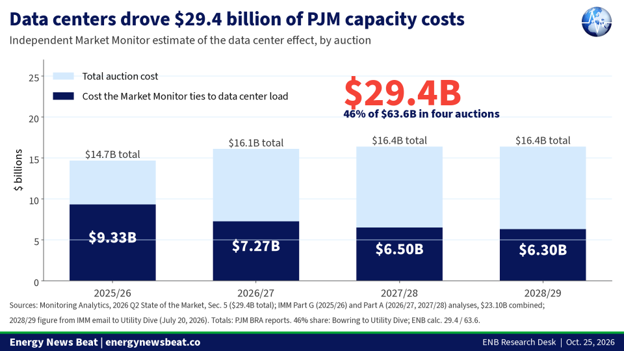
[THE RECORD SAYS] The Market Monitor’s analyses (Part G for 2025/26; Part A for 2026/27 and 2027/28) put the data center effect at $9.33 billion (2025/26), $7.27 billion (2026/27) and $6.50 billion (2027/28), a combined $23.10 billion (IMM 2027/28 Part A; SOM Sec. 5). Bowring told Utility Dive the 2028/29 effect was about $6.3 billion, 38% of that auction. The total is $29.4 billion (SOM Sec. 5). That is 46% of the $63.6 billion, Bowring told Utility Dive.
4.2 Dominion and Virginia transmission riders
[THE RECORD SAYS] Dominion’s typical 1,000-kWh residential bill was $180.79 on July 1, 2026, and about $40.6 billion of its $54.8 billion 2026–2030 capital plan is recovered through riders rather than base rates, as ENB reported in its Virginia Energy Plan review.
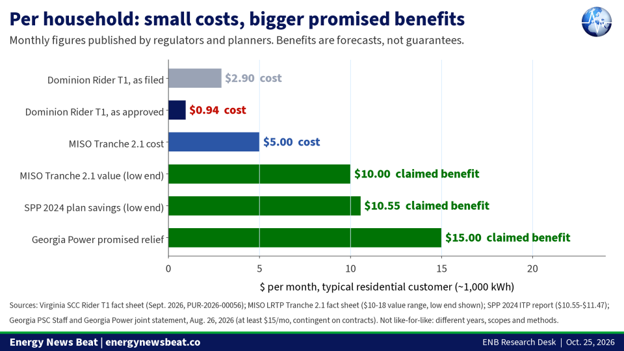
[THE RECORD SAYS] In the 2026 Rider T1 (transmission) case, PUR-2026-00056, the SCC changed the allocation so the residential increase fell from $2.90 to $0.94 a month at 1,000 kWh. It also noted an 85% transmission minimum demand charge for large loads that starts Jan. 1, 2027, and opened a new docket, PUR-2026-00131, on directly assigning the cost of facilities that serve a single large customer (SCC fact sheet). The cut is about 67.5% (SCC).
4.3 MISO, SPP and ERCOT long-range plans
| Plan | Cost | Scope | $ per customer (as published) |
| MISO LRTP Tranche 2.1 (approved Dec. 12, 2024) | $21.8B | 24 projects, 3,631 miles of 765/345 kV; in service 2032–34 | About $5 of cost per 1,000 kWh a month vs. $10–18 of value; benefit-cost 1.8–3.5 |
| SPP 2024 ITP | $7.68B | About 2,333 miles of new lines (plus 495 miles rebuilt); first 765 kV line (Phantom–Crossroads–Potter, $1.69B, 293 mi) | Net savings of $10.55–$11.47 on the average residential monthly bill; benefit-cost 8.23–8.88 |
| SPP 2025 ITP (approved Nov. 2025) | $8.6B approved | 765 kV backbone | Rate impacts published by zone and state in the 2025 ITP report |
| ERCOT Permian 765 kV (PUCT) | $10.114B import paths (765 kV) vs. $8.277B (345 kV) | Statewide STEP plan $32.99B (765 kV) vs. $30.75B (345 kV) | No sourced $ per customer figure found |
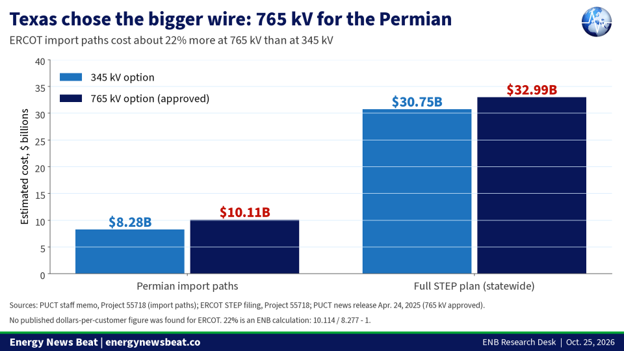
[ENB ANALYSIS] The 765 kV choice in Texas carries a 22% premium on the import paths and about 7% on the full plan. Texas also passed SB 6 in 2025; the PUCT’s large-load rule, 16 TAC §25.194, took effect Oct. 8, 2026. [THE RECORD SAYS] The rule requires a $100,000 study fee and financial security of $50,000 per MW before ERCOT studies a large load (16 TAC §25.194; SB 6). ERCOT says the full-plan gap narrows to about $1.35 billion once hot-line work is counted (ERCOT STEP filing). Stu is having an issue with the justification for the extra lines, and as he says the Math Ain’t Mathing.
4.4 The alternatives: make the big customer pay
[THE RECORD SAYS] AEP Ohio, Schedule DCT. PUCO adopted the tariff on July 9, 2025 (effective July 23). New data centers pay at least 85% of contracted demand for up to 12 years (a ramp plus eight years), post collateral of 50% of minimum charges, and owe an exit fee (AEP Ohio tariff page; release). Of 30,000 MW requested, 13,022.7 MW paid for load studies and 5,642 MW signed; another 12,219 MW had signed before the tariff, for 17,861 MW contracted. Tranche 2 studies start Oct. 1, 2026.
[THE RECORD SAYS] Georgia Power. The Georgia PSC approved rules in January 2025 for customers over 100 MW: contracts of up to 15 years, minimum bills and PSC review of each contract (PSC news release). In an Aug. 26, 2026 joint statement, PSC Staff and Georgia Power agreed that if a data center ends its contract early, the company “shall not seek to recover from Non-Large Load customers” the resulting revenue shortfall. The company will raise its promised “downward pressure on rates” from $8.50 to at least $15.00 a month for a 1,000-kWh home in 2029–2031, if enough contracts are approved. The no-recovery promise covers a net shortfall that the Commission may assign to other large-load customers. Base rates are frozen through Dec. 31, 2028 (joint statement).
[THE RECORD SAYS] Co-location: Talen and Amazon at Susquehanna. In November 2024 FERC rejected, 2–1 (two commissioners did not participate), an amended interconnection agreement that would have raised the co-located load at the Susquehanna nuclear plant from 300 MW to 480 MW (FERC order, ER24-2172). AEP and Exelon argued the deal could shift up to $140 million a year in transmission costs to other customers (Utility Dive). In June 2025 Talen and Amazon moved to a 1,920 MW power purchase agreement through 2042, switching to front-of-the-meter service with PPL handling transmission (Talen release). The reconfiguration was “expected in the Spring of 2026”; ENB could not confirm it has happened. Talen’s appeal of the 2024 order was moved from the Fifth Circuit to the Third Circuit on Nov. 3, 2025, and ENB found no ruling. On Dec. 18, 2025, FERC ordered PJM to create co-location rules with four transmission service options: network service, interim non-firm, firm contract demand and non-firm contract demand (FERC fact sheet; June 2026 follow-up). [ENB ANALYSIS] Front-of-the-meter means the load pays grid charges like other customers. That answers the cost-shift complaint, at the price of more grid use.
[THE RECORD SAYS] Large-load rules at FERC. On Oct. 9, 2026, in ER26-3515, FERC accepted PJM’s Large Load definition and Large Load Registry, effective Oct. 12, and rejected the rest of the proposal: the Interim Resource Adequacy Service (IRAS), a requirement that suppliers line up new capacity for new large loads, Bring Your Own New Capacity (BYONC) rules, and removing new large load from the capacity demand curve (FERC order). A compliance filing is due in 30 days.
[THE RECORD SAYS] Bring your own generation. The Market Monitor recommends a load queue so large data centers “are not added until there is adequate generation capacity to serve them,” with an expedited path for those that “bring their own new generation” (SOM Sec. 5).
5. Land and resource needs
[THE RECORD SAYS] MISO’s Tranche 2.1 alone is 3,631 miles of new 765 kV and 345 kV lines (MISO); SPP’s 2024 plan is about 2,333 miles of new lines, plus 495 miles rebuilt (SPP). [ENB ANALYSIS] That works out to about $6.0 million a mile for MISO’s portfolio and $5.8 million a mile for SPP’s first 765 kV line. These are portfolio averages that include substations, not per-mile construction bids.
[ENB ANALYSIS] Every one of those miles needs a right-of-way through farms, forests and neighborhoods. PJM notes it does not choose routes; developers seek siting approval from the states (PJM). ENB did not find a sourced acreage figure for these portfolios, so this report does not estimate one.
6. Limitations and risks
- [ENB ANALYSIS] Forecast risk. If forecast data center load does not show up, new lines and capacity costs stay in rates. The Ohio queue shows how much requested load is speculative.
- [ENB ANALYSIS] Benefit claims are forecasts. MISO and SPP’s per-customer savings are planner estimates over decades, not guaranteed refunds.
- [THE RECORD SAYS] Rules are unsettled. PJM’s Order 1920 cost allocation is still pending (PARSEC), and FERC’s co-location framework was still being refined in June 2026 (FERC).
- [ENB ANALYSIS] Stranded cost. Minimum bills last 12 to 15 years; transmission lines are depreciated over much longer periods. Who pays in year 20 is not settled by any tariff ENB reviewed.
- [ENB ANALYSIS] The Market Monitor’s $29.4 billion is one estimate built on counterfactual auction reruns. PJM and others dispute parts of the framing (see Section 8).
7. Track record
- [THE RECORD SAYS] PJM’s last three auctions cleared at a negotiated cap and the 2028/29 auction still fell 6,831 MW short (PJM).
- [THE RECORD SAYS] FERC blocked the first big behind-the-meter co-location expansion in 2024 (FERC), then wrote rules for it in 2025 (FERC).
- [THE RECORD SAYS] AEP Ohio says more than 30,000 MW of requests shrank to 17,861 MW under contract (AEP Ohio). Georgia Staff says it has reviewed six earlier large-load contracts and found that each protects smaller customers (joint statement).
- [THE RECORD SAYS] The SCC cut the residential Rider T1 increase by about two-thirds (SCC).
- [ENB ANALYSIS] No long-range plan here has been in service long enough to check its promised savings.
8. Criticism and counterpoints
- “Transmission benefits everyone.” [THE RECORD SAYS] FERC’s rule lists reliability, lower production costs and extreme-weather resilience as benefits (FERC). MISO and SPP publish benefit-cost ratios above 1 (MISO; SPP). [ENB ANALYSIS] That is fair: lines built partly for data centers also serve homes during a winter storm.
- “It’s just supply and demand.” [THE RECORD SAYS] The Market Monitor calls that claim “misleading” and says current conditions “are almost entirely the result of large load additions from data centers” (SOM Sec. 5). [ENB ANALYSIS] Critics of the Monitor, including generators, say high prices are the signal that builds new plants. Both points can be true.
- “Data centers pay their way.” [THE RECORD SAYS] Georgia Power and PSC Staff say the contract portfolio means smaller customers bear none of the cost (joint statement). [ENB ANALYSIS] That holds only if the forecasts and the contracts hold; it is a promise backed by later rate cases.
- “Tariffs will chase data centers away.” [ENB ANALYSIS] Ohio’s queue fell sharply, but 5,642 MW still signed, more than many utilities’ entire new load. Some of the drop is speculative projects leaving, which is the point of the tariff.
- “765 kV is gold-plating.” [THE RECORD SAYS] The PUCT picked 765 kV at a 22% premium on the import paths (PUCT memo). [ENB ANALYSIS] Supporters argue fewer, bigger lines need less land per megawatt moved; ENB did not find a sourced Texas analysis of household cost either way. Stu has said the Math Ain’t Mathing, and we can’t confirm that it is a good investment for the consumers.
9. For consumers: what this means for your bill
| Consumer checklist
• Check your bill for riders. In Virginia, transmission (Rider T1) is separate from base rates, and a base-rate freeze does not stop it (ENB Virginia review). • Capacity costs show up in supply charges. In shopping states (Ohio, Pennsylvania, Maryland), look at your price to compare. • Comment in your state’s docket. Virginia’s PUR-2026-00131 on direct assignment (SCC) and AEP Ohio’s Tranche 2 studies (AEP Ohio) are open. • Ask your utility one question: if a data center leaves early, who pays? Georgia got a written answer (joint statement). Ask for the same. |
10. For investors
| Investor lens
[ENB ANALYSIS] Regulated transmission owners earn a return on rate base, so long-range plans grow earnings. The risk is political: commissions are moving costs to large loads and freezing base rates (Georgia through 2028). [ENB ANALYSIS] Independent generators benefit from capped-but-high PJM prices and direct deals like Talen–Amazon. The risk is a separate data center auction or a load queue, as the Market Monitor proposes, which could change who captures the premium. [ENB ANALYSIS] Data center developers face higher fixed costs: 85% minimum demand, collateral and exit fees. Sites with their own generation may get faster service. This is not investment advice. ENB did not review company earnings or stock prices for this report. |
11. What readers should ask or watch
- PJM’s Order 1920 cost-allocation filing and schedule (PARSEC motion; FERC schedule).
- The FERC ER26-3515 large-load order, PJM’s 30-day compliance filing and any rehearing requests (FERC order).
- FERC suspended PJM’s Reliability Backstop Procurement on Sept. 29, 2026 (Docket ER26-3380, effective date Feb. 28, 2027).
- The 2029/30 capacity auction, scheduled for December 2026 according to ESAI’s auction calendar; check PJM’s official schedule.
- Virginia SCC docket PUR-2026-00131 on direct assignment; the 85% large-load transmission minimum starting Jan. 1, 2027 (SCC).
- AEP Ohio Tranche 2 studies, which started Oct. 1, 2026 (AEP Ohio).
- Georgia Power’s semi-annual large-load report and its 2028 rate case (joint statement).
- Whether the PUCT publishes household cost estimates for the 765 kV build (PUCT).
- The next PJM auction and whether the price cap is extended (PJM).
12. Open questions
- What is ERCOT’s transmission cost per residential customer for the Permian 765 kV plan? ENB found no published figure.
- How much of PJM’s 2025 765 kV backbone will the Virginia SCC assign to data center classes vs. homes?
- Will FERC accept a PJM cost-allocation method that treats data center-driven lines differently? Order 1920 bars allocation by project type (FERC).
- What does the March 4, 2026 hyperscaler pledge commit the companies to? ENB did not review its text.
- Who pays for lines after 12- to 15-year minimum-bill contracts end?
Appendix A. Sources
All accessed Oct. 25, 2026 (CT) unless noted. Some pages were first read Oct. 20 to 24, 2026 and rechecked for this report where possible.
- PJM, 2028/2029 Base Residual Auction Report (July 2026). https://www.pjm.com/-/media/DotCom/markets-ops/rpm/rpm-auction-info/2028-2029/2028-2029-bra-results-report.pdf
- Monitoring Analytics, 2026 Q2 State of the Market Report for PJM, Section 5: Capacity. https://www.monitoringanalytics.com/reports/PJM_State_of_the_Market/2026/2026q2-som-pjm-sec5.pdf
- Monitoring Analytics, Analysis of the 2027/2028 RPM Base Residual Auction, Part A (Jan. 5, 2026). https://www.monitoringanalytics.com/reports/Reports/2026/IMM_Analysis_of_the_20272028_RPM_Base_Residual_Auction_Part_A_20260105.pdf
- Utility Dive, PJM data centers / capacity auction, IMM Bowring (July 2026). https://www.utilitydive.com/news/pjm-data-centers-capacity-auction-imm-bowring/825626/
- U.S. EIA, Electric Power Monthly, Table 5.6.A, July 2026 vs July 2025, cents/kWh (September 2026 issue archive). https://www.eia.gov/electricity/monthly/archive/september2026.zip
- FERC order, ER26-3515-000, 197 FERC ¶ 61,019 (Oct. 9, 2026; PJM copy). https://www.pjm.com/pjmfiles/directory/etariff/FercOrders/9207/20261009-er26-3515-000.pdf
- Virginia SCC, Fact sheet: How the SCC Rider T1 decision protects ratepayers (Sept. 3, 2026). https://www.scc.virginia.gov/media/sccvirginiagov-home/about-the-scc/fact-sheets/fact-sheet-how-the-scc-rider-t1-decision-protects-ratepayers.pdf
- PJM Inside Lines, PJM Board approves new transmission projects (Feb. 26, 2025). https://insidelines.pjm.com/pjm-board-approves-new-transmission-projects-to-support-grid-reliability/
- MISO, LRTP Tranche 2.1 fact sheet. https://cdn.misoenergy.org/LRTP%20Tranche%202.1%20Fact%20Sheet%20Website666573.pdf
- SPP, 2024 ITP Assessment Report v1.0. https://www.spp.org/media/2229/2024-itp-assessment-report-v10.pdf
- SPP news, Board advances regional transmission plan (Nov. 2025). https://spp.org/news-list/spp-board-advances-regional-transmission-plan-to-keep-pace-with-accelerating-growth-and-ensure-grid-reliability/
- SPP, 2025 ITP Report v1.0 (Nov. 25, 2025). https://www.spp.org/media/2429/2025-itp-report-v10.pdf
- PUCT news release, first extra-high-voltage lines in ERCOT (Apr. 24, 2025). https://ftp.puc.texas.gov/public/puct-info/agency/resources/pubs/news/2025/PUCT_Approves_Plan_for_the_First_Extra_High_Voltage_Transmission_Lines_in_ERCOT_Region.pdf
- PUCT staff memo, Project 55718. https://interchange.puc.texas.gov/Documents/55718_106_1490800.PDF
- ERCOT STEP filing, Project 55718. https://interchange.puc.texas.gov/Documents/55718_54_1462478.PDF
- PUCT, 16 TAC §25.194 (effective Oct. 8, 2026). https://ftp.puc.texas.gov/public/puct-info/agency/rulesnlaws/subrules/electric/25.194/25.194.pdf
- Texas Legislature, SB 6 (89R) enrolled. https://capitol.texas.gov/tlodocs/89R/billtext/html/SB00006F.htm
- FERC, Explainer on the Transmission Planning and Cost Allocation Final Rule (Order 1920, 1920-A, 1920-B). https://www.ferc.gov/explainer-transmission-planning-and-cost-allocation-final-rule
- FERC, Order No. 1920 compliance filings schedule. https://www.ferc.gov/news-events/news/order-no-1920-compliance-filings-schedule
- PARSEC, PJM TOs and PJM, Joint motion for extension, RM21-17 (Sept. 8, 2026). https://opsi.us/wp-content/uploads/2026/09/RM21-17-PARSEC-PJM-and-PJM-TOs-Motion-for-Additional-Extension-of-Time.pdf
- AEP Ohio, Data Center Tariff page. https://www.aepohio.com/company/about/rates/data-center-tariff/
- AEP Ohio news release, data center queue update (Feb. 13, 2026). https://www.aepohio.com/company/news/view?releaseID=10753
- Georgia PSC news release, data center rule (Jan. 23, 2025). https://psc.ga.gov/site/assets/files/8617/media_advisory_data_centers_rule_1-23-2025.pdf
- Georgia PSC Staff and Georgia Power, Joint statement, Docket 44280 (Aug. 26, 2026). https://services.psc.ga.gov/api/v1/External/Public/Get/Document/DownloadFile/228126/109297
- FERC order rejecting amended Susquehanna ISA, ER24-2172 (Nov. 1, 2024). https://www.ferc.gov/sites/default/files/2024-11/20241101-3061_ER24-2172-000.pdf
- Utility Dive, FERC rejects Talen–Amazon ISA (Nov. 2024). https://www.utilitydive.com/news/ferc-interconnection-isa-talen-amazon-data-center-susquehanna-exelon/731841/
- Talen Energy, Expands nuclear energy relationship with Amazon (June 11, 2025). https://ir.talenenergy.com/news-releases/news-release-details/talen-energy-expands-nuclear-energy-relationship-amazon/
- FERC fact sheet, co-location order EL25-49 (Dec. 18, 2025). https://www.ferc.gov/news-events/news/fact-sheet-ferc-directs-nations-largest-grid-operator-create-new-rules-embrace
- FERC order, EL25-49-002 (June 2026). https://www.ferc.gov/sites/default/files/2026-06/EL25-49-002_0.pdf
- Energy News Beat, Six Holes in Virginia’s Energy Plan (Oct. 23, 2026). https://energynewsbeat.co/electrical-generation/six-holes-in-virginias-energy-plan-starting-with-your-power-bill/
- Energy News Beat Substack, same article. https://theenergynewsbeat.substack.com/p/six-holes-in-virginias-energy-plan
- Energy News Beat Substack, Who Pays For Data Center Power stand up (Oct. 13, 2026). https://theenergynewsbeat.substack.com/p/who-pays-for-data-center-power-and
Appendix B. Key excerpts
“With the completion of the 2028/2029 BRA, the inclusion of data center load in the capacity market auctions has resulted in an irreversible total increase in costs of $29.4 billion.” (Monitoring Analytics, SOM Q2 2026, Sec. 5)
“The combined total increase in capacity market revenues resulting from data center load, both actual and forecast, for the 2025/2026 BRA, the 2026/2027 BRA and the 2027/2028 BRA was $23,100,955,341.49” (Monitoring Analytics, SOM Q2 2026, Sec. 5)
“Baseline reliability project allocations are calculated using a distribution factor methodology that allocates cost to the load zones most served by the new facility.” (PJM Inside Lines, Feb. 26, 2025)
“Proposed cost allocation methods must distribute costs in a manner that is at least roughly commensurate with estimated benefits.” (FERC Order 1920 explainer)
“…the Company agrees that, in future ratemaking proceedings, it shall not seek to recover from Non-Large Load customers any Incremental Cost Revenue Deficiency associated with serving Large Load Data Center Customers…” (Georgia PSC Staff and Georgia Power, Aug. 26, 2026)
“…the parties have made significant progress toward a settlement in principle.” (PARSEC, PJM TOs and PJM motion, Sept. 8, 2026)
Appendix C. Data tables
C1. PJM capacity auctions (as of July 2026 BRA report; IMM estimates as of July 2026). Auction cost is PJM’s cleared-MW × price total; PJM notes this is not the total cost to customers.
| Delivery year | Clearing price $/MW-day | Auction cost | IMM data center effect |
| 2024/25 | $28.92 | n/a in this report | n/a |
| 2025/26 | $269.92 | $14.7B | $9.33B |
| 2026/27 | $329.17 | $16.1B | $7.27B |
| 2027/28 | $333.44 | $16.4B | $6.50B |
| 2028/29 | $325.00 | $16.4B | $6.3B (email to Utility Dive) |
| Total (4 auctions) | $63.6B | $29.4B (46%, Bowring/ENB calc.) |
C2. Residential price, July 2026 vs July 2025, cents/kWh (EIA Table 5.6.A, September 2026 Electric Power Monthly archive)
| State | July 2026 | July 2025 | Change |
| Virginia | 17.55 | 15.78 | +11.2% |
| Maryland | 21.41 | 18.83 | +13.7% |
| Ohio | 19.45 | 17.38 | +11.9% |
| Pennsylvania | 21.72 | 19.51 | +11.3% |
| U.S. | 18.31 | 17.45 | +4.9% |
C3. AEP Ohio data center queue (as of Feb. 12, 2026 company update)
| Stage | MW |
| Requested (more than) | 30,000 |
| Paid for load studies | 13,022.7 |
| Signed under Schedule DCT | 5,642 |
| Signed before tariff | 12,219 |
| Total contracted | 17,861 |
C4. ERCOT 765 kV vs. 345 kV (PUCT Project 55718; as of April 2025 decision)
| Scope | 345 kV | 765 kV | Premium (ENB calc.) |
| Permian import paths | $8.277B | $10.114B | 22.2% |
| Full STEP plan | $30.75B | $32.99B | 7.3% |
Appendix D. Methodology
- ENB used documents from FERC, PJM, Monitoring Analytics, the Virginia SCC, AEP Ohio (PUCO-approved tariff), the Georgia PSC, MISO, SPP, the PUCT/ERCOT and EIA. Trade press (Utility Dive) is used only where it reports a direct statement not found in a primary document, and is labeled.
- ENB calculations: price multiple 325.00 / 28.92 = 11.24; data center share 29.4 / 63.6 = 46.2%; Rider T1 cut (2.90 − 0.94) / 2.90 = 67.6%, SCC reports 67.5%; AEP not contracted 1 − 17,861 / 30,000 = 40.5% (30,000 MW is a floor); data center share 29.4 / 63.6 = 46.2%, which Bowring gave as 46%; ERCOT premium 10.114 / 8.277 − 1 = 22.2%; MISO $21.8B / 3,631 mi = $6.0M/mi; SPP $1.69B / 293 mi = $5.8M/mi.
- Per-household figures in Chart 3 come from different years, scopes and methods and are shown side by side for scale, not as a single total.
- Not verified: the Talen–Amazon “$18 billion” contract value (press reports only, not used); PJM Order 1920 activity after Sept. 25, 2026 (no filing found; the FERC docket sheet could not be fully checked); the March 4, 2026 hyperscaler pledge text; any ERCOT per-customer cost.
- The full ENB Virginia Energy Plan deep dive could not be found published as of Oct. 25, 2026 as it is still under construction and review; the linked piece is ENB’s Oct. 23 teaser review.