

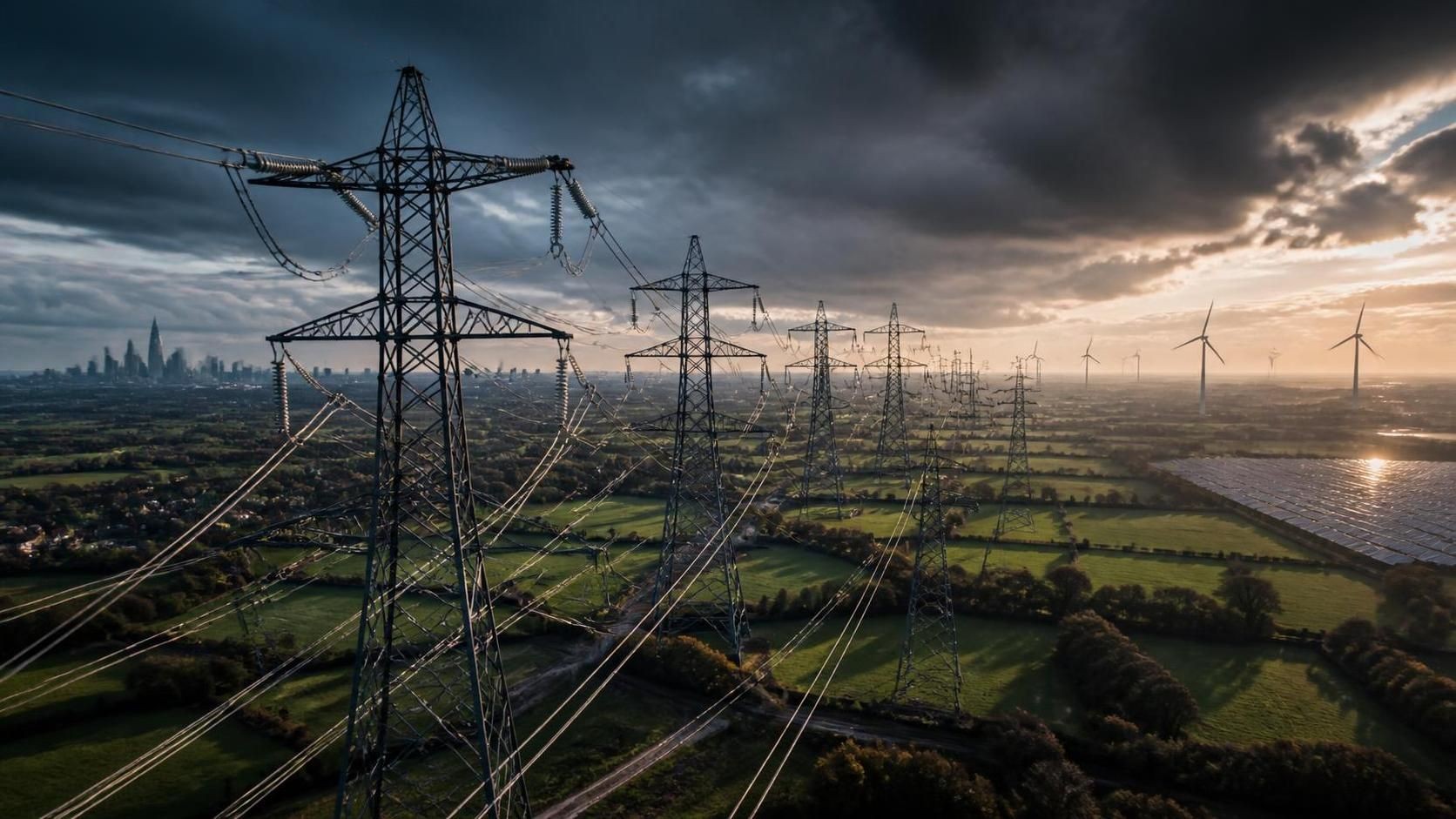
Britain has spent years accelerating wind and solar deployment under Clean Power 2030 and net-zero targets. The generation numbers look impressive on paper. The grid, however, was not built for them, and the mismatch is now producing record costs, regular curtailment of green power, emergency interventions, and growing questions about reliability.
Felicity Bradstock’s October 25, 2026 OilPrice analysis, “Britain’s Renewable Energy Boom Is Hitting a Grid Bottleneck,” lays out the immediate symptoms. On 14 October the system operator spent £47.9 million in a single day switching off wind farms and hydro while turning on gas plants and arranging imports. Nine gigawatts of renewable capacity — enough for roughly eight million households — was paid not to generate. September’s balancing bill reached a record £505 million; full-year costs are projected toward £3.2 billion even as £150 billion in transmission upgrades are planned. Scotland produces about 19 percent of UK generation (and a large share of the wind) but consumes only 8 percent. With only two major high-voltage links south of the border, the “B6 boundary” routinely forces wind farms offline while gas plants farther south are paid to run. Demand for new connections has surged from 41 GW to 125 GW in a matter of months, stranding projects behind the queue.
These are not isolated weather events. They are the predictable result of building intermittent generation faster than the wires, substations, and synchronous plant that keep the system stable.
Independent energy consultant Kathryn Porter has documented the operational consequences in real time on X and in detailed analyses on Watt-Logic. Frequency has repeatedly left the normal 49.8–50.2 Hz band even on days when overall margins looked healthy. On one October day it stayed below the lower limit for nine continuous minutes (reaching 49.75 Hz); other days saw swings above 50.2 Hz within short periods. NESO has requested emergency assistance from French interconnectors, traded against market flows for hours beyond published limits, and issued system warnings for insufficient turn-down capacity in Scotland. Porter’s review of the June 2025 heatwave investigations shows NESO’s own interim report admitting that five transmission constraints were breached with no available pre- or post-fault mitigation options, while frequency remained outside the normal range and forecasting errors on both demand and wind were material. An internal significant-event report stated that “system constraints were breached and system security was compromised.” Record-keeping relied on incomplete logs and spreadsheets; engineers had raised concerns about risk aversion in issuing warnings.
Porter’s broader points are structural. Clean Power 2030 still assumes the existing ~32 GW gas fleet will be available for security of supply (running at low load factors of around 5 percent on low-wind days). Roughly a third of that fleet dates from the 1990s and faces retirement risk within the next 5–7 years; combined-cycle plants are not designed for such infrequent operation. Lead times for life-extension rotors or new turbines run 5–8 years. Synchronous inertia from conventional plant has historically provided the kinetic buffer that resists rapid frequency changes; lowering minimum inertia requirements to advance net-zero targets reduces that buffer. Embedded solar is poorly visible in real time. Legacy 1980s balancing software and communications systems remain in service. Multiple risks — forecast error, constraint breaches, aging assets, reduced inertia, and weather correlation between low wind and high demand — can coincide.
The result is a system held together by increasingly expensive last-minute balancing actions whose costs flow straight into consumer bills. High-wind days in the north produce surplus that cannot reach the south; low-wind winter evenings expose the residual dependence on gas and imports. The lights have stayed on so far under relatively benign conditions, but Porter and others note that the margin for error is shrinking as more weather-dependent capacity is added and conventional plant ages out.
Parallels in U.S. Blue-State Policies
Several U.S. states with aggressive renewable portfolio standards and electrification targets are on a similar trajectory, though market designs and geography differ.
California has the highest solar capacity and has achieved periods of 100 percent renewable supply for hours at a time, aided by rapid battery deployment. It also continues to experience high retail prices and has historically recorded large numbers of outages. Past heat-wave events required emergency measures; the 2020 rolling blackouts remain a reference point. Batteries have improved the situation by shifting midday solar into the evening, yet the state still relies on gas peakers and imports during multi-day low-renewable periods, and interconnection queues and transmission constraints persist.
New York’s Climate Leadership and Community Protection Act sets aggressive targets for renewables and electrification (including heating and transport). Upstate wind and hydro resources are distant from downstate demand centers; transmission upgrades lag, and the state has faced reliability warnings from the New York ISO as thermal plants retire. Similar patterns appear in other northeastern and mid-Atlantic jurisdictions pursuing rapid coal and gas retirement while adding weather-dependent generation.The horrific contract with New York City and Canada for billions of dollars for a power connection to Canadian hydro power has been a flop.
Texas (not a blue-state policy model, but the largest wind market) offers a partial contrast: its competitive market and relatively permissive interconnection rules allowed faster battery and solar scaling after the 2021 freeze, and reliability metrics have improved even as renewable penetration rose. The isolated ERCOT grid still carries weather risks, but the absence of the same regulated-return incentives and slower permitting has produced different outcomes from the UK’s centrally driven approach.
The common thread is not that wind and solar cannot generate electricity. It is that adding them faster than transmission, firm capacity, inertia sources, and operational tools can absorb them raises both costs and operational risk. Consumers pay twice — once in subsidies and capital for the new plant, again in balancing and constraint payments — while residual dependence on gas or imports remains for the periods when the weather does not cooperate. Grid operators in both the UK and high-renewable U.S. states are already using emergency tools more frequently and operating closer to stability limits.
National Grid and NESO have large upgrade programs underway, and batteries will continue to help. The question Porter and the OilPrice reporting raise is whether the pace of renewable additions, the retirement of synchronous plant, and the timelines for transmission can be aligned before the next severe low-wind, high-demand, or heat-driven event tests the system more severely than the near-misses already recorded. For U.S. states following comparable policy paths, the British experience is a live case study in the difference between generation capacity and a secure, affordable electricity system.
Check out the World’s Greatest Podcast Show Notes at EnergyNewsBeat.co or EnergyNewsBeat.com. And subscribe to: The Energy News Beat Substack.
Appendix: Sources and Links
- Felicity Bradstock, “Britain’s Renewable Energy Boom Is Hitting a Grid Bottleneck,” OilPrice.com, 25 October 2026: https://oilprice.com/Energy/Energy-General/Britains-Renewable-Energy-Boom-Is-Hitting-a-Grid-Bottleneck.html
- Kathryn Porter (@KathrynPorter26) posts on X, October 2026 (frequency charts, system warnings, balancing costs, NESO emergency instructions): https://x.com/KathrynPorter26
- Kathryn Porter, “NESO admits constraints breached and large forecast errors in interim grid security report,” Watt-Logic, 20 October 2026: https://watt-logic.com/2026/10/20/neso-admits-errors-in-grid-security-report/
- Kathryn Porter, Telegraph column on grid blackout warnings, 20 October 2026: https://www.telegraph.co.uk/business/2026/10/20/neso-must-stop-dismissing-blackout-fears-as-scaremongering/
- Kathryn Porter report and commentary on electrification and gas-fleet risks (Watt-Logic and related X posts), January 2026 onward.
- Utility Week, Energy Live News, and LCP Delta analyses of September–October 2026 balancing costs (cited via secondary reporting).
- U.S. context: Institute for Energy Research on renewable penetration and outage data; ERCOT, CAISO, and NYISO reliability assessments; California and New York clean-energy statutes and ISO warnings.