


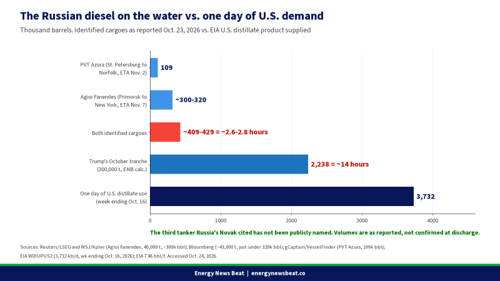
Moscow says three cargoes are on the water under the Trump-Putin diesel deal. Diesel is $6.34 a gallon, up $2.70 in a year, and Russia’s drone-battered refineries are the real bottleneck.
Why Russia has so little to sell
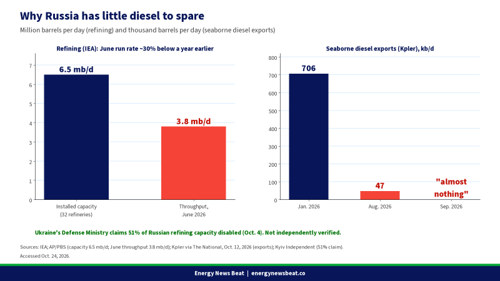
Russia has about 6.5 million barrels a day of installed refining capacity across 32 major refineries, but June throughput was 3.8 million barrels a day, about 30% below a year earlier, the International Energy Agency reported (IEA; AP via PBS). The IEA says diesel output is down about 30% (PBS). Ukraine’s Defense Ministry claimed on Oct. 4 that strikes have disabled 51% of Russian refining capacity, up from the 45% Ukraine’s General Staff cited on Sept. 21 (Kyiv Independent). It has not been independently verified (Kyiv Independent; PBS). Repairs to the most complex units can take months, and a refinery has been hit about every three days (PBS, citing the IEA; Washington Post). Lukoil’s Volgograd refinery halted on Oct. 2 after a strike (Hydrocarbon Processing).
Exports tell the same story. Kpler data show Russian seaborne diesel exports fell from about 706,000 barrels a day in January to 47,000 in August and “almost nothing” in September (Kpler via The National).
Russia’s export bans: what is open, what is not
- Diesel: Russia had barred non-producers from exporting diesel since Jan. 31, 2026, and later restricted producers’ exports too. On Oct. 10, Moscow partially lifted the ban to allow 500,000 tons to world markets “at the current stage,” citing the Putin-Trump agreements (Russian Government; TASS). Novak says full diesel exports could return toward year-end (S&P Global).
- Gasoline: still banned. Novak said in August the ban was extended to the end of January 2027 (Izvestia).
The legal fight
On Oct. 9, Treasury issued General License 135, which authorizes otherwise-sanctioned transactions related to the sale, delivery, offloading and importation of Russian-origin diesel, including into the U.S., through 12:01 a.m. EDT on April 7, 2027 (OFAC). It does not by itself resolve the 2022 statute. A bipartisan group of senators, including Thom Tillis and Jeanne Shaheen, says it violates the 2022 Ending Importation of Russian Oil Act, which can only be lifted after a presidential certification to Congress (Daily Caller). Treasury’s Office of Terrorism and Financial Intelligence said the license “is in compliance with all applicable laws” (Daily Caller). ENB laid out both readings in our Oct. 12 report, which the Daily Caller quoted: the first three tranches, 1.8 million tons, cover about 3.7 days of U.S. diesel use. No court has ruled.
The diesel deal also rides on an “energy ceasefire” that Moscow never confirmed in detail (ENB). If refinery strikes resume, the later tranches may not show up.
What it means for consumers
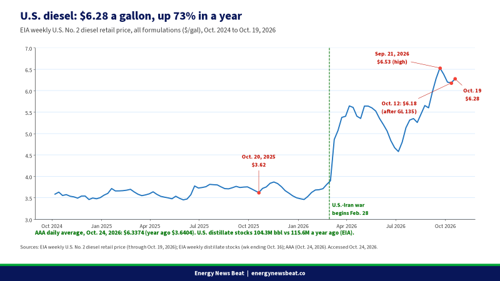
EIA’s weekly diesel price was $6.276 on Oct. 19, up from $3.620 a year earlier, a 73% jump, and below the $6.529 high on Sept. 21. AAA’s daily average rose 2 cents overnight, from $6.3172 on Friday to $6.3374 on Saturday. U.S. distillate stockpiles were 104.3 million barrels in the week ending Oct. 16, about 11.3 million barrels below a year ago. Heating oil is essentially the same fuel as diesel. Analyst Tom Kloza told the Daily Caller that “many people in the industry doubt whether any substantial diesel will make its way from Russia to the U.S.” (Daily Caller).
What it means for investors
Three things to watch: whether CBP clears the first cargo under GL 135 when it lands; whether Russia can actually ship the 500,000 tons promised for November; and how tight U.S. distillate inventories stay into winter, which supports refining margins for U.S. refiners. Lipow Oil Associates’ Andy Lipow said the shipments show “the U.S. is open for business when it comes to buying Russian diesel” (gCaptain).
Caveats and criticism
- Tracking data are signals, not deliveries. Agioi Fanendes already switched to “for orders” (WSJ), and PVT Azura’s barrels are “reportedly” figures (gCaptain).
- The third ship and both buyers are unidentified. Volumes differ by source (40,000 vs. about 43,000 tons).
- The 51% refinery figure is Ukraine’s claim, not an independent measure (PBS; Kyiv Independent).
- Critics say the deal funds Russia’s war. FDD’s Mark Montgomery estimated it would provide “3 or 4 billion dollars to the Russian war machine” (Daily Caller). ENB’s Stu Turley told the Daily Caller it “gets President Putin to the table” (Daily Caller).
- Nothing here is legal advice. The question of whether GL 135 is legal is still open.
| Stu’s Take
Two tankers we can name, maybe 409,000 to 429,000 barrels, against a country that burns 3.7 million barrels a day of distillate. That is under three hours. Diesel is $6.34 this afternoon versus $3.64 a year ago, and it will not come down because of a few ships out of the Baltic. Russia’s refineries are running at about 3.8 million barrels a day against 6.5 million of capacity, and its diesel exports were close to zero in September. As I told the Daily Caller, this is “a help because it gets President Putin to the table,” but it is not a fix. There are only two ways diesel and gasoline prices come down: demand destruction or more refineries. Stockpiles are 11.3 million barrels below last year heading into winter, so watch your heating-oil bill. Use the Defense Production Act to build and restart American refining. Buckle up. |
