In a bold strategic pivot, Baytex Energy Corp. has officially exited the U.S. market by selling its Eagle Ford shale assets for net proceeds of approximately $2.14 billion.
This move, completed on December 19, 2025, marks the end of Baytex’s presence in the prolific South Texas basin and shifts the company’s focus entirely to its Canadian operations. For investors, this divestiture signals a streamlined, debt-free future with enhanced shareholder returns, though it comes with the trade-off of reduced overall production scale. Let’s break down the details, drawing from recent earnings reports and forward guidance, to explore the implications.
Background on the Sale
Rumors of Baytex exploring a sale of its Eagle Ford assets surfaced in early October 2025, with reports indicating a potential valuation of up to $3 billion.
These assets, acquired in 2023 through an all-stock deal for Ranger Oil Corp. valued at about $2.5 billion USD at the time, had become a cornerstone of Baytex’s portfolio, contributing over half of its production—around 84,000 barrels of oil equivalent per day (boe/d) out of a total 147,000 boe/d in recent quarters.
The decision to sell aligned with broader industry trends, where operators are streamlining portfolios amid volatile oil prices (WTI averaged around $64 per barrel in Q2 2025) and prioritizing high-margin core areas.
The sale was formally announced on November 12, 2025, with a gross value of approximately $2.31 billion (C$3.25 billion), though net proceeds after adjustments came in at $2.14 billion.
The buyer remains undisclosed, as confirmed in official statements and analyst reports.
Closing occurred swiftly on December 19, ahead of initial expectations for late 2025 or early 2026, following an early results announcement for a related cash tender offer on December 15.
Proceeds from the sale are earmarked for aggressive debt reduction and shareholder value enhancement. Specifically, Baytex plans to repay outstanding credit facilities, redeem its 8.5% senior notes due 2030, fund a tender offer for its $575 million senior notes due 2032, and resume share buybacks under its normal course issuer bid once debt is cleared.
This leaves the company in a net cash position, a significant turnaround from its $2.2 billion net debt at the end of Q3 2025.
Baytex’s Q3 2025 Performance: A Snapshot Before the Shift
To understand the sale’s context, it’s essential to review Baytex’s third-quarter results, released on October 30, 2025. The company delivered solid performance, with average production of 150,950 boe/d (86% oil and natural gas liquids), up 5% from Q2 2025 on a per-share basis.
Highlights included record output from the Pembina Duvernay shale play at 10,185 boe/d, a 53% increase from the prior quarter, underscoring the strength of its Canadian assets.
The Eagle Ford contributed 82,765 boe/d, or about 55% of total production, but Baytex had already begun reallocating capital toward Canada, with U.S. spending down to $209 million in Q2 from $238 million a year earlier.
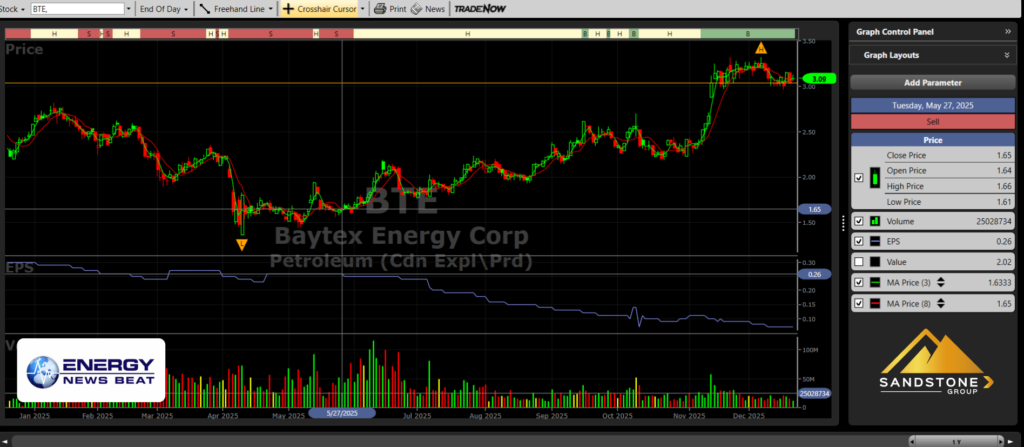
Financially, Q3 revenue from petroleum and natural gas sales reached $927.6 million, with net income of $32 million ($0.04 per basic share) and free cash flow of $142.7 million ($0.19 per basic share).
Year-to-date free cash flow stood at $198.4 million, with full-year 2025 guidance targeting around $300 million—all allocated to debt repayment after dividends.
Baytex beat analyst expectations, delivering earnings and revenue surprises of +200% and +17.88%, respectively.
Net debt was reduced by $50 million in the quarter to $2.2 billion, with a healthy debt-to-EBITDA ratio of 1.1x.
Guidance for 2025 remained on track, with full-year production expected at 148,000 boe/d and exploration and development expenditures of $1.2 billion.
Forward-looking statements emphasized continued focus on the Duvernay and heavy oil plays in Alberta and Saskatchewan, including an asset swap to consolidate Duvernay acreage and the addition of 200 heavy oil drilling locations for sustained development.
Strategic Implications: A Pure-Play Canadian FocusPost-sale, Baytex transforms into a pure-play Canadian producer, centered on the Western Canadian Sedimentary Basin.
The Eagle Ford assets represented not just 55% of Q3 production but also about 68% of proven reserves as of year-end 2024.
Shedding these will halve output in the short term, but Baytex views this as a quality-over-quantity play. The company’s Canadian assets, particularly the Pembina Duvernay and heavy oil operations in Peace River and Lloydminster, have shown stronger economic returns and growth potential.
Recent Duvernay wells have delivered impressive results, and the company plans a one-rig program to ramp production to 20,000-25,000 boe/d by 2029-2030.
Baytex’s 2026 guidance, set for release on December 22, 2025, will provide clarity on post-sale operations.
Earlier 2025 budget announcements (from late 2024) targeted $1.2-$1.3 billion in capex for 2025, but the sale’s proceeds enable flexibility for accelerated development or further returns.
What This Means for Investors
For investors, the Eagle Ford exit is largely positive, reshaping Baytex’s risk-reward profile.
The immediate benefit is a fortified balance sheet: Moving to net cash eliminates interest burdens and enhances financial resilience against oil price swings.
This positions Baytex to boost shareholder returns through dividends (a quarterly payout was maintained for January 2026) and buybacks, potentially driving stock appreciation.
Analysts have responded favorably, with Raymond James upgrading Baytex’s stock rating following the announcement, citing the portfolio shift and debt reduction.
The sale unlocks value at a premium to the 2023 acquisition cost, especially given Baytex’s $2.8 billion market cap pre-sale.
Long-term, the focus on Canadian assets could yield higher returns, as heavy oil and Duvernay plays benefit from lower costs and strong well performance.
However, risks remain. Production cuts could pressure near-term cash flows if oil prices falter, and reliance on Canadian differentials (e.g., Western Canadian Select) introduces exposure to pipeline constraints.
Investors should monitor the 2026 guidance for capex plans and production targets. Overall, this divestiture positions Baytex as a leaner, more agile player—potentially a buy for those betting on Canadian energy resilience.
As the energy sector evolves, Baytex’s move exemplifies the push toward portfolio optimization. Stay tuned for the 2026 outlook, which could further illuminate the path ahead for shareholders.
Sources: nasdaq.com, baytexenergy.com, seekingalpha.com, energynewsbeat.co