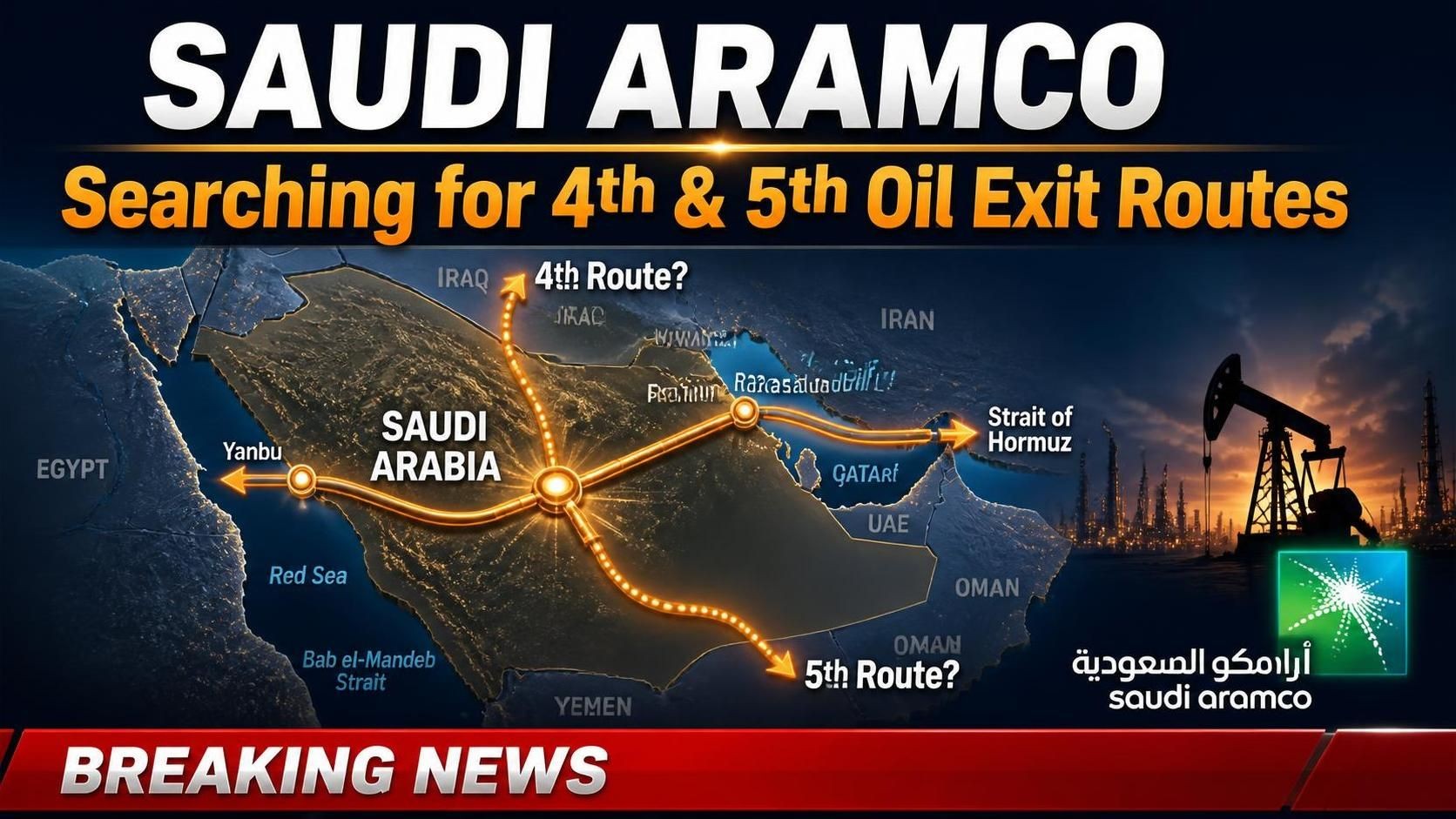
The remark, given to Nikkei Asia in Tokyo on September 24, is the clearest signal yet that Riyadh no longer treats three outlets as enough insurance against a two-front maritime crisis.
Nasser said engineering and feasibility work is already underway. He did not name destinations, capacities, or dates. He did say Aramco can restore interrupted operations “within days,” that the East-West system is “multiple lines,” and that the company never stopped supplying customers even when Hormuz and Bab el-Mandeb were both under pressure. He also confirmed talks on more overseas storage, including in Japan.
That is not a press line. It is a response to a year in which Saudi Arabia has had to invent a logistics system on the fly.
The three routes that exist today
Aramco’s current map is simple on paper and messy at sea.
- Route 1 — Arabian Gulf / Strait of Hormuz.
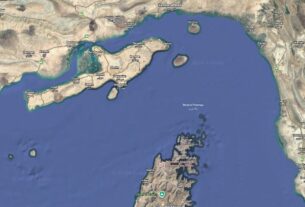
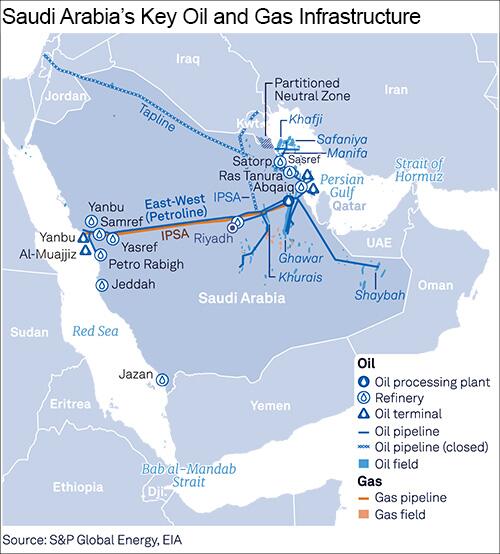
The historic spine. Ras Tanura and Juaymah, on the Eastern Province coast, handled 7–8 million barrels per day before the war. After Iran’s de facto closure of Hormuz from late February, those terminals went quiet, then reopened in stages as escorts, dark sailings, and ship-to-ship transfers returned. In mid-September, they became the relief valve again when the East-West line went down. Combined Ras Tanura–Juaymah loadings have been reported near 4 million bpd in recent weeks. - Route 2 — East-West Pipeline to the Red Sea.
The 1,200-kilometer Petroline from Abqaiq/Ghawar country to Yanbu was built in the early 1980s for exactly this kind of war. Nameplate is 7 million bpd across multiple parallel lines; about 2 million bpd typically feeds west-coast refineries, leaving roughly 5 million bpd for export from Yanbu Crude Terminal and Muajjiz. After Hormuz closed, Yanbu became the main loading port. June west-coast exports ran about 4.14 million bpd. - Route 3 — North through Egypt.
Tankers from Yanbu run up the Red Sea to Ain Sukhna, discharge into the SUMED pipeline, and reload at Sidi Kerir on the Mediterranean. SUMED’s practical ceiling is about 2.5–2.8 million bpd. Kpler data showed more than 1.9 million bpd on that path in August, up from under 650,000 bpd in June, after Houthis squeezed Bab el-Mandeb. The Suez Canal itself cannot take fully laden VLCCs, so SUMED is the real Mediterranean door. The voyage to Asia via the Cape adds 20–25 days and several dollars a barrel.
Nasser has repeatedly listed a fourth commercial layer that is not a pipeline: strategic storage in Japan, South Korea, Egypt, and the Netherlands. That inventory is how Aramco keeps term customers whole when a terminal goes dark.2026 year to date: the numbers behind the speech
The year split into three acts.
- Act I — Shock (March–May).
The US-Israel war with Iran began February 28. Hormuz traffic collapsed. Saudi crude production, above 10 million bpd in February, fell sharply. May crude exports hit 3.434 million bpd, a record low in the JODI series that starts in 2002. Production was 6.560 million bpd that month. - Act II — Workaround (June–July).
East-West ran hard. Gulf ports began to reopen after an interim US-Iran understanding. June exports recovered to 3.993 million bpd; production 7.122 million. July exports rose 3.3 percent to 4.125 million bpd, the highest since March; production 8.135 million. Aramco still posted a 25 percent jump in first-quarter profit and a 42 percent rise in second-quarter profit. The company was selling fewer barrels on some days and still printing cash because prices were high and the West Coast system was doing the work it was built for. - Act III — Second squeeze (August–September).
Houthi blockade language and attacks on Red Sea shipping, then the September 10–11 drone strikes on East-West pumping stations, cut the kingdom’s options again. August production dropped 1.9 million bpd to 6.238 million — the lowest since 1990. August exports were reported as low as 2.4–3.2 million bpd, the weakest in more than a decade. Yanbu loadings stopped after September 12.
September is the rebound month. Bloomberg tanker tracking put September-to-date exports at 5.28 million bpd, the highest since the war began. Kpler and other trackers saw the kingdom back above 4 million bpd after the August trough. The recovery is not a return to the old 7 million bpd export machine. It is a hybrid of Gulf loadings, Sohar ship-to-ship cargoes, leftover west-coast stocks, and a pipeline that is only now coming back online.
East-West: hit, shut, restarted, not yet normal
Drone strikes attributed to Iraq-based militias damaged three of eleven pumping stations on September 10–11. The line was shut as a precaution. Loadings at Yanbu stopped. Saudi officials blamed launches from Maysan province.
Sources told Reuters the system restarted on September 22 at a low rate. Near-term target is about 4 million bpd — enough to feed west-coast refineries and put some cargoes back on the water. Reaching 40 percent of capacity was expected within days. Full 7 million bpd restoration is still quoted at six to eight weeks because the damaged stations have to be rebuilt, not just restarted. As of September 24, volumes were building inside the pipe, but tanker loadings at Yanbu had not clearly resumed; two ships due September 23 did not load, while a cluster of Aframaxes, a Suezmax, and a VLCC were lined up for September 24–27.
Nasser’s “multiple lines” point matters here. Petroline is not a single tube. Parallel crude lines and converted NGL lines give Aramco the option to run one string while another is repaired. That is why a partial restart is possible before the last pump station is whole.
Shuttle tankers and the Sohar relay
When Yanbu went dark, Aramco did not wait for welders. It rebuilt an east-side conveyor.
Trade sources told Reuters Aramco sold about 60 million barrels for September and October loading from Ras Tanura, to be moved on shuttle tankers through Hormuz and transferred ship-to-ship off Sohar, Oman — outside the strait — onto VLCCs bound for China, South Korea, India, and Japan. Gulf loadings averaged about 3.7 million bpd after September 12, up from 2.9 million earlier in the month. JPMorgan’s satellite read had Hormuz-bound Saudi oil at 2.9 million bpd over a six-day stretch, versus 700,000 bpd in August. Seven VLCCs took on about 14 million barrels at Gulf terminals on a single Sunday.
The constraint moved from steel in the desert to water in the Gulf of Oman. Sohar and Fujairah STS slots filled. VLCC freight from the Gulf to Asia spiked. Some shuttle runs have used US Navy escort. Analysts also note “dark” crossings that vessel-tracking misses, so official transit numbers understate the true flow.
This is not a new pipeline. It is a floating pipeline. It works until insurance, escorts, or Iranian interdiction stop it. That is why Nasser is talking about routes four and five.
What a fourth and fifth route could be
Aramco has not published a map. The public record of what the company and the kingdom have already studied is not empty.
Expand Petroline. Reuters reported in July that Saudi Arabia was considering adding up to 2 million bpd of East-West capacity, with preliminary talks that could let neighbors without a Hormuz bypass — Kuwait, Bahrain, Qatar — put barrels on a Saudi westbound line. One source mentioned a smaller products string. Cost would be in the billions, and the work would take years. Port capacity at Yanbu would have to rise with the pipe. Some industry notes have floated a 9 million bpd Petroline target if the Yanbu bottleneck is solved.
A Gulf-to-Arabian Sea line. Concept papers circulating this year describe a coastal or inland pipeline from Kuwait/Saudi fields toward Omani terminals at Sohar, Duqm, or Salalah — 1,800 to 2,400 kilometers, 3–10 million bpd depending on the variant, $15–25 billion. The strategic prize is an Indian Ocean loading port that never enters Hormuz. Terrain and politics have killed versions of this idea before. The war has put them back on the table.
A northern overland exit. Recycled projects include Basra–Aqaba (Iraq–Jordan, about 1 million bpd to the Red Sea), wider Gulf–Mediterranean corridors through Jordan and Syria, and even discussion of a Saudi-to-Israel hookup into the old Eilat–Ashkelon system. Those routes trade Hormuz risk for transit-state risk. They are geopolitics first, engineering second.
More steel plus more tanks. Nasser paired new routes with overseas storage. A fourth “route” could be a new pipe; a fifth could be a new tank farm in Japan or elsewhere that lets Aramco sell from inventory when a chokepoint closes. That is how the company already uses Egypt and Rotterdam.
None of this is funded public FID. All of it is consistent with Nasser’s August comment that engineering teams were looking at “how we can not only expand what we have, but at the same time identify other routes.”
The gas division Energy News Beat already flagged
Two days before the Nikkei interview, Reuters reported Aramco plans to split gas out as a third division alongside upstream and downstream, each with its own president. Listings or lease-and-leasebacks of pieces of that business are on the table. Aramco declined to comment.
Energy News Beat’s September 23 analysis, “What a standalone gas division actually changes,” is the right frame. This is not an org chart. It is a financing and accountability vehicle. Gulf NOCs have spent years monetizing everything except the core oil barrel. Aramco already listed SABIC and raised billions against pipelines. Jafurah’s processing kit went into an $11 billion BlackRock/GIP lease-and-leaseback last year. A gas company with its own P&L can raise project finance and chase LNG without putting Ghawar on the block.
The operating base is already large. Sales-gas production averaged about 11.4 billion standard cubic feet per day in 2025. Raw-gas processing hit 19.6 bscfd. The 2030 target is an 80 percent lift in sales-gas capacity from 2021, taking gas plus associated liquids to roughly 6 million barrels of oil equivalent per day and $12–15 billion of incremental operating cash flow.
Jafurah is the centerpiece: 17,000 square kilometers, 229 tscf raw gas, 75 billion barrels of condensate in place. First shale gas flowed in December 2025. 2030 aims are 2 bscfd sales gas, 420 million scfd ethane, and about 630,000 bpd of high-value liquids. Tanajib is ramping toward 2.6 bscfd of raw-gas processing in 2026 from Marjan and Zuluf. Master Gas System Phase 3 adds about 3.15–3.2 bscfd of transmission by 2028.
The energy-security link is crude displacement. Saudi power still burns oil when gas is short or summer load spikes. Combined crude and fuel-oil burn has run above 1 million bpd at peaks. Vision 2030’s Liquid Fuel Displacement Program wants more than 1 million boe/d out of domestic use by 2030. Aramco has said the unconventional gas program can displace the electricity equivalent of 500,000 bpd of crude.
Every barrel not burned in a Riyadh turbine is a barrel that can leave Ras Tanura or Yanbu.2026 made the point brutally. When export-route chaos forced field shut-ins, associated gas slipped, and fuel-oil imports jumped to about 360,000 bpd in April. A dedicated gas budget is a bet that Jafurah and the Master Gas System make that relapse the exception.LNG is the offshore book, not a second Qatar yet. Domestic demand will swallow most new molecules through 2030. The international portfolio — Rio Grande, Commonwealth LNG, MidOcean Energy, a long-term target near 20 mtpa of capacity — sits naturally inside a gas division that investors can underwrite without touching the oil concession.
What “forward thinking” actually means this year
Saudi energy security in 2026 is not a slogan. It is a stack of options that failed in sequence and were replaced in days.
The kingdom spent forty years and tens of billions building Petroline so it would not live or die by Hormuz. That bet paid when the strait closed. It did not pay enough when drones hit the pumps, and Houthis closed the southern Red Sea door. So Aramco ran SUMED harder, then ran shuttles to Sohar, then restarted a wounded pipeline at half speed, then announced two more routes and more tanks in Japan.
That is the doctrine: never one door. Multiple lines inside one corridor. A Mediterranean pipe when the Bab is closed. A floating STS chain when the desert pipe is closed. Gas at home so oil can leave. A corporate structure that can fund the next pipe without a cabinet crisis.
Nasser told Nikkei the interruption is “significant. It’s not a small interruption.” He also said the company never stopped. Both can be true. Exports fell more than 70 percent from the 7.5 million bpd loadings of January–February to the 2.1 million bpd trough in early September, then climbed back above 5 million on a September average because the logistics bench was deep enough to improvise.
Fourth and fifth routes will take years if they are steel in the ground. Storage in Japan can be contracted faster. An expanded East-West is the most obvious increment. An Omani-sea outlet is the cleanest geographic answer to Hormuz. A gas division is how you free barrels and fund the steel.
The market will price the speech as reassurance until the first new right-of-way is surveyed. The operational record of 2026 says the reassurance is earned, and incomplete. Three routes were not enough. Aramco is now designing five.
Making Appendices Great Again
Check out the World’s Greatest Podcast Show Notes at EnergyNewsBeat.co or EnergyNewsBeat.com.
Appendix: Sources and links
Nasser / fourth and fifth routes
- Nikkei Asia, “Saudi Aramco chief says any interruption can be fixed ‘within days’,” Sept. 24, 2026 — https://asia.nikkei.com/spotlight/iran-tensions/iran-war/saudi-aramco-chief-says-any-interruption-can-be-fixed-within-days
- ZeroHedge recap of the Nikkei interview — https://www.zerohedge.com/geopolitical/aramco-ceo-eyes-fourth-fifth-oil-export-routes-break-hormuz-chokehold
- TokenPost — https://www.tokenpost.com/news/business/23705
- Saudiweek — https://saudiweek.com/aramco-eyes-more-export-routes-overseas-storage-ceo/
- The National, Aug. 4, 2026 (earlier “other routes” comments on Q2 call) — https://www.thenationalnews.com/business/energy/2026/08/04/aramco-posts-42-jump-in-q2-profit-despite-supply-disruptions/
Exit ports, SUMED, and route structure
- Al Jazeera, “From Yanbu to Sohar,” Sept. 17, 2026 — https://www.aljazeera.com/news/2026/9/17/from-yanbu-to-sohar-tracking-saudi-arabias-alternative-oil-routes
- New York Times, Aug. 26, 2026 — https://www.nytimes.com/2026/08/26/business/saudi-oil-houthis-iran.html
- Kpler factbox on Red Sea / Bab el-Mandeb / SUMED — https://www.kpler.com/blog/factbox-red-sea-crude-flows-bab-el-mandeb-and-alternative-routes
- Argaam, April 8, 2026 (Nasser on Yanbu, SUMED, storage) — https://www.argaam.com/en/article/articledetail/id/1925834
2026 production and exports
- Reuters / JODI, July exports 4.125 million bpd — https://www.reuters.com/business/energy/saudi-crude-oil-exports-hit-four-month-high-july-data-shows-2026-09-22/
- JODI June recovery — https://boereport.com/2026/08/20/saudi-june-crude-exports-climb-from-record-may-low-data-shows/
- Al-Monitor / OPEC, August output 6.238 million bpd — https://www.al-monitor.com/originals/2026/09/saudi-arabias-oil-production-slumps-lowest-36-years-war-bites
- Bloomberg, September exports 5.28 million bpd — https://www.bloomberg.com/news/articles/2026-09-24/saudis-gulf-oil-surge-drives-exports-to-highest-since-war-began
- CryptoBriefing / Kpler, September rebound above 4 million bpd — https://cryptobriefing.com/saudi-oil-exports-recover-september/
- Trading Economics production series — https://tradingeconomics.com/saudi-arabia/crude-oil-production
East-West repairs
- Reuters, pipeline building volumes, loadings not resumed, Sept. 24 — https://www.reuters.com/business/energy/saudi-east-west-pipeline-building-up-volumes-loading-yet-resume-sources-say-2026-09-24/
- Reuters, restart Sept. 22 — https://www.reuters.com/business/energy/saudi-arabia-restarts-east-west-oil-pipeline-resume-exports-yanbu-sources-say-2026-09-22/
- Reuters, three pumping stations hit — https://www.reuters.com/business/energy/three-pumping-stations-along-saudi-east-west-pipeline-were-hit-recent-attack-2026-09-17/
- Pipeline Technology Journal — https://www.pipeline-journal.net/news/saudi-arabia-restarts-east-west-pipeline-resume-exports-days-after-drone-attack
Shuttle tankers / Sohar STS
- Reuters, 60 million barrels via Sohar — https://www.reuters.com/business/energy/saudi-arabia-ramps-up-gulf-oil-exports-after-pipeline-attack-shipping-data-shows-2026-09-21/
- Reuters, more Oman STS offers — https://www.reuters.com/business/energy/saudi-offers-more-crude-via-oman-loading-after-pipeline-attacks-sources-say-2026-09-16/
- Ship Universe, Sohar relay explainer — https://www.shipuniverse.com/news/saudi-arabia-rebuilds-oil-exports-with-60-million-barrel-sohar-ship-to-ship-relay/
- AGBI, eastern-port climb and shuttling — https://www.agbi.com/oil-and-gas/2026/09/saudi-oil-exports-through-gulf-climb/
Proposed pipelines and expansions
- Reuters, East-West expansion talks, July 7, 2026 — https://www.reuters.com/business/energy/saudi-arabia-considers-expansion-oil-pipeline-red-sea-sources-say-2026-07-07/
- Financial Times, Gulf pipelines to avoid Hormuz — https://www.ft.com/content/880664d8-e110-4760-8b00-aa3141a770ff
- Gulf Research Center paper on coastal / Super Express concepts — https://www.grc.net/documents/69f058690fe13EvenReopeningHormuzMoreOilExportPipelinesUrgentlyNeededGulfcompressed.pdf
- Reuters factbox, alternative Hormuz routes — https://www.reuters.com/business/energy/alternative-routes-middle-east-oil-gas-due-hormuz-disruption-2026-04-21/
Gas Division and Energy News Beat
- Energy News Beat, “What a standalone gas division actually changes,” Sept. 23, 2026 — https://energynewsbeat.co/big-oil-companies/what-a-standalone-gas-division-actually-changes-saudi-aramco-looking-ahead/
- Energy News Beat, Halliburton–Jafurah contract — https://energynewsbeat.co/big-oil-companies/saudi-aramco-awards-halliburton-a-multi-billion-dollar-multi-year-contract-for-jafurah-unconventional-gas-development/
- Energy News Beat, “Saudi Arabia’s Pipeline Investment Pays Off,” March 12, 2026 — https://energynewsbeat.co/saudi-arabias-pipeline-investment-pays-off/
- Reuters exclusive on the gas division — https://www.reuters.com/business/energy/saudi-aramco-plans-reorganisation-create-gas-division-sources-say-2026-09-22/