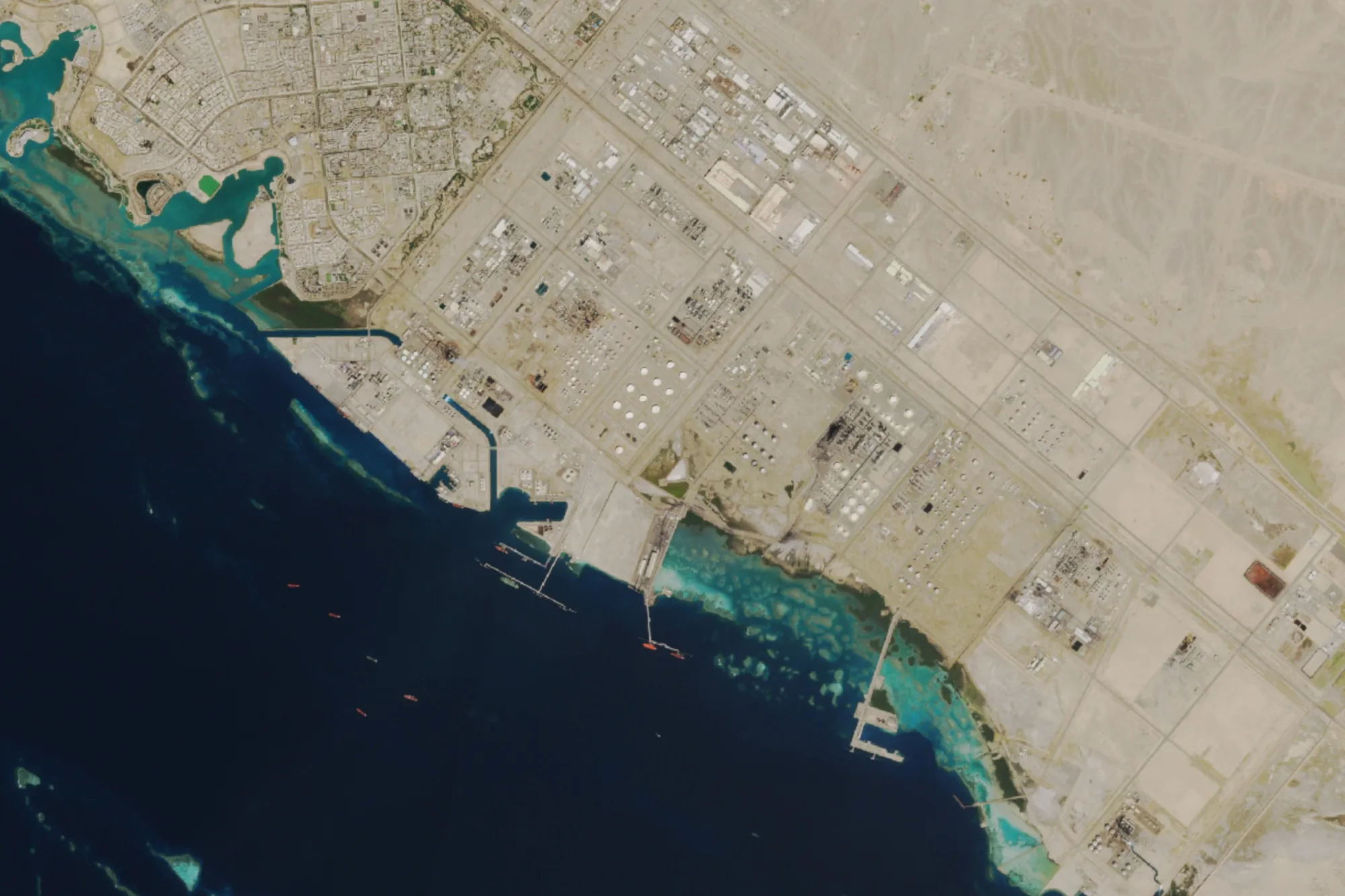
Saudi Arabia is exporting and producing less oil amid ongoing regional conflicts and shipping disruptions, yet its oil revenues have risen sharply thanks to elevated crude prices. This paradox highlights the resilience of the Kingdom’s energy sector even as capacity constraints, security threats, and infrastructure damage create significant hurdles.
In the second quarter of 2026, Saudi oil production fell by as much as 25%, with the oil sector contracting sharply and contributing to an overall GDP decline of around 4.8%. Crude output averaged roughly 6.7 million barrels per day (bpd) in the quarter, well below pre-conflict levels near 9 million bpd or higher. Total exports, which stood at about 7.96 million bpd in January across Gulf and Red Sea terminals, have declined substantially.
Exports via the key Red Sea port of Yanbu illustrate the volatility. After the Strait of Hormuz disruptions early in the conflict, Saudi Arabia ramped up flows through its East-West Pipeline (Petroline) to Yanbu. Yanbu exports surged 330% from pre-war levels to around 2.47 million bpd in early March, peaking above 4 million bpd in April. By June, however, they had fallen to 2.39 million bpd—a 41% drop from the March peak. The East-West Pipeline itself reached its full 7 million bpd capacity, but Yanbu’s loading terminals face practical limits of roughly 3–4.5 million bpd under wartime conditions, creating a bottleneck.
Higher prices more than offset the volume decline. Brent crude rose more than 47% since the start of the year, trading near $90 per barrel in late July before easing somewhat toward the low-to-mid $80s in early August. Saudi oil revenues increased 28% from the first quarter to SR185.1 billion (approximately $49.3–49.4 billion) in Q2 2026. This was also up 22% year-on-year. The stronger revenues helped shrink the quarterly budget deficit by nearly three-quarters, to 34.3 billion riyals ($9.1 billion).
These gains come despite serious operational challenges. The partial closure and security threats in the Red Sea, driven by Houthi actions, have forced major adjustments. Houthis declared a naval blockade targeting Saudi-bound vessels, prompting tankers to reroute. Some vessels now sail north via the Suez Canal and the SUMED pipeline in Egypt (capacity about 2.5 million bpd), while others detour around Africa via the Cape of Good Hope—adding significant time and cost. SUMED and Suez capacity is further constrained because other countries have reserved space, limiting Saudi flows. At least six Saudi tankers recently skipped the Bab el-Mandeb Strait entirely. Drone strikes have also hit related infrastructure, including two LNG tankers in Egypt’s Damietta port.
Drone and missile attacks have directly damaged Saudi facilities. On or around July 25–27, 2026, Houthi forces claimed strikes on Aramco sites in Jazan and Yanbu using ballistic missiles, cruise missiles, and drones—the first direct hits on Saudi oil infrastructure since 2022. Saudi Aramco suspended operations at its 400,000-bpd Jazan refinery after damage to the integrated gasification combined-cycle (IGCC) complex and oil storage area. Satellite imagery indicated at least three oil storage tanks fully destroyed by fire, with others heavily damaged. Repairs are tentatively expected to be completed with operations gradually resuming by around August 15, 2026. Separate reports noted a drone impact at the SAMREF refinery (Aramco-ExxonMobil joint venture) in Yanbu, with damage under assessment, and earlier intercepts of drones targeting facilities in the Eastern Province and Riyadh.
These incidents compound earlier pressures from the broader conflict, including temporary reductions in East-West Pipeline throughput after prior strikes on pumping stations (quickly repaired). While Saudi Arabia has demonstrated strong technical capabilities in restoring production after past attacks (such as the 2019 Abqaiq-Khurais incident), the combination of port capacity limits, Red Sea security risks, and refinery outages continues to restrict export volumes.
Looking ahead, the Kingdom’s ability to sustain higher revenues depends on price levels remaining elevated and on resolving or mitigating the Red Sea and Hormuz-related bottlenecks. Analysts note that Saudi Arabia may need oil prices near $115 per barrel to fully balance spending under current conditions, higher than previous estimates. Pipeline expansion talks and alternative routing options are under consideration, but security remains the overriding constraint. For now, lower shipments paired with stronger prices have provided a temporary buffer, narrowing the deficit while the oil sector and broader economy navigate wartime disruptions.
Appendix: Sources and Links
- https://oilprice.com/Energy/Crude-Oil/Saudi-Oil-Reroutes-Hit-Capacity-and-Security-Limits.html (Irina Slav, Aug 2, 2026) – Primary source on Yanbu exports, reroutes, capacity limits, Red Sea issues, production and revenue figures.
- https://oilprice.com/Latest-Energy-News/World-News/War-Sends-Saudi-Oil-Output-Down-and-Revenue-Up.html (Julianne Geiger, Jul 30, 2026) – Details on Q2 production contraction (~25%), revenues (+28% QoQ), budget deficit, Brent prices, Yanbu redirection.
- https://oilprice.com/Latest-Energy-News/World-News/Saudi-Aramco-Shuts-400000-Bpd-Refinery-After-Houthi-Strike.html – Jazan refinery shutdown, damage, and repair timeline (to ~Aug 15).
- https://saudigazette.com.sa/article/663370 and related Finance Ministry reports – Official Q2 2026 oil revenue of SR185.1 billion (+22% YoY, +28% QoQ).
- https://english.alarabiya.net/business/economy/2026/07/30/saudi-arabia-s-budget-revenues-reach-903-billion-in-q2-2026 – Confirmation of revenue and deficit figures.
- Washington Post, Reuters, and related reports on July 25–27, 2026 Houthi claims and Jazan/Yanbu strikes (e.g., coverage of damage to IGCC, tank farm, and satellite assessments).
- Windward, Kpler, Vortexa, and Argus Media data referenced in OilPrice and secondary reporting on tanker movements, Yanbu loading capacity (3–4.5 million bpd practical), and East-West Pipeline (up to 7 million bpd).
- EIA, IEA, and Trading Economics data on Saudi production levels (~6.7 million bpd Q2 average; June figures around 6.6–7.3 million bpd range).
- Additional context on Red Sea crisis, SUMED (2.5 million bpd), Suez, and historical Abqaiq repairs from EIA, World Bank, and prior analyses.
- East-West Pipeline details from Wikipedia, Reuters (expansion talks), MEES, and Argus Media.