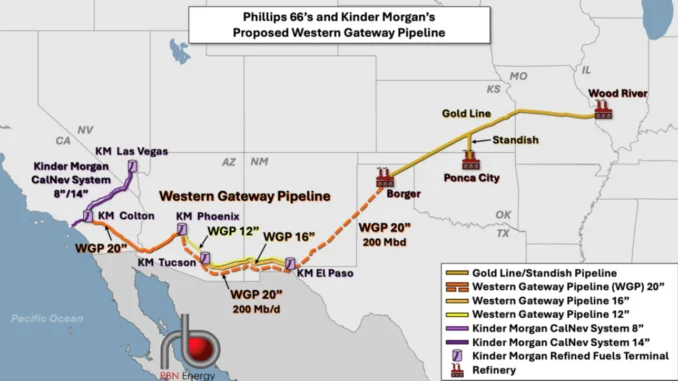
Phillips 66’s and Kinder Morgan’s Proposed Western Gateway Pipeline. Source: RBN
In the heart of America’s most populous state, a self-inflicted energy crisis is brewing—one that threatens not just California’s economy but the nation’s security. Governor Gavin Newsom’s aggressive push toward Net Zero emissions by 2045 has accelerated the decline of the state’s oil and gas industry, leading to refinery closures, skyrocketing fuel prices, and increased reliance on foreign imports. This vulnerability exposes California—and by extension, the U.S.—to geopolitical risks from unstable oil suppliers like Brazil, Iraq, and Ecuador. But there’s a viable solution on the horizon: new pipelines from Texas that could deliver domestic gasoline, diesel, and jet fuel, bolstering energy independence while easing the burden on consumers. The question is whether Newsom’s administration will permit them amid its environmental agenda.
The Roots of the Crisis: Newsom’s Policies and Their Fallout
California’s energy landscape has been dramatically reshaped under Governor Newsom, who has positioned himself as a climate champion. His administration has implemented a suite of policies aimed at phasing out fossil fuels, including extending the cap-and-trade program through 2045, mandating electric vehicle adoption, and imposing stringent regulations on oil production and refining.
These measures align with the state’s goal of achieving Net Zero carbon emissions by 2045, which includes slashing oil use by 91%, cutting air pollution by 60%, and reducing refinery pollution by 94%.
However, these ambitions have come at a steep cost. High taxes, fees, and regulatory burdens—such as bans on new offshore leases, well stimulation treatments, and requirements for special gasoline blends—have made operating in California increasingly untenable for energy companies.
Oil production has plummeted by about 35% since Newsom took office in 2019, with new drilling permits largely halted.
Refineries, once numbering over 40, are now down to a handful, with major closures announced by Phillips 66 (its 139,000 barrels per day Los Angeles-area complex by late 2025) and Valero (its 150,000 b/d Benicia refinery by April 2026).
These shutdowns will strip away nearly 20% of the state’s refining capacity, exacerbating fuel shortages and price volatility.
The ripple effects are profound. California, a “fuel island” isolated from national pipelines, now imports more crude from abroad, heightening national security risks. Disruptions in global supply chains could lead to blackouts or fuel rationing, impacting everything from agriculture to military operations. Gas stations and pipelines are also closing under the weight of overregulation, with Newsom’s policies forcing companies to relocate operations elsewhere. As one analysis notes, these moves are driving up costs without reducing demand for the 6,000+ products derived from oil, from fertilizers to medical supplies.
Critics argue this approach ignores the reality of a managed transition, risking economic havoc in pursuit of an ideological goal.
Recent concessions, like expediting onshore well permits in Kern County to boost domestic production, show Newsom warming to the industry amid fears of $8-per-gallon gas.
Yet, environmental groups decry these as betrayals, highlighting the tension between affordability and climate purity.
Insights from RBN Energy: Market Shifts and Opportunities
A recent analysis from RBN Energy underscores the dramatic transformations in U.S. energy markets, driven by regulatory pressures and demand trends.
On the West Coast, California’s hostile environment—marked by declining demand for petroleum due to EV mandates and non-fossil alternatives—has accelerated refinery closures. Projections indicate over 1 million barrels per day (b/d) of capacity loss from 2026 to 2045, potentially worsening jet fuel shortages and requiring massive imports.
Meanwhile, Gulf Coast and Midcontinent refiners are poised to benefit. New pipelines are redirecting refined products westward, filling the void left by California’s retreating industry. Arizona and Nevada, with growing demand (Arizona’s refined products needs rising 10% to 350,000 b/d over the next decade, including jet fuel surging to 70,000 b/d), are becoming key hubs. This shift undermines California’s traditional export model, as Texas, Oklahoma, and the Rockies supply flow in via innovative pipeline projects.
The Pipeline Solution: Capacity, Timeline, and Investment Potential
The proposed pipelines from Texas represent a practical fix, enabling secure, domestic fuel transport to California and neighboring states. These projects could ship substantial volumes of gasoline, diesel, and jet fuel, offsetting refinery losses and stabilizing prices.Key initiatives include:
Western Gateway Pipeline (Phillips 66 and Kinder Morgan): A 1,300-mile system delivering up to 200,000 b/d from Borger, Texas, to Phoenix, Arizona, and onward to Colton, California, via reversed existing lines. It connects Midcontinent supplies, with access to Las Vegas. Startup targeted for 2029, pending permits.
Sun Belt Connector (ONEOK): A 440-mile greenfield line from El Paso, Texas, to Phoenix, with 200,000 b/d capacity for long-haul movements from Houston and Oklahoma. Expected mid-to-late 2029 operation.
HF Sinclair Expansions: Multi-phased upgrades to Pioneer and UNEV pipelines, adding up to 150,000 b/d from the Rockies to Nevada and California. Initial 35,000 b/d by 2028, with further expansions post-FID in mid-2026.
Collectively, these could transport 550,000+ b/d of fuels, covering a significant portion of California’s needs (which total around 1.5 million b/d for gasoline alone). Construction timelines range from 3-4 years, aligning with escalating closures. These pipelines would reduce reliance on costly marine imports, potentially lowering pump prices by increasing supply competition.For investors, these projects highlight opportunities in resilient midstream companies. Phillips 66 (NYSE: PSX) and Kinder Morgan (NYSE: KMI) offer stable dividends and growth from Western Gateway. ONEOK (NYSE: OKE) stands out for its Sun Belt ambitions, while HF Sinclair (NYSE: DINO) provides upstream exposure with pipeline upside. These firms are well-positioned amid U.S. energy shifts, with strong balance sheets to navigate permitting hurdles.
The Big Question: Will Newsom Permit It?
Permitting remains the wildcard. While federal oversight covers interstate pipelines, California wields influence over coastal and environmental reviews.
Newsom’s track record is mixed: He’s sued to block offshore pipelines and emphasized climate goals, but recent moves—like approving 2,000 new Kern County wells—suggest pragmatism to avert price spikes.
The California Energy Commission hasn’t explicitly endorsed these projects, but analysts note they could provide the “cheap gasoline” Newsom craves without new in-state builds.
Environmental opposition is fierce, viewing pipelines as setbacks to Net Zero. Yet, with refinery exits accelerating and public frustration over high prices (California’s gas averages $1 more per gallon than the national figure), political pressure may force approval. If permitted, these lines could mark a turning point, securing California’s energy future without compromising national security.In summary, California’s crisis stems from policies that prioritize ideology over practicality, but Texas-sourced pipelines offer a lifeline. By embracing domestic infrastructure, the state can mitigate risks, stabilize supplies, and foster a truly balanced transition. The ball is in Newsom’s court—will he seize the solution?
October 30, 2023 Reposted October 30, 2023 to update data. Data source: California Independent System Operator The California Independent System Operator (CAISO), the grid operator for most of the state, is increasingly curtailing solar- and […]
It’s no secret that climate change will impact every facet of our lives, from where we live to how we prepare for natural disasters. But what about our food? In the spring, Anastasia Telesetsky, a […]
A map released on Thursday by US Drought Monitor shows that the convey belt of severe rain and winter storms for the last two months has significantly eased California’s extreme drought. The Sierra Nevada region […]
We use cookies to ensure that we give you the best experience on our website. If you continue to use this site we will assume that you are happy with it.





Be the first to comment